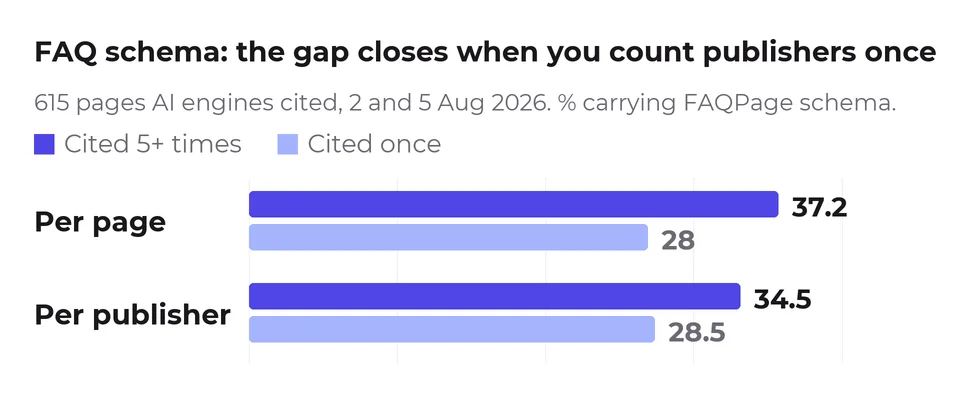
No, on this evidence. We took 615 pages that AI engines actually cited and checked which carried FAQPage schema. Heavily-cited pages did carry it more often, 37.2% against 28.0%, but that difference disappears once you count each publisher once rather than each page.
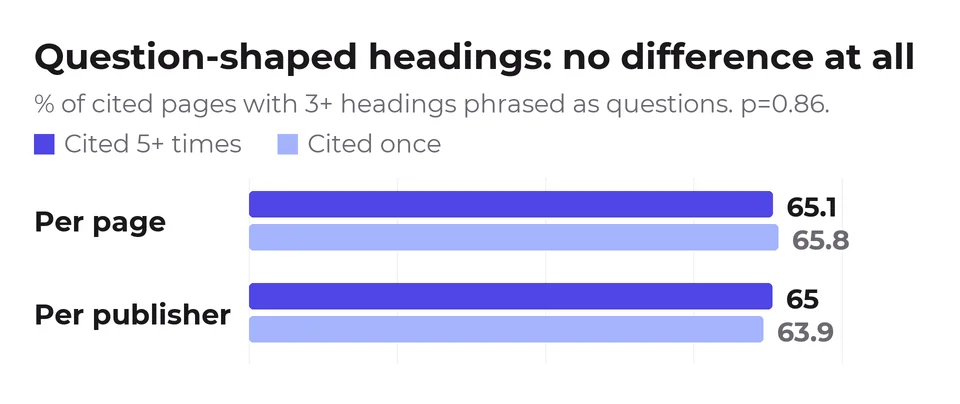
The thing everyone bundles with it, writing your headings as questions, showed no difference at all: 65.1% against 65.8%.
Disclosure: GetIntel sells AI visibility tracking, and we added FAQ blocks to five of our own articles the day before running this. The result argues against something we had just done. The raw per-page data is published as CSV and JSON so every figure can be recomputed.
In this article
- Does FAQ schema help AI citations?
- Why the page-level number is misleading
- What about writing in questions?
- How does this square with SE Ranking's study?
- How did we test it?
- So should you add FAQ schema?
Does FAQ schema help AI citations?
FAQ schema does not detectably help AI citations once you control for who published the page. The full result across 615 tested pages:
| cited 5+ times | cited once | significant? | |
|---|---|---|---|
| FAQPage schema, per page | 37.2% | 28.0% | yes, p=0.016 |
| FAQPage schema, per publisher | 34.5% | 28.5% | no, p=0.156 |
| 3+ question headings, per page | 65.1% | 65.8% | no, p=0.86 |
Read the first row alone and you have a publishable finding: pages AI engines cite heavily are significantly more likely to carry FAQ schema. That is the article most people would have written.
Read the second row and it falls apart.
Why the page-level number is misleading
The page-level FAQ schema number misleads because a handful of publishers supply several heavily-cited pages each, and each one carries its whole site's markup conventions with it.
In the heavily-cited group, Zapier contributed 10 pages, TechRadar 7, Amplitude 7. A publisher that has decided to use FAQ schema uses it site-wide. So when a site earns many citations for reasons that have nothing to do with markup, domain authority, backlinks, being the obvious source for a category, every one of its pages enters the sample carrying that site's schema decision.
Count each publisher once and the sample goes from 261 pages to 197 domains on the heavy side, 354 to 305 on the light side. The gap narrows from 9.2 points to 6.0, and the p-value moves from 0.016 to 0.156, no longer distinguishable from chance at any conventional threshold.
That is not a small technical footnote. It is the difference between "add FAQ schema, the data says it works" and "we cannot tell".
What about writing in questions?
Writing in questions makes no detectable difference either, and that is the more interesting half. 65.1% of heavily-cited pages had three or more headings phrased as questions, against 65.8% of once-cited pages. Per publisher: 65.0% against 63.9%. The p-value is 0.86, which is about as flat as a result gets.
This matters because the two things get sold as one piece of advice. "Structure your content as questions and mark it up with FAQPage schema" treats markup and writing as a single lever. They are not the same, and here neither one separated the heavily-cited pages from the barely-cited ones.
We should be straight about what this costs us. Our own product's content-gap analysis reports that FAQ-structured content is cited more often by AI Overviews, and we have repeated that figure. This test does not reproduce it. The two are not measuring quite the same thing, ours looks at content gaps within a tracked category, this looks at markup across cited pages generally, but we would rather publish the disagreement than quietly keep citing the number that flatters us.
How does this square with SE Ranking's study?
Our 615-page FAQ schema test neither contradicts nor confirms SE Ranking's study, because the two measure different things.
SE Ranking, working across roughly 216,000 pages, reported FAQ schema as slightly negative for citation, 3.6 citations per page with it, 4.2 without. That is a different measurement from ours: they counted citations per page across a large corpus, we compared markup rates between citation-frequency bands on pages we had already observed being cited.
The two point estimates actually point in opposite directions: theirs is slightly negative, ours is positive before it dissolves under deduplication. It would be spin to call that agreement. What the two do share is the only conclusion either supports, neither produced evidence that FAQ schema earns citations, which is the claim the advice rests on.
The honest summary of the category's evidence on FAQ schema right now: two observational studies, no controlled test, no established effect.
How did we test it?
We tested FAQ schema against a population of 4,149 unique URLs cited by AI engines across two runs of the same 100 buyer-intent questions (2 August and 5 August 2026) through ChatGPT, Perplexity, Gemini, Google AI Overviews and Google AI Mode. No new probing was needed; this reuses citation data already collected.
Exclusions. Aggregators and platforms: YouTube, Reddit, social networks, app stores, Amazon. One YouTube URL alone was cited 374 times, and a video page's markup says nothing about whether article schema helps.
Bands. 296 URLs cited five or more times, 2,670 cited exactly once. The heavy band is small enough to take whole, so all 296 were used; the light band was sampled down to 400 at a fixed random seed. Fetching succeeded on 261 and 354 of them respectively.
Per-publisher counting. Where a domain appears more than once in a band, only its first page is kept (261 pages become 197 domains, 354 become 305). That is the simplest correction for the fact that pages from one publisher are not independent observations. A clustered model would preserve more power than discarding rows, and would be the better approach on a larger sample.
Measures. FAQPage schema means a JSON-LD block declaring that type. Question headings means H2 or H3 elements ending in a question mark or opening with how/what/why/when/which/who/where/is/are/do/does/can/should. Counted separately throughout, deliberately.
Limitations. Deduplicating to one page per publisher drops the sample to 197 and 305, which costs statistical power: a null result at that size is weaker evidence of no effect than the same result on thousands of pages would be. This is observational. These are pages engines already chose, so nothing here establishes causation in either direction. A difference would have shown association, and even that did not survive. The sample is one category set of 100 software-buying questions, not the whole web. And schema detection reads the served HTML, so markup injected later by JavaScript would be missed.
So should you add FAQ schema?
Add FAQ schema if you want the answer visible in search results, not because it will earn you AI citations.
Three practical conclusions from this:
- Do not expect Google rich results from it. Since August 2023 FAQ rich results have been restricted to authoritative government and health sites. Across our own 160 pages carrying FAQPage schema, Search Console reports rich results on exactly zero of them.
- Do not treat markup and structure as one decision. If you write genuinely useful question-and-answer content, that content stands on its own. The markup is cheap to add and, on this evidence, does nothing measurable on its own.
- Be suspicious of anyone selling schema as the lever. Including us, when we do it. Nobody in this category has run a controlled test, and the two observational studies that exist point in opposite directions with neither reaching a solid effect.
The reason we keep FAQ blocks on our own articles is not the schema. It is that a self-contained answer to a real question is the most liftable unit of text on a page, and that is a claim about writing, which this test says nothing about either way.
If you want to check your own pages against this, our AI visibility tracking shows which sources each engine actually pulled for your category, and you can start free. For the wider picture of which sources engines reach for at all, see what AI cites across five engines and why there is no stable top 10. The full dataset behind this article is public, one row per page.