OpenAI runs three bots, and they do three different jobs. GPTBot collects pages for training future models. OAI-SearchBot builds the index behind ChatGPT search. ChatGPT-User fetches a page live when someone asks ChatGPT a question that needs it. Each has its own robots.txt token. On getintel.ai, 16 September to 15 October 2026, they made 5,408 verified requests between them.
GPTBot, the one most people block, made just 504 of them (9%), and 90% of those came on two days. OAI-SearchBot made 3,326 and came every day. ChatGPT-User made 1,578, and never fewer than 26 in a day.
Disclosure: GetIntel sells AI visibility tracking, including AI crawler logs. These numbers come from one site, ours, over one month, from DataFast's bot report. The daily counts per bot are downloadable as a CSV. For every AI company's bots side by side, see our full AI crawler log.
In this article
- What do GPTBot, OAI-SearchBot and ChatGPT-User each do?
- Three bots, three daily rhythms
- GPTBot came on two days
- OAI-SearchBot crawls every day
- ChatGPT-User follows people, not a schedule
- Do the three bots read the same pages?
- The GPTBot and OAI-SearchBot robots.txt rules
- Which OpenAI bots should a B2B site allow?
- Limits of one month of OpenAI logs
What do GPTBot, OAI-SearchBot and ChatGPT-User each do?
GPTBot trains future models, OAI-SearchBot builds ChatGPT's search index, and ChatGPT-User reads a page live for a user's question. Blocking one leaves the other two untouched.
| Bot | User agent token | Job | Requests to getintel.ai, 30 days | Share of OpenAI |
|---|---|---|---|---|
| GPTBot | GPTBot | Collects pages to train future models | 504 | 9% |
| OAI-SearchBot | OAI-SearchBot | Builds the ChatGPT search index | 3,326 | 62% |
| ChatGPT-User | ChatGPT-User | Fetches a page live for a user's question | 1,578 | 29% |
OpenAI was the busiest AI company on our site: 5,408 of the 17,599 verified bot requests we logged, 31% of the total. OAI-SearchBot alone made 1.7 times as many requests as Googlebot.
The split matters because people usually talk about "blocking GPTBot" as if it were OpenAI's crawler. On our site it was the smallest of the three by a wide margin. The bot that decides whether you show up in ChatGPT search is OAI-SearchBot, and the one that reads your page while a buyer waits is ChatGPT-User.
Three bots, three daily rhythms
GPTBot came in two bursts, OAI-SearchBot crawled every day and got busier through the month, and ChatGPT-User held steady between 26 and 92 requests a day, 16 September to 15 October 2026.
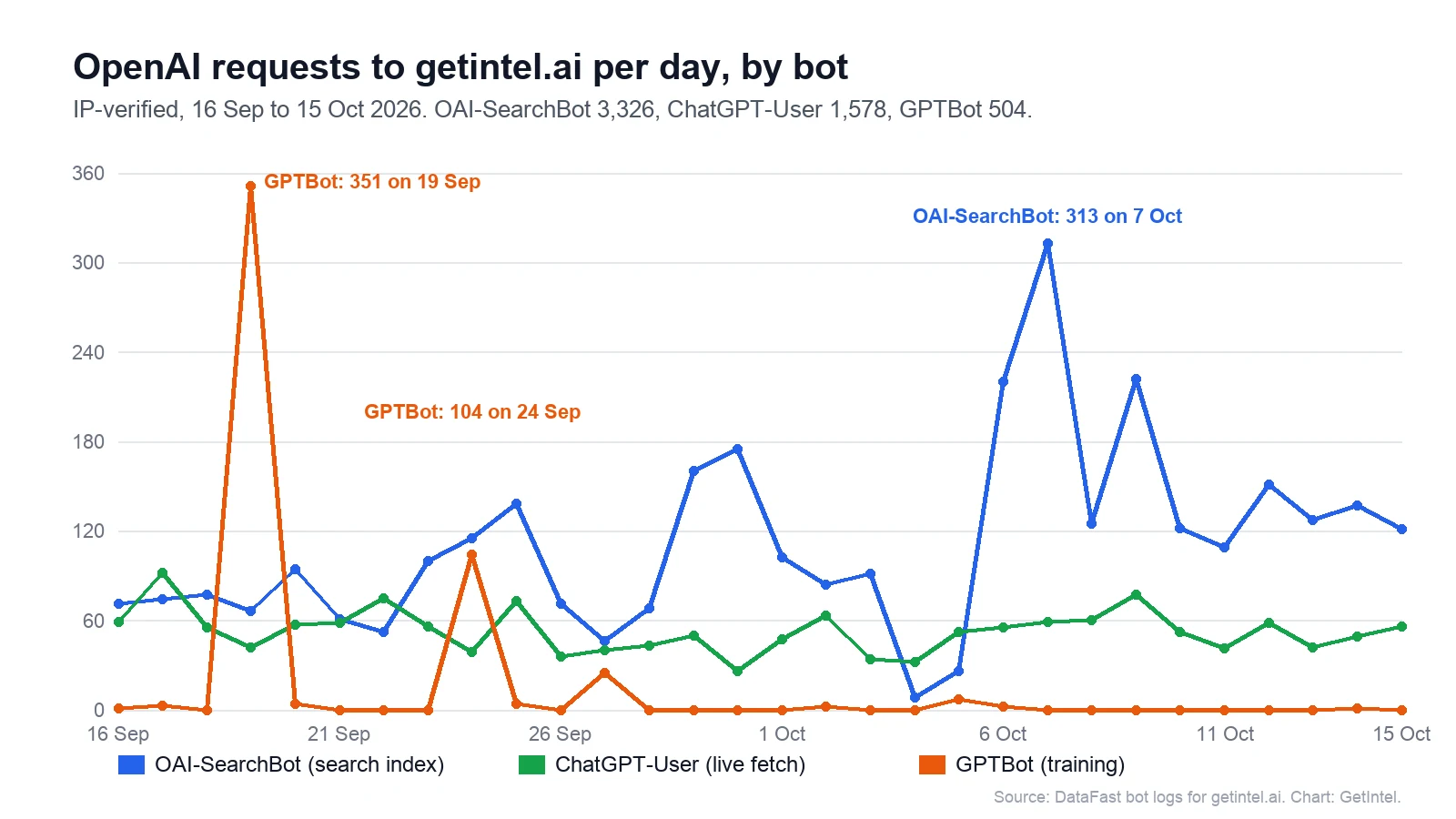
Daily requests by OpenAI bot, days in IST. Chart by GetIntel from DataFast bot logs for getintel.ai, October 2026.
| Bot | Busiest day | Quietest day | Days with zero requests |
|---|---|---|---|
| GPTBot | 351 (19 Sep) | 0 | 19 of 30 |
| OAI-SearchBot | 313 (7 Oct) | 8 (4 Oct) | 0 |
| ChatGPT-User | 92 (17 Sep) | 26 (30 Sep) | 0 |
GPTBot came on two days
GPTBot made 351 requests on 19 September and 104 on 24 September. Those two days carried 455 of its 504 requests (90%). It made no requests at all on 19 of the 30 days.
On 7 of the other 9 days it came, it made fewer than five. Across the month it read each page about once: 504 requests across 433 URLs.
Half of what it read was our docs, and a quarter of its page requests (118) were the raw .md versions of our docs pages, the plain-text copies we publish for machines. ChatGPT-User didn't ask for a single .md file all month.
ClaudeBot swept the same week, on 20 and 22 September (our ClaudeBot breakdown). If GPTBot looks heavy in your logs one day and absent the next, that's the normal pattern, not a change in policy.
OAI-SearchBot crawls every day
OAI-SearchBot showed up on all 30 days. It made 1,368 requests in the first 15 days and 1,958 in the last 15, a 43% rise. 6 to 9 October drew 880 requests, and three of those days (6, 7 and 9 October) were its busiest of the month.
That run started the day we re-checked and republished our SaaS directories list and pushed several other updates. We can't prove the link from one site's logs, but it fits how an index bot should behave: when pages change, it comes back to read them.
It also comes back to pages it already knows. It reached 697 distinct URLs and came back to each four to five times, and it re-read the homepage 363 times in the month. Its other top pages were our tool roundups, guides and pricing pages, the ones ChatGPT search would quote when someone asks which tool to buy.
One cost of a crawler that remembers everything: OAI-SearchBot logged more 404 errors than any other bot, mostly old docs URLs we had already fixed. Our crawler log covers that quirk and the redirect fix.
ChatGPT-User follows people, not a schedule
ChatGPT-User made between 26 and 92 requests every day, about 53 on average. Its four full weeks totalled 438, 337, 309 and 389. It didn't spike when we published and it didn't sweep. That's what you'd expect from a bot that only fires when a person asks ChatGPT something.
What it fetches tells you what those people asked. 53% of its requests were our homepage (838 fetches). Three of the next five were competitor pricing pages:
| Page | ChatGPT-User fetches |
|---|---|
| Peec AI pricing | 70 |
| Best SaaS directories | 63 |
| Semrush AI Visibility Toolkit pricing | 37 |
| Profound pricing | 32 |
| AI search statistics | 30 |
Pricing pages on this site took 266 fetches in all, 17% of everything it loaded. Live fetches like this only happen inside the real chatgpt.com, which is one reason the API and the real ChatGPT interface cite such different sources.
Do the three bots read the same pages?
Mostly not. Across the 771 distinct pages any OpenAI bot touched in the month:
- 101 pages were read by all three.
- 250 pages were read only by OAI-SearchBot.
- 34 pages were read only by GPTBot, mostly docs.
- 40 of the 199 pages ChatGPT-User fetched were never crawled by OAI-SearchBot in that month.
That last line matters most. Two of ChatGPT-User's five most-fetched pages, the Profound and Semrush pricing posts, had no OAI-SearchBot visit in the window. A live fetch doesn't need the search bot to have been there first. ChatGPT can find a URL somewhere else and load it for the user directly.
So the three tokens are not three views of one crawl. Each bot keeps its own list, and blocking one leaves a gap the others don't fill.
The GPTBot and OAI-SearchBot robots.txt rules
The three tokens are independent, so you can opt out of training without leaving ChatGPT search. To keep search and live fetches but stop training, block GPTBot only:
User-agent: GPTBot
Disallow: /

User-agent: OAI-SearchBot
Allow: /

User-agent: ChatGPT-User
Allow: /
To block all three, give each its own group with Disallow: /. A User-agent: * block catches them too, but naming each bot is clearer and survives a later edit to the wildcard group.
Two things to know before you change the file:
- OpenAI says robots.txt changes take about a day to reach its systems for OAI-SearchBot.
- ChatGPT-User is the grey one. OpenAI's crawler docs say that because a user starts the fetch, robots.txt rules may not apply to it the way they do to the crawlers. If you need ChatGPT not to load a page at all, that's a job for authentication or your firewall, not robots.txt.
Which OpenAI bots should a B2B site allow?
Allow OAI-SearchBot and ChatGPT-User. Blocking OAI-SearchBot takes you out of ChatGPT search answers. Blocking ChatGPT-User may stop ChatGPT reading your homepage and pricing page when a buyer asks about you, though OpenAI says robots.txt may not apply to it. On our site those two made 91% of OpenAI's requests.
Blocking GPTBot only decides whether future OpenAI models learn from your pages. On our site it was a light visitor either way: about 17 requests a day on average, almost all of them in two sweeps. The wider case for and against blocking training bots is in our full crawler log.
If you want to see these bots on your own site rather than ours, GetIntel's AI traffic view logs every verified AI crawler and live fetch by page, on the Pro and Growth plans.
Limits of one month of OpenAI logs
- One docs-heavy site, one month. A news site or a store will see different pages fetched and probably a different mix of bots.
- Two sweeps is not a schedule. Two GPTBot sweeps in 30 days is a pattern for this window. The next could come in a week or in three months.
- The page counts come from a page-level match. Totals and daily counts are in the CSV; the per-page figures (homepage fetches, overlaps, URL counts) come from the 98% of requests DataFast matched to a URL.
- Fetches are not citations. A ChatGPT-User fetch means ChatGPT read the page for someone. It doesn't tell you whether the answer named you.