
PerplexityBot is Perplexity's search crawler. Perplexity says it exists to "surface and link websites in search results on Perplexity", and that it is not used to crawl content for AI foundation models. On getintel.ai it made 2,141 IP-verified requests in the 30 days to 15 October 2026, 12.2% of all verified bot traffic. Only two other bots sent more: OAI-SearchBot (3,326) and Amazonbot (2,549).
PerplexityBot came every day, and it read at two speeds. 71 pages took half its requests, each re-read 10 to 44 times in the month, while most of our docs got one or two visits. Perplexity-User, the agent that fetches a page live to answer a question, made no verified requests at all.
Disclosure: GetIntel sells AI visibility tracking, including AI crawler logs. These numbers come from one site, ours, over one month, from DataFast's bot report. The daily counts are downloadable as a CSV. For every AI company's bots side by side, see our full AI crawler log.
In this article
- What is the difference between PerplexityBot and Perplexity-User?
- How often does PerplexityBot crawl?
- Which pages does PerplexityBot re-read most?
- What does PerplexityBot read?
- Why no Perplexity-User requests showed up
- PerplexityBot robots.txt rules
- Should you block PerplexityBot?
- What one month of Perplexity logs can't show
What is the difference between PerplexityBot and Perplexity-User?
PerplexityBot builds Perplexity's search index ahead of time. Perplexity-User fetches a page at the moment a user asks something. Perplexity documents both, and says neither collects content to train foundation models:
| User agent | What Perplexity says it does | Follows robots.txt? | Requests to getintel.ai, 30 days |
|---|---|---|---|
PerplexityBot | Surfaces and links websites in Perplexity's search results | Yes, Perplexity says | 2,141 |
Perplexity-User | Visits a page during a user's request and may link it in the answer | Perplexity says it "generally ignores" robots.txt | 0 |
Every Perplexity request we logged was the indexer. Counted by company rather than by bot, that put Perplexity fourth on our site, after OpenAI (5,408), Google (2,665) and Amazon (2,549).
How often does PerplexityBot crawl?
Every day. On getintel.ai, 16 September to 15 October 2026, PerplexityBot made between 16 and 231 requests a day, and its month fell into three phases.
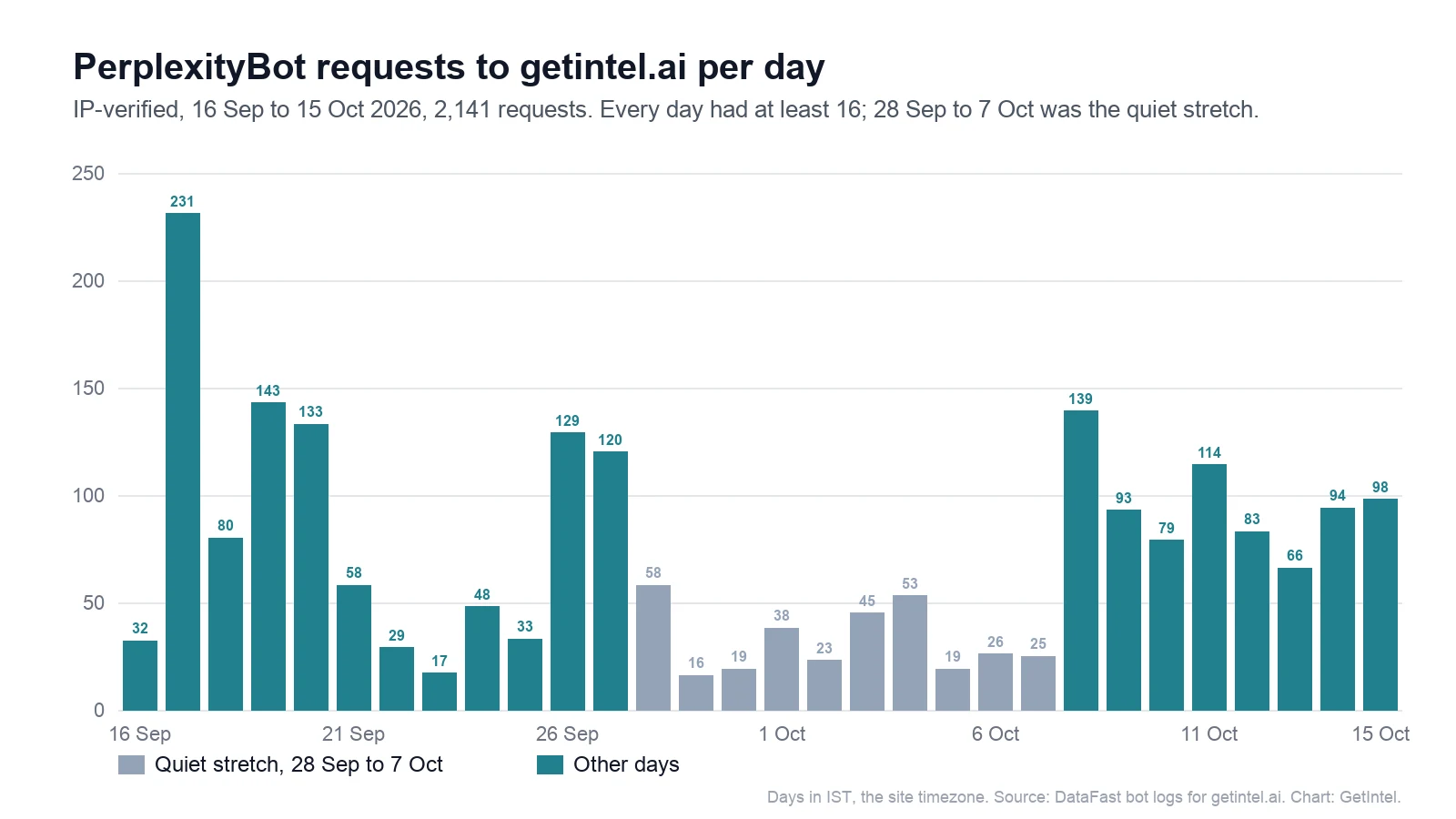
Daily PerplexityBot requests, days in IST, the quiet stretch shaded grey. Chart by GetIntel from DataFast bot logs for getintel.ai, October 2026.
| Period | Requests | Per day |
|---|---|---|
| 16 to 27 September (12 days) | 1,053 | 88 |
| 28 September to 7 October (10 days) | 322 | 32 |
| 8 to 15 October (8 days) | 766 | 96 |
The busiest day was 17 September 2026, with 231 requests. The quietest was 29 September, with 16. Weekends averaged 102 requests a day against 60 on weekdays, but most of that gap came from the first two weekends. Amazonbot, by contrast, topped 100 requests on all eight weekend days.
That steady presence fits Perplexity's description of a search crawler. Most training crawlers on our site came in short sweeps and then vanished for days: GPTBot sent 90% of its month on two days. PerplexityBot never stopped. It slowed for ten days, then picked back up.
Which pages does PerplexityBot re-read most?
Feature, solution, pricing and comparison pages. In the 30 days to 15 October 2026, PerplexityBot averaged about 4 requests per URL on getintel.ai, roughly one visit a week. That average hides a split: a small core read constantly, and a long tail read once or twice.
| Pages, by requests in the month | Pages | Requests | Share of requests |
|---|---|---|---|
| Read 10 or more times | 71 | 1,088 | 51% |
| Read 2 to 9 times | 221 | 813 | 38% |
| Read once | 239 | 239 | 11% |
Page-level figures come from the 2,140 requests we could match to a URL, across 531 raw paths. Our crawler log counts 521 URLs at 4.1 requests each after merging duplicate paths.
The 71 heavy pages were mostly commercial: feature pages, solution pages, our pricing page, the per-engine tracker pages, and blog posts that compare or price tools. Our AI brand monitoring guide was read 44 times, more than any other URL. Blog posts about tool pricing, comparisons and "best tools" lists averaged 7.1 requests each, against 4.5 for the rest of the blog.
In the same 30 days, docs pages averaged 1.9 requests each, and our AI Software Index category pages 1.8. PerplexityBot read them, then mostly left them alone.
If that pattern holds, PerplexityBot fetches an edited pricing, feature or comparison page again within about three days, while a deep docs page may wait weeks. Our logs show when it fetched a page, not when Perplexity's index changed.
What does PerplexityBot read?
Mostly the blog. On getintel.ai, 16 September to 15 October 2026, PerplexityBot spent 36% of its requests on blog posts, almost twice its share on docs.
| Section | Share of PerplexityBot requests |
|---|---|
| Blog | 36% |
| Docs | 19% |
| Features | 10% |
| Solutions, tracker pages and other pages | 21% |
| AI Software Index | 6% |
| Tools | 3% |
| Homepage (including tracked-link versions) | 3% |
| Glossary | 2% |
The blog led, as it did for OAI-SearchBot (35%) and Bingbot (42%). Only 79 of PerplexityBot's requests (4%) were the raw .md copies of our docs that we publish for machines, against 31% for Applebot.
Of 72 homepage requests, 46 carried directory tracking tags such as ?ref=taaft, so it followed links exactly as directory sites print them, tags included. A canonical tag folds those back into the clean URL.
Why no Perplexity-User requests showed up
Two explanations fit our logs, and we can't tell them apart:
- Perplexity may have answered from its index. With PerplexityBot re-reading our main pages every few days, Perplexity may rarely have needed a live fetch to answer a question about us.
- Live fetches may have gone unverified. Our DataFast setup keeps only requests it can match to an operator's published IP ranges. A Perplexity-User request from an address outside the published list would have been dropped.
Either way, the bot you can see, and the one to keep open, is PerplexityBot. For how Perplexity then picks which pages to cite, see our Perplexity citation data and how to rank in Perplexity.
PerplexityBot robots.txt rules
To keep Perplexity out of one section while leaving the rest of the site in its search results:
User-agent: PerplexityBot
Disallow: /docs/
To leave Perplexity's search entirely:
User-agent: PerplexityBot
Disallow: /
Three things Perplexity's bot documentation (checked October 2026) adds:
- Changes take up to 24 hours. Each agent's setting works independently.
- Perplexity-User generally ignores robots.txt. Because a user requested the fetch, a Disallow line won't reliably stop it. A page that must stay private needs authentication.
- Firewalls can block it anyway. Perplexity publishes IP range files for both agents and suggests allowing them explicitly in your firewall, matching both the user agent and the IP. A bot-blocking rule at your CDN can shut PerplexityBot out even when robots.txt allows it, which is the first thing our access checklist test checks.
Should you block PerplexityBot?
For almost any site that wants to be found, no. Perplexity says PerplexityBot isn't used to train foundation models, so blocking it buys no training opt-out. It only removes your pages from Perplexity's index, and with them your chance of being cited in its answers. Being crawled often doesn't guarantee a citation, but not being crawled rules one out.
If load is the worry, the busiest day we saw was 231 requests, roughly one every six minutes (231 in 24 hours). Rate-limit at the CDN before you block. The one case for a Disallow is content you never want in any AI answer, and then you also need authentication for Perplexity-User.
To see PerplexityBot and every other AI crawler on your own site, by page and by day, GetIntel's AI traffic view logs verified requests on the Pro and Growth plans.
What one month of Perplexity logs can't show
- One site. getintel.ai is a B2B software site. A news site with more Perplexity readers may see Perplexity-User where we saw none.
- One month. The quiet ten days in the middle may be a pattern or a one-off.
- Verified requests only. We counted requests DataFast matched to Perplexity's published ranges. Anything Perplexity fetched from other addresses, or under another user agent, isn't here.
- Reads are not citations. A request tells you PerplexityBot fetched a page. It doesn't tell you whether Perplexity ever cited it.