Perplexity's citation behavior isn't a black box, it's a distribution. In a 2026 audit summarized by MarGen, the platform surpassed 230 million monthly active users, processed more than 780 million monthly queries, and averaged 8.2 cited sources per answer, with 94% of answers carrying at least one inline numbered citation per a 2026 MarGen audit. That makes perplexity citation sources data useful as a diagnostic dataset, not just a curiosity about which pages happened to show up.
If you only track whether a brand appears, you miss the story. Perplexity's source mix changes by query type, source class, and citation position, and those patterns tell you where buyers are being sent, which domains are winning trust, and what kind of content can displace them. The practical move is to treat each answer as a measurable set of citation decisions, then compare those decisions across identical prompts, competitors, and refresh cycles.
Table of Contents
- What Perplexity Citation Sources Data Actually Tells You
- Probing Perplexity With Real Buyer Prompts
- Which Sources Does Perplexity Actually Pull From?
- Running Citation Gap Analysis Against Competitors
- Which Metrics Go Beyond Simply Being Included?
- Which Content Fixes Actually Move Citation Share?
- Diagnostic Cadence and What to Track Next
What Perplexity Citation Sources Data Actually Tells You
Perplexity citation data tells you which domains it draws on and in what order, read per prompt rather than per keyword. Reviewed 19 September 2026.
Distribution beats rank
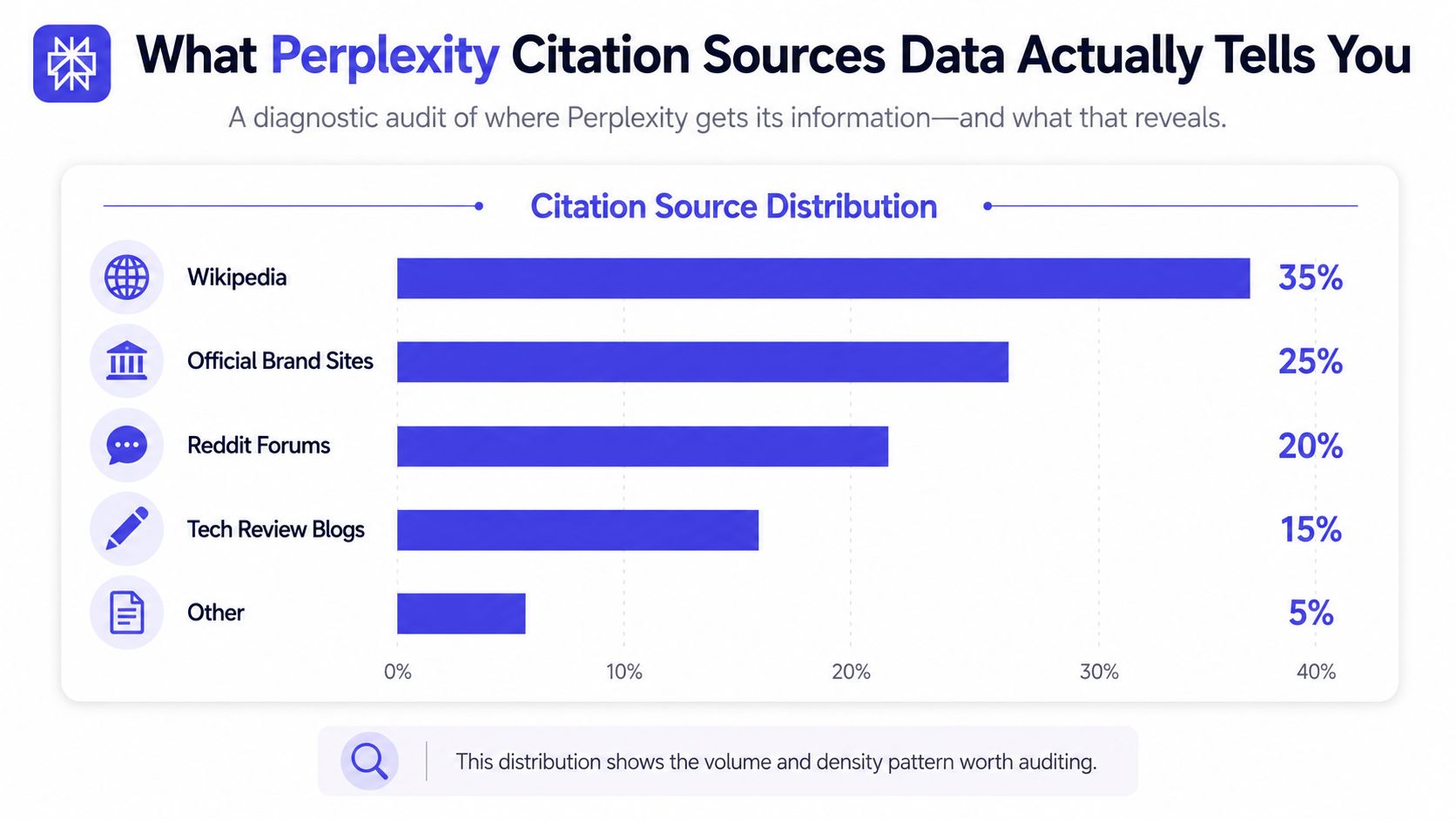
Distribution matters more than rank here: Perplexity's citation footprint is dense enough to treat as a discovery channel, not a novelty feature. In the MarGen audit summary, 5 to 12 sources accounted for 81% of answers, and 17% of answers cited 15 or more sources, especially on technical and financial queries per the same MarGen audit. Source selection is concentrated, and concentrated systems can be audited.
A single ranking score cannot show that pattern. An aggregate visibility number hides which domain types are winning, which prompts trigger broad citation sets, and which sources keep reappearing in strong positions. A per-prompt dataset, by contrast, shows whether your page was retrieved, cited, cited early, or bypassed for a competitor with cleaner structure or stronger entity signals.
Practical rule: if the answer changes from prompt to prompt, the metric should change with it. Track the prompt, the cited domains, and the citation order, or the dataset will not tell you much.
Why the unit of analysis is the prompt
Perplexity's own mechanics explain why prompt-level data is the right lens. The answer engine decomposes intent, retrieves live pages, reranks candidates, and then synthesizes a final response with inline citations according to published overviews of its source-selection pipeline. A page can survive retrieval and still fail later gates if it is hard to quote, structurally weak, or less authoritative than a cleaner competitor.
It helps teams compare AI answer-engine concepts without collapsing every platform into one vague “AI search” bucket.
The right takeaway is simple. Perplexity citation sources data is a structured record of how the model resolved a buyer question, which source classes it trusted, and which pages were extractable enough to survive the full pipeline.
Distribution and citation order expose different signals
Distribution and citation order expose different problems. Source mix shows where Perplexity is willing to look, while citation order shows what it treats as usable first. Those are related but separate signals. A domain can appear in a wide source mix and still sit late in the answer, which usually points to weaker extractability, less direct answer framing, or thinner entity support.
That distinction matters for analysis. If your page appears in the corpus but never rises into early citation positions, the issue is often not discovery. It is the way the page packages the answer, the clarity of the entity relationships on the page, or the lack of supporting signals around the topic.
Use citation data as a diagnostic dataset
Perplexity citation sources data works best when you treat it like a diagnostic record. The goal is to isolate which source classes dominate a prompt set, which domains co-occur with your competitors, and where your content gets excluded despite being relevant. That gives you a practical map of content fixes and entity signals, instead of a vanity report about visibility.
It also gives you a cleaner way to prioritize work. Pages that never get retrieved need different fixes from pages that get retrieved but are not cited, and pages that are cited only on narrow prompts need different treatment again. The dataset is most useful when it separates those cases clearly.
Probing Perplexity With Real Buyer Prompts
Build the probe set around buyer intent
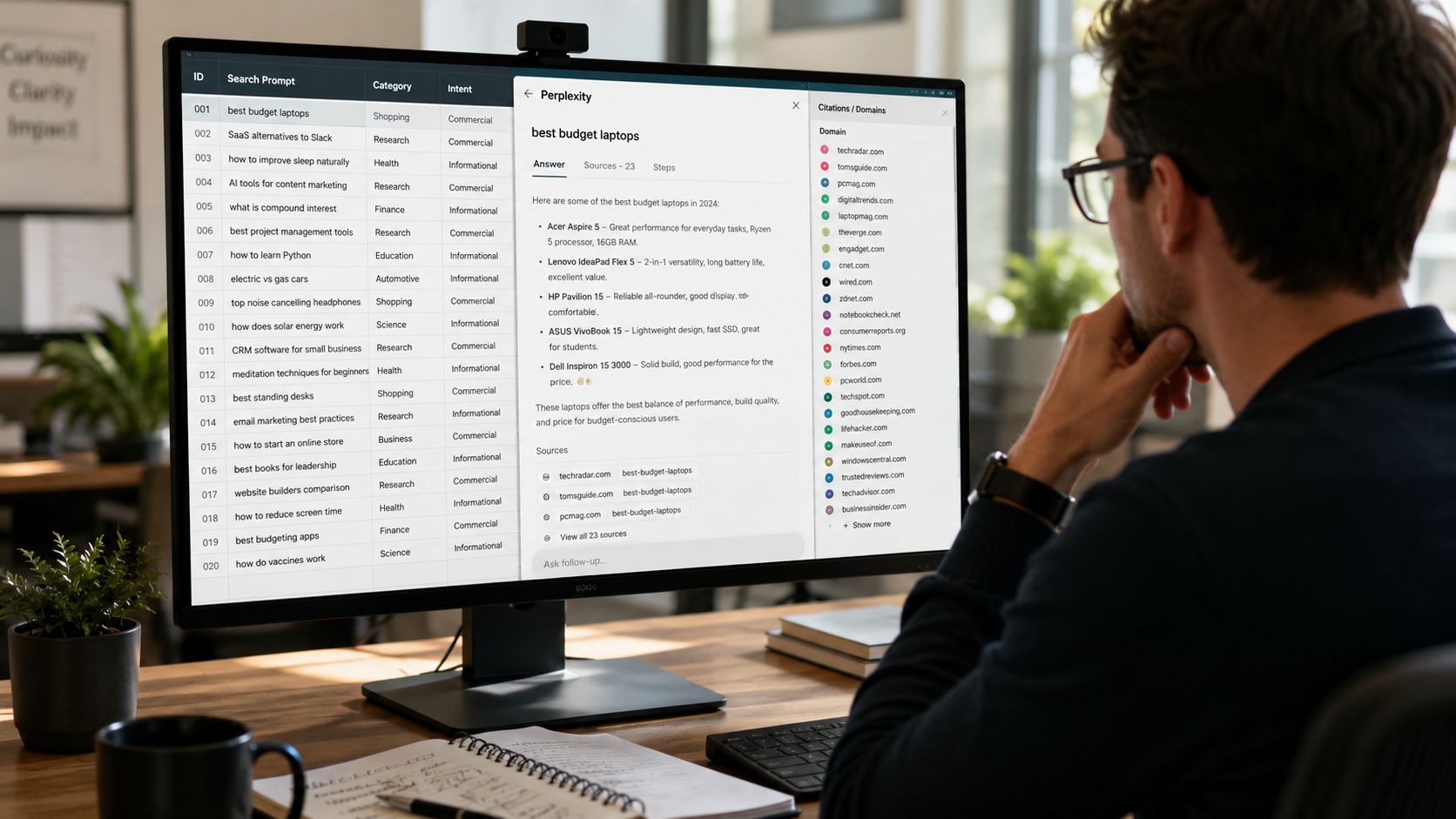
The cleanest probe set starts with the questions buyers ask. For B2B software, that usually means pricing, alternatives, best-of, and comparison prompts, because those are the moments when citation selection has commercial impact. If you want usable data, keep the wording stable and vary only what you're testing, so you can tell whether a different cited domain came from the prompt or from the page.
GetIntel's multi-engine probing captures which specific domains Perplexity cites per buyer prompt, enabling a side-by-side comparison against named competitors on the identical question GetIntel. That workflow matters because it doesn't stop at an aggregate score. It captures the returned domains per prompt, which is the raw material you need if you want to compare overlap, gap ownership, and repeated co-citation.
Capture the answer the way a buyer sees it
Interface capture and API capture aren't the same thing. If you want fidelity to buyer experience, the rendered answer matters more than a sanitized output, because the visible citations are what a user can click and what a market team can audit. For that reason, repeat the same prompts daily and preserve the cited domains in a consistent log, so the trendline reflects the same question under the same conditions.
A useful operating pattern is to store the prompt text, the date, the cited domains, the citation order, and whether your brand appeared at all. That gives you a traceable dataset for later comparison. It also makes it easier to spot when a domain appears once in a deep answer but never in the top slots that get the most attention.
See how buyer-answer capture works in practice if you want a concrete example of how the prompt layer maps to the answer layer.
Keep the probe cycle comparable
Perplexity's ranking stack is sensitive to freshness and structural clarity, so a one-off test can mislead you if the page ages or the prompt drifts. Re-running identical prompts produces cleaner trendlines than ad hoc checking, because you can isolate whether a content change affected the citation set or whether the system shifted retrieval candidates that day. That's the point of a probe set, it turns a moving answer engine into something you can measure.
Which Sources Does Perplexity Actually Pull From?
Owned, review, and community sources dominate the picture
Perplexity's source mix is not a single undifferentiated web pool. Presenc AI's 2026 analysis reported 5.8 citations per answer, up from 4.9 in Q1 2025, and said 41% of users clicked at least one cited source per a 2026 Presenc analysis. In the same dataset, company websites rose from 19% to 23% of citations, while review and comparison sites rose from 22% to 26%. Together, those two categories accounted for 49% of citations in Q1 2026.
That is the first market signal worth acting on. If nearly half of citations flow through owned sites and review-style third-party pages, then a visibility program cannot rely on blog posts alone. It needs direct-answer pages, comparison assets, review coverage, and community proof.
| Perplexity Citation Share by Source Class | Share of citations | Year-over-year change |
|---|---|---|
| Company websites | 23% | Up from 19% |
| Review and comparison sites | 26% | Up from 22% |
Reference and community sources fill the long tail
The long tail matters too. Another 2026 audit found Wikipedia appeared in 31% of answers, while Reddit + Stack Exchange together appeared in 18% per a 2026 Presenc analysis. A separate July 2026 source concentration analysis reported that news and media were the largest source category, Reddit was the single most-cited domain, and about 18% of citations pointed to brand-owned sites per a July 2026 Indexly analysis.
That mix says Perplexity is not choosing only polished corporate pages. It is also pulling from reference-style resources and community discussion, which means brands need both explanation content and third-party validation. A clean landing page can help, but it rarely wins alone if the answer engine wants a broader evidence cluster.
What the mix means for strategy
The important conclusion is not that one source type wins. It is that citation share can be shaped by source class. Company pages, review sites, structured reference sources, and discussion forums each play a different role in the citation stack. The winning move is to map which category already owns the prompt, then decide whether your fix is owned content, earned coverage, or community participation.
This source-class split is covered in more detail in the companion piece on how many sources Perplexity cites, which is useful when you are translating raw source mix into a content backlog.
Running Citation Gap Analysis Against Competitors
Overlay the same prompt on every domain
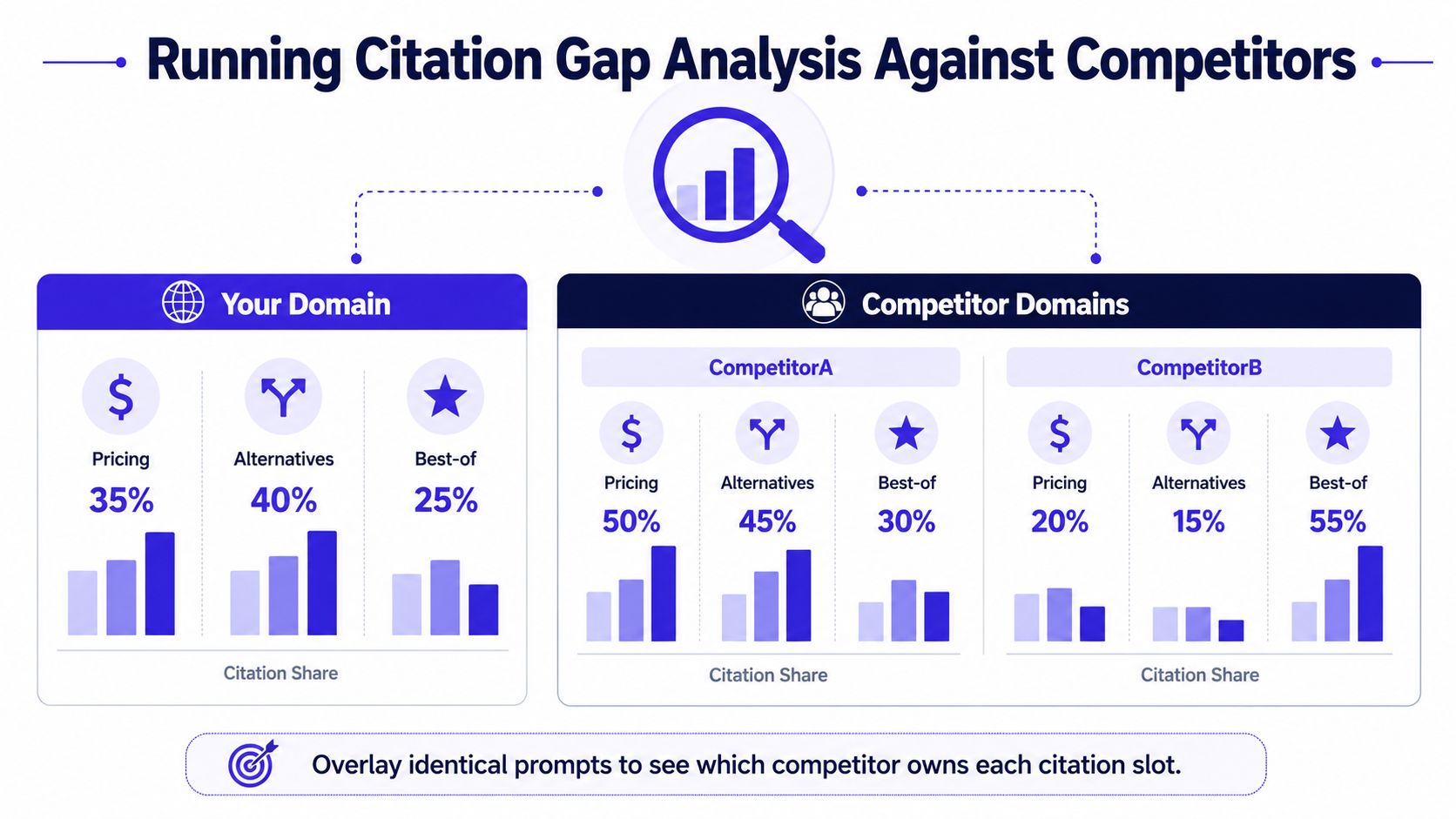
Citation gap analysis starts with a simple comparison. Run the same buyer prompt against your domain and named competitors, then record who appears, who disappears, and which domains are co-cited with the winner. That side-by-side view tells you whether the competitor owns the prompt outright or just shares the answer set with you.
A useful external benchmark is the cross-engine overlap finding that only 11% of domain citations were shared between ChatGPT and Perplexity across 100,000 prompts LinkedIn post by Joshua Blyskal. Even though that figure compares engines rather than competitors, it proves the broader point. Citation wins are often engine-specific, so a domain can dominate one answer environment and be absent in another.
Read the missing slot, not just the missing mention
The most valuable gap is the citation slot you don't occupy. If a competitor consistently appears on pricing prompts while you show up only on broad informational queries, the problem probably isn't brand awareness. It's that your page doesn't answer the commercial question quickly enough, or doesn't read cleanly enough for Perplexity's reranker to trust it.
Competitor gaps usually point to a content brief, not a branding problem.
Side-by-side reporting comparisons work the same way, surfacing who owns a given query instead of generic rank movement. That's the right model for citation diagnostics, because it keeps the comparison anchored to the identical query.
Turn the gap into a brief
Once the gap is visible, translate it directly. If a competitor owns “best of” prompts, your brief should add comparison tables, clearer entity labels, and a tighter opening that resolves the buyer question before the first scroll. If they own alternatives prompts, add a direct “who this is for” passage and a clean list of adjacent tools. If they own pricing prompts, your content probably needs more explicit commercial language and easier extraction.
The goal isn't to “rank higher” in the abstract. It's to own a citation slot competitors currently hold.
Which Metrics Go Beyond Simply Being Included?
Measure frequency, position, and co-citation separately
Being cited once is not the same as being consistently useful to the answer engine. The metrics that matter most are citation frequency by prompt, average citation rank, and co-citation with category leaders. Each one answers a different question, and together they tell you whether Perplexity merely noticed your page or prefers it.
Frequency tells you how often your domain enters the pool for the same buyer question. Rank tells you whether the citation shows up early enough to matter. Co-citation tells you whether your domain is being treated as part of the same authoritative cluster as the category leader, which is a much stronger signal than a lone appearance in the tail.
Why retrieval alone is a trap
Perplexity's pipeline filters sources in stages, from intent matching to retrieval, reranking, and final selection according to published explanations of that pipeline. That means a page can be retrieved and still fail the final citation decision. Teams get misled when they stop at raw inclusion, because retrieval proves only that the page was considered, not that it survived the later gates.
Useful test: if a page appears in retrieval but not in the final answer, don't celebrate. It still lost the selection contest.
The quality bar also explains why pages with weak structure or broad claims tend to underperform. Perplexity's answer engine can't cite what it can't quote cleanly, and it can't trust what doesn't look easy to extract. That's why citation rank is more actionable than inclusion alone.
What a defensible review looks like
A review-ready measurement stack should show the prompt, the cited domains, the citation order, and the competitor cluster around each answer. Then segment the data by source class so you can see whether you're losing to owned sites, review pages, or reference sources. If the same competitor keeps appearing beside you in strong positions, that's a sign of durable visibility, not a random one-off.
Which Content Fixes Actually Move Citation Share?
Start with extractability
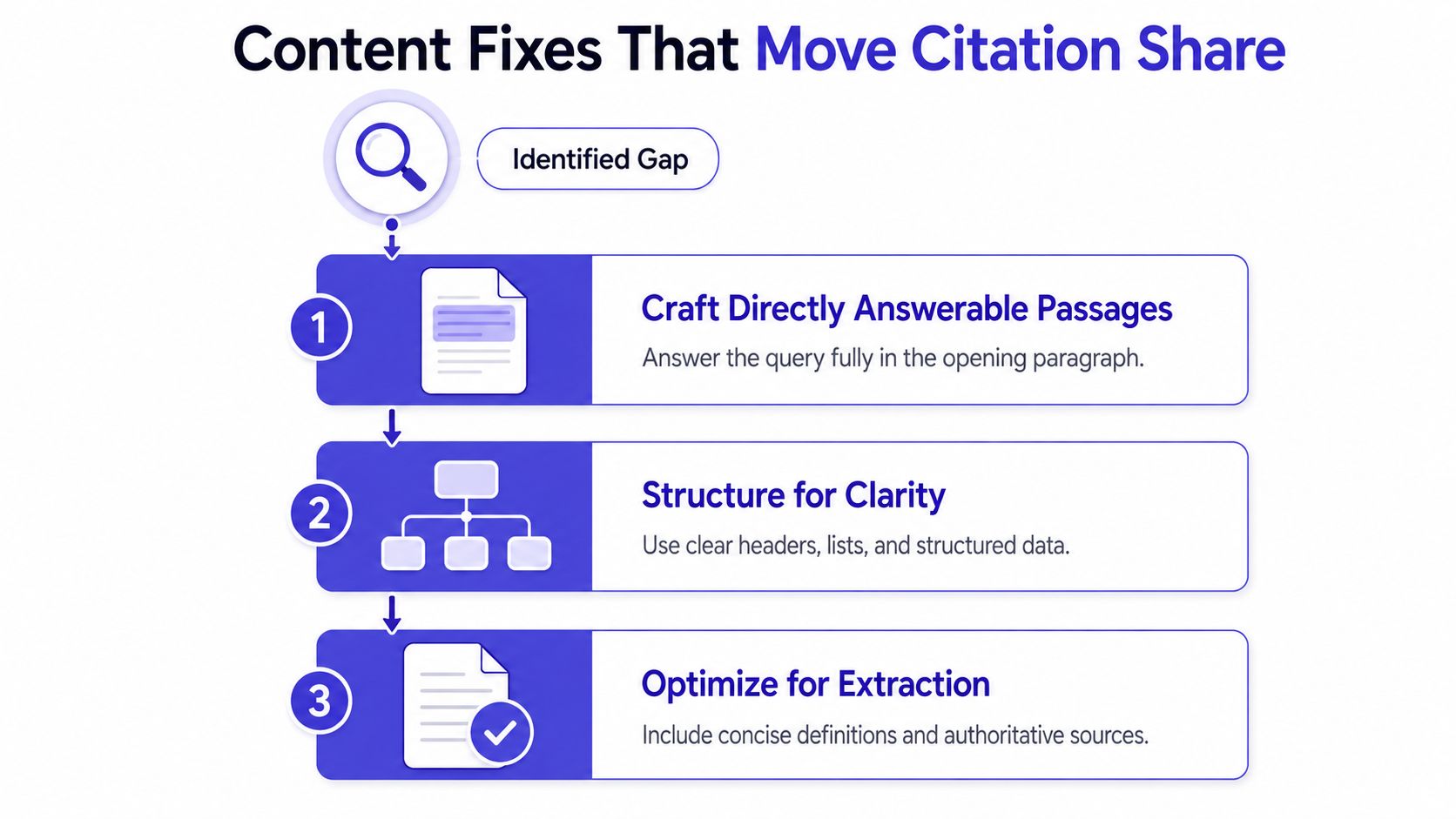
Perplexity's ranking behavior rewards pages that answer the question early, use clear entity labels, and stay fresh. Guidance around its citation selection says complex buyer questions often split into 3 to 5 sub-searches, retrieve roughly 10 candidate pages, and surface only 3 to 4 cited sources in the final answer, while Pro Search can expand the citation set to about 8 to 15 sources First Motion analysis. That means your page has to win twice, first in retrieval and then in final citation ranking.
The simplest fix is usually the opening paragraph. Put the answer there, not after a long setup. Then reinforce it with headings that mirror buyer language, because the model is looking for passages it can quote without distortion.
Match the fix to the failure mode
If your page is too diffuse, add direct-answer sections and shorten the introductory copy. If the topic is too vague, add entity labels and comparison language so the model knows what category you belong to. If freshness is the issue, update the page and mark the new date clearly, because older pages tend to lose to newer ones in time-sensitive contexts.
Perplexity also supports academic narrowing through search_domain_filter, which can restrict retrieval to domains such as arxiv.org, nature.com, pubmed.ncbi.nlm.nih.gov, and .edu Perplexity academic search guidance. That matters because source selection changes when the query mechanics change. A page that works in broad web mode might still lose in a filtered environment if it lacks the right source signals.
Use a backlog, not a brainstorm
A practical fix stack usually includes llms.txt, Schema.org markup, Wikidata entries, counter-articles that answer competitor prompts directly, and outreach to the review and community domains that already appear in the citation mix. These aren't decorative SEO tasks. They map to the same gates Perplexity uses when deciding which sources can be quoted cleanly.
Sequence it this way: first make the page extractable, then make the entity legible, then earn supporting mentions where Perplexity already looks.
The most reliable way to prioritize is to line up the gap with the likely fix. If you're absent from review-heavy prompts, outreach matters. If you're missing on definition-style queries, your on-page structure is the issue. If you're losing to a competitor's comparison page, your counter-article probably needs to answer the buyer's real objection faster than theirs does.
Diagnostic Cadence and What to Track Next
Run the same prompt set every day, then log the citation domains, citation rank, and any shipped fix tied to the page. That lets you separate a real improvement from ordinary answer drift. The common mistake is to read a one-week lift as proof, when a trendline across repeated probes is what shows movement.
If you're using GetIntel, log each change against the metric it's meant to move, topic score, Share of Voice, or Average Citation Rank, so you can connect a citation shift to the exact fix that triggered it. That audit trail is what makes the result defensible in a review, especially when a competitor appears to move for the same query class. The main question is simple, did the change improve daily visibility, average citation rank, or the breadth of prompts where your domain was surfaced?
Perplexity citations don't reliably transfer to other engines, either. Cross-engine overlap is limited, so treat each answer engine as its own visibility environment rather than assuming one win carries everywhere.
If you want to see where your brand is already appearing inside AI answers, use the Perplexity brand tracking to probe the same buyer questions across Perplexity and the other major engines. If you are still choosing a tool, we ranked the Perplexity visibility tracking tools and published the engine-by-engine data behind the choice. It captures cited domains, ranks them by prompt, and turns the gaps into fixable content and entity work you can ship into your own stack.