Yes, PR.co is genuinely useful for AI search visibility, but for a different job than a dedicated tracking tool. All five major AI answer engines agreed on the same split when asked directly: PR.co helps AI engines find and read your content (structured newsrooms, schema markup, crawler access), but it doesn't tell you whether ChatGPT or Perplexity is actually citing you. You need both, not one instead of the other.
Why does this question come up?
If PR.co now markets "GEO" features, the natural next question is whether that closes the AI-visibility loop entirely, or whether you still need a separate tool to know if any of it is working. On August 2, 2026, we ran the exact question, "Is pr.co useful for improving AI search visibility in ChatGPT and Perplexity, or do I need a dedicated LLM SEO tool for that?", through ChatGPT, Perplexity, Gemini, Google AI Overview, and Google AI Mode, the same five engines GetIntel probes daily. We'll re-run this exact prompt quarterly, since both PR.co's feature set and the AI-visibility tooling landscape move fast.
What did all five AI engines actually say?
Every engine drew the same line, independently: PR.co helps you get read, not measure whether you got cited.
- OpenAI/ChatGPT: strong for publishing and earned media, weak-to-absent on tracking mentions, benchmarking competitors, or discovering which prompts you appear in.
- Perplexity: helps with PR and link-building visibility, but optimizing AI search visibility itself "typically" needs a dedicated LLM SEO tool that tracks citations and crawler indexing.
- Gemini: framed it as two roles, PR.co as "distribution and authority engine," a separate dedicated tool as "measurement and auditing layer" to see if the PR efforts are actually landing.
- Google AI Overview: PR.co is useful for "publishing and structuring brand announcements for AI crawlers," but has "no tracking capabilities" for how often ChatGPT, Perplexity, Claude, or Gemini actually cite your brand.
- Google AI Mode: same split, PR.co helps build the authority AI models trust, but doesn't tell you whether they're actually citing you.
Five different models, one consistent answer: PR.co is real infrastructure for being findable, not a way to find out if you're being found.
What does PR.co's own product page confirm?
PR.co's own GEO-focused page lists exactly the features the AI engines described, not tracking or citation monitoring:
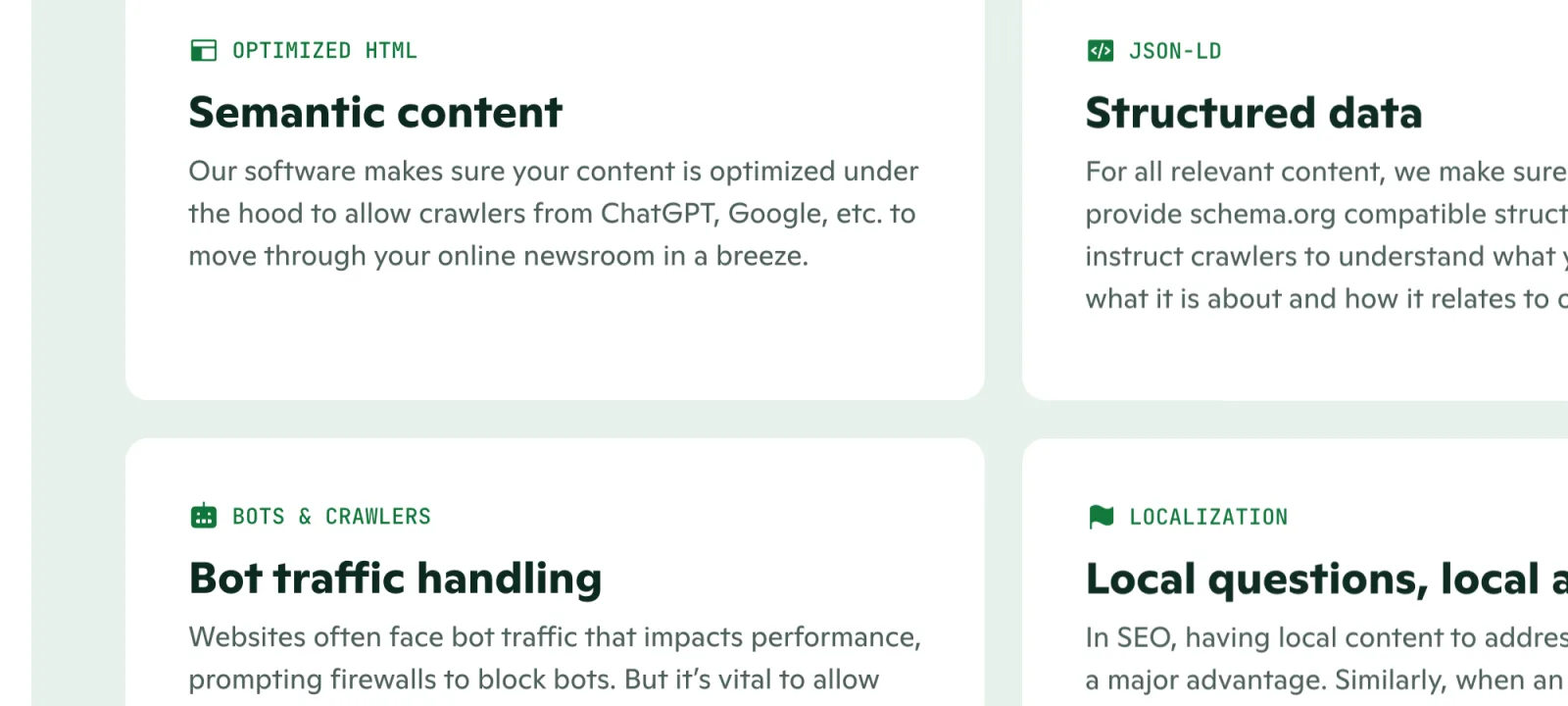
The four features on that page (optimized HTML/semantic content, JSON-LD structured data, bot traffic handling, and localization) are all about making your existing newsroom easier for AI crawlers to read and index. None of them are a dashboard showing which buyer prompts cite your brand, which competitors AI recommends instead, or how your citation rate is trending. That's not a gap in PR.co's marketing copy: it's a different product category entirely.
Where does PR.co genuinely help?
PR.co helps on the publishing side: a clean, fast, schema-annotated newsroom that AI crawlers can read, and distribution that puts a story where engines look. Reviewed 19 September 2026.
Publishing infrastructure AI crawlers actually want
A clean, fast, schema-annotated newsroom is a real input to AI citation, not a vanity feature. AI engines pull from sources they can parse cleanly and trust, and a structured press-release archive with consistent entity data is exactly the kind of source that gets picked up. If your current newsroom is a PDF dump or a slow WordPress plugin, PR.co's GEO features are a legitimate upgrade over what you have today.
Earned media and authority signals
PR.co's core business (getting your announcements picked up by journalists and industry outlets) builds the kind of third-party mentions AI engines weight heavily. That's a genuine, if indirect, AI-visibility lever: more clean coverage of your brand across the web gives every AI engine more consistent material to draw from when it decides whether to recommend you.
Where does PR.co fall short?
PR.co falls short on measurement: nothing in it tells you whether any of the coverage changed what an AI engine says about you.
No visibility into whether any of it worked
Every engine agreed on this gap: PR.co has no feature that tells you whether ChatGPT actually cited your latest press release, whether Perplexity recommends you over a competitor on a specific buyer prompt, or whether your citation rate moved after a PR push. You can do everything PR.co suggests and still have no idea if it changed anything in AI answers.
No competitor or prompt-level benchmarking
A dedicated AI visibility tool tells you which exact buyer prompts you're missing, and which competitor gets cited instead. PR.co has no equivalent. It optimizes your own content, but it doesn't watch the answer engines themselves.
What mistakes do teams make here?
- Assuming "GEO features" means "AI visibility is covered." A publishing tool with GEO-friendly markup is necessary, not sufficient: it's the input side, not the measurement side.
- Running PR campaigns with no before/after citation check. Without a tracking layer, you can't tell whether a press push actually moved your AI citation rate or whether the timing was coincidental.
- Treating this as an either/or decision. The real data says both tools solve different problems; picking one instead of the other leaves a real gap on either the publishing or the measurement side.
When do you need a dedicated tool alongside PR.co?
The moment you want to know whether your PR or content work is actually changing what AI engines say about you, you need a tracking layer PR.co doesn't provide. GetIntel runs daily probes across ChatGPT, Perplexity, Gemini, Google AI Overviews, and Claude, turning citation gaps into the same kind of structured artifacts PR.co optimizes for delivery. See the AI visibility tracker or the AI Brand Visibility Tracking guide for more.
What the "dedicated tool" category actually looks like
None of the five engines treated "dedicated AI visibility tool" as a hypothetical category. Each named real examples in the same breath as PR.co: Gemini pointed to AirOps and Ahrefs Brand Radar, Google AI Overview named Profound, and ChatGPT laid out a comparison table contrasting "publish AI-friendly content" against "track ChatGPT/Perplexity mentions" as two separate rows a buyer has to fill in. That consistency across engines is itself a signal: this isn't an edge case a PR platform might eventually cover, it's a distinct, already-established product category with its own vendors.
PR.co vs. a dedicated AI visibility tool
| PR.co | Dedicated AI visibility tool | |
|---|---|---|
| Job | Publish + structure content for AI crawlers | Track + measure actual AI citations |
| Schema/semantic HTML | Yes, built in | Not its focus |
| Earned media distribution | Core feature | Not offered |
| Tracks ChatGPT/Perplexity mentions | No | Core feature |
| Competitor citation comparison | No | Core feature |
| Fix generation (llms.txt, schema, counter-content) | No | Yes |
If you want the measured version of what engines actually cite, we publish the five-engine citation study. Two different jobs, one real gap if you only run one of them: publish without measuring, or measure without a clean publishing pipeline to fix what you find.