Between 10 July and 15 August 2026 our own AI visibility agent proposed 83 fixes for the GetIntel brand. We approved none of them. That gap between what a tool finds and what a team ships is the real constraint in this category, and it is almost never measured.
Disclosure: GetIntel is an AI visibility tool, so this is our own product's data about our own brand. Every figure below was read from the live account on 17 August 2026 and can be reproduced from the same account.
Every tool in this category is good at finding gaps. Run a prompt set, compare the answers, and a backlog of things to fix appears within a day. The industry sells that discovery step hard, and it works.
What almost nobody reports is the conversion rate on the other side.
What is the action gap?
GetIntel uses the action gap to mean, in AI visibility specifically, the difference between fixes a visibility tool proposes and fixes a team actually ships. The phrase is borrowed rather than invented. It sits alongside the value-action gap in behavioural research and the knowing-doing gap in management, and the mechanism is the same one: knowing what to do is not the constraint. It is a ratio, not a score, and it goes the wrong way as the tool gets better at finding things.
A tool that surfaces five opportunities a week is easy to keep up with. A tool that surfaces fifteen produces a backlog by week two. Nothing in the product tells you this is happening, because every dashboard is built to show what it found rather than what you closed.
The number matters because it caps everything downstream. Visibility only moves when a fix ships. A team with a 100 percent discovery rate and a zero percent action rate has bought a very good report.
What did our own agent propose?
GetIntel's own agent proposed 83 tasks across five weeks and we shipped none of them: 59 Reddit replies, 15 backlink pitches and 9 content publishes, from the GetIntel task backlog between 10 July and 15 August 2026, read 17 August 2026.
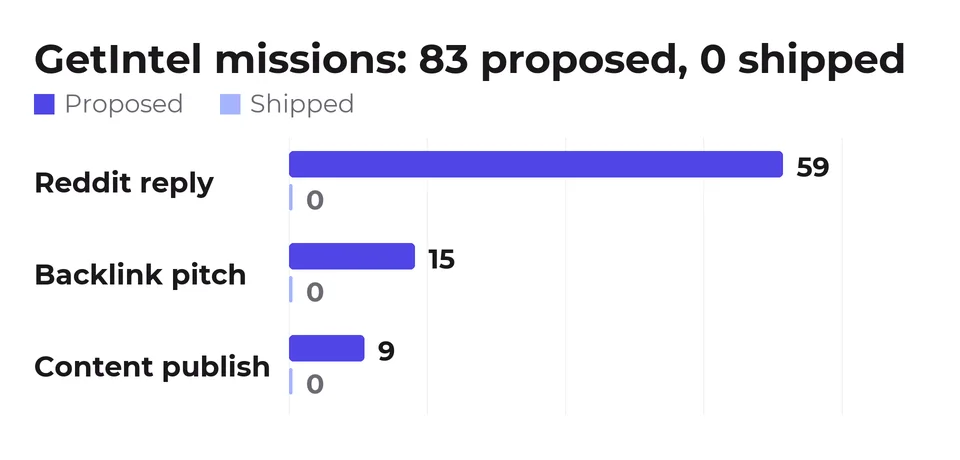
| Task type | Count | What it is |
|---|---|---|
| Reddit reply | 59 | A thread AI engines cite for one of our tracked prompts, where our brand is absent |
| Backlink pitch | 15 | A site to pitch for a contributed piece |
| Content publish | 9 | A buyer question where AI cited competitors and not us |
| Total | 83 |
Every one of them is still open. None was picked up, so none has been completed either.
The proposals are specific rather than generic. One reads: "AI search cites this thread when answering 'What tool lets me see which Reddit threads or G2 reviews AI engines are pulling brand recommendations from?' and GetIntel is not in it." Another names the competitors that were cited instead: GrackerAI, HubSpot and Citations.io on one question, Ahrefs and Aeranking on another.
So the finding step worked. Five weeks of it worked, daily, without anyone asking.
Why does the backlog form?
An AI visibility backlog forms because the three task types have very different costs and the tool does not price them. GetIntel's own backlog splits three ways.
- Reddit replies were 59 of our 83. Each one needs a human who knows the product, has an account with standing in that subreddit, and can write something worth reading. That is the highest-value action in this category and the least automatable.
- Backlink pitches were 15. Each is an email to a real editor, which means a relationship and a follow-up, not a send.
- Content publishes were 9. These are the closest to automatable, because the output is a page on your own site.
The agent attaches its own impact score to each task, 13 for the outreach items and 6 for the content ones, so it already ranks outreach as the more valuable work. What is missing is the other axis. Nothing records that a Reddit reply might take an hour of a founder's week while a content draft can be generated in minutes.
Sort a backlog by value alone and the expensive items sit at the top forever. That is what ours did.
Why does no tool report this number?
No AI visibility tool reports its action gap because it is the one metric that makes the product look worse the better it works.
A dashboard exists to show what it found. Findings are the proof of value, they justify the subscription, and they grow every week whether or not anything is done with them. An action rate does the opposite. It falls as discovery improves, it attributes the failure to the customer, and it gives a renewal conversation an awkward number to explain.
There is also a measurement problem that is real rather than convenient. Most tools cannot see whether a fix shipped, because the shipping happens somewhere they have no visibility into: a Reddit account, an editor's inbox, a repository. A tool that only proposes has no honest way to close the loop on its own reporting.
That excuse runs out once a fix ships through the tool itself. Anything delivered through an integration is countable, and the count should be on the dashboard next to the findings.
Does this show up in the score?
The action gap does show up in GetIntel's own visibility score, and it explains a plateau that otherwise looks like the content is failing.
Our own visibility score moved from 2 in mid-July to 22 by 2 August, then sat at 22 and 23 for the following fortnight. Share of voice across the tracked prompt set is 3.0 percent, read 17 August 2026. Of the 240 engine-and-prompt cells GetIntel tracks (60 buyer questions across four engines), 87 are still open, meaning an engine answered and named nobody at all, us included.
It is tempting to read a flat fortnight as evidence that the work stopped paying. The task log suggests something duller. The measurement kept running and the actions did not, so there was nothing new for the score to reflect. Discovery and action had decoupled.
Worth stating the limits on that. Two weeks is a short series, our score rests on 14 brand mentions across 239 probes, and one or two mentions moves it a point. This is a plausible reading of a plateau, not a proven cause.
How do you measure your own action gap?
Measure your own action gap by counting two numbers for the last 30 days and dividing: how many fixes your tool proposed, and how many of them actually shipped.
- Proposed: every fix, task, opportunity or recommendation your tool generated. Most tools expose this through an API or an export. Ours is a task list.
- Shipped: every one that reached production. A published page, a live Reddit reply, a merged pull request, a sent email.
Shipped divided by proposed is your action rate. Ours, for the period above, is zero. Worth checking the cheap end of the backlog first: the technical gates are quick to close, though testing them against the pages AI actually cites suggests they are a floor rather than a lever.
Then split the proposed count by how the fix has to be delivered. Anything that lands on your own site is cheap. Anything that needs a third party, a relationship or a human voice is not. If the expensive bucket is the majority of your backlog, as it was in ours, the constraint is your delivery capacity and buying a better detector will not help.
The practical response is to stop treating the backlog as a queue to clear. Pick the smallest set you can actually ship in a week, close those, and let the rest sit visibly unshipped rather than quietly rotting.
What are we doing about ours?
Publishing it is the first part, because a number that only appears in an internal dashboard tends not to get acted on. GetIntel is the subject of this one, not the exception to it.
The second is that the fix path we sell is the one designed for this problem. Our own documentation describes handing a task to Claude Code or Cursor via MCP so the agent does the work in your own codebase and you review it, and as of 17 August 2026 the live server exposes 20 read tools alongside 5 act tools. That path only helps the cheap bucket, the fixes that land on your own site. It does nothing for 74 of our 83 tasks, which need a human in a Reddit thread or an editor's inbox.
That is the honest shape of it. The loop closes on the part that is code. The part that is other people stays manual, for us as much as anyone.
We will publish the ratio again in 30 days, whichever way it has gone.
How did we measure this?
Every figure came from the live GetIntel account for the GetIntel brand, read on 17 August 2026 through the product's own MCP server. Task counts and states, including that none were completed, come from the task list, and the visibility figures are the trailing seven-day window from the visibility and competitor endpoints.
Two limitations are worth naming. This is one brand over five weeks, so it is an illustration rather than a benchmark, and the brand is our own, which means we are both the subject and the vendor. The method is described precisely enough that you can run the same two counts on your own account and get a number that is not ours.
If you want the mechanics of shipping the cheap bucket, our guide to shipping AI visibility fixes without an engineering backlog covers that path end to end, and which AI visibility tools connect to Claude Code covers which vendors expose a connection at all. For the broader case against stopping at a dashboard, see why monitoring AI visibility alone isn't enough. The task list those 83 fixes came from is Tasks.