The popular advice is simple: track your AI visibility, watch the score rise, and assume your brand is winning the next search channel. That advice confuses being mentioned with being trusted, understood, and chosen. A citation can point to the wrong page, describe a deprecated feature, disappear after a model refresh, or sit inside an answer that sends no qualified buyer to your site.
That's why monitoring AI visibility alone isn't enough. A score is useful when it triggers a content fix, an entity correction, a schema update, an outreach task, or a measured experiment. Without that operational layer, the dashboard creates the appearance of progress while referral traffic, branded search lift, and pipeline remain unchanged.
Table of Contents
- Why Does a Rising AI Visibility Score Mislead You?
- What Do Visibility Scores Leave Out?
- Why Does the Same Check Return Different Answers?
- What Should You Track Alongside a Visibility Score?
- Turning Visibility Data into Content and Entity Fixes
- Operationalizing AI Visibility with GetIntel
- Designing Experiments and Attributing Outcomes
Why Does a Rising AI Visibility Score Mislead You?
Reviewed 19 September 2026. A rising AI visibility score does not automatically mean business progress. It may mean that a model mentioned your company more often, but the mention could be incomplete, contextually wrong, or attached to a source buyers can't verify. The metric answers whether the brand appeared, not whether the answer gave a buyer a credible reason to investigate.
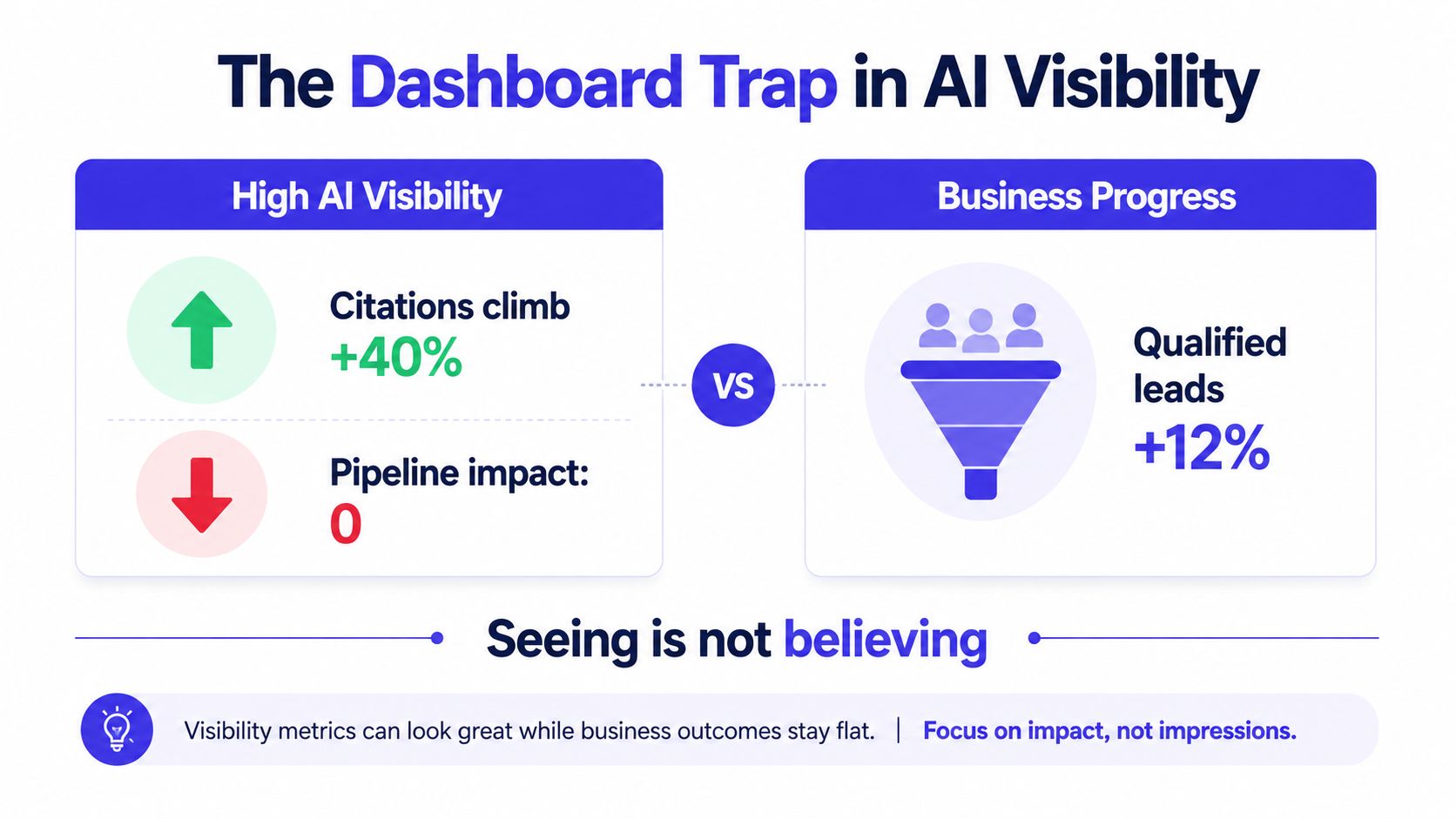
Many B2B SaaS teams celebrate when citation counts increase, then discover that AI-referred sessions haven't moved and branded search remains flat. The problem isn't that visibility monitoring has no value. The problem is treating the first diagnostic signal as the final business outcome.
Practical rule: A green visibility dashboard should open a work queue, not close a reporting cycle.
Consider a common operating scenario. A SaaS company's visibility score doubles after several new articles and external references are indexed, while referral traffic from AI interfaces flatlines. The dashboard reports improvement, but the buyer experience hasn't changed. The citations may appear in low-intent prompts, lack direct links, or describe the product without a clear use case, proof point, or next step.
That's a vanity citation. It looks positive in a monitoring export but fails to create consideration because it lacks context, authority signals, or a clickable pathway. Product teams already connect product information with user behavior through their own analytics; the same principle applies here: a mention becomes commercially meaningful only when teams can connect it to what buyers do next.
What a raw score leaves out
A raw score leaves out everything about why it moved. It cannot, by itself, tell you whether:
- The citation is accurate: The answer may attribute a feature, integration, or customer use case the product doesn't support.
- The source is authoritative: A model might cite a weak directory page while ignoring the company's current documentation.
- The mention is commercially relevant: A brand can appear for an educational prompt while remaining absent from pricing, alternatives, and implementation questions.
- The recommendation is attributable: Buyers may see a generic category reference without recognizing the company as the recommended vendor.
- The mention persists: A single snapshot says little about whether the citation survives retrieval changes or competitor updates.
The practical workflow starts after the score changes. Review the prompt, inspect the answer, verify the cited page, compare the competitor that appeared instead, and assign a specific remediation. If no one owns that next action, monitoring becomes a weekly ritual rather than a growth program.
What Do Visibility Scores Leave Out?
Raw citation counts flatten several different quality questions into one number. A citation can be present and still fail on accuracy, relevance, sentiment, competitive position, or source integrity. Those omissions matter because buyers increasingly consume the answer itself instead of checking every outbound reference.
The 2025 Tow Center study tested 1,600 queries across eight AI search engines and found that systems failed to retrieve the correct citation details more than 60% of the time. A separate 2025 Columbia Journalism Review analysis reported that more than half of Gemini and Grok 3 responses cited fabricated or broken URLs. Visibility monitoring that counts a mention without validating its source trail can therefore reward exposure that undermines trust.
The three gaps behind inflated scores
Three gaps sit behind an inflated score, and citation accuracy is the first. A tool may record a brand mention even when the linked page is outdated, the publisher is wrong, or the citation doesn't support the claim. A SaaS company might be cited for a feature it deprecated months ago, while a competitor's branded term is incorrectly attributed to it. The score rises, but the buyer receives misinformation.
Hallucination risk creates a more serious version of the same problem. A fluent answer can invent product capabilities, pricing context, or implementation details. The 2024 Harvard and medical reference study found low factual precision in citation-heavy paper-identification tasks, with GPT-3.5 at 9.4% and GPT-4 at 13.4%. The same 2024 Harvard and medical reference study reports hallucination rates of 39.6% for GPT-3.5 and 28.6% for GPT-4. These findings don't measure brand visibility directly, but they show why a polished answer can't serve as its own quality control.
Correlation versus causation is the third gap. A visibility spike may coincide with a launch, a press cycle, a third-party review, or a retrieval change. Unless the team logs what it changed and compares the affected prompts with stable controls, it can't know whether its work caused the movement.
| Measurement Gap | What It Misses | Business Risk |
|---|---|---|
| Citation accuracy | Whether the cited page supports the answer | Buyers encounter incorrect or outdated information |
| Answer grounding | Whether claims align with available evidence | Trust declines when the product is misrepresented |
| Prompt relevance | Whether mentions occur on high-intent buyer questions | Teams optimize visibility that has little revenue value |
| Competitive positioning | Which alternatives appear beside or instead of the brand | A rising count can hide lost consideration |
| Causal attribution | Whether shipped changes produced the score movement | Budgets flow toward tactics that only correlate with growth |
A useful audit separates mention frequency from answer quality. Review sentiment, supporting evidence, page-level attribution, and the commercial intent of each prompt. A score should be considered incomplete until those dimensions are visible beside it.
Why Does the Same Check Return Different Answers?
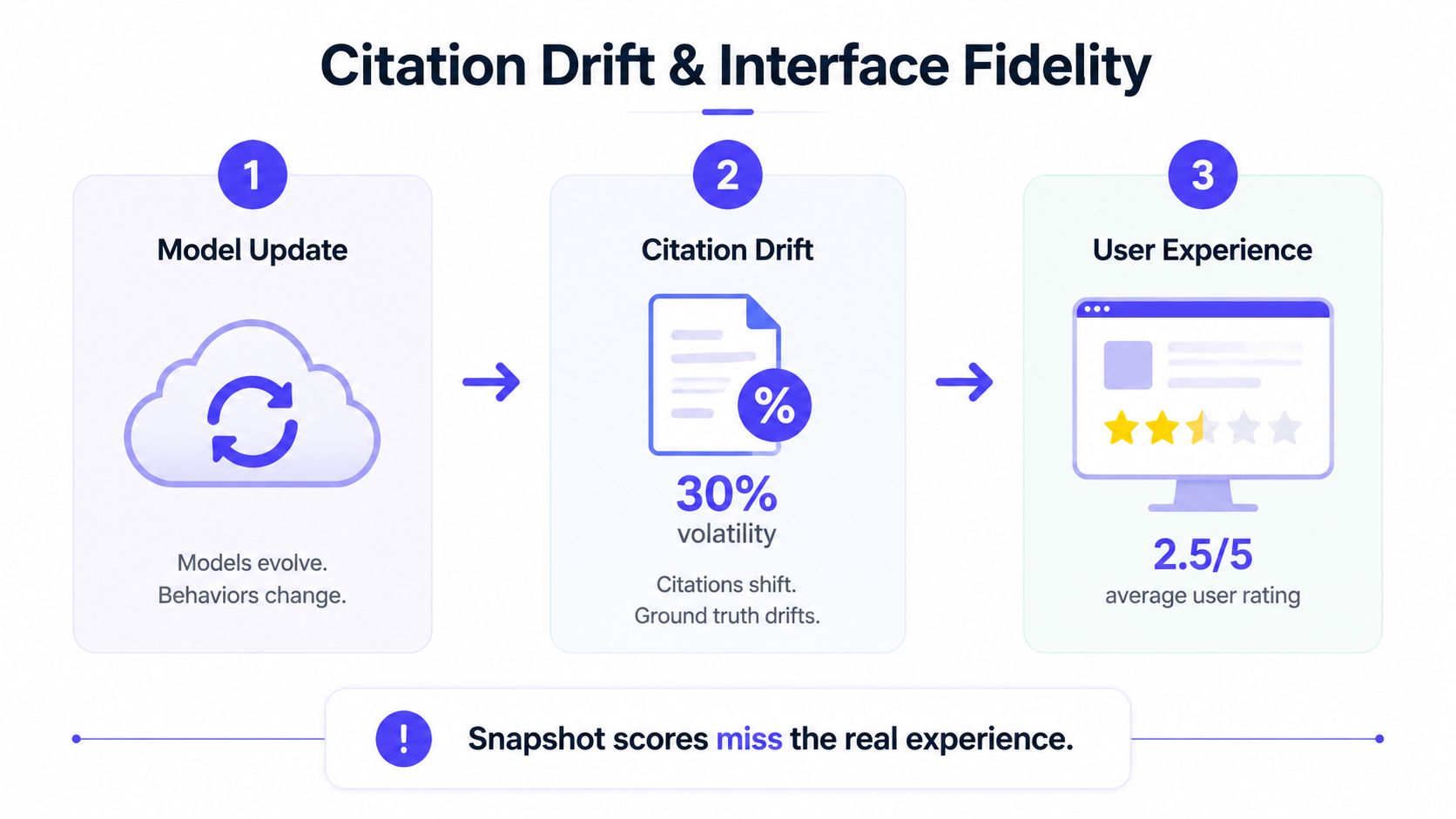
A snapshot score describes one observation, not a durable position. AI answer engines change their retrieval sources, ranking logic, summaries, and citation selections. The 2026 citation-drift benchmark analyzed 82,619 prompts and 1,548,213 snapshots across six countries, three platforms, and 17 weeks, reporting weekly domain-level citation churn of 56% in Google AI Mode and 74% in ChatGPT Search (benchmark details).
That volatility changes the operating question. Instead of asking only whether your brand appeared today, ask whether the same domain remains selected, whether competitors are replacing it, and whether the citation still supports the intended claim.
Interface fidelity adds another layer. An answer captured through an API may not match what a buyer sees in ChatGPT, Perplexity, Claude, Gemini, or Google AI Overviews. Interfaces can truncate context, collapse source details, place links behind expandable elements, or render a brand as a generic category reference. A monitoring result may register the domain while the user experiences an unbranded or weakly supported recommendation.
Why snapshots mislead operators
Snapshots mislead operators because a single observation is not a position. Suppose a company appears strongly during a scheduled probe, but the live interface later renders the mention as “a project management platform” without the company name or a usable source link. The monitoring system may preserve the citation event, yet the buyer loses the brand association that creates recall and consideration.
This is why teams should inspect the rendered answer, not just the extracted citation. The distinction between being mentioned and being cited is also explained in this guide to mentioned versus cited by AI, where the practical issue is attribution rather than simple textual presence.
Track drift at three levels:
- Domain stability: Record which source domains remain in the answer set and which competitors replace them.
- Page stability: Check whether the engine cites the same page, a redirect, an outdated article, or a generic homepage.
- Interface rendering: Review the answer as the buyer sees it, including visible context, source labeling, and link behavior.
A volatile score isn't useless. It's a signal that requires trendlines and answer inspection. The teams that benefit from monitoring treat drift as a prioritization input, then improve the pages and entities most likely to survive retrieval changes.
What Should You Track Alongside a Visibility Score?
Track referral traffic and branded search lift alongside a raw visibility or citation score. They provide a reality check on whether AI recommendations reach actual buyers rather than remaining dashboard events.
Referral traffic shows whether someone moved from an AI interface to your site. Branded search lift shows whether the mention created enough interest for a buyer to search for the company later, even when the original AI interaction doesn't pass a clean referrer. Together, they capture direct and indirect demand.
The 2026 Similarweb analysis summary reported that users visited a mentioned brand's website at 1.5 to 2.5 times the forecasted baseline rate over the following seven days. The same 2026 Similarweb analysis summary reported platform differences, including a relative lift of about 2.5 times baseline for Gemini, while ChatGPT's uplift across industries ranged from 38% to 86% above baseline. These figures support a measurement principle, not a guarantee for every company: validate visibility against downstream behavior.
Build the measurement layer
Start with clean source capture:
- Tag AI destinations: Use consistent UTM parameters on links your team controls, especially comparison pages, documentation, and high-intent landing pages.
- Parse referrers: Separate traffic from ChatGPT, Perplexity, Gemini, and other identifiable AI interfaces in analytics.
- Create branded query groups: In Google Search Console, isolate searches containing the company name, product names, and common branded variations.
- Connect sessions to outcomes: Compare AI-referred sessions with demo requests, trial starts, sign-ups, and qualified pipeline.
- Benchmark competitors: Track whether your share of voice rises while competitor citations fall, not merely whether your own count increases.
Google AI Overviews can also change click behavior by query type. A 2026 analysis reported that branded queries with AI Overviews saw CTR uplift of 18.68%, while non-branded queries saw CTR decline of 19.98%, and brands cited inside an Overview earned 35% more organic clicks and 91% more paid clicks than brands left out (analysis summary). Treat those results as directional evidence and segment your own reporting by query class.
| Signal | What It Reveals | How to Capture |
|---|---|---|
| AI referral traffic | Direct buyer response to visible recommendations | Referrer parsing, analytics channels, UTM links |
| Branded search lift | Indirect demand after an AI exposure | Google Search Console query groups |
| Conversion rate | Commercial quality of AI-referred sessions | CRM and product analytics joins |
| Competitor share of voice | Relative consideration within the same prompt set | Repeated buyer-prompt probes |
| Citation quality | Whether exposure is accurate and defensible | Page checks, source validation, answer review |
The composite dashboard should place visibility at the top of the funnel, then show traffic, branded demand, conversion quality, and pipeline underneath it.
Turning Visibility Data into Content and Entity Fixes
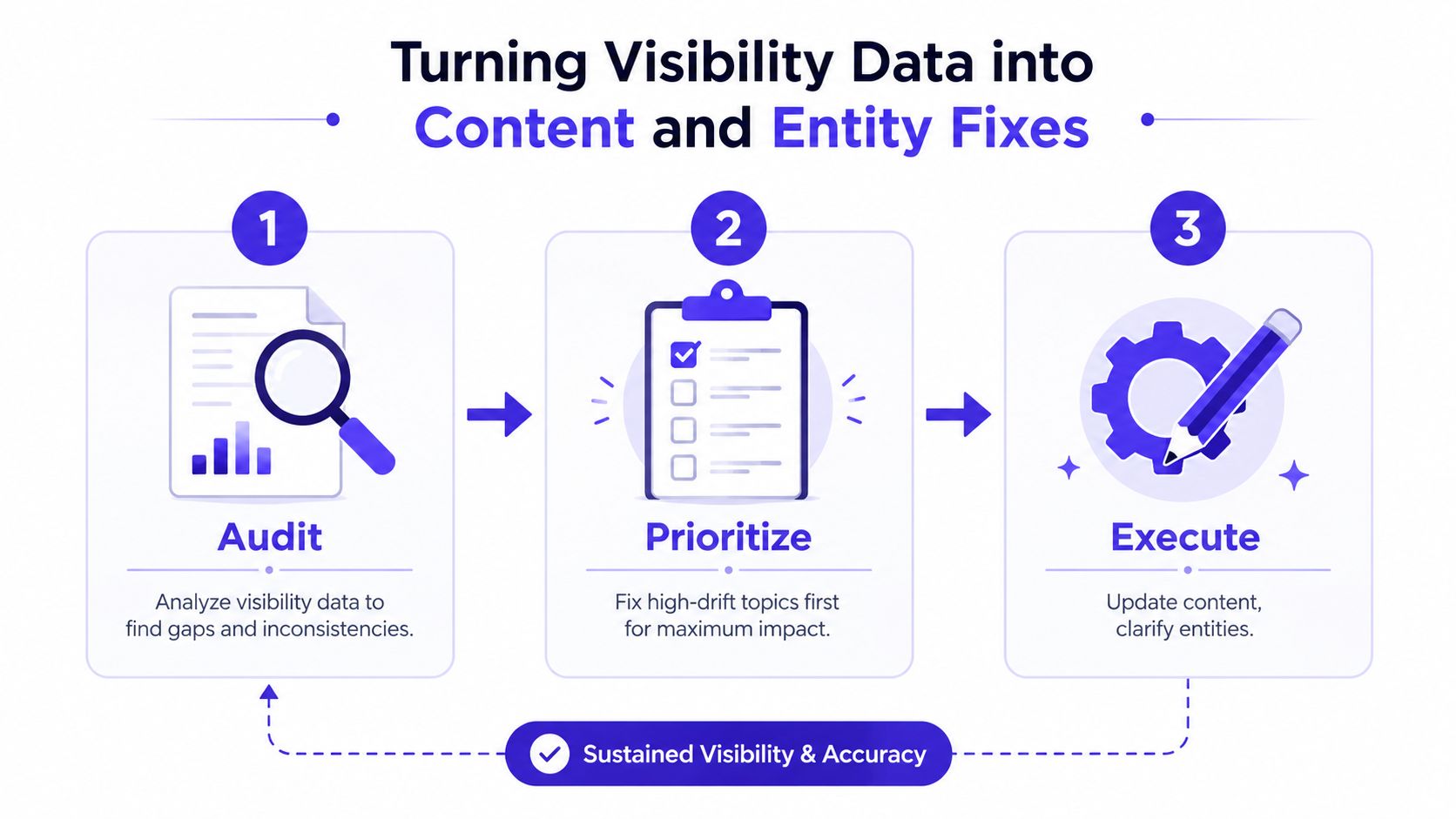
Monitoring tells you where the gap exists. It doesn't close the gap. High-performing programs convert each finding into a specific intervention with an owner, a target page, and a later measurement cycle.
Start with the trigger
When competitors appear for prompts where your company is absent, create a content gap brief. The brief should identify the prompt intent, competitor sources, missing claims, evidence requirements, and the page format needed to answer the buyer directly. For broad “best of” prompts, a structured comparison may work better than another generic product article. Teams that need a repeatable way to plan comparison-driven assets should template the format once and reuse it, provided each final draft is reviewed for accuracy and differentiated value rather than published as a near-duplicate.
When the engine cites an outdated or weak page, update the source rather than publishing another overlapping draft. Add clear definitions, current product facts, implementation details, alternatives, and links to primary documentation. The page needs to answer the buyer's question in a form both humans and retrieval systems can interpret.
Schema is the next remediation. FAQ schema, HowTo schema, and Organization markup can clarify page structure, entities, and relationships. A schema study summary reports that users clicked rich results 58% of the time, compared with 41% for non-rich results, a 17 percentage point difference (schema study summary). Structured data doesn't guarantee an AI citation, but it gives search systems cleaner signals to parse and connect.
Repair the entity layer
Entity fixes matter when the same company appears under inconsistent names, duplicate profiles, old product names, or conflicting descriptions. Audit the company's foundational facts across authoritative third-party sources, then correct discrepancies in places such as Wikipedia, Wikidata, Crunchbase, G2, Product Hunt, and relevant industry databases. Outreach should point to verifiable information, not attempt to manufacture praise.
Content refreshing also needs substance. A summary based on 15,000 URLs found that pages expanded by 31% to 100% averaged a +5.45 position gain, while non-updated pages averaged a -2.51 position change (content refresh analysis). The same 15,000-URL study found minor edits averaging 0% to 10% content change showed a -0.51 position change, reinforcing the practical lesson that superficial rewrites rarely solve a meaningful retrieval gap.
Operationalizing AI Visibility with GetIntel
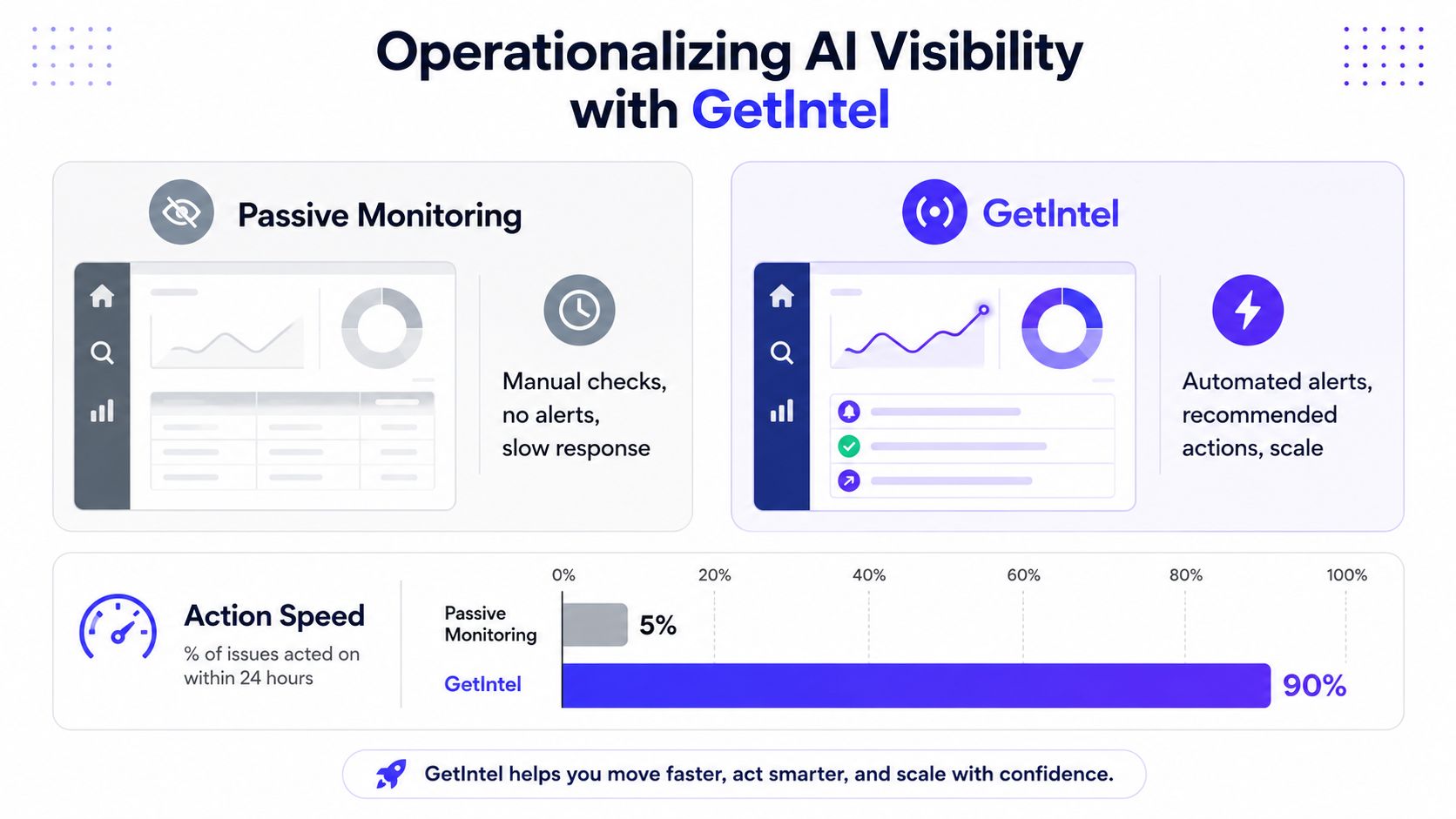
Passive monitoring asks a marketer to open a dashboard, scan a score, notice an anomaly, and manually decide what to do. That workflow breaks down when prompts, engines, citations, competitors, and content changes multiply. It also creates a long delay between detection and remediation: the gap between finding an issue and actually shipping a fix is real enough that GetIntel's own team measured 83 proposed fixes over five weeks with none shipped.
An operational program connects the observation to a repeatable queue:
| Passive Monitoring | Operational Visibility |
|---|---|
| Weekly score review | Regular probes and trend histories |
| Manual citation inspection | Source and page-level gap analysis |
| General “write more content” advice | Issue-specific drafts and entity fixes |
| Unassigned observations | Prioritized tasks with owners |
| No change log | Shipped interventions linked to later movement |
GetIntel is one example of this operational approach. Its AI visibility tracker probes buyer-style prompts across ChatGPT, Claude, Perplexity, Gemini, and Google AI Overviews, then reports topic-level scores, Share of Voice, and Average Citation Rank. It also captures live interface answers, identifies citation-source gaps against competitors, and aggregates signals from sources such as Reddit, X, G2, Wikipedia, and Product Hunt.
The difference is the handoff
The useful handoff is not “your score fell.” It's “your brand is absent from these buyer prompts, this competitor is cited instead, these source domains support the competitor, and this draft or entity correction addresses the gap.” GetIntel's AI visibility tracking feature fits that model by connecting monitoring with citation intelligence and prioritized remediation artifacts.
The platform can produce gap-closing drafts for items such as Schema.org markup, Wikidata entries, counter-articles, and outreach emails. Teams can deliver changes through coding agents such as Claude Code or Cursor via MCP, with optional publishing workflows for WordPress, Ghost, or Webflow. The important control remains human review. Automation should accelerate a grounded fix, not publish unverified claims.
A mature workflow records the change, the affected prompt cluster, the target engine, and the expected outcome. Later probes then show whether the intervention improved coverage, citation quality, or competitor displacement.
Designing Experiments and Attributing Outcomes
AI visibility optimization needs experiments because model behavior changes independently of your marketing work. A rising score may reflect a retrieval update, new third-party coverage, a competitor change, or your own intervention. Without a test design, the team can't separate those causes.
Start with a narrow change. Update schema on a defined cluster of product pages, improve the supporting copy, or correct one inconsistent entity across authoritative sources. Keep the prompt set, target engines, and comparison group stable while the change runs through a defined observation window. The plan should specify the primary outcome before deployment.
Use a layered attribution model
A useful sequence is:
- Exposure: Did citation frequency, source quality, or answer inclusion change?
- Consideration: Did branded searches or AI referral sessions move for the affected topic?
- Commercial response: Did those sessions produce stronger conversion or qualified pipeline?
- Durability: Did the result persist through later retrieval and interface changes?
Cohort-based tracking helps isolate interventions. Group prompts by intent, such as alternatives, pricing, implementation, and category recommendations. Compare the changed cohort with a similar group that didn't receive the intervention. This won't eliminate every confounding variable, but it creates a more defensible signal than comparing two unrelated dashboard snapshots.
| Experiment Type | Measurement Window | Primary Outcome Signal | Attribution Confidence |
|---|---|---|---|
| Schema update on a page cluster | Defined post-deployment cycle | Citation inclusion and source quality | Moderate |
| Content gap closure | Repeated prompt cycles | Share of voice and branded search lift | Moderate to high |
| Entity correction across reference sources | Multiple retrieval cycles | Correct brand facts and citation stability | Moderate |
| Competitor counter-content | Prompt cohort comparison | Competitor displacement and referral traffic | Moderate |
| Multi-intervention program | Staged cycles with change log | Pipeline influenced by AI-referred demand | Lower unless tightly controlled |
The RAG hallucination-detector benchmark reinforces why answer-quality auditing belongs in this loop. Reference-free methods are necessary because the model output can't be trusted as ground truth, while related work using nearly 18,000 manually annotated RAG responses shows that hallucinations can occur at the word level. Your experiment should therefore measure not only whether the brand appears, but whether the surrounding answer is supported and decision-useful.
A defensible AI visibility program looks less like rank reporting and more like growth experimentation. Monitor, diagnose, ship, measure, and retain the fixes that improve buyer-facing outcomes.
GetIntel connects AI answer monitoring with citation-source intelligence, buyer-prompt probes, competitor gaps, and concrete remediation workflows, so your team can move from a visibility score to shipped improvements. Visit GetIntel to see how an operational AI visibility process can connect citations with referral traffic, branded demand, and measurable growth.