The most popular advice about AI visibility is also the least useful: count how often your brand appears and call that success. That approach treats a passing name drop as equal to a source the buyer can inspect, click, and trust. It makes dashboards look healthier while hiding the gap between recognition and recommendation.
To do this in GetIntel, see Citations vs mentions.
The practical mentioned vs cited by AI difference is simple. A mention places your brand in the answer text. A citation attributes evidence to your page, domain, or another source associated with your brand. Those signals can appear together, but they don't mean the same thing, and they shouldn't share one KPI.
| Signal | What the AI engine does | What the buyer sees | Business meaning |
|---|---|---|---|
| Retrieved | The engine reads or selects a page during answer generation | Usually nothing visible | Your content entered the evidence set |
| Mentioned | The engine names your brand in the answer text | A brand reference, list entry, or comparison | Recognition and category association |
| Cited | The interface attributes the answer to a source | A link, footnote, or source card | Verifiable authority and an actionable path |
That three-state model is the foundation for reliable AI-search measurement. A brand can be retrieved without appearing in the final answer, mentioned without being cited, or cited without being named in the visible prose.
Table of Contents
- Why Mention Counts Inflate Your AI Visibility
- The three states teams need to separate
- How Does Each AI Engine Surface Mentions and Citations?
- Google AI Overviews concentrate source visibility
- Which Is Worth More to the Business, a Mention or a Citation?
- Why vanity metrics survive
- Measuring AI Visibility Beyond Raw Mention Counts
- Use a layered scorecard
- Probe the gaps directly
- Which Sources Does the Data Quietly Favour?
- Owned authority and distributed authority
- Technical and Content Fixes That Convert Mentions Into Citations
- Prioritize the page-level fixes
- What usually fails
- Real Workflow for Closing Citation Gaps With GetIntel
- A repeatable operating sequence
Why Mention Counts Inflate Your AI Visibility
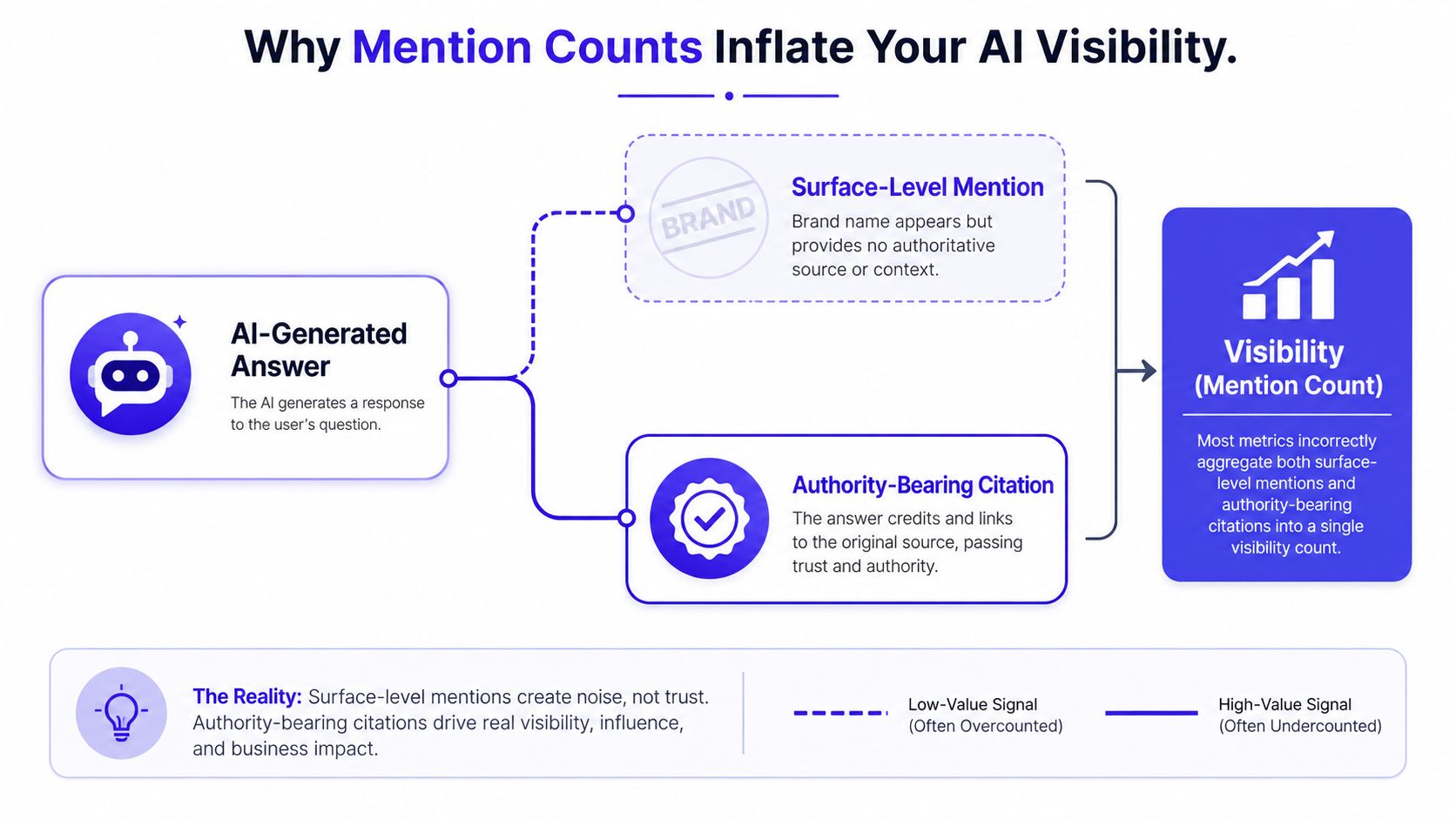
Reviewed 19 September 2026. Mention counts inflate an AI visibility number because a brand name appearing in an answer is not automatically a meaningful win. The model might include it in a category list, mention it as an alternative, or use it as context while linking to an entirely different source. The buyer sees your name, but the engine hasn't necessarily presented your company as evidence.
A mention is the brand name appearing in the answer text. A citation is a source attribution that the model or interface presents as evidence. As the operational distinction between AI mentions and citations makes clear, a brand can appear in a comparison without being the source the buyer would click, trust, or act on.
The three states teams need to separate
Three states need separating, and retrieved is the first: the engine read or selected a page as part of its evidence process. That page may influence the answer without becoming visible to the user. Retrieval is therefore a diagnostic state, not a visibility win.
Mentioned means the brand name appears in the generated text. This can support awareness and category association, but it doesn't prove that the model used your site as evidence. A mention may come from the model's learned brand memory rather than live retrieval.
Cited means the interface attributes information to a source page or domain, generally through a link, footnote, or source card. Citation gives the buyer a way to verify the claim and investigate the source behind it.
Practical rule: Track whether your brand was retrieved, mentioned, and cited as three separate events. Combining them makes it impossible to tell whether you have a memory problem, a retrieval problem, or a source-authority problem.
The distinction matters because raw mention counts reward low-intent appearances. A brand can collect more mentions while remaining absent from the source panels that shape trust and clicks. BuzzStream reported that only 23.1% of brand mentions were backed by a citation in the same response, while 69.9% of citations also included the brand name . The overlap is real, but it's limited.
Semrush research reported an even more important measurement trap. 61.7% of AI citations were “ghost citations,” where the page was used as a source but the brand name didn't appear in the answer, while 38.3% of appearances included a brand mention (the 2026 Semrush study available through arXiv). The lesson is uncomfortable: a brand-name report can miss valuable source usage, while a mention report can overstate buyer-facing authority.
How Does Each AI Engine Surface Mentions and Citations?
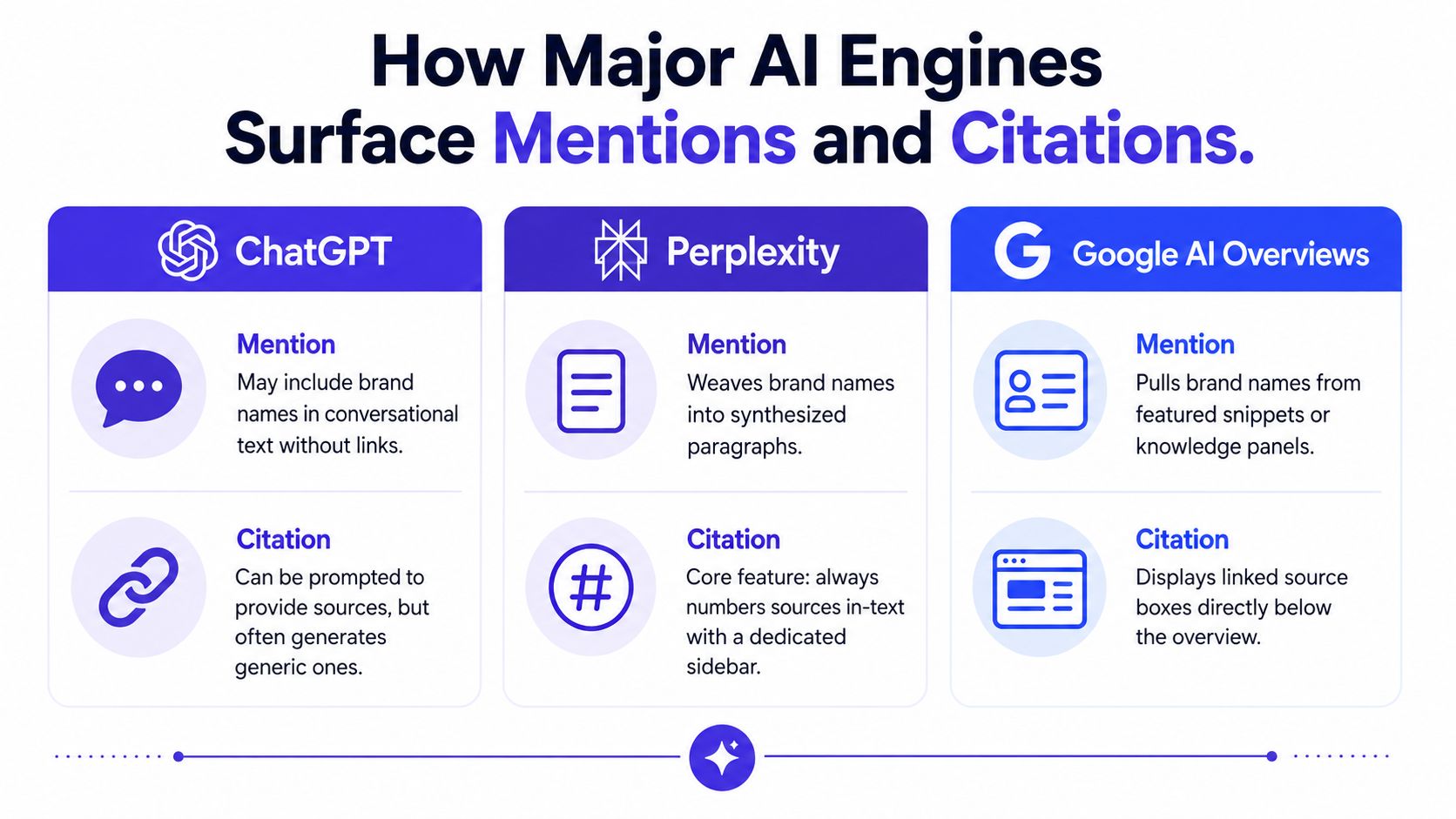
AI engines expose brand visibility through different interface and retrieval behaviors. ChatGPT may reference a brand in conversation without showing a link, while web-enabled responses can display source cards. Perplexity places citations prominently in its interface. Google AI Overviews presents linked sources beneath a synthesized answer. Claude and Gemini can also mention brands, but source attribution varies with the product mode, query, and live retrieval availability.
ChatGPT creates a measurement trap for teams that count names without checking sources. Recent research notes that ChatGPT mentions brands about 3.2 times more often than it cites them, as shown in the AI mentions and citations comparison from BuzzStream. A confident-sounding answer can therefore increase reported visibility without giving the buyer a page to verify. Our own 100-prompt run found the same asymmetry from the other side: ChatGPT names more brands than any other engine while citing the fewest sources.
Perplexity offers more visible evidence, yet a displayed source list does not mean every source performs the same role. A FACCT 2025 study of three answer engines found an average of 4.31 sources displayed per answer, compared with 3.0 sources cited in the final answer (the analysis of AI-search indexing and source exposure). Perplexity displayed the most sources, averaging 5.00, but cited the fewest among the engines tested. Source retrieval, display, and final attribution are separate states.
Google AI Overviews concentrate source visibility
Google AI Overviews demonstrates how selective citation systems can be. Responses are widely reported to average 4.2 citations, with the top 1% of domains capturing 47% of all citations, though we cannot trace that pair to a named study. A wide mention footprint can therefore coexist with a small citation share.
Organic ranking does not fully predict citation presence. The same source summary reported that 38% of AI Overview citations came from pages ranking in the top 10 organic results. A page can earn attribution without being the obvious organic winner, while a highly visible brand remains absent from the cited sources.
Track Claude and Gemini separately instead of folding them into one generic AI figure. Their source behavior can change by mode, query, and retrieval setting. Record each probe at engine level, including the exact answer, brand position, source links, and whether a cited source named your domain.
For platform-specific interpretation, GetIntel's analysis of Google AI Overview citation patterns examines source selection as measurable behavior rather than treating every brand appearance as equivalent.
Which Is Worth More to the Business, a Mention or a Citation?
Mentions and citations contribute to different parts of the buyer journey. A mention can increase familiarity, especially when a buyer is asking for category options or comparing vendors. A citation carries a stronger verification signal because the buyer can follow the source and examine the underlying claim.
That difference doesn't make mentions worthless. It makes them unsuitable as a substitute for citations. A team with high mention volume and low citation share may have a distribution and authority problem, not a visibility success.
| Dimension | Mention | Citation |
|---|---|---|
| Buyer intent correlation | Often broad and contextual | More closely tied to evaluation and verification |
| Trust signal | Shows that the model recognizes the brand | Shows that the interface attributes evidence to a source |
| Click-through path | May offer no path at all | Usually gives the buyer a link, footnote, or source card |
| Purchase influence | Can shape consideration | Can support vendor validation and decision-making |
| Main optimization lever | Earned coverage, reviews, communities, consistent entity references | Sourceable content, clear claims, structure, attribution, and authority |
| Useful KPI | Mention rate or brand visibility | Citation share, citation rank, and source quality |
Why vanity metrics survive
Vanity metrics survive because mention counts are easy to collect. A crawler can search answer text for your brand name and report an impressive total. Citation analysis requires more work because it must identify the actual source attribution, distinguish your domain from a third-party page about you, and preserve the answer context.
That measurement convenience creates a bias toward the wrong signal. Teams often celebrate a brand appearing in a “best tools” response even when the answer cites a review site, a marketplace, or a competitor's comparison page. The brand has entered the conversation, but another domain owns the evidence.
A citation is also not identical to a recommendation. The engine may cite a neutral explanation that mentions your company without recommending it, or recommend your product while citing an independent review. Measure mention, citation, and recommendation separately whenever the interface makes that possible. The more intent-heavy the prompt, the more damaging it is to treat a contextual appearance as an actionable endorsement.
Measuring AI Visibility Beyond Raw Mention Counts
Measure AI visibility beyond raw mention counts by starting with buyer prompts, not vanity prompts. Build a query set around the questions that influence selection, including pricing, alternatives, best-of requests, implementation concerns, and category comparisons. Run those prompts across each target engine and capture the live interface, not just a sanitized API response.
The measurement stack should answer four questions:
- Can the engine find the brand?
- Does the answer mention it?
- Does the interface cite the brand or its sources?
- How much citation share does the brand earn against named competitors?
Use a layered scorecard
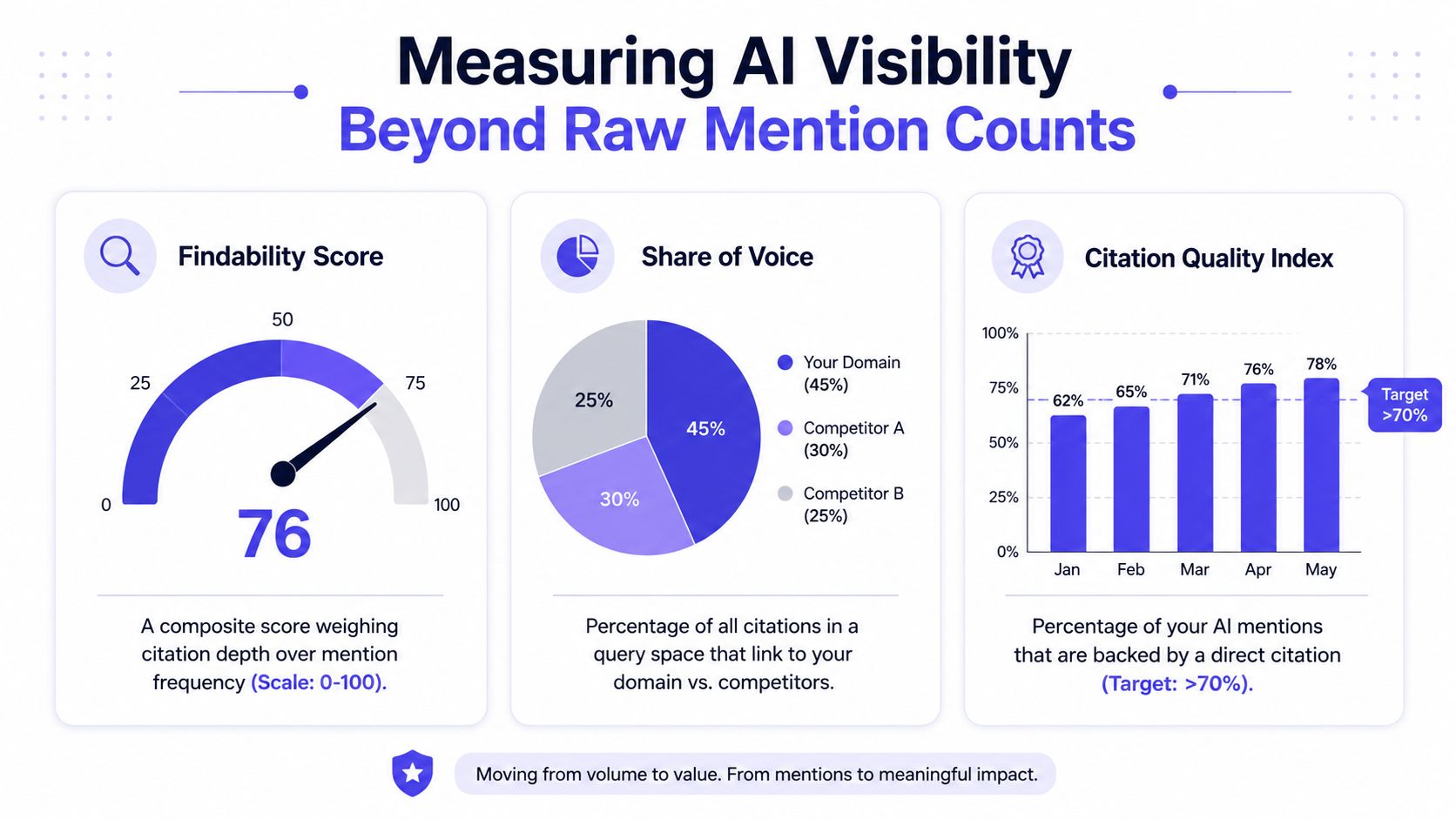
Topic score should reflect how easily buyers can locate your brand across relevant prompts and engines. BirdChime's score moved 10 percentage points over six months as fixes surfaced through GetIntel closed citation gaps, but that movement reflects overall gap-closing work. It doesn't isolate mention-to-citation conversion as the sole cause, so treat it as directional evidence of improved visibility rather than clean causal proof.
Share of Voice should show your portion of relevant answer visibility against competitors. Keep brand mentions and citations visible as separate layers, because a competitor may own source share while your brand owns name share.
Average Citation Rank shows where your sources appear among the cited references. A citation buried among many sources doesn't necessarily carry the same buyer attention as a prominent source attached to a key claim. Track position, source type, cited page, and whether the answer names your brand.
Probe the gaps directly
Run the same prompt families consistently and record changes over time. A useful probe sheet includes:
- Mention state: absent, present, or repeated in the answer.
- Citation state: no source, third-party source, or your domain cited.
- Recommendation state: recommended, listed neutrally, criticized, or omitted.
- Competitor state: which named competitors appear and which domains support them.
- Source gap: the trusted page or domain cited for competitors but missing from your coverage.
Live answer capture matters because interfaces can show source cards, footnotes, or rendered links that an API output doesn't reproduce. The buyer experiences the interface, not your internal extraction format. Preserve the answer and source evidence so marketers can audit a score instead of trusting an unexplained number.
Which Sources Does the Data Quietly Favour?
Being a good source isn't the same as being the cited source. Many brands publish detailed product pages, educational guides, and proprietary explanations, then wonder why answer engines cite a review, news article, forum, or reference page instead.
One 2026 research summary reported that 94% of AI citations in one analysis came from non-paid, non-brand-owned sources, and it described a University of Toronto experiment that found a systematic preference for earned media over brand-owned and social content (the summary of earned-media citation research). That finding changes the resource allocation question. The objective isn't to make your own domain more citeable. It's to increase your share of citations across the sources answer engines already trust.
Owned authority and distributed authority
Your own site remains essential for definitions, product facts, implementation guidance, documentation, and original research. It gives engines a clear, controlled source to retrieve and attribute. But owned content has a credibility ceiling in prompts where buyers expect independent judgment.
Third-party ecosystems can carry that missing context:
- Independent reviews can support comparative and evaluation prompts.
- Industry publications can establish category relevance and company legitimacy.
- Reference sites can clarify entities, products, and relationships.
- Communities can surface lived experience and practical objections.
- Analyst and partner pages can provide context that a product page naturally lacks.
The trade-off is control. You can restructure your own article, add citations, and clarify claims immediately. You can't force an independent publisher to describe your product accurately or update its page on your schedule. Third-party work therefore needs a focused target list based on the domains engines already cite for your category, not a broad campaign to collect arbitrary mentions.
The right question isn't “How do we get cited more?” It's “Which sources already earn citations for our buyer's question, and what credible evidence is missing from that source set?”
A brand-owned citation can be valuable, but citation share across trusted third-party domains may be more decisive for high-intent prompts. Measure both. If your domain is cited but competitors dominate independent sources, your authority is concentrated and vulnerable. If third parties mention you but never link or cite your evidence, your recognition is ahead of your source position.
Technical and Content Fixes That Convert Mentions Into Citations
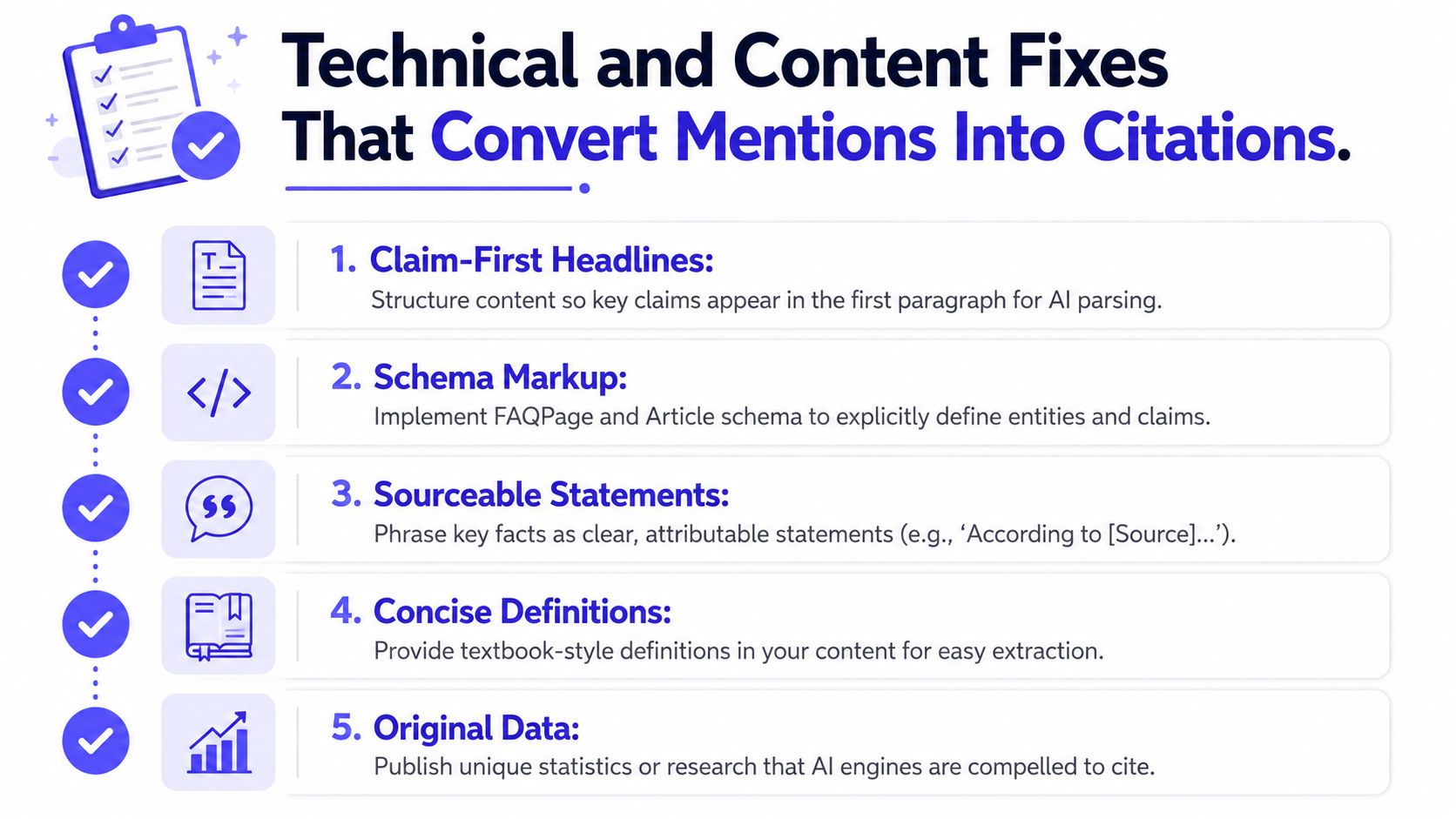
A raw mention count can look healthy while citation visibility remains weak. The practical target is to move a page through three states: retrieved by the engine, mentioned in the answer, and cited as supporting evidence. Retrieval requires access and relevance. Mentioning requires entity recognition. Citation requires an extractable claim with enough source clarity for attribution.
The page should make that final step easy. CXL's analysis found that 55% of AI Overview citations came from the top 30% of a page, while 21% came from the bottom 40%. It also reported that named-source citations increased citation odds by 2.1 times, schema markup raised citation likelihood by 2.3 times, and HowTo schema showed a 2.8 times lift (CXL's analysis of AI Overview citation sources). Put the answer, definition, or key claim near the top rather than burying it after a long introduction.
Prioritize the page-level fixes
-
Lead with the claim. Use a descriptive headline and an opening paragraph that answers one buyer question directly. Write each important section so it remains understandable when extracted without the surrounding article.
-
Add named attribution. Identify the source behind important claims, explain what it supports, and link to the original material. Attribution gives an engine a clearer basis for reusing a passage. Do not manufacture authority or attach a source to a claim it does not support.
-
Use structured data carefully. Schema.org markup can clarify whether a page is an article, organization, FAQ, or how-to resource. Markup must describe visible, accurate content. It should not introduce claims that the page itself cannot substantiate.
-
Create entity consistency. Keep company names, product names, authorship, descriptions, and organization relationships consistent across your site and reputable external references. Where appropriate, improve Wikidata entries and reference documentation so engines can resolve the entity cleanly.
-
Build sourceable third-party coverage. Use citation-source intelligence to identify pages that already support competitor answers. Then offer publishers, communities, or partners useful research, clarification, or evidence. A generic request for a brand mention rarely changes the retrieved source set.
Use this AI citation gap framework to map where a brand is retrieved, mentioned, or cited, and to separate page fixes from source-footprint problems.
What usually fails
Keyword stuffing does not turn a contextual mention into evidence. Adding the brand name to every heading can reduce readability without giving an engine a stronger reason to cite the page. A company article that repeats common knowledge also has little extraction value unless it contributes a distinct definition, methodology, data point, or attributable claim.
The practical test is simple: could an answer engine quote one paragraph and explain why that paragraph supports the answer? If not, improve the claim, evidence, structure, or attribution before publishing more volume. Measure the result through citation share, not mention volume alone.
Real Workflow for Closing Citation Gaps With GetIntel
A workable citation-gap process starts with the buyer's question, not with a content calendar. Run probes for prompts such as pricing, alternatives, implementation, and category recommendations. Capture which brands appear, which brands are recommended, and which domains the engine cites.
Next, compare your source footprint with competitors. Look for patterns rather than isolated misses. If competitors are cited from independent reviews, reference pages, or community discussions while your site is only mentioned, the gap may require third-party authority. If the engine cites your domain but extracts weak passages, the fix may be structural.
A repeatable operating sequence
-
Probe the live engines. Record answers from ChatGPT, Claude, Perplexity, Gemini, and Google AI Overviews. Separate retrieved evidence, visible mentions, citations, and recommendations.
-
Inspect the source set. Identify the domains and pages supporting competitor answers. Note whether each source is owned, earned, community-generated, or reference-based.
-
Turn the gap into a task. GetIntel ranks the fix, on-page, off-page, UGC, or technical, with why it matters and a checklist of what to do.
-
Ship through the existing stack. Connect Claude Code, Cursor, or another coding agent over MCP so it can read the task and do the work in your own repo. Keep approval with the team. Nothing should ship without a human review of accuracy and brand claims.
-
Rerun the same probes. Compare citation share, source position, recommendation status, and topic score against the baseline. Log the change and the area it was intended to improve.
BirdChime's topic score moved 10 percentage points over six months as fixes surfaced through GetIntel closed citation gaps. That's a useful directional example, not a causal experiment. The score reflects overall gap-closing work, so it doesn't prove that mentions alone became citations or that one technical change produced the movement.
The honest expectation is that citation work improves findability through several connected levers: clearer content, stronger entities, better source coverage, and more relevant third-party authority. Measure each state separately so the next decision follows evidence rather than a flattering mention count.
Mention versus citation is a structural distinction. There's a separate, tonal one worth measuring too: brand sentiment in AI answers covers what happens when an engine names a brand while still framing it unfavorably when asked directly.
GetIntel helps teams measure AI answers as buyers see them, separating brand mentions from source citations across major answer engines and benchmarking citation share against competitors. Visit GetIntel to run buyer-prompt probes, inspect citation-source gaps, and turn the findings into reviewable fixes your team can ship.