Google AI Overviews now average 4.2 citations per response, with a median of 4 and a range of 2 to 9. That means Google is not building these answers from a wide-open source pool, it's choosing a tight set of citations, and your content either makes that shortlist or disappears from the answer layer entirely, as shown in the 1,000-overview analysis from Digital Applied. For B2B SaaS teams, that changes visibility strategy fast, because citation presence in AI Overviews is becoming its own discovery system, separate from the blue links.
Table of Contents
- Introduction to Google AI Overviews and Citation Patterns
- Why citation share now matters
- What marketers should watch
- Understanding Key Concepts
- Citation is not the same as ranking
- What makes a page extractable
- Typical Citation Sources and Formatting Patterns
- Source type matters as much as domain strength
- Schema and answer format shape extractability
- Empirical Examples and Measurement Methods
- How to measure citation share
- A simple measurement model
- Signals That Drive Citation Selection
- Actionable Tactics to Increase Citation Share
- Build pages for extraction first
- Strengthen credibility and distribution
- Prioritize the most effective page types
- Setting Up Monitoring Workflows
- Build a repeatable prompt loop
- Turn captures into decisions
- Conclusion and Next Steps
Introduction to Google AI Overviews and Citation Patterns
Reviewed 19 September 2026. Google AI Overviews add a citation layer that does not follow classic organic ranking logic. That matters because brands can still appear in search results without shaping the answer users see first, and competitor pages can influence the Overview even if they do not hold the strongest organic positions. For marketers, that creates a second visibility layer that deserves its own measurement.
Why citation share now matters
Citation share matters now because it is no longer a proxy for rank. A page can perform well in standard SEO and still be excluded from the sources Google cites inside an Overview, which means traditional ranking reports miss part of the visibility picture. For SaaS and B2B teams, the key question is not only where a page ranks, but whether Google treats it as a source worth pulling into the answer set.
That difference changes how analysts should evaluate content. Google's citation list appears to reward pages that are structured for extraction, supported by reference material, and easy to attribute. In practice, that can favor UGC, reference sites, and other pages that answer a query directly, even when they are not the strongest organic performers. An IndieTool listing for Aioverview shows how these citation patterns are being tracked across tools and workflows, which is useful for teams trying to measure their share of this layer.
What marketers should watch
Marketers should watch citations as a separate research surface. The clearest way to analyse AI Overview visibility is to treat them as a separate research object. Organic ranking tells you where a page sits in the standard results, while citation analysis shows which sources shape the synthesized response. Those are related, but they are not the same signal, and conflating them leads to weak reporting.
That distinction also changes the operational workflow. Teams need to identify which query types trigger citation-heavy Overviews, map the sources Google prefers in those responses, and compare their own coverage against competitors across those same prompts. Once that process is in place, citation share becomes measurable rather than anecdotal, and the analysis can show where a brand is present, where it is absent, and which content formats are being selected most often by Google's answer system.
Understanding Key Concepts
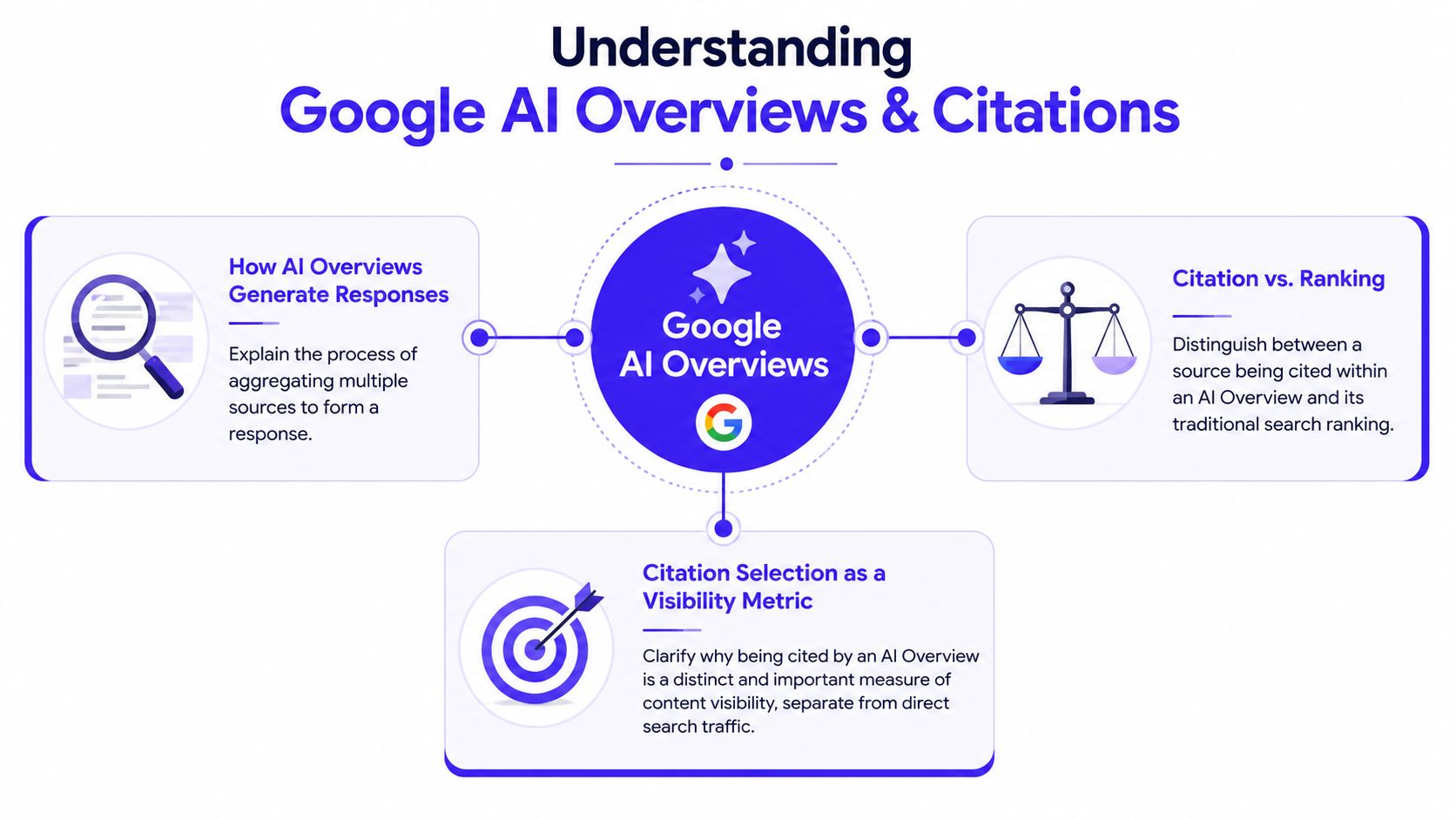
Google AI Overviews generate synthesized answers by pulling from multiple sources, then exposing a small set of citations inside the response. The important distinction is that a page can influence the answer without ranking in the traditional top positions, and a page can rank well without being cited at all. That decoupling is measurable. Ahrefs analysed 863,000 keywords and 4 million AI Overview URLs and reported it two ways. Counting every result type, 38% of cited pages ranked in the top 10, 31.2% sat in positions 11 to 100 and 31.0% fell beyond position 100. Filtered to organic listings only, the top-10 figure is 37% and 36% fall outside the top 100. Those are two cuts of one study, not two findings. The number that matters is the trend: in Ahrefs' earlier run the top-10 share was 76%, so the link between ranking and being cited has weakened sharply rather than disappeared.
Citation is not the same as ranking
Ranking measures where a page appears in the organic results. Citation measures whether Google selected that page as a source inside the Overview itself. Those are related signals, but they're no longer interchangeable.
A useful analogy is the difference between a book jacket and the footnotes inside the book. The jacket can get attention, but the footnotes show which materials support the argument. Google's citations function more like footnotes, because they reveal the pages the system trusted enough to reference in the answer layer.
Practical rule: if you're only tracking organic rank, you're measuring the wrong layer for AI Overview visibility.
What makes a page extractable
Google appears to prefer content that it can parse cleanly and attribute confidently. That means clear headings, direct answers, named sources inside the body, and page structures that help the model identify the answer quickly. Those signals don't guarantee citation, but they make the page easier to select when the Overview needs a source.
Schema markup belongs in this conversation too, because it helps structure the page for machines as well as humans. FAQ, HowTo, Organization, Article, and BreadcrumbList patterns can all make a page more legible to a system deciding which passage to pull into a synthesized answer.
Typical Citation Sources and Formatting Patterns
The most revealing pattern in Google AI Overviews is not just which pages get cited, but which source types keep appearing even when they do not lead traditional organic search. Based on the citation-source research in the brief, community and UGC sources like Reddit and reference platforms like Wikipedia and G2 show up disproportionately often in Overview citations relative to their share of classic organic results. That matters because Google seems willing to trust sources that answer a query in a compact format the system can extract quickly.
Source type matters as much as domain strength
Citation-source research shows that Google AI Overviews average 4.2 citations per overview, with a median of 4 and only 8% of overviews citing more than 7 domains, according to Digital Applied. The citation layer is selective, and it does not need a long list of sources to feel complete.
| Source Type | Share of Citations |
|---|---|
| Community and UGC sources | Disproportionately represented |
| Reference sites | Disproportionately represented |
| Brand-owned pages | Present, but less favored than expected in many queries |
| Other editorial sources | Present when they are structured and source-rich |
Because the citation set is small, formatting becomes a key factor. Pages that put the answer early, use clear subheads, and cite named sources in the body are easier for Google to extract. One study of 100 pages found that 55% of citations came from the first 30% of content and only 21% from the bottom 40%, a pattern that points directly to answer placement, not just length, according to CXL.
Schema and answer format shape extractability
Schema markup belongs in this discussion, but it works best when the visible content already reads like an answer. FAQ schema fits pages that are naturally question-led. HowTo schema fits pages that break a task into steps. Organization schema helps with entity clarity. None of these is a shortcut on its own, but each one reduces ambiguity for the system deciding what to cite.
Google appears to reward pages that are easy to quote, easy to verify, and easy to place into a multi-source answer.
That is why answer formatting and source formatting need to be built together. A page that opens with a direct answer, then supports it with named-source citations, has a far better chance of being extractable than a page that buries the answer deep in a long narrative.
The practical takeaway for marketers is straightforward. AI Overview citations are not just a stronger version of organic ranking, they are a separate visibility layer with different source preferences. Teams that want to increase their citation share need pages that read cleanly, cite evidence inside the body, and make the answer easy for Google to lift into the overview.
Empirical Examples and Measurement Methods
The cleanest way to study google ai overviews citation patterns is to treat them as a live dataset and measure the interface directly. A fixed query set, a repeatable capture method, and a clear way to log cited sources will show how citation behavior changes across prompt types and source categories.
How to measure citation share
Start with a stable list of buyer-intent prompts. Run the same prompts on a consistent schedule, capture the Overview whenever it appears, and record every cited source, including source type, domain, and whether your brand appears in the answer layer.
That workflow lets you measure three things at once. You can see how often an Overview is triggered, how often your brand is cited, and how often competitors take the citation slot on the same query set. It also makes it easier to compare citation behavior across content formats, because reference sites, community threads, and brand pages do not tend to compete in the same way.
If you are evaluating tooling, compare systems on how well they capture the live interface rather than cleaned-up exports. The goal is to mirror what a buyer sees, not a stripped-down keyword report. That is why live prompt setups matter more than generic rank trackers for citation analysis, especially if you want to understand whether your visibility is coming from your own pages or from UGC and reference sources.
It clarifies the tradeoff between speed, fidelity, and the kind of source capture required for AI Overview measurement.
A simple measurement model
Use three layers of measurement:
- Prompt coverage, which shows whether your target queries trigger an Overview.
- Citation presence, which shows whether your brand appears in the source list.
- Citation share, which shows how often your brand appears relative to competitors across the same prompt set.
Operational note: if your team cannot reproduce the same prompt set every day, your trendline will be too noisy to trust.
That matters most in competitive analysis. A brand can hold strong organic positions and still lose citation share to Reddit, Wikipedia, or other reference sources inside the Overview. The reporting goal is not to replace SEO analysis, it is to add a second visibility layer that shows where Google is drawing answers from.
Signals That Drive Citation Selection
Google's citation selection appears to follow authority, structure, and answer usefulness more than raw ranking position. That split is reported in Search Engine Journal. That pattern points to a wider source pool and a citation layer where platform-based and reference-style pages can outrank conventional SEO winners.
Authority still matters, but it does not decide the outcome on its own.
Analysts at Digital Applied found a +0.61 correlation between domain authority and citation rate in their 1,000-overview study. Established sites therefore start with an advantage, yet that advantage weakens when the page is hard to extract from or does not present a clear, source-backed answer. A strong domain can still miss the citation slot if a competitor page is easier for Google to quote.
Page length helps only when it supports answerability. The same study found that pages over 2,500 words were cited 1.6× more often than pages under 800 words, but the useful signal was not length in isolation. Longer pages tended to win when they combined depth, visible answer placement, and supporting evidence the model could parse quickly.
Structure and sourcing push a page closer to selection. Pages with at least one named-source citation in the body were cited 2.1× more often than pages without named sources, according to the same analysis from Digital Applied. That is consistent with Google favoring pages that make verification easier, especially on topics where users can compare several reference points.
So citation share needs tracking in its own right, separately from rank. Teams that want more AI Overview citations should measure where their pages fit against UGC, reference sites, and branded competitors. A practical workflow starts with prompt coverage, then tracks citation presence, then compares brand share across the same query set. If you are trying to boost local business visibility inside this layer, use the same process to see whether Google is drawing from your own pages, local reference assets, or third-party discussion sources.
For teams building a broader program, AI search engine optimization guidance from GetIntel is useful because it frames optimization around extractability, not just blue-link rankings.
Pages get cited when they are easy to quote, easy to verify, and easy to map to the query. That usually means concise answers near the top, explicit source references, and markup that matches what the page actually does.
What this looks like on our own domain
We track getintel.ai against the same fixed question set every day. Between 12 July and 8 August 2026, across 872 Google AI Overviews answers to buyer-intent questions in our category, our brand name appeared in 3 of them (0.34%). Over the same window ChatGPT named us in 27 of 878 and Perplexity in 15 of 940.
That is a small brand losing, and it is useful precisely because it is unflattering. It says the bottleneck is not our page structure, which is already built the way this article recommends. It is that the third-party sources Google AI Overviews reaches for do not discuss us. The full per-engine dataset is published.
Actionable Tactics to Increase Citation Share
If citation share is the KPI, the plan has to start with extractability. The CXL and Digital Applied findings above give the shape of it: answer early, keep one idea per section, and cite named sources in the body.
Build pages for extraction first
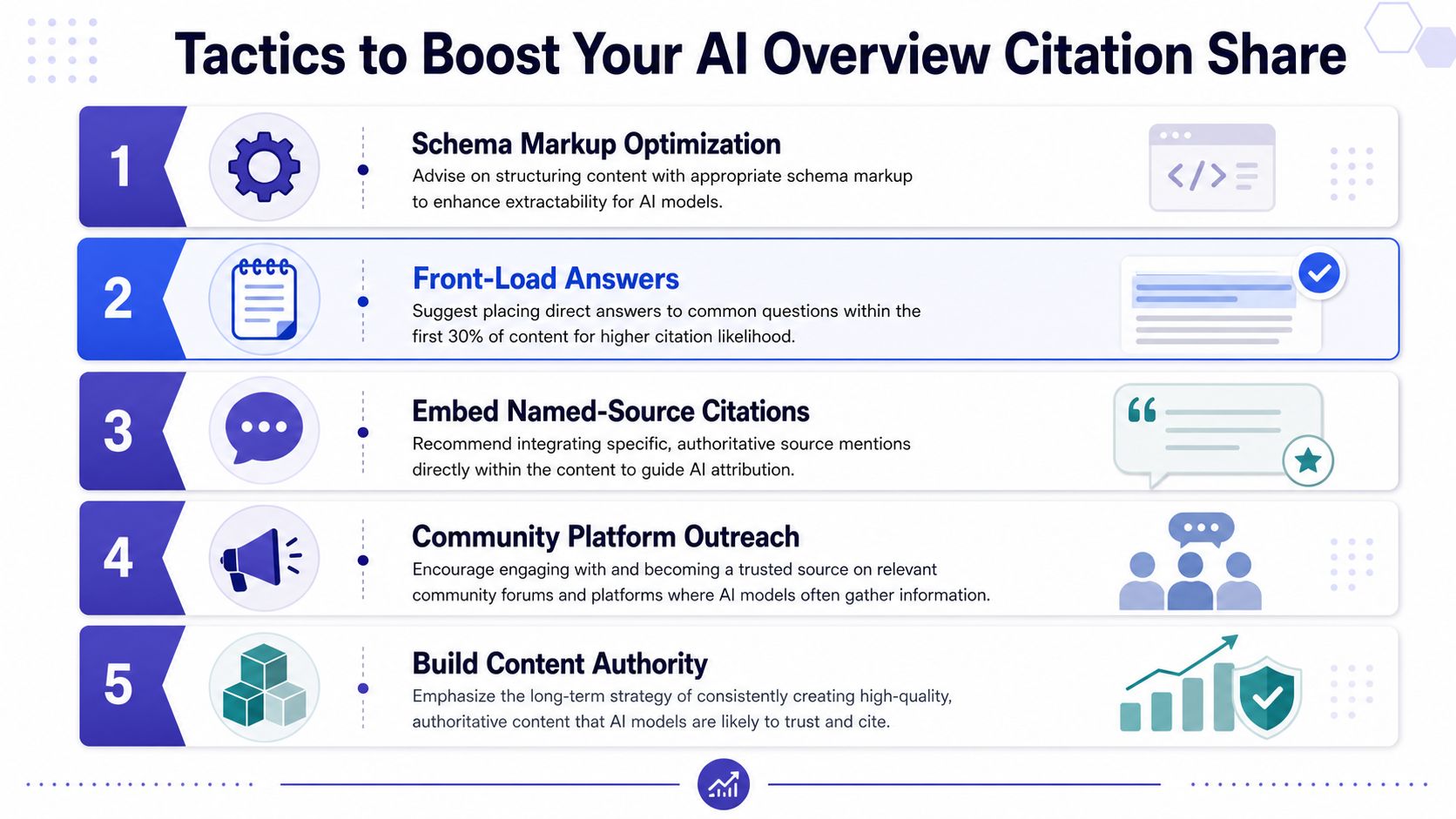
Start with schema markup, but do not treat it as a checkbox. FAQ schema fits pages where users are asking questions. HowTo schema fits procedural content. Article and BreadcrumbList help the model understand structure. The goal is to make the page unmistakable, not merely decorated with tags.
Front-load the answer in the first third of the page. Do not wait until the conclusion to say what the reader needs. If the core answer is buried, Google may still read the page, but it has less reason to cite it. That pressure is stronger on buyer-intent prompts, where the citation set is usually tighter and more selective.
Practical rule: every target page should answer the primary query in the opening block, then support that answer with source-backed detail below.
Strengthen credibility and distribution
Embed named-source citations in the body, not only at the end. Google appears to respond to visible credibility signals, and citations inside the content carry more weight than a bare bibliography. For many teams, that means updating editorial standards so every important page names its evidence explicitly.
Community platforms matter too. Reddit, in particular, shows up disproportionately in AI Overview citations relative to its share of organic results, and reference sites like Wikipedia and G2 appear repeatedly in answer layers. That does not mean every brand should chase those sources directly, but it does mean you should monitor them and build content that can compete with them on clarity and utility.
Local SEO has worked this way for years. For broader AI visibility, keep the same mindset, make the page easier to cite than the alternatives.
Prioritize the most effective page types
Not every page deserves the same treatment. The best candidates are pages that already answer repeated buyer questions, explain core product concepts, or summarize category comparisons. Those pages can be rewritten into compact, citation-friendly assets without losing their usefulness for humans.
The strongest sequence is usually:
- Structured answer block
- Visible named-source support
- Clear schema
- Focused intent match
- Ongoing citation monitoring
Setting Up Monitoring Workflows
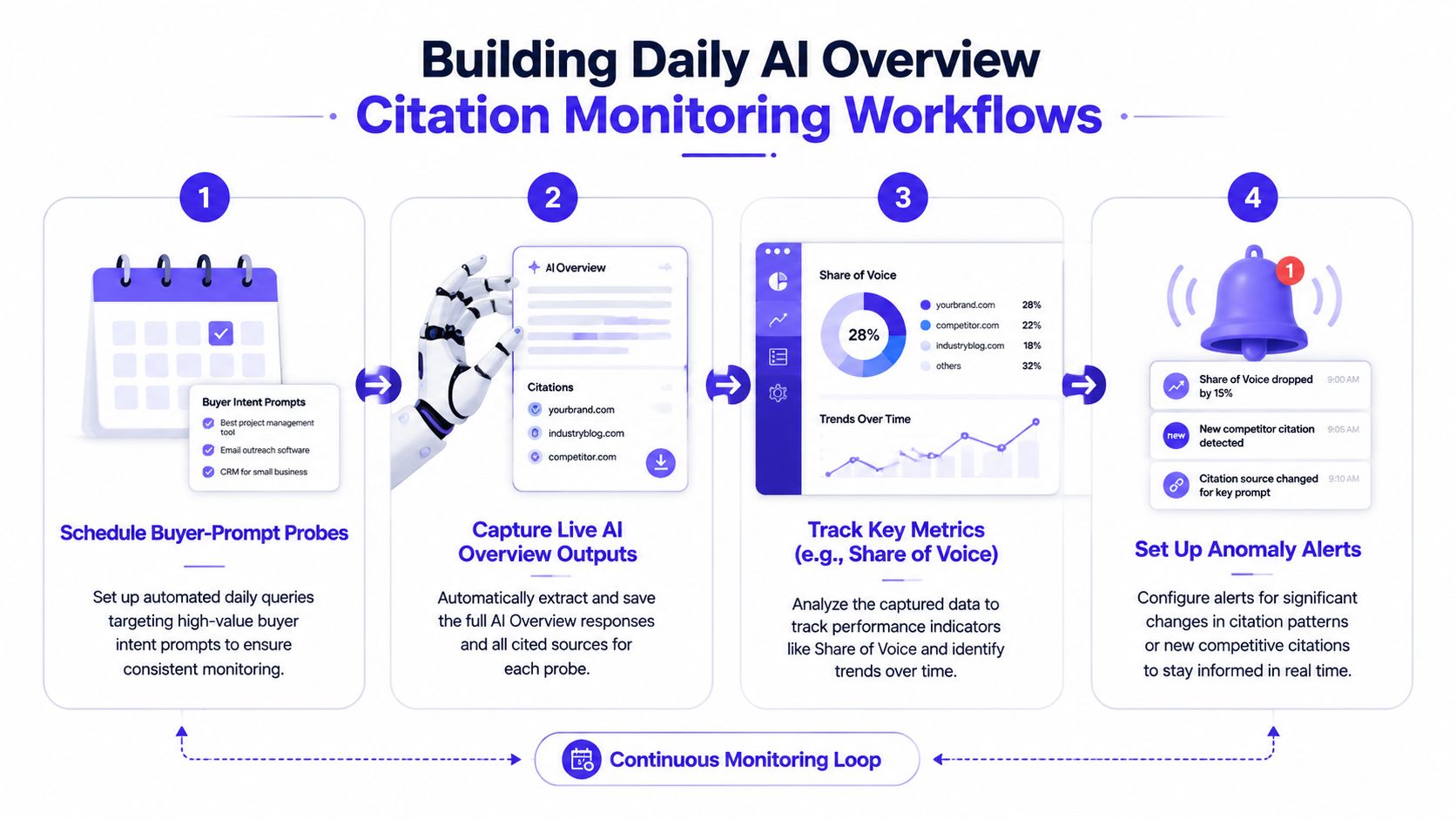
Citation work only gets better when teams inspect it daily. If you're trying to measure AI Overview visibility, weekly rank reports are too blunt. A better process is to prompt the exact buyer questions that matter, capture the live Overview, and record whether your brand is cited, omitted, or displaced by a competitor.
Build a repeatable prompt loop
Start with a prompt set organized by intent. Include pricing, alternatives, comparisons, and category-defining questions, since those are the queries most likely to expose citation behavior that matters commercially. Then run those prompts on a schedule and store the rendered response, the cited sources, and the surrounding metadata.
Tools like GetIntel can be used for this kind of live capture because they track what the engine shows buyers, not just what a keyword database predicts. That matters when you want to benchmark Share of Voice and citation position across engines rather than only looking at organic positions.
Turn captures into decisions
Once the data is captured, assign ownership. SEO can own the page changes, content can rewrite answer blocks, and analytics can watch for trend shifts. Alerts should trigger when a competitor enters a citation slot, when your brand drops out, or when a high-value query stops citing your page altogether.
A simple operating rhythm works well:
- Schedule buyer-prompt prompts for the highest-value queries.
- Capture live AI Overview outputs and preserve the cited URLs.
- Track key metrics like Share of Voice and citation position.
- Set anomaly alerts for citation losses or new competitor gains.
The AI Overview Checker is one way to operationalize that monitoring pattern if you need a dedicated workflow for brand-specific prompts. The important part isn't the tool name, it's the consistency of the process.
Conclusion and Next Steps
Google AI Overviews have turned citation into a distinct visibility layer, and the data shows it doesn't behave like classic organic SEO. Google now pulls from a broader candidate set, cites only a handful of sources per response, and appears to favor pages that are structured, source-backed, and easy to extract. Community and reference sources are punching above their organic weight, which means the old “rank higher and you'll get cited” assumption is no longer enough.
The next move is practical. Audit the pages that answer your highest-value buyer questions, tighten the opening blocks, add named sources inside the body, and align schema with the way the page is written. Then stand up monitoring so you can see when citation share rises, slips, or gets taken by competitors.
If your team wants a clearer view of how Google AI Overviews are treating your brand, start measuring the citation layer directly. Use the AI Overview tracker to see what Google cites, compare your share of voice against competitors, and turn those findings into concrete content changes.
Related measurement from our own runs: Google's three AI surfaces do not behave like one product, and why there is no stable top 10 of cited sources. If your own pricing page is one of the pages you're trying to get cited, see how to get your pricing page cited in AI Overviews.