You're in a budget meeting defending a category that still sounds theoretical. The CFO asks what the company is losing by not measuring AI answers, and someone points to the existing SEO dashboard. Then you open ChatGPT, type a real buyer question, and watch a competitor get recommended while your brand doesn't appear once.
That moment is the business case. The strongest argument for an AI visibility tool isn't that AI search is fashionable. It's that buyers are forming opinions in answer engines, competitors can occupy those answers, and your current reporting may not show the exposure gap.
Table of Contents
- The Moment You Realize Your Brand Is Missing From AI Answers
- Running Buyer-Prompt Probes Before You Buy Anything
- How Do You Frame This as Competitive Risk?
- Which Four KPIs Will Leadership Scrutinise?
- Building the ROI and Risk-Reduction Model
- The Pitch Deck, the Demo, and the Proof Artifacts
- Which Five Objections Kill an AI Tool Pitch?
The Moment You Realize Your Brand Is Missing From AI Answers
Reviewed 19 September 2026. The hardest part of the case for an AI visibility tool is proving the work did anything. Two things worth bringing to that conversation: most AI visibility numbers move on their own between runs, and what a tool stores matters more than how many engines it counts.
A senior marketer usually finds the problem by accident. They type “best [category] for [use case]” into ChatGPT, expecting a neutral overview, and see a named competitor appear repeatedly. The competitor's pricing page is cited, a case study supports the recommendation, and a Reddit discussion adds social proof. The marketer's own brand is absent from both the answer and the citations.
The same buyer prompt goes into Gemini and Perplexity. The wording changes slightly, but the pattern remains. A rival is present across the consideration set, while the company paying for content, SEO, and demand generation is missing from the conversation that happens before the click.
Other prompts expose the same risk:
- “[Competitor] vs alternatives”
- “Top vendors for [job-to-be-done]”
- “Which [category] tools are best for a growing B2B team?”
- “What should I look for when choosing a [category] platform?”
These aren't vanity queries. They're the conversational equivalent of comparison pages, review searches, and sales enablement questions. If the buyer accepts the answer, the sales team may enter the process after a competitor has already shaped the shortlist.
The leadership question: Which high-intent prompts recommend a named competitor while leaving our brand out?
Why this belongs in the acquisition budget
Google said in May 2024 that hundreds of millions of users already had access to AI Overviews and expected to reach over 1 billion people by the end of 2024. By October 28, 2024, Google said AI Overviews would have more than 1 billion global monthly users. Google's announcement on AI Overviews makes the leadership implication clear: AI-mediated discovery has reached channel scale.
The economics are also different from traditional search. SparkToro's clickstream research found that 68.01% of US Google searches ended without a click in January to April 2026, up from 60.45% in 2024, and when we checked 469 B2B software searches in October 2026, Google showed an AI Overview on 98.2% of the result pages (zero-click searches has the full breakdown and a fact-check of the older figures). That supports a practical conclusion: AI answers can influence pipeline before a buyer ever becomes visible in web analytics.
Don't pitch this as a replacement for SEO. Pitch it as measurement for a different layer of discovery. Traditional SEO can show whether your page ranks. It can't show whether ChatGPT, Gemini, Perplexity, or Google AI Overviews recommend your company, cite your documentation, or give a competitor the source slot instead.
The competitive risk compounds quietly
A missed citation today can become a persistent source gap if nobody records it, assigns an owner, and tests a corrective action. The risk isn't only that a buyer fails to click. The buyer may never learn that your product belongs in the category.
The board-level case is stronger when you acknowledge uncertainty. The Tow Center found that AI search tools failed to produce correct citations in more than 60% of tests, while another analysis found only 38% of AI citations came from top-10 organic pages, 44% came from pages ranked 11–100, and 18% came from pages outside the top 100. Those findings are summarized in Nieman Lab's coverage of the Tow Center study.
That source mix changes the investment question. You aren't asking leadership to fund another rank report. You're asking for a way to identify where the company is absent, where competitors are being surfaced, and whether targeted changes improve citation share over time.
Running Buyer-Prompt Probes Before You Buy Anything
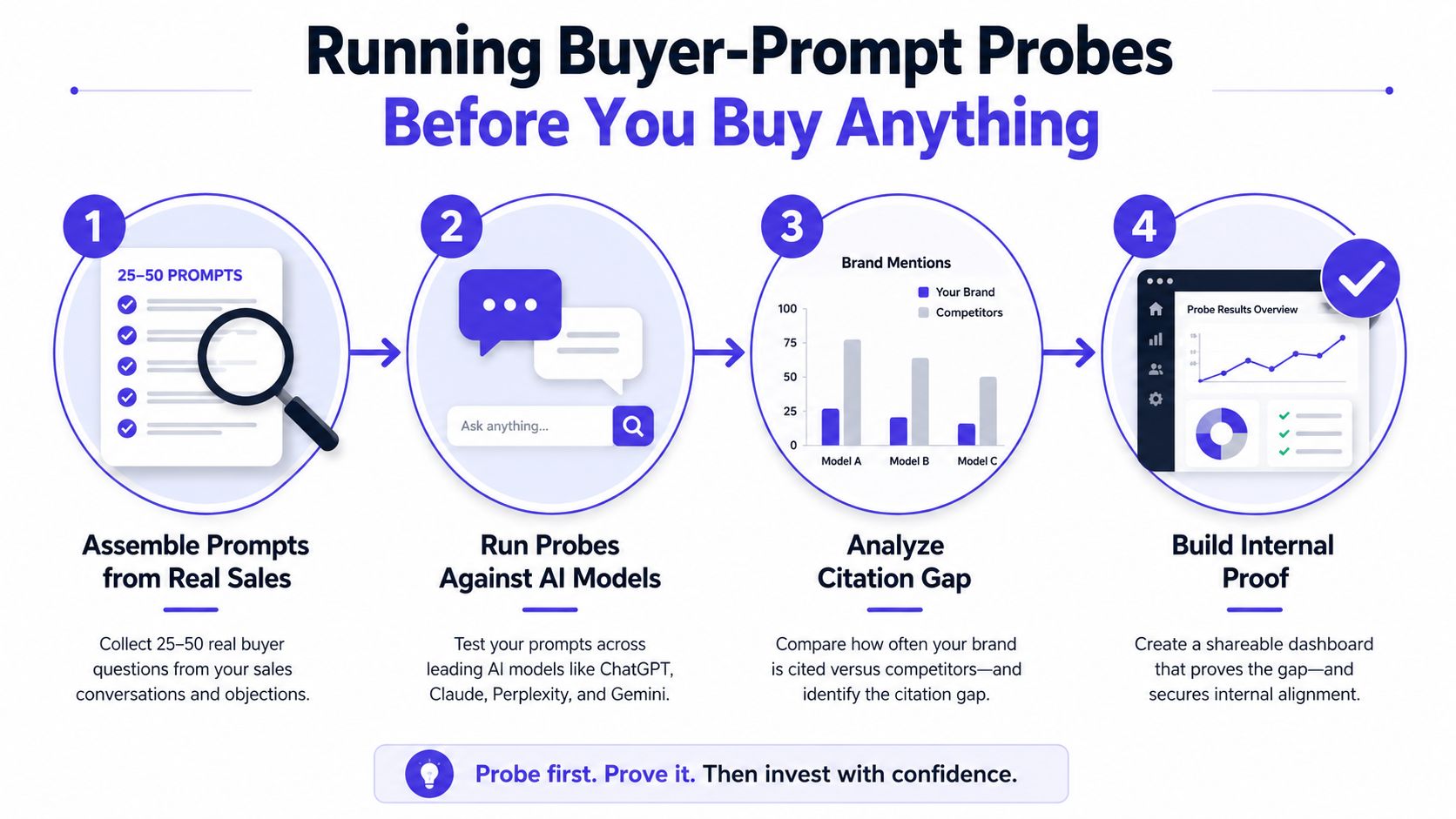
You don't need a vendor contract to produce the first piece of evidence. Run a controlled buyer-prompt probe using questions your customers and sales team already ask.
Build a prompt set from real demand
Start with 25 to 50 representative buyer prompts, a range widely recommended for measuring answer-engine visibility, though we cannot attribute it to a named methodology. Pull them from sales call notes, support tickets, product comparison pages, win-loss interviews, and competitor research. Include category prompts, alternative prompts, pricing questions, implementation questions, and job-to-be-done language.
Avoid prompts invented by the marketing team because they sound clever. A prompt belongs in the baseline when a buyer could realistically use it to evaluate vendors.
Capture answers across engines
Run every prompt through ChatGPT, Gemini, and Perplexity. Capture the complete answer, the cited URLs, the brands mentioned, the order of those mentions, and the date of the run.
Then rerun every prompt three times per platform. A single answer is a snapshot, not a reliable baseline. The methodology described by Norg.ai's answer-engine measurement guidance recommends repeated runs because citation behavior can vary and requires baseline and error tracking.
A buyer-prompt generator can help expand the initial library, but the final set still needs review against real customer language.
Code the gap, not just the mention
Code the gap rather than only the mention. For each answer, record:
- Brand mention: Does the answer name your company?
- Citation presence: Does a source link support the mention?
- Citation rank: Is your source first, later, or absent?
- Competitor presence: Which named rivals appear?
- Mention-citation gap: Are you named while another company receives the supporting link?
- Sentiment and accuracy: Does the answer represent your product correctly?
The resulting one-page gap report should show the exact prompts where a competitor wins and the prompts where no brand appears. Include a few verbatim answer captures, with timestamps, so the report survives a “show me the data” challenge.
Keep SEO measurement beside AI measurement
AI visibility tracking answers a different question from rank tracking, so run both rather than swapping one for the other.
| Dimension | Traditional SEO rank tracking | AI visibility tracking |
|---|---|---|
| Metric | Organic position, impressions, clicks | Mentions, citations, citation rank, share of voice |
| Signal type | Ranked search result | Synthesized recommendation or answer |
| Query format | Keywords and search terms | Buyer prompts and conversational questions |
| Primary platforms | Search engines and SERPs | ChatGPT, Gemini, Perplexity, Claude, and AI Overviews |
| Cadence | Scheduled rank checks | Repeated prompt runs and trend tracking |
| Cannot measure | Answer inclusion and citation competition | Traditional ranking position and organic click performance |
Neither system replaces the other. Rank tracking measures the web layer that still drives discovery and demand. AI visibility tracking measures whether answer engines intercept that discovery upstream, including moments that end without a website visit.
How Do You Frame This as Competitive Risk?
Leadership doesn't need another tool category. It needs a clear exposure statement.
Use three risk vectors:
- Citation gap: A competitor is cited, but your brand is absent.
- Mention-citation gap: Your brand is named, but the competitor receives the supporting link.
- Prompt-level displacement: A specific buyer prompt routes recommendations toward a rival.
Suppose the prompt is “best [category] tools for [use case]”. A competitor appears in the answer and earns the citation, while your company doesn't appear. If the team doesn't monitor that prompt, the rival can occupy the recommendation repeatedly before marketing notices. The immediate evidence is the prompt-level gap. The commercial risk is the qualified demand that may never enter your measurable funnel.
Don't invent a revenue figure to make the slide look precise. Use your own average deal size, the observed prompt volume, and the conversion assumptions finance already accepts. Multiply the prompts where a competitor wins by the estimated monthly buying opportunities, then show a low, midpoint, and high exposure case.
Which Four KPIs Will Leadership Scrutinise?
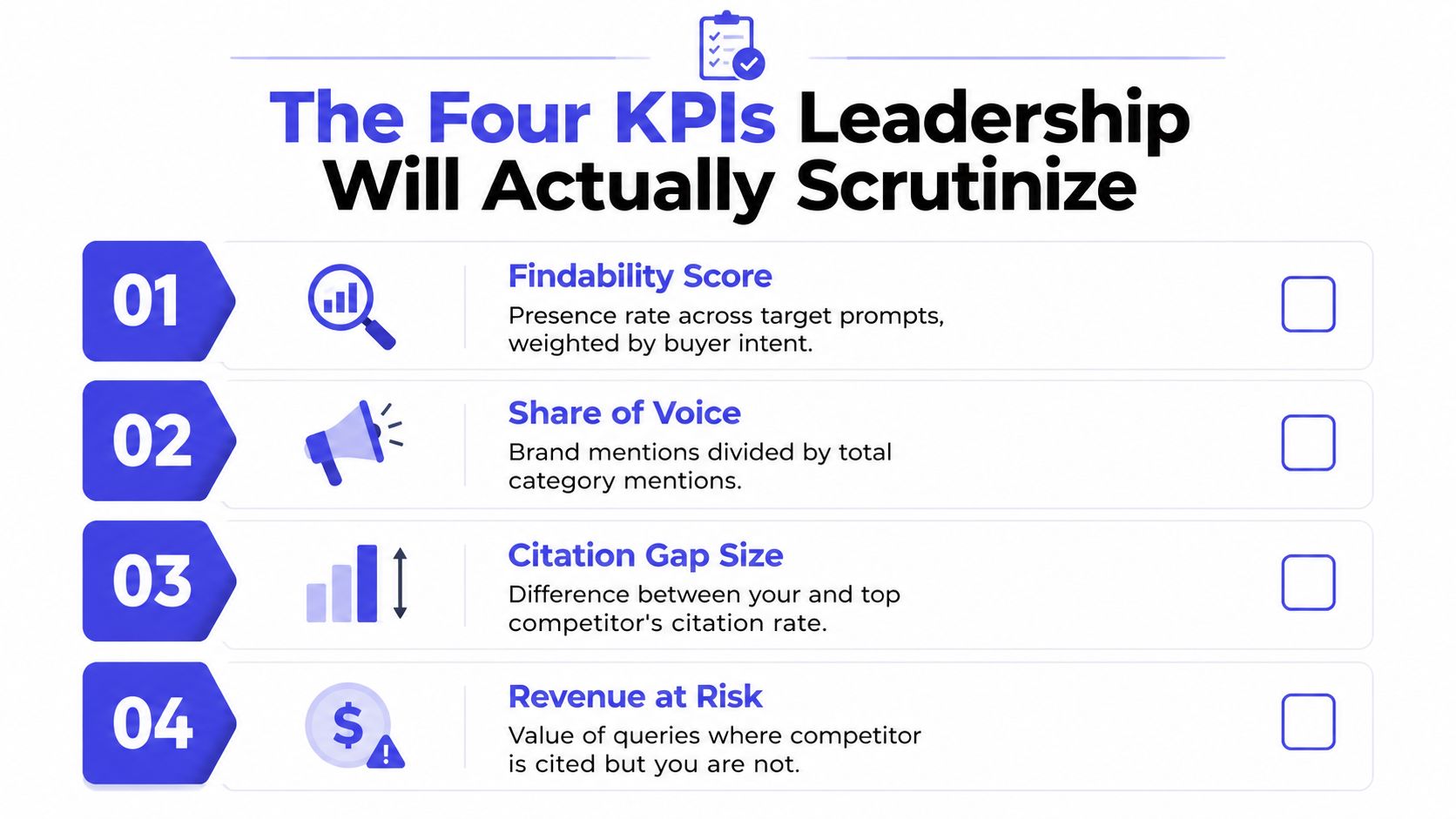
A CFO needs a scorecard that explains movement and exposes assumptions. Use four metrics, each tied to a specific decision.
- Answer Rate: Target-prompt runs where your brand appears, weighted by buyer intent. Report a weekly snapshot and a monthly trend.
- Share of Voice: Your brand mentions divided by total category-brand mentions across the answer set. Review the monthly competitive delta.
- Average Citation Rank: The mean position of your citations when your sources appear. A lower average position indicates stronger placement, but don't treat it as revenue by itself.
- Mention-citation gap: The rate at which your brand is mentioned without receiving the supporting citation, compared with competitors. Bring this to a quarterly leadership review.
The formulas should remain visible in the scorecard. Leadership should be able to trace every result to the prompt library, platform, run date, and captured answer.
Avoid promising a universal baseline range for a mid-market B2B brand. The available evidence doesn't establish a stable cross-platform starting range, and the 2026 survey usually cited for this is one we cannot trace to whoever ran it, so treat the variation it reports as directional. Your own repeated probe set is the baseline that matters.
Building the ROI and Risk-Reduction Model
Build two models, not one. The first estimates operational return from improved visibility. The second prices the exposure created when competitors win high-intent citations.
Public examples can make the first model concrete. Appointo reported a 15-percentage-point AI-visibility gain, from 13% to 28%, in 4 weeks, while RingOwl went from 0% to 3% in one month, a first citation rather than a multiple, since nothing multiplies from zero. These examples are useful benchmarks, not forecasts for your company. Your model should use your own baseline, tool cost, labor cost, average deal size, and accepted pipeline assumptions.
| Metric | Baseline | 30 Days | 60 Days | 90 Days Target |
|---|---|---|---|---|
| Answer Rate | Your measured baseline | First movement | Mid-cycle trend | Target tied to tested fixes |
| Share of Voice | Your measured category share | Early competitor delta | Updated prompt coverage | Target share |
| Average Citation Rank | Initial citation position | Source changes logged | Citation movement | Target position |
| Risk exposure | Competitor-winning prompts | Repriced prompt set | Reduced gap estimate | Approved residual risk |
For sensitivity planning, add a row showing the outcome if results reach only 50% of forecast. Keep the forecast tied to actions, such as restructuring a product page, improving metadata, adding structured data, or earning a citation from an authoritative third-party source. A 2025 empirical study of 1,702 citations across product-intent prompts found metadata, freshness, semantic HTML, and structured data were strong predictors of citation behavior, supporting targeted fixes rather than broad content production. The study is available on arXiv.
Use GetIntel's guide to proving AI visibility ROI as a practical reference for turning this assumption chain into a reviewable business case.
The Pitch Deck, the Demo, and the Proof Artifacts
Your deck should make the competitive gap visible before it explains the product. Use this 10-slide order:
- Title: A single-line thesis about measurable citation exposure.
- Invisible-in-AI moment: A screenshot showing a competitor named while your brand is absent.
- Scale shift: Google's AI Overviews user milestone and the zero-click context, with sources.
- Buyer-prompt results: The prompts, engines, reruns, and observed gaps.
- KPI definitions: Answer Rate, Share of Voice, Average Citation Rank, and mention-citation gap.
- ROI model: Tool cost, labor, assumptions, and scenarios.
- Risk-reduction view: Competitor-winning prompts and estimated exposure.
- Demo hand-off: The workflow from question to action.
- Objection appendix: SEO overlap, volatility, attribution, and budget timing.
- 90-day plan: Owners, milestones, review cadence, and decision gate.
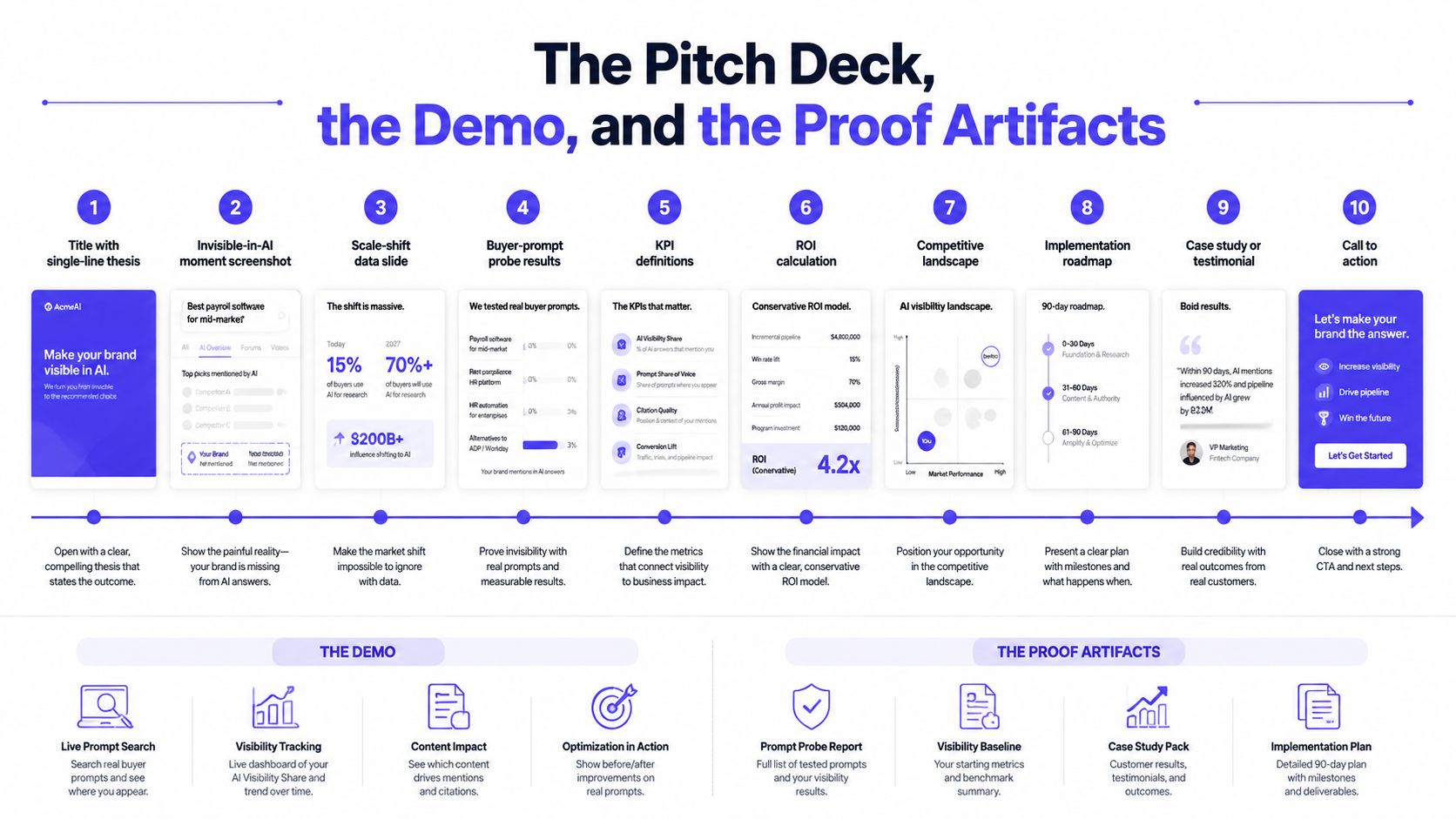
Open the live demo on your own brand. Run five buyer prompts word for word, then pause at the answer where a competitor appears and your company doesn't. Leadership remembers observed exposure more than a tour of navigation menus.
Bring three artifacts:
- Prompt log CSV: Include timestamps, platform, prompt text, answer capture, and citations.
- Gap report PDF: Rank competitor-winning prompts by buyer intent.
- Answer Rate trend chart: Show repeated measurements from a comparable client, without presenting the result as a guarantee.
Which Five Objections Kill an AI Tool Pitch?
“Isn't this just SEO rank tracking?”
No. Rank tracking reports where a URL appears in a search result. AI visibility tracking reports whether an answer engine recommends the brand, cites the brand's source, gives that citation a strong position, or mentions a competitor instead. Put the same prompt and keyword beside each other to show the measurement gap.
“Models change weekly, so any number is fake.”
A single run is fragile. A repeated baseline is more defensible. Rerun each prompt three times per platform, preserve the raw answers, and report movement with the run count and platform breakdown. Don't claim certainty. Show variance as part of the result.
“We already have an LLM analytics tool.”
Ask it to demonstrate three things: prompt-level share of voice, average citation rank, and competitor mention tracking. If it only reports referrals or chatbot sessions, it measures downstream activity rather than the answer-level exposure where the recommendation occurs.
“Attribution from AI answers is unprovable.”
Direct attribution can be difficult, but that doesn't make measurement useless. Use tagged URLs where the platform supports them, ask new leads how they discovered the company, and separate sourced evidence from influenced-pipeline assumptions. Keep citation movement as a leading indicator and revenue as a later-stage validation.
“Budget is frozen until Q3.”
Offer a narrow pilot for one product line with a 60-day exit clause. Lock the prompt library, define the scorecard, and agree on the decision criteria before the pilot begins. Deferral then becomes a smaller commitment than approving an open-ended program.
Approval isn't the finish line. In the first 30 days, assign owners, capture instrumentation, and lock the baseline prompt set. At 60 days, review lift, competitor movement, and surface changes. At 90 days, renew, revise, or stop based on the evidence.
Maintain a weekly one-page scorecard, a monthly competitive delta memo, and a quarterly board-ready readout. Assign one owner to the prompt library, another to outreach toward cited sources, and an executive sponsor to the review meeting. The operating rhythm matters because a tool without ownership becomes a dashboard nobody trusts.
The evidence also calls for restraint. A 2026 survey concluded that reviewed GEO techniques had not demonstrated a stable, longitudinal, cross-platform causal effect on organic discoverability or downstream behavior. That's precisely why leadership should fund ongoing measurement and controlled fixes, not a one-time optimization project. The critical GEO survey is available here. Research also reports a strong bias toward earned media and third-party authoritative sources in AI search, which makes citation-source intelligence part of the competitive response, not an optional content exercise. The related generative-engine optimization research is available on arXiv.
GetIntel measures brand visibility inside AI answer engines, including topic-level scores, Share of Voice, Average Citation Rank, buyer-prompt coverage, and competitor citation gaps. Visit GetIntel to see how its recurring scorecards and answer-level evidence can support a defensible leadership case.