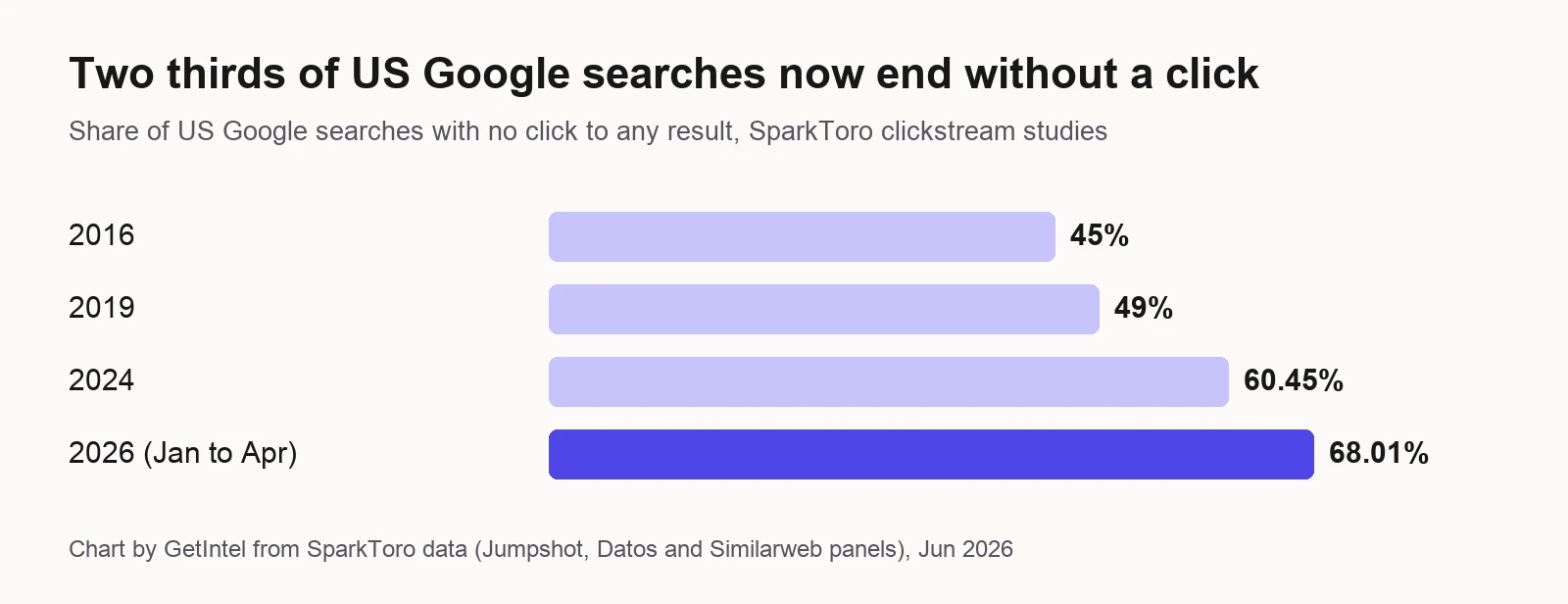
In the first four months of 2026, 68.01% of US Google searches ended without a click to any result, according to SparkToro's clickstream study of Similarweb's panel, up from 60.45% in 2024. That is the most recent primary figure, and most of the other zero-click numbers in circulation are older, narrower or rounded versions of it.
For software buyers the picture is starker. On 3 October 2026 we ran 469 B2B software searches through Google on desktop and mobile, 935 result pages across all 126 categories of our AI Software Index. Google put an AI Overview on 98.2% of them, above the first ordinary result on 94.8% of pages. An answer is waiting at the top of nearly every page a software buyer sees, before any website gets a chance.
Disclosure: GetIntel makes an AI visibility tracking tool, including for Google AI Overviews, so a world where Google answers on the page is good for our business. That is why the full result-page dataset is downloadable as JSON: every query, its category, intent, device and the features Google showed.
What is a zero-click search?
A zero-click search is a Google search that ends without the searcher clicking any result. The answer was on the page (an AI Overview, a featured snippet, a knowledge panel), or the searcher gave up, or they typed a new search instead.
That last part matters, because studies disagree on it. SparkToro counts a search that leads to another search as zero-click; in its 2024 study, about 37% of US and EU searches ended the session outright and about 22% led to a new query. Semrush's 2022 study counted "keyword change" as its own outcome, which is why its zero-click shares look so much lower. Same behaviour, different bucket, very different headline.
What percentage of Google searches are zero-click in 2026?
About two thirds, and probably more. SparkToro's June 2026 study, built on Similarweb's US desktop and mobile panel for January to April 2026, puts it at 68.01%, the highest figure SparkToro has recorded in a decade of measuring it. The panel leaves out the Google app, where Google shows even more answers on the page.
Two more details from the same study change how to read the number:
- AI Overviews are the likely driver. SparkToro reports AI Overviews on more than 20% of all searches, and says that when one is present, click-through falls by nearly 60%.
- AI Mode is not the cause yet. Only 0.34% of searches in the period went to AI Mode.
The share of searches that reach the open web is lower still. In SparkToro's 2024 study, for every 1,000 US Google searches, 360 clicks went to a site that was not Google's own property or a Google ad.
Is it true that 60% of searches are zero-click?
Roughly, for 2024, but no study published 60% as its finding. Most zero-click figures you will see quoted trace back to five studies, and several of them are routinely quoted out of scope.
| Figure as quoted | Where it actually comes from | Verdict |
|---|---|---|
| "68% of searches are zero-click" | SparkToro with Similarweb data, US, January to April 2026 (68.01%) | Right, and the latest |
| "58.5% of searches are zero-click" | SparkToro with Datos data, US, September 2022 to May 2024, published July 2024 (EU: 59.7%) | Outdated. SparkToro's 2026 study supersedes it and restates 2024 as 60.45% |
| "60% of searches are zero-click" | No study. A rounding of the 2024 figures above | Untraceable as a finding of its own |
| "65% of searches are zero-click" | SparkToro with SimilarWeb data, worldwide, calendar year 2020 (64.82%), published March 2021 | Misquoted. It is a worldwide figure, usually dated 2021 or 2022; the same study's US-only figure for late 2020 was 68.3% |
| "About half of searches are zero-click" | SparkToro with Jumpshot data, US browser searches, June 2019 (50.33%) | Outdated. Pre-AI Overviews, and the panel no longer exists |
| "25.6% desktop, 17.3% mobile" | Semrush zero-clicks study, May 2022 data, published October 2022 | Outdated, and counts new searches separately, so it is not comparable to the others |
| "93% of AI Mode searches are zero-click" | Usually credited to a Seer Interactive study, but that study measures AI Overview click-through, not AI Mode | Untraceable. We found no primary source for it |
Two related figures are accurate but often folded into zero-click claims as if they measured the same thing. Bain & Company's February 2025 survey of 1,117 US consumers found that about 80% of search users rely on AI summaries at least 40% of the time, and estimated that this cuts organic web traffic by 15% to 25%. Ahrefs' February 2026 update found that an AI Overview correlates with a 58% lower average click-through rate for the top-ranking page. Both describe what AI answers do to clicks; neither is a share of searches with no click. We have written before about how numbers like these drift as they are retold.
How often does Google answer software buyers' searches on the page?
Almost always. Across 935 result pages for 469 software searches, Google showed an AI Overview on 98.2%, and on 94.8% it sat above every ordinary result. A "People also ask" box appeared on 98.1%.
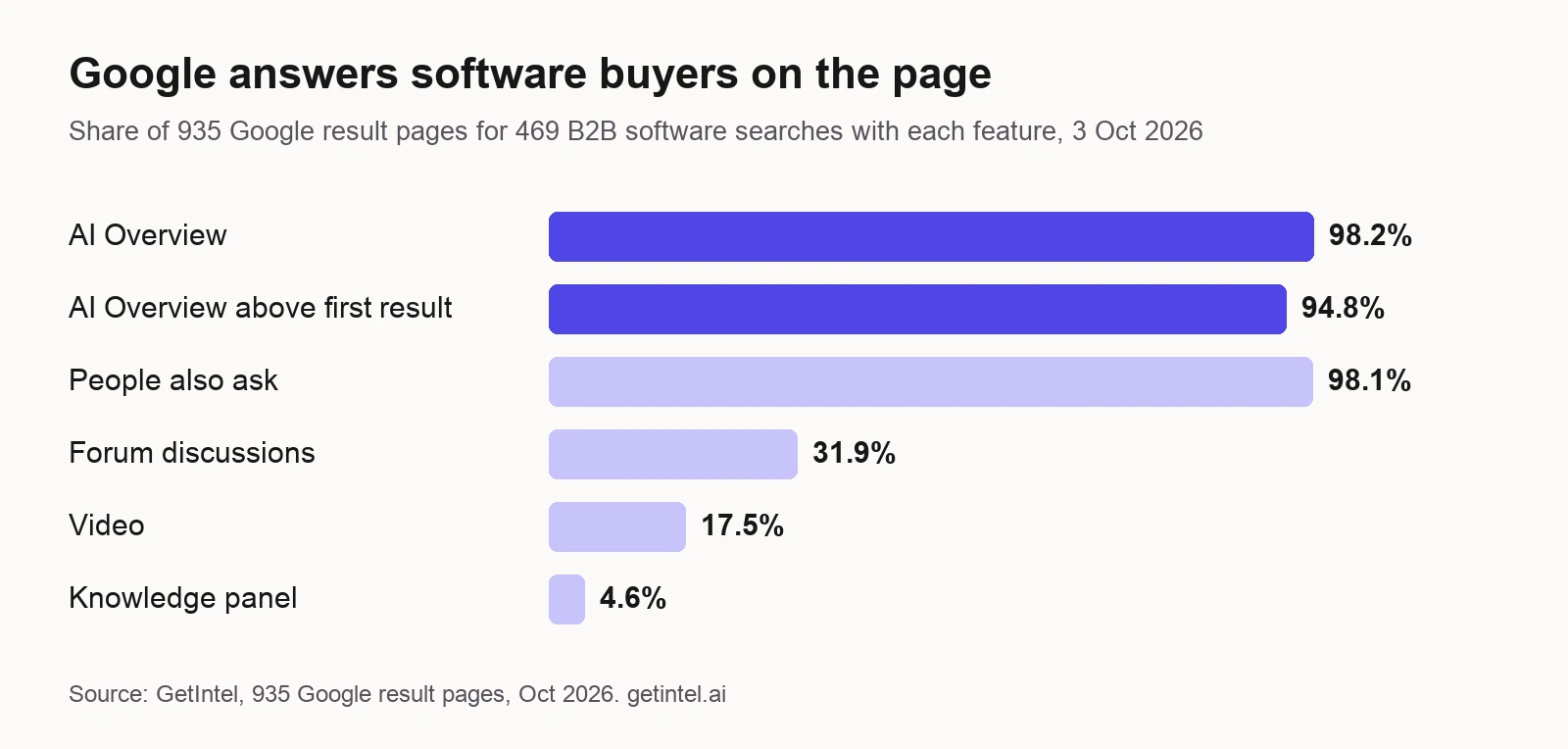
That is far above the 20%-plus SparkToro reports across all searches, and it fits with where AI Overviews show up: "best X software", "X for nonprofits", "free X" and "what is X" are exactly the comparison and explanation searches Google now answers itself. The rate held across every kind of search we checked:
| Search intent | Result pages | With an AI Overview |
|---|---|---|
| Informational ("free note taking software") | 180 | 99.4% |
| Commercial ("restaurant pos software") | 572 | 98.4% |
| Navigational ("zendesk ticketing software") | 107 | 96.3% |
| Transactional | 76 | 96.1% |
The exceptions were mostly searches for one named product, such as "greenhouse recruiting software" or "zoom video conferencing software", where Google sends people to the brand instead. Weighted by search volume, the AI Overview rate falls to 91.6%, because a few of those brand searches carry very large volumes. Device made almost no difference: 98.1% on desktop, 98.3% on mobile, and 96.8% of the 466 searches with both a desktop and a mobile page showed an AI Overview on both.
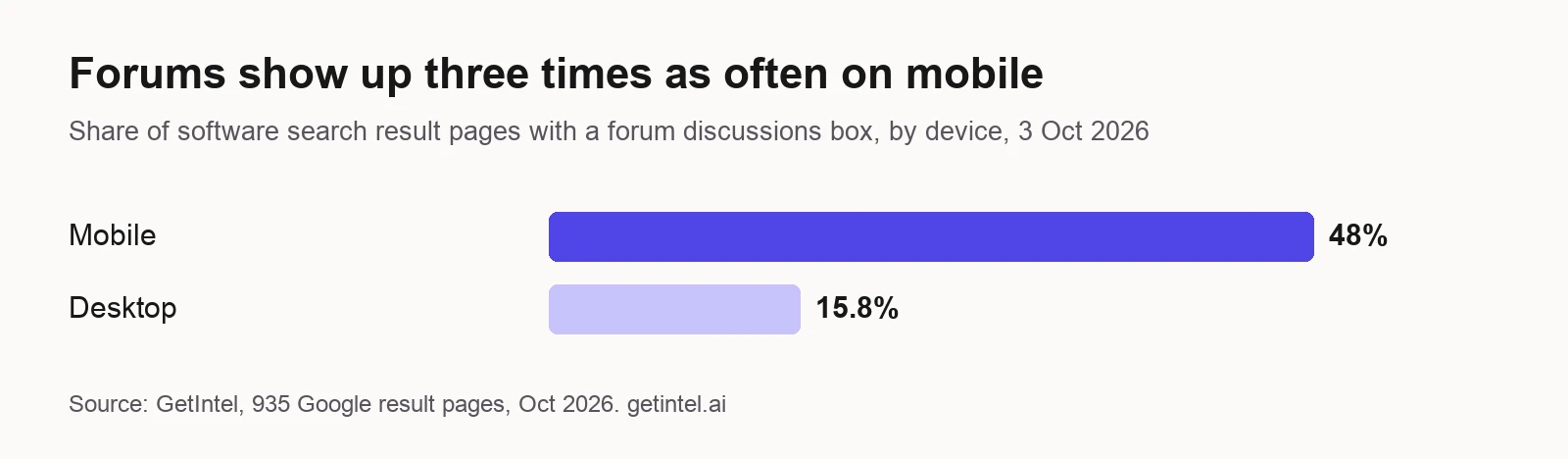
The device gap that did show up is forums. A "Discussions and forums" box, usually Reddit threads, appeared on 48% of mobile result pages against 15.8% on desktop. For a buyer researching on a phone, what other users say about a product is often on the page before the vendor's own site.
Does a zero-click search mean your brand lost?
No. It means the decision moved onto Google's page. The share of searches that end without a click says nothing about whose name was in the answer, and an AI Overview that names your product, in the 98% of software searches that carry one, reaches the buyer whether or not they click.
What the numbers do mean is that rank alone stops describing visibility. On the same day a page can hold position one, sit below an AI Overview that names three competitors, and lose clicks on the scale Ahrefs' 58% figure describes. The pages an AI Overview draws from are not always the pages that rank highest, as our analysis of Google AI Overview citation patterns shows, so being cited is a separate job from ranking. For software brands that means three things:
- Get named inside the answer. Track which brands the AI Overview names for your category's searches and which pages it cites; how to rank in AI Overviews covers what moves it.
- Answer the "People also ask" questions. They sit on 98% of these pages, and each expanded answer is another place to be quoted.
- Show up where mobile buyers read. With forum threads on nearly half of mobile software searches, the threads that AI engines already cite for your competitors are worth answering.
None of this shows up in a traffic report, which is the whole problem with zero-click: the result is visible only if you check the answers themselves. GetIntel tracks Google AI Overviews daily alongside ChatGPT, Perplexity and Gemini, and the free AI citation checker runs 20 buyer questions across three engines (60 checks) so you can see where you stand. For the wider picture, our AI search statistics collect the clicks, traffic and citation figures in one place.
How we measured this
Date: 3 October 2026. Searches: 469 real US English Google searches, four per category across the 126 software categories of the GetIntel AI Software Index. We drew them from DataForSEO keyword data with at least 30 US searches a month, taking the highest-volume informational, commercial, transactional and navigational search in each category where one existed. Result pages: each search fetched once on desktop and once on mobile through DataForSEO's live Google results, top 10 positions; 935 pages, with 3 failed fetches excluded. Check: we re-fetched 80 random pages with the AI Overview fully loaded; 75 of 80 carried a complete AI Overview, and 6 of 80 differed from the first fetch, so expect a few percent of run-to-run variation. Cost: under $5 in API fees.
Limits. We measured what Google put on the page, not whether anyone clicked; the share of searches that end without a click comes from SparkToro's clickstream studies above. The searches are software-buying searches, not a sample of all Google searches, and this is one day's snapshot. Sources for the fact-check: each figure was traced to the publisher that produced it, and checked on that publisher's own page on 3 October 2026. A widely shared "56% to 69%" figure, which circulates as a Similarweb finding about news searches, is left out because we could not open the original report to confirm it.