Google AI Mode cites 16.38 unique domains per answer. AI Overviews cites 10.17. Gemini cites 3.43. Same 100 buyer-intent questions, same day, three surfaces owned by the same company, a 4.8x spread. We put those questions, spread across 10 software categories, to all three on 5 August 2026, and they do not behave like one product.
The gap that matters more is which sources they pick. Of the 1,364 distinct domains cited across all three, 1,011 appeared on only one surface. Just 93 were cited by all three.
Disclosure: GetIntel sells AI visibility tracking, so we have an interest in how this gets measured. Every figure below comes from one run we did ourselves, and the per-answer counts, the full list of cited domains and the summary are all downloadable (counts, domains, JSON) so you can recompute any of it.
In this article
- How many sources does Google AI Mode cite?
- Do the three Google surfaces cite the same sources?
- Why is Gemini so different from the other two?
- Did these numbers move three days later?
- Treating Google as one AI surface
- How the three surfaces were compared
- Which surface to optimise for first
How many sources does Google AI Mode cite?
Google AI Mode cites 16.38 unique domains per answer, across 100 buyer questions in 10 software categories, more than any engine we have measured, and 4.8x what Gemini cites on the identical question. Its most source-heavy answer cited 36 distinct domains. If you want AI Overviews tracked daily rather than checked once, the AI Overviews tracker runs a live check with no signup. Across 100 questions it reached 1,026 different domains, roughly four times Gemini's 265.
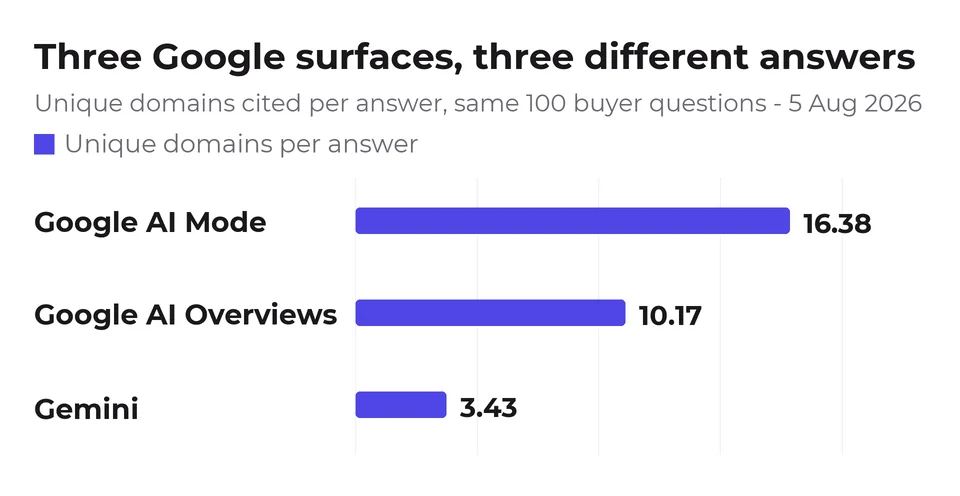
| Surface | Unique domains per answer | Raw citations per answer | Distinct domains across 100 questions | Answered |
|---|---|---|---|---|
| Google AI Mode | 16.38 | 19.80 | 1,026 | 100 |
| Google AI Overviews | 10.17 | 11.89 | 519 | 75 |
| Gemini | 3.43 | 8.65 | 265 | 100 |
One published figure exists for comparison. Omnia, working from 42 million citations, reported AI Mode at 13.8 domains per answer and about 3.4x ChatGPT. We measured 16.38, and 4.7x the 3.51 we saw for ChatGPT the same day. Those are not the same numbers: ours runs about 19% higher on the base figure and 38% higher on the multiplier, and we would not present either as settled. What the two runs agree on is the ordering and the rough magnitude, AI Mode reaches for several times more sources than any chat assistant, and the gap is wide enough that no plausible methodology difference closes it. Different prompt sets, different dates and different rules for collapsing subdomains each move a number like this, so the agreement worth claiming here is directional, not numerical.
Note the AI Overviews row: it answered 75 of 100 questions. The other 25 returned no AI Overview at all. That is not a failure to cite, it is a refusal to appear, and it is excluded from its average rather than counted as zero.
Do the three Google surfaces cite the same sources?
The three Google surfaces barely cite the same sources. The most similar pair, AI Mode and AI Overviews, share only 21.8% of their combined domains. Gemini and AI Mode share 13.4%.
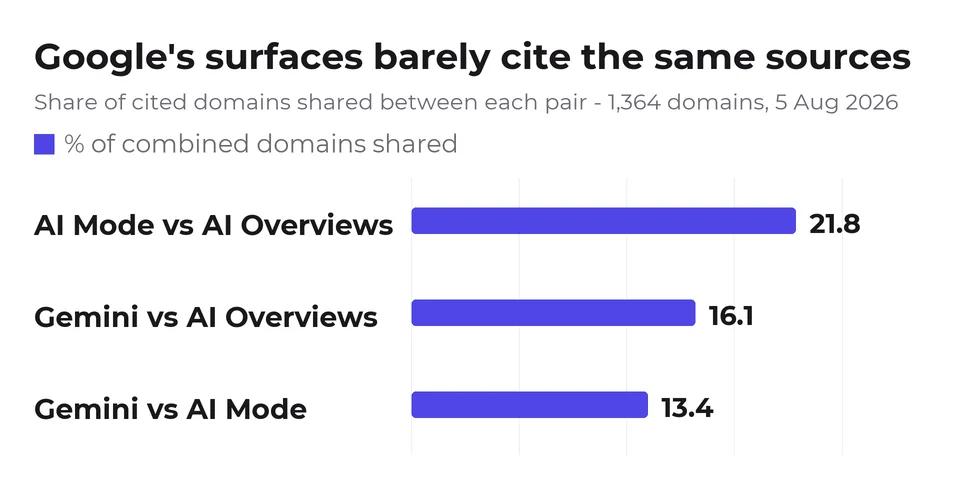
| Pair | Shared domains | Share of combined |
|---|---|---|
| AI Mode vs AI Overviews | 277 of 1,268 | 21.8% |
| Gemini vs AI Overviews | 109 of 675 | 16.1% |
| Gemini vs AI Mode | 153 of 1,138 | 13.4% |
Put the other way, across these 100 questions: 1,011 of the 1,364 domains we saw, 74%, appeared on exactly one Google surface. Only 93 domains were cited by all three.
This is the part the category prices but does not measure. Vendors routinely sell AI Overviews tracking and AI Mode tracking as separate line items, which is defensible, but not one published page we have read shows how far apart the two actually are. They are not two views of one index. On the evidence here they are closer to three different search engines that happen to share a parent company.
Why is Gemini so different from the other two?
Gemini differs because it re-cites the same few sources rather than reaching for more. Gemini returns 8.65 raw citations per answer but only 3.43 distinct domains, an inflation factor of 2.52x, by far the highest of the three. AI Mode's is 1.21x and AI Overviews' 1.17x.
So Gemini is not quiet. It cites at a similar rate to Perplexity; it just keeps pointing at the same handful of places within a single answer. If you count citation slots rather than unique domains, and many published figures do not say which they count, Gemini looks roughly three times more source-rich than it is. We wrote about that counting problem in detail after finding the same trap on Perplexity.
The practical consequence: Gemini is the hardest of the three to break into, because there are simply fewer slots. 265 distinct domains across 100 questions is a narrow door.
Did these numbers move three days later?
These numbers moved less three days later than the category assumes. We ran these same 100 questions on 2 August, across five engines, and again on 5 August, three days apart, and the aggregate citation behaviour barely moved:
| Surface | 2 Aug | 5 Aug | Change |
|---|---|---|---|
| Google AI Overviews | 10.00 | 10.17 | +1.7% |
| Gemini | 3.50 | 3.43 | −2.0% |
| Perplexity | 7.58 | 7.99 | +5.4% |
| ChatGPT | 3.64 | 3.51 | −3.6% |
Every surface moved under 6%. That sits awkwardly beside the most-quoted stability claim in this category, Profound's finding, from 27 million prompts, that 40–60% of cited domains change month-to-month.
Both can be true, and the distinction is the useful part. Which specific domains get cited may churn heavily; how many sources an engine reaches for does not. The first is a property of the ranking; the second looks like a property of the product. If you are tracking your own citations you should expect volatility. If you are deciding which surface is worth investing in, that decision appears to be stable enough to plan against.
Three days is a short window and we are not claiming it settles the month-long question. It does show the two claims are measuring different things.
Treating Google as one AI surface
Three assumptions break here: treating Google as one AI surface, assuming a bigger citation count means a better opportunity, and reading Gemini's raw citation number at face value.
Treating "Google" as one AI surface
AI Mode, AI Overviews and Gemini share 93 domains out of 1,364. Optimising for one tells you very little about the others. "We show up in Google's AI" is not a statement that survives contact with the data.
Assuming more citations means more opportunity
AI Mode cites 16 domains an answer, which sounds like sixteen chances. But breadth cuts both ways: a surface that cites 1,026 different domains across 100 questions is also a surface where any single citation carries less weight. Ten slots on a question where you are not recommended is not ten chances to win the customer, a point the wider citation data makes clearly.
Reading raw citation counts as source diversity
Gemini's 8.65 citations per answer collapse to 3.43 domains. Any comparison that does not say which it counted is unusable, and most do not say.
How the three surfaces were compared
Date: 5 August 2026. Sample: 100 buyer-intent questions across 10 software categories, 10 each: the same set used on 2 August, unchanged, so the two runs are comparable. Surfaces: Google AI Mode, Google AI Overviews and Gemini, captured from their real consumer surfaces via a data provider rather than through APIs.
Counting. For each answer we recorded both the raw citation count and the number of distinct registrable domains. Domains were collapsed so subdomains of one publisher count once. That choice works against this article's own thesis, since not collapsing them would inflate the distinct-domain counts and make the surfaces look even less alike than they already do.
Absent answers. AI Overviews returned nothing on 25 of 100 questions; those are excluded from its averages rather than counted as zero, because an absent answer has no citation behaviour to report. Gemini and AI Mode answered all 100.
Limitations. Ten software categories are not the whole web, and citation breadth is likely to differ in categories with a dominant reference source. This is one day's snapshot of systems that change. The 2 vs 5 August comparison is three days, which is long enough to show aggregate stability and far too short to speak to month-long churn.
The data. google-surfaces-2026-08-05.csv has one row per answer with both counts, the surface and the category. google-surfaces-domains-2026-08-05.csv goes a level deeper (one row per cited domain per answer), which is what the overlap figures actually rest on, so the 1,364 / 1,011 / 93 counts and all three percentages can be recomputed rather than taken on trust. A JSON summary carries the same aggregates plus the three-day comparison. Every figure we report from our own run recomputes from those files. The two third-party numbers on this page (Omnia's and Profound's) are theirs, attributed where they appear, and are not ours to reproduce.
Which surface to optimise for first
Stop treating Google as one target and pick the surface your buyers actually use.
The three behave differently enough to warrant different work. AI Mode is the widest door (16 domains an answer and 1,026 distinct domains across 100 questions), which makes it the most winnable of the three, and it is the one almost nobody is deliberately optimising for yet. AI Overviews is narrower and refuses to answer a quarter of buying questions outright, so the first thing worth knowing is whether your questions trigger one at all. Gemini is the hardest: fewer distinct domains than any surface we have measured, so citation there is closer to a fixed set than an open contest, and being named matters more than being linked, which is a different problem, covered in how to rank in Gemini.
Practically: take the ten or twenty questions your buyers actually ask, check them against each surface separately, and treat the results as three independent problems, because on this evidence, they are. If you would rather not assemble that by hand, that is what GetIntel does. It tracks the questions your buyers ask across ChatGPT, Perplexity, Gemini, Claude and Google AI Overviews, and shows which sources each engine pulled, with the date attached.