Update, 11 August 2026. This is no longer true, and the date it stopped being true is worth recording. Gemini named us for the first time on 10 August 2026 at 05:05, on the prompt "How do I fix an AI visibility gap and get a PR into my codebase without waiting weeks for an engineer". The zero in this article was correct when published: across 1,080 Gemini runs up to 8 August there were no mentions at all. The current count is 1 mention in 1,280 runs, which is 0.08%, so the headline finding stands in substance even though the word never no longer does. We have left the original text below unchanged rather than quietly editing the claim.
Over 28 days and 919 Gemini answers to buyer questions in our own category, Gemini named GetIntel exactly zero times. Not rarely. Zero. Over the same window it named Profound in 412 of those answers, Otterly.ai in 341 and Semrush in 328 (GetIntel tracker, 12 July to 8 August 2026).
Disclosure: GetIntel sells AI visibility tracking, and this is our own brand losing. Every row is published as CSV and JSON.
In this article
- How bad is it, exactly?
- Is Gemini just bad at naming brands?
- Why didn't our own dashboard flag this?
- What would a blended score have shown?
- How were the 3,609 answers counted?
- What are we doing about it?
How bad is it, exactly?
Across 3,609 answers on the same fixed set of buyer questions, here is how often each engine put our name in the text:
| engine | answers | named GetIntel | rate |
|---|---|---|---|
| ChatGPT | 878 | 27 | 3.1% |
| Perplexity | 940 | 15 | 1.6% |
| Google AI Overviews | 872 | 3 | 0.3% |
| Gemini | 919 | 0 | 0.0% |
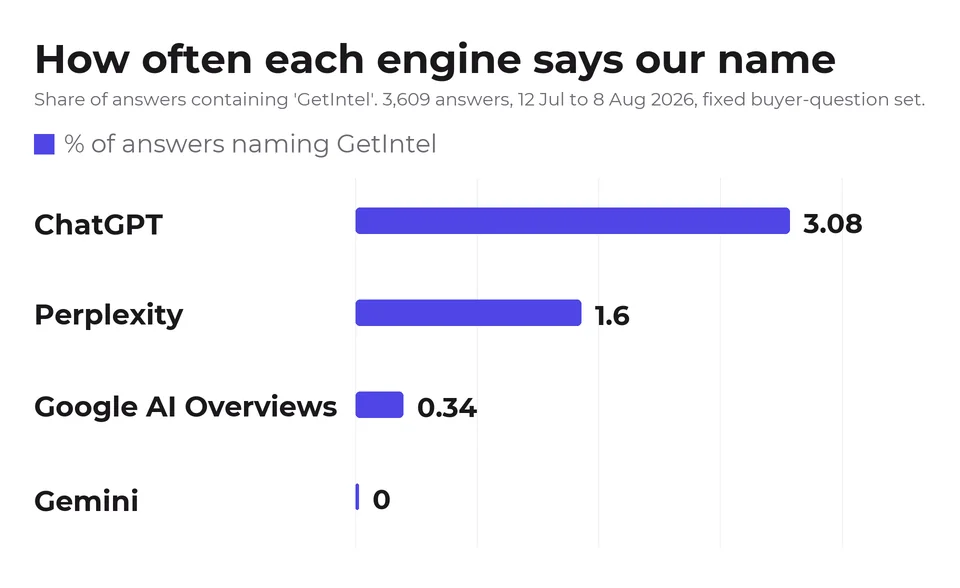
Three of the four engines know we exist, faintly. The fourth has never once said the word.
That distinction matters more than the small numbers suggest. Going from 0.3% to 3% is a question of degree, and the usual advice applies: publish more, earn citations, build entity signals. Going from zero to one is a different problem, because nothing about our current position is being rewarded at all on that surface.
Is Gemini just bad at naming brands?
Gemini is not simply bad at naming brands, and that is the part that removes the comfortable explanation.
Gemini is the most brand-generous engine of the four. Across the same 919 Gemini answers to buyer-intent questions in the AI-visibility category, 12 July to 8 August 2026, it named:
| brand | answers naming it | rate |
|---|---|---|
| Profound | 412 | 44.8% |
| Otterly.ai | 341 | 37.1% |
| Semrush | 328 | 35.7% |
| Peec AI | 242 | 26.3% |
| Ahrefs | 191 | 20.8% |
| LLMrefs | 151 | 16.4% |
| Frase | 57 | 6.2% |
| GetIntel | 0 | 0.0% |
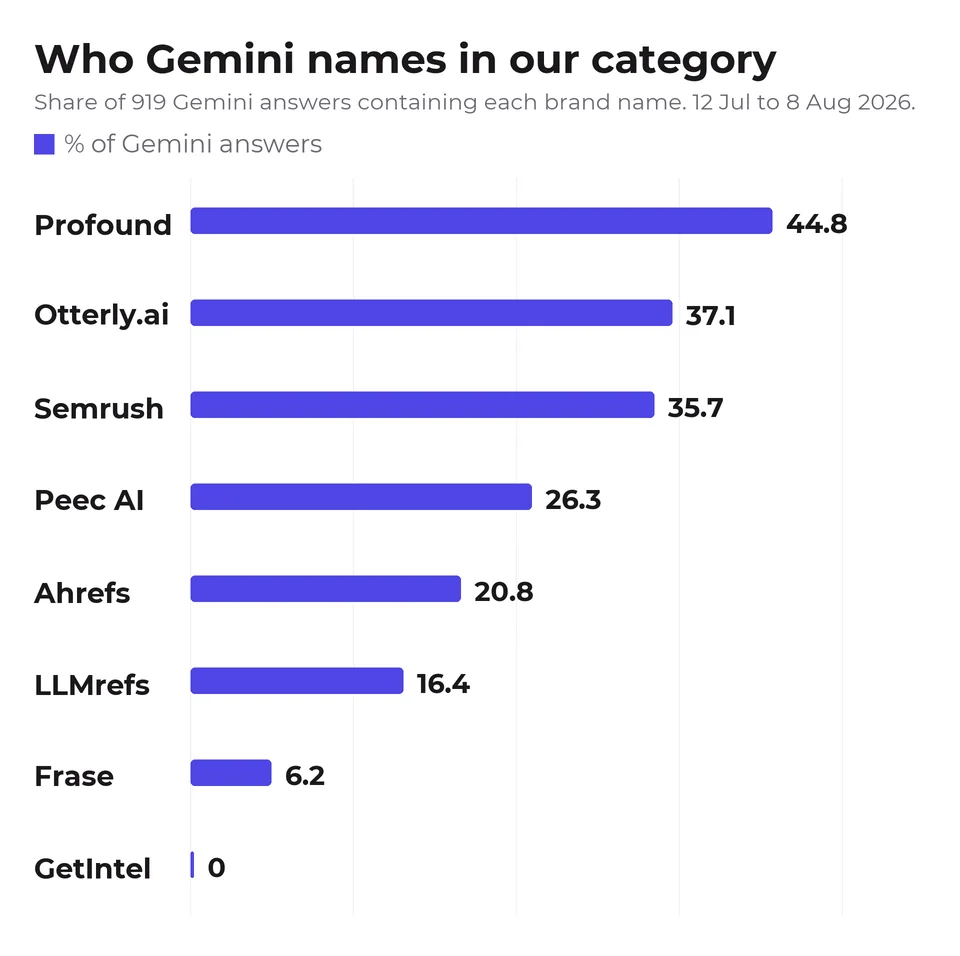
Gemini names at least one competitor in 663 of its 919 answers (72.1%). That is a union across the 13 rival brands we checked, not the sum of the rows above, because one answer usually names several. For contrast the same measure is 64.1% on Google AI Overviews, 46.6% on ChatGPT and 5.4% on Perplexity, which barely names brands at all. It is not withholding brand names, hedging, or refusing to recommend. It reaches for specific products constantly. We are simply not among them, and LLMrefs at 16.4% shows the bar is not "be one of the three biggest".
Why didn't our own dashboard flag this?
Across those 3,609 answers between 12 July and 8 August 2026, our tracker reported us as mentioned in 190 of them. The text of those same answers contains our name 45 times.
The gap is a definition. What our product records as a mention is a citation: the answer carried a link to our domain. We checked, and the two numbers line up exactly per engine: 83 Perplexity citations against 83 flagged mentions, 78 for ChatGPT, 29 for Google AI Overviews, 0 for Gemini.
| engine | cited our domain | said our name |
|---|---|---|
| ChatGPT | 78 | 27 |
| Perplexity | 83 | 15 |
| Google AI Overviews | 29 | 3 |
| Gemini | 0 | 0 |
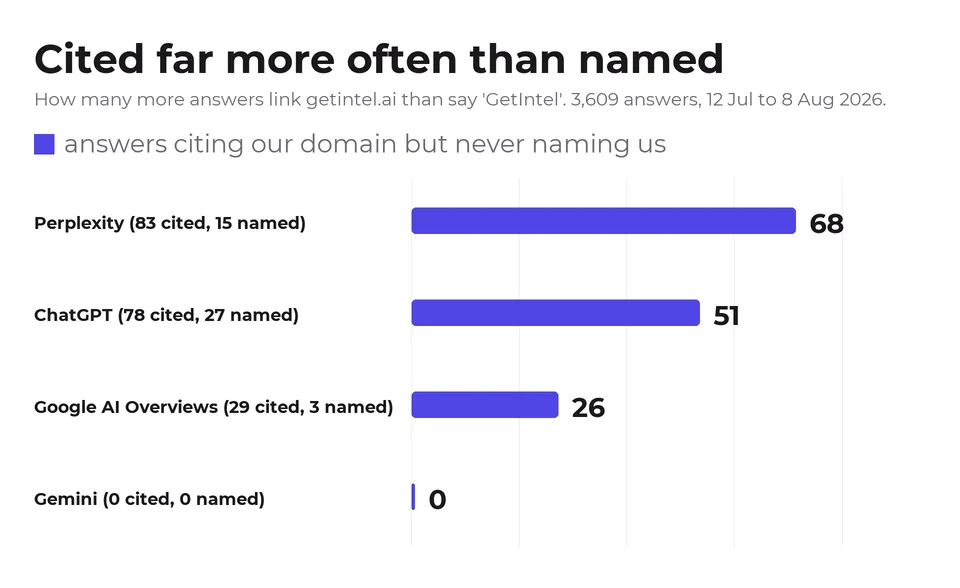
So on Perplexity we are linked five times more often than we are named. A buyer reading that answer sees a source link they may never click, not a recommendation they remember. Both are worth having. They are not the same thing, and our own metric was quietly reporting the easier one.
We wrote about naming and citing being different measurements a week ago, across engines generally. It is a good deal less comfortable applied to ourselves.
What would a blended score have shown?
GetIntel's headline visibility figure for 12 July to 8 August 2026, across all 3,609 answers, sits around 8%. Read on its own it says: small brand, present but weak, keep publishing.
The per-engine truth is three engines between 0.3% and 3.1% and one at absolute zero, where Profound, the category leader, appears in 44.8% of the same Gemini answers. That is not one problem of degree. It is three engines where we are gaining slowly and one where we do not exist, and the second needs a different fix (entity presence, third-party sources Gemini actually reads), not more of the same.
Averaging the four produces a number that describes none of them. We measured the same divergence between Google's own three AI surfaces earlier this month: AI Mode cited 16.4 domains an answer against Gemini's 3.4, on identical questions the same day. This is the third time our own data has argued against a single blended score, and it is the first time the argument cost us something.
How were the 3,609 answers counted?
We counted every answer our tracker collected for our own brand across four engines over four weeks.
What we did. Every answer our tracker collected for our own brand between 12 July and 8 August 2026: 3,609 answers across ChatGPT, Perplexity, Google AI Overviews and Gemini, on a fixed set of buyer-intent questions in the AI-visibility category. Erroring runs excluded.
What "named" means. The brand string appears in the answer text, case-insensitive. "Cited" means the answer carried a link to the brand's domain. The CSV carries both: answers_naming_brand for naming and cited_by_url for citations, plus answers_naming_any_competitor for the union rate, so every figure here recomputes from the file.
Limits. One brand, ours, in one category. Substring matching could over-count a brand whose name is a common word, though none here is. A fixed question set measures those questions and not the whole category. And this is a 28-day window on engines that change: the zero is real for this window, not a permanent property of Gemini.
What would change our mind. A single Gemini answer naming us. We will publish it when it happens, and the date it happened.
Engine choice changes what you observe more than almost any other variable, and the same holds for how often the answer moves: measured across 4,220 consecutive runs, Gemini returned a different set of cited sources 99.0% of the time against Perplexity's 76.4%.
What are we doing about it?
We are treating Gemini as an entity problem rather than a content problem, because 919 answers of evidence say publishing more of what we already publish has not moved it. That means third-party presence on the sources Gemini actually reads, not another post on our own domain. The mechanics of how Gemini narrows its citation pool in the first place, and why a page can rank and still never be cited, are covered in our piece on Gemini source selection. For the current cross-engine picture rather than Gemini alone, which AI engine is most likely to recommend a competitor over you puts Gemini's 91.7% competitor-favoring rate next to the other three engines, read 26 August 2026.
If you want to see this split for your own brand rather than a blended number, our AI visibility tracking reports each engine separately, Gemini brand tracking covers the engine this piece is about on its own, and you can start free.