Why does a page sit comfortably in Google's results, earn clicks, and still never appear when Gemini answers the buyer's question? That gap is where many organizations get stuck, because they keep treating Gemini AI visibility source selection like a ranking problem when it's really a citation problem. The page may be visible to search, yet still fail the later gates that decide whether Gemini can confidently pull it into an answer.
Table of Contents
- Why Your Page Can Rank and Still Disappear from Gemini
- What Grounding Means and Why It Changes Source Selection
- How Does Gemini's Source-Selection Pipeline Work?
- Does Entity Clarity and Structured Data Help in Gemini?
- Do Google AI Mode and AI Overviews Cite the Same Sources?
- Measuring and Influencing Citation Share in Practice
- A Scenario Walk-Through From Zero Citations to a Closing Gap
- Putting It All Together Into a Repeatable Visibility Loop
Why Your Page Can Rank and Still Disappear from Gemini
Reviewed 19 September 2026. A page can rank in Gemini's top 10 and still never be cited, because ranking and source selection are separate steps. A lot of teams discover this the hard way. They've got a page in the top 10 organic results, the content is clean, and the topic matches the query, yet Gemini still cites something else or skips them entirely. That feels inconsistent until you stop thinking like a search marketer and start thinking like a source-selection system.
The key difference is that Gemini isn't trying to reward every strong page. It's trying to assemble a small set of sources that can support a specific answer, and that set is much smaller than the candidate universe it starts with. In Google AI Overviews the pipeline narrows a large candidate pool down to a handful of cited sources through successive gates. Google has not published the mechanics, so treat any specific stage list as third-party inference rather than documented behaviour. That means a page can be “good” and still lose the citation slot because another page is cleaner, clearer, or easier to ground.
The failure usually happens after ranking
The failure usually happens after ranking, and that is the part many SEO playbooks miss. Ranking gets you into consideration, but source selection asks a different question, which is whether the page can be extracted, trusted, and aligned to the exact sub-question being answered. Gemini can favor concise, authority-rich sources even when they aren't the highest-ranking result, and the citation set does not simply mirror the organic ranking. We have seen precise-looking splits quoted for this - shares to the top 10, shares from beyond the top 50, brand-owned versus third-party - but every version we could trace led back to a secondary blog rather than a primary study, so we are not repeating the numbers.
Practical rule: If your page ranks but doesn't get cited, don't ask, “How do I rank higher?” Ask, “Which gate is rejecting me?”
That question changes the work. Instead of chasing more keywords, you inspect whether the page is entity-clear, passage-ready, recent enough for the query, and backed by corroboration that makes it easy for Gemini to justify the citation. The rest of this article is about those gates, because that's where source selection happens.
What Grounding Means and Why It Changes Source Selection
Grounding is Gemini deciding whether to retrieve live pages before answering, and it changes which sources can be cited at all. Gemini does not answer from a frozen memory bank. It first decides whether live retrieval would improve the answer, and then it reaches into Google Search to gather fresh material for the sub-questions hidden inside the user's prompt. That's query-time grounding, and it's the step that makes Gemini feel more like a research assistant than a chat-only model.
A researcher at a library decides whether a topic needs a current book before writing the answer, then looks up the exact shelf, not the whole building. Gemini does something similar. Grounding with Google Search is documented behaviour: the model can issue Search queries and use what comes back as support for its answer. How it splits a question up before doing that is not documented, so treat the decomposition step as a reasonable inference rather than something anyone outside Google has observed.

Retrieval shapes the citation pool before selection starts
Retrieval shapes the citation pool before selection begins, which is why source selection cannot be separated from it. If the answer is grounded, Gemini is not choosing from the whole web, it's choosing from whatever Google Search surfaced for the sub-question. That candidate set already reflects entity clarity, topical fit, and whether the page looks like a usable source rather than just a relevant result.
Once the candidates are in play the set narrows again. The pattern people report is a preference for sources that speak directly to the sub-question, appear authoritative, and are recent where timeliness matters. The same caveat applies as to the gates described later: this is read off what gets cited, not off anything Google has published. A page that addresses the topic broadly can still lose to a narrower page that answers one sub-question with less ambiguity. That's the subtle part, because the model is not rewarding “best overall page.” It's rewarding “best passage for this exact answer.”
Gemini's grounding step is a filter on top of a filter. If retrieval never brings you into the candidate pool, no amount of on-page polish can make you citeable.
That's also why teams get confused when they see strong organic performance but weak AI visibility. Organic search can reward breadth, links, and general relevance. Gemini's grounded answer path cares about whether the page can be pulled cleanly into the response, passage by passage, with enough confidence to cite it. The selection logic is narrower than ranking, and that's the reason the same page can win in search and vanish in the answer.
How Does Gemini's Source-Selection Pipeline Work?
How does Gemini decide which pages deserve a citation when it has far more candidates than it can show? The cleanest way to read Gemini AI visibility source selection is as a funnel with hard gates, not a single ranking stack. Google AI Overviews, which closely informs Gemini's source behaviour, appears to start from a broad candidate pool and shrink it to a handful of cited sources through several stages. Descriptions of those stages circulating in the SEO community, including specific similarity thresholds, are reverse-engineered guesses rather than anything Google has confirmed, and we have not been able to verify any of them. For a deeper look at the mechanics, see our guide on source selection.
Each gate removes a different kind of weak page
Everything in this section describes a model the SEO community has inferred from observed behaviour. Google has not documented these stages, we have not tested them, and you should read the whole thing as a working mental model rather than as how the system is built. It is useful because it predicts which pages lose and where, not because anyone has seen the machinery.
The semantic retrieval gate is described as the first cleanup pass. It looks for documents that are close to the query, not just keyword-adjacent. If your page uses the right terms but does not match the intent closely enough, it may never make it through this stage.
An authority filter is said to come next. A page can be semantically relevant and still lose if the system does not trust the source enough to cite it. The intuition is that E-E-A-T matters in practice, because the system is judging not only what the page says but who is saying it. That is an inference from observed citation patterns rather than a documented ranking input, and we have not measured it ourselves.
Passage-level re-ranking is where many pages fail
The passage stage is described as where selection gets stricter, and the same caveat applies here as to the gates above: this is inferred from what gets cited, not from anything Google has published. On that model a document does not win because the page is good in general. It wins because a specific passage inside it is useful enough to quote or summarise. If the answer system cannot extract a clean passage, or if the passage is too vague, too buried, or too poorly structured, the page can lose even after passing relevance and authority checks.
Data fusion is described as the final consolidation step, blending signals from the earlier stages to decide which sources survive into the visible answer set. That is why the cited set is so small, and why an otherwise strong article can disappear if it fails one gate.
A page can rank well, pass retrieval, and still fail extraction. That is the real mental model.
This also explains why source selection feels stricter than organic ranking. Ranking says your page belongs in the search ecosystem. Source selection says your page is shaped well enough to support a specific answer. The second test is narrower, more editorial, and much more unforgiving.
Does Entity Clarity and Structured Data Help in Gemini?
Gemini sits on top of Google's index and Knowledge Graph, which is the usual reason given for entity clarity mattering more here than on a chat-only engine. The argument runs that when a page, brand or product is easy to resolve as a distinct entity, the model can ground an answer against it with less ambiguity. That is an inference from how the pieces fit together, not a documented behaviour, and we have not tested it. That's why Schema.org markup, Wikidata-style consistency, and Knowledge Panel signals show up again and again in guidance around Gemini source selection.
What structured data can and cannot do here
A chat-only engine may infer your brand from repeated mentions, co-occurrence, or context. Gemini has a structured entity layer available to it that a chat-only engine does not, tied to Google's own infrastructure. Whether it leans on that layer when choosing citations is the part nobody outside Google can see. The intuition is that markup makes your content easier to classify and connect. We should be straight about our own evidence here, because it cuts against that: when we compared the 40 most-cited pages in our corpus, those carrying JSON-LD averaged 118.3 citations against 121.3 for pages without it, which is no measurable effect. Schema is worth doing for the things it demonstrably does. We cannot show it drives citations.
The practical levers are straightforward. Claim and verify the Knowledge Panel where possible. Build toward a Wikipedia entry if the brand qualifies. Add structured entity data on your own site. Keep the same entity signals consistent across the open web, including the formats that humans and machines can both recognize. Those moves make it easier for Gemini to decide that your source is about the entity the user asked about.
Where GetIntel-style drafts fit in
Entity work gets operational when a gap-closing draft includes ready-to-ship Schema.org markup and Wikidata edit suggestions aimed at improving entity clarity for systems like Gemini. That kind of draft matters because it turns an abstract recommendation into a concrete change set the team can ship. It also lines up with the way Gemini source selection appears to prefer entity-clear pages over pages that are merely well written.
The argument is that if the model can resolve your brand cleanly the citation path gets shorter, and if it can't the page has to work harder at every earlier gate. Treat that as a reasonable theory of the mechanism rather than a demonstrated result.
The takeaway, stated at the confidence the evidence supports: entity clarity is widely believed to matter more for Gemini than for chat-only engines, because of the index and Knowledge Graph underneath it. That is plausible and it is not something we have measured. What we have measured is narrower and points the other way on one specific lever - the schema markup people reach for first showed no citation effect in our corpus.
Do Google AI Mode and AI Overviews Cite the Same Sources?
A lot of people still talk about “Gemini visibility” as if it were one surface with one behavior. It isn't. Third-party analyses circulating in the SEO community report very low URL overlap between Google AI Mode and AI Overviews even though both run on Gemini. We have not verified those figures against a primary source, so treat the direction as the useful part and the specific percentages as unconfirmed. That means a page can win citations in one surface and still be absent in the other.
Why the same brand can show up differently
The important part is not just the overlap number. It's the implication that each surface behaves like a different citation environment with its own prompt patterns, source mix, and answer construction. If your team only audits one surface, you can mistake partial visibility for broad success.
That's why surface-specific prompt portfolios matter. You need separate probes for AI Mode and AI Overviews, separate source audits, and separate optimization notes. Otherwise, you'll keep fixing the wrong bottleneck and wondering why visibility doesn't move where you expected it to move.
Treat the surfaces as cousins, not twins. They share a model family, but they don't hand out the same citations.
This is also where generic “rank in Gemini” advice breaks down. The citation logic changes enough across surfaces that a single playbook won't hold. A brand may look strong in one answer environment because the sub-question matches its content style, then vanish in another because the source mix is different or the entity signals don't map as cleanly.
The practical shift is small but important. Don't benchmark Gemini as one bucket. Benchmark the specific surface the buyer sees. That's the only way to tell whether you're dealing with a retrieval issue, an authority issue, or a surface mismatch.
Measuring and Influencing Citation Share in Practice
The work gets easier once you treat it like a measurement loop instead of a vague visibility project. Start with buyer-prompt probes that mirror how real prospects ask questions, pricing questions, alternatives questions, and “best of” questions. Then capture the rendered answers, not a sanitized API version, because the user experience is the thing you're trying to influence.
Track the sources before you change the content
Tools like Get Cited by the AI from AY Rank can be useful, because the task isn't just content production, it's spotting who gets cited and why.
A useful workflow starts with citation-source intelligence. For each prompt, identify which domains Gemini cites, which competitors appear, and where your brand is missing. Do that per engine rather than as a blended figure, because our own citation rank moves sharply between engines, and keep the denominator visible: the same data yields anywhere from 0.94% to 40% share of voice depending on what you divide by. That gives you a concrete gap, not a feeling. From there, you can sort the missing pieces into the kind of fix they need, entity updates, schema changes, counter-content, outreach, or a new support page that answers the sub-question more directly.
The task isn't just content production, it's spotting who gets cited and why. The point is to compare the sources that win answer space with the sources your brand controls.
Ship fixes into the same workflow you measure in
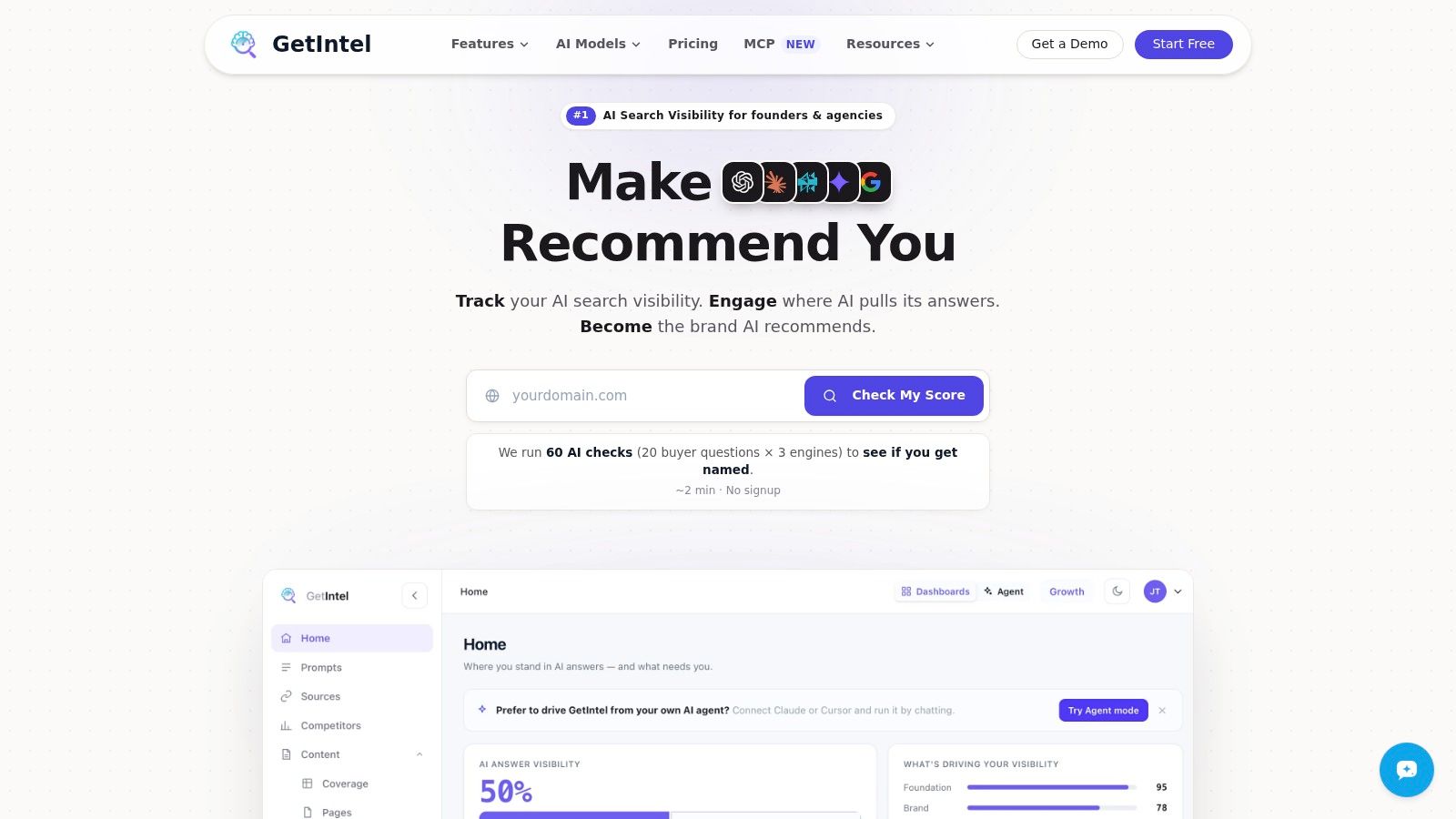
Once the gap is clear, the fix should be grounded and reviewable. In practice that means on-page fixes to your own pages, off-page work getting into the lists and comparison pages AI already reads, UGC on Reddit, YouTube, and LinkedIn, and technical fixes like clearing blocked AI crawlers. It can also mean llms.txt and Schema.org markup, though our own testing found no measurable citation effect for either, so we would not lead a plan with them. GetIntel is one platform that operationalizes this workflow with daily refreshes, topic-level scoring, Share of Voice, Average Citation Rank, buyer-prompt probes, and a ranked task list a coding agent can work through in your own codebase. The point isn't automation for its own sake. It's making the fix traceable to the miss.
If you want a deeper measurement model, Gemini brand tracking is built for that kind of recurring audit. The cadence matters because daily checks make the trendline comparable, which is how you tell whether a change moved findability or just shuffled one answer for one prompt.
Measure the prompt, the cited domain, and the next change in one loop. If you split those apart, you lose the story.
The final discipline is attribution. Log each change against the metric it's meant to move, topic score, Share of Voice, or Average Citation Rank, so the team can see which lever moved the result. That's how citation share stops being a mystery and starts behaving like an operational metric.
A Scenario Walk-Through From Zero Citations to a Closing Gap
The following is a constructed illustration, not a customer case study, and no part of it is measured. It is here to show the shape of the workflow.
A lean B2B SaaS team starts with a familiar problem. Their product pages rank well, their schema is in place, and buyers still don't see them in Gemini answers for the questions that matter most. They're visible in search, but they're not winning citations, and that mismatch is hurting discovery at the exact moment prospects compare options.
The team splits the audit by surface. AI Mode shows one set of citations, AI Overviews show another, and their own domain barely appears in either set. They map the cited sources, spot one missing Wikipedia-class source, notice several missing Reddit threads, and realize their entity signals are inconsistent enough to make the brand harder to resolve than it should be.
The fixes land in layers
First, they clean up entity data and ship updated Schema.org markup. Then they prepare Wikidata edits and a couple of grounded counter-articles that answer the buyer prompt more directly. They also use outreach to reinforce third-party corroboration where the brand is already being discussed.
The next refreshes show the effect in the metrics they care about, not in a vague sense of “better SEO,” but in changes to visibility, citation presence, and the prompts where the brand now shows up. The important lesson isn't that one fix solved it. It's that each problem matched a different gate in the source-selection pipeline, and each fix targeted one of those gates.
That loop is the work. Diagnose by surface, fix by signal, measure by pillar. When the team does that consistently, Gemini stops feeling random and starts feeling legible.
Putting It All Together Into a Repeatable Visibility Loop
Gemini AI visibility source selection starts with a grounded retrieval decision, then runs the result through a tight funnel that ends with only a small set of cited sources. The cross-surface trap matters too, because AI Mode and AI Overviews don't hand out the same citations, even when both run on Gemini. Once you accept those two facts, the workflow gets clearer.
The repeatable loop is simple enough to run every day. Probe each surface, audit the cited sources against your brand entity, ship schema and Wikidata fixes plus counter-content where needed, log the change against a pillar, and check the next daily refresh. Teams that do that stop arguing about rankings and start improving citation share with intent.
Agencies built around this problem, RankingOnAI among them, run their own version of the same loop. The core discipline stays the same regardless of who runs it. Treat citation gates as the unit of work, not the search result.
GetIntel measures how your brand shows up inside Gemini, Google AI Overviews, and other answer engines, then turns the gaps into practical fixes your team can ship. If you're trying to understand which sources Gemini selects, and how to improve your odds of being cited, visit GetIntel and review how its tracking and gap-closing workflow fits your team.