A B2B SaaS marketing lead inherits a spreadsheet with fourteen competitors, a flat share-of-voice chart, and eight weeks of movement that looks like no movement at all. Every rival receives equal weight, every prompt runs against the same roster, and the final report produces a familiar question from leadership: which competitor is taking buyers from us?
That question exposes the weakness in most AI visibility programs. Tracking AI visibility against many competitors isn't mainly a problem of collecting more responses. It's a problem of deciding which rivals matter for each buyer prompt, then measuring the competition on that prompt without allowing irrelevant brands to distort the result.
AI search has grown large enough to create an operational visibility problem. Monthly active usage of AI search and assistant tools has grown sharply over the past two years, by most public estimates, though the specific figures circulating (often published by vendors selling into this exact market) vary too widely to treat any single number as authoritative.
The practical answer is to make the buyer prompt the unit of work. Competitor shortlists should change with the query archetype, the buyer stage, and the product line. The sections below show how to build that system without confusing a larger dataset with a better benchmark.
Table of Contents
- The Real Problem With Tracking AI Visibility Across Many Competitors
- Three symptoms of a static roster
- How Does AI Visibility Measurement Actually Work?
- Layer one, probes
- Layer two, captures
- Layer three, metrics
- Why Beat a Static Roster With Per-Prompt Prioritisation?
- A practical shortlist rule
- Building the Prompt Set That Drives the Benchmark
- A usable prompt schema
- Capture Mechanics and the Data Pipeline Behind the Score
- Treat surfaces as separate datasets
- Store immutable records and normalized rows
- How Do You Read the Numbers Across Engines?
- Share of voice
- Average citation rank
- Citation source mix
- The engine gap matrix
- Reporting, Remediation, and Closing the Loop on Changes Shipped
- Move from gap to counter-asset
- Verification checklist
The Real Problem With Tracking AI Visibility Across Many Competitors
Reviewed 19 September 2026. Tracking AI visibility across many competitors fails on roster size, not on tooling. The fourteen-brand spreadsheet usually starts with good intentions. The team wants a complete view, so it adds direct rivals, adjacent platforms, aspirational category leaders, review sites, and any company sales has mentioned recently. The dashboard then calculates one blended visibility score across every prompt and every competitor.
That score can be numerically tidy while being strategically useless. A competitor that appears frequently for implementation questions may have no relevance to a pricing comparison. A platform that dominates “best tools” prompts may never surface for a narrow integration request. Treating both as equal opponents makes the report look thorough, but it prevents the team from seeing who is winning the decision a buyer is making.
Three symptoms of a static roster
A static roster shows three symptoms, and noisy averages hiding movement is the first. If a relevant rival gains mentions on comparison prompts while several irrelevant companies remain absent, the blended average may barely change. The important shift disappears inside an oversized denominator.
Resources spread across brands that never appear. Analysts spend time extracting and validating mentions for companies that don't compete on the prompt. That effort could have gone into identifying the cited source, improving the comparison page, or checking why a more relevant rival is named first.
Coverage creates false confidence. Running the same probes against fourteen brands feels thorough. It isn't necessarily representative. A broad roster can tell you who was included in the test without telling you who influenced the answer.
The useful question isn't “How visible is our brand?” It's “Which brands compete with us for this exact buyer prompt, and where do they win?”
The market context makes this distinction more urgent. A growing share of B2B buyers now use AI tools somewhere in their purchase research, and AI-generated summaries are an increasingly common way people encounter search results at all. Those answers shape shortlists, but they don't use one universal competitor set.
For a category prompt, the relevant rivals may be broad platforms and established authorities. For a comparison prompt, the named alternative matters more. For an integration prompt, the answer may favor a specialist that rarely appears in category-level reports. The benchmark should reflect those differences.
The operating model is simple: freeze the prompt, identify the meaningful competitors for that prompt, capture the answer consistently, and report the gap in context. A smaller, prompt-specific shortlist gives the team a clearer target than a permanent company-wide roster.
How Does AI Visibility Measurement Actually Work?
A reliable program has three separate layers. Keeping them distinct prevents a change in one part of the system from being mistaken for a performance change.
Layer one, probes
Probes are the prompt set. Each prompt needs frozen wording, an intent tag, a buyer stage, a persona, a product line, and a version identifier. The probe is the test case you re-issue on a fixed cadence.
A good probe set includes category, comparison, alternative, integration, pricing, and use-case questions. It should also preserve the exact wording used in prior runs. If you rewrite “best analytics platform for ecommerce teams” into a more specific question, the resulting delta doesn't show a visibility change. It shows a different test.
Layer two, captures
Captures are the raw responses. Run the same probes across ChatGPT, Perplexity, Gemini and Google AI Overviews, using APIs or controlled browser sessions. Store the complete answer, not just a parsed “brand mentioned” field.
Every record should include the timestamp, engine version, model identifier, retrieval mode, session seed when available, and the raw sources block. Interface and API captures should be treated as separate surfaces because they can return different answers and citation sets.
Teams moving from manual checks to repeatable operations can use this guide to automated AI visibility monitoring as a reference point for the transition.
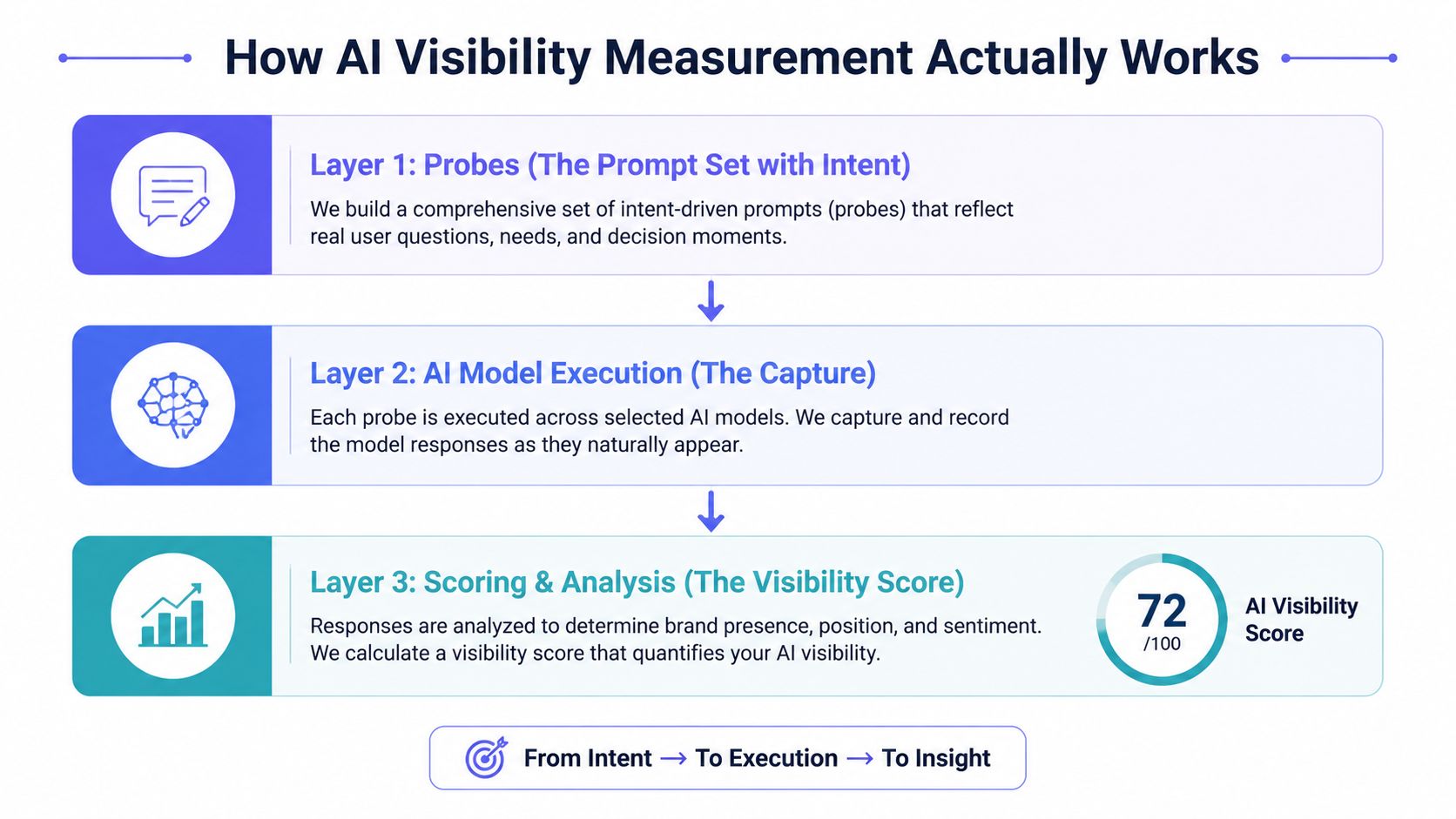
Layer three, metrics
Metrics are derived views of the captures. Useful outputs include mention rate, share of voice, average citation rank, citation source mix, and an engine gap matrix. These metrics support decisions, but they shouldn't replace the raw response.
Each layer carries a trade-off. More probes improve coverage but increase execution cost and sampling noise. Browser captures better reflect the buyer experience but are harder to stabilize. More complex metrics can expose important distinctions, but they also create more opportunities for inconsistent definitions.
Freeze the methodology once the baseline exists. A probe change breaks trendlines. A capture-method change shifts fidelity. A metric-definition change resets the meaning of historical scores. Consistent prompts, engines, geography, and timing matter more than any single metric, and analyzing each engine separately rather than relying on one blended score is what actually surfaces where a program is losing ground.
Why Beat a Static Roster With Per-Prompt Prioritisation?
A longlist of ten or more rivals is useful for discovery. It's a poor measurement set. The benchmark should cut that longlist into a three-to-five-brand shortlist for each prompt archetype, then allow the shortlist to change when the buyer question changes.
Start by tagging prompts by archetype:
- Category definition: Which platforms solve a particular problem?
- Comparison: Which vendor is better for a named use case?
- Alternative: What should a buyer consider instead of a known competitor?
- Integration: Which products work with a specific system?
- Pricing: Which options fit a budget or procurement constraint?
A category-definition prompt may produce broad recommendations. A comparison prompt often narrows the field to vendors that buyers already recognize. An integration prompt may surface a specialist that isn't present in the category discussion. The competitor set should follow the answer pattern, not the org chart.
A practical shortlist rule
Use the longlist to identify brands that have appeared in an AI answer for the archetype during the recent observation window, then add one or two aspirational names that the team wants to challenge. The result is a per-prompt artifact, not a permanent “competitors” field in a company profile.
A workable starting point is freezing three to five direct rivals per prompt archetype and building 25 to 60 buyer-intent prompts per benchmark, repeating prompts to reduce sampling noise, and calculating baseline share-of-voice and citation-share changes from there.
| Dimension | Static Roster | Per-Prompt Shortlist |
|---|---|---|
| Competitor selection | Same brands for every test | Changes by prompt archetype |
| Share-of-voice denominator | Inflated by irrelevant brands | Limited to meaningful rivals |
| Reporting | One blended company score | Prompt and engine gap views |
| Analyst effort | Spent across every brand | Concentrated on active competition |
| Remediation | Generic content recommendations | Counter-assets tied to a specific gap |
The shortlist also improves interpretation. Suppose your brand appears in a comparison answer alongside two direct rivals, while a fourth company appears only in a footnote. Counting all four equally treats incidental presence as competitive pressure. A prompt-level benchmark can distinguish the primary alternatives from peripheral mentions.
The operational payoff is substantial even without expanding the dataset. Probe runs become shorter, trendlines become easier to read, and Monday reporting can name the competitor to beat for a specific prompt cluster. Teams exploring the difference between researching prompts and monitoring them can also consult prompt tracking versus prompt research.
Building the Prompt Set That Drives the Benchmark
The benchmark should begin with 150 to 300 buyer prompts, not a generic keyword list. A keyword tells you what a person typed into a search box. A buyer prompt captures the question an AI engine must answer, including context, constraints, persona, and decision stage.
Mine prompts from places where buyer language already exists:
- Sales call transcripts: Pull questions that appear during discovery, evaluation, security review, and procurement.
- Support tickets: Look for recurring implementation, integration, and capability questions.
- Win and loss interviews: Capture the wording buyers used when comparing vendors.
- Commercial page research: Expand the question tails around your highest-value product and comparison pages.
Tag every prompt before it enters the benchmark. The tags should include buyer stage, intent type, persona, product line, archetype, and business priority. “Best customer data platform for a lean marketing team” and “How does a customer data platform sync with our warehouse?” may sit in the same product line, but they require different content and competitor sets.
A usable prompt schema
| Field | Example Value |
|---|---|
| Prompt ID | CDP-COMP-014 |
| Prompt text | Best customer data platform for a lean marketing team |
| Buyer stage | Comparison |
| Intent type | Evaluative |
| Persona | Growth lead |
| Product line | Customer data platform |
| Archetype | Best-of |
| Priority | High |
| Shortlist version | cdp-comp-v3 |
| Run cadence | Core |
Freeze the first version in a configuration file before the initial capture. Store the version hash in every run record. That one decision makes a sudden share-of-voice drop auditable, because the team can verify whether the question changed before investigating content or competitors.
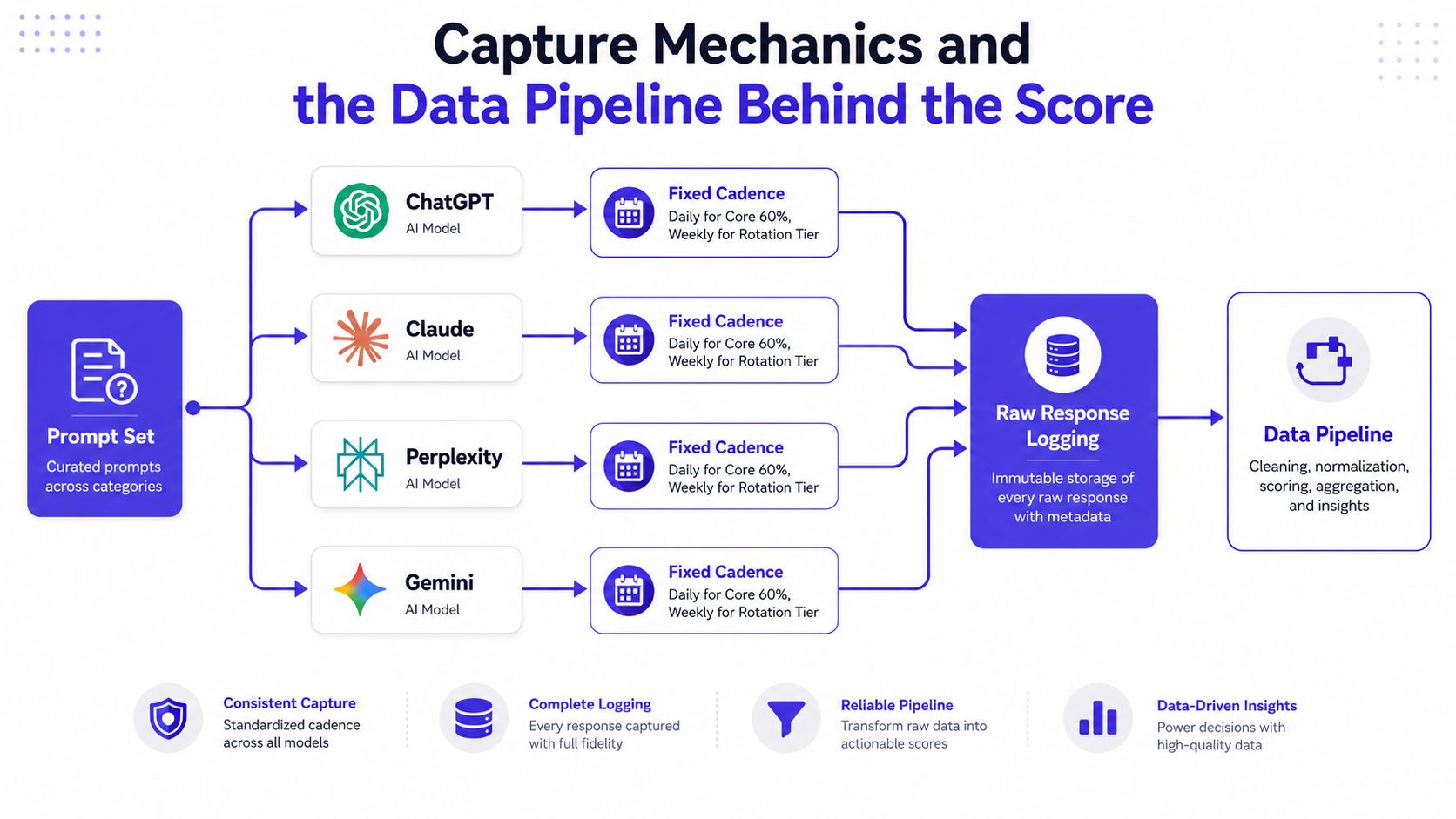
Use two rotation tiers. A stable core of 60% runs daily, while a 40% long tail rotates weekly. The core gives you a dependable trendline around revenue-critical questions. The long tail catches new phrasing, emerging use cases, and prompts that sales or support recently surfaced. These proportions belong in the methodology, so teams should change them deliberately rather than adjusting them whenever a result looks inconvenient.
Don't add a prompt reactively because a competitor gained share. Put it in a candidate pool, score it against existing coverage, and promote it during a scheduled review. Otherwise, the benchmark becomes a moving target that rewards the team for changing the test instead of improving the answer.
Keep the schema, version hash, cadence, and definitions in the same README used by the capture script. When someone asks why the trend changed, the answer should take minutes to find.
Capture Mechanics and the Data Pipeline Behind the Score
The raw response is the primary record. A parsed score is only an interpretation of that record, so the pipeline must preserve enough detail to reprocess it when an engine changes.
Run the core prompt tier daily and the rotation tier weekly across ChatGPT, Perplexity, Gemini and Google AI Overviews. Use a fixed schedule and consistent geography. Repeat prompts when the platform or methodology allows it, because one response can reflect sampling variation rather than a durable ranking preference.
Every capture should log:
- Engine and model: Record the engine version and model ID.
- Execution settings: Store temperature, retrieval mode, browsing state, and session seed when available.
- Timing: Use a UTC timestamp for every request and response.
- Raw output: Preserve the complete answer and its literal sources block.
- Extraction fields: Store brand mentions with character offsets, ordered competitor mentions, citation URLs, source domains, and citation rank positions.
Treat surfaces as separate datasets
An API response and a browser response aren't automatically equivalent. Perplexity's interface may show more citations than its API for the same prompt, and that difference is itself worth tracking. If the program combines them, a capture-method shift can look like a visibility gain.
Use a surface field such as browser or api, then report the difference rather than hiding it. This matters whenever the objective is to understand what buyers see instead of what a sanitized endpoint returns.
Store immutable records and normalized rows
Persist raw payloads as immutable JSON in object storage. Parse those payloads into normalized tables for scoring, with separate records for prompts, runs, mentions, citations, competitors, domains, and engine metadata.
A daily idempotent job should reconcile the raw and normalized layers. If the job runs twice, it shouldn't create duplicate observations. If the parser changes, it should create a new parser version and allow historical rows to be recomputed explicitly.
The minimum citation record should include the prompt ID, run ID, engine, brand, URL, domain, rank position, citation context, and parser version. Keep the original text offsets so a reviewer can confirm whether the parser identified a real recommendation, a passing mention, or a competitor cited in a footnote.
Version the parser alongside the schema. An extraction rule that changes “mentioned” to include a product alias should never rewrite last week's results. The score is only trustworthy when the team can explain both the answer and the method that produced it.
How Do You Read the Numbers Across Engines?
Four metrics usually provide enough signal for a working team. The mistake is treating any one of them as the whole story.
Share of voice
Calculate share of voice as the share of prompts in a relevant shortlist where your brand is mentioned at all. Keep the base measure deliberately unweighted. A buried mention should remain a mention, but it shouldn't be treated as equivalent to a first recommendation in the remediation discussion.
The denominator must match the prompt-level competitor set. If a pricing prompt includes irrelevant category brands, the resulting score describes roster construction more than market visibility.
Average citation rank
Average citation rank measures the mean position of your domain among citations for prompts where you are cited. Calculate it separately for each engine. The first citation in Gemini isn't necessarily comparable to the first citation in Perplexity, because each interface structures sources differently.
A rising mention rate with a worsening citation rank means your brand is entering more answers but losing prominence. That usually calls for stronger evidence, clearer source material, and better content depth, not publishing more pages.
Citation source mix
Group cited domains into owned, earned, third-party review, and competitor properties. A gain driven by your own comparison page has a different strategic meaning from a gain driven by an independent review site. The source mix tells you which authority pathway is working.
The engine gap matrix
The gap matrix plots your share of voice against each shortlisted competitor for each model. It shows where one rival dominates ChatGPT but disappears on Perplexity, or where your brand performs well in one surface and poorly in another.
Different engines draw on meaningfully different sets of cited sources for the same category of question, in our own experience running this kind of benchmark. The implication is practical: a blended score can hide a surface-specific competitor advantage.
| Competitor | ChatGPT SoV | Claude SoV | Perplexity SoV | Gemini SoV |
|---|---|---|---|---|
| Competitor A | Track | Track | Track | Track |
| Competitor B | Track | Track | Track | Track |
| Competitor C | Track | Track | Track | Track |
Use the four views together. Share of voice tells you whether you're present, citation rank shows prominence, source mix reveals influence pathways, and the engine matrix identifies where the gap exists.
Reporting, Remediation, and Closing the Loop on Changes Shipped
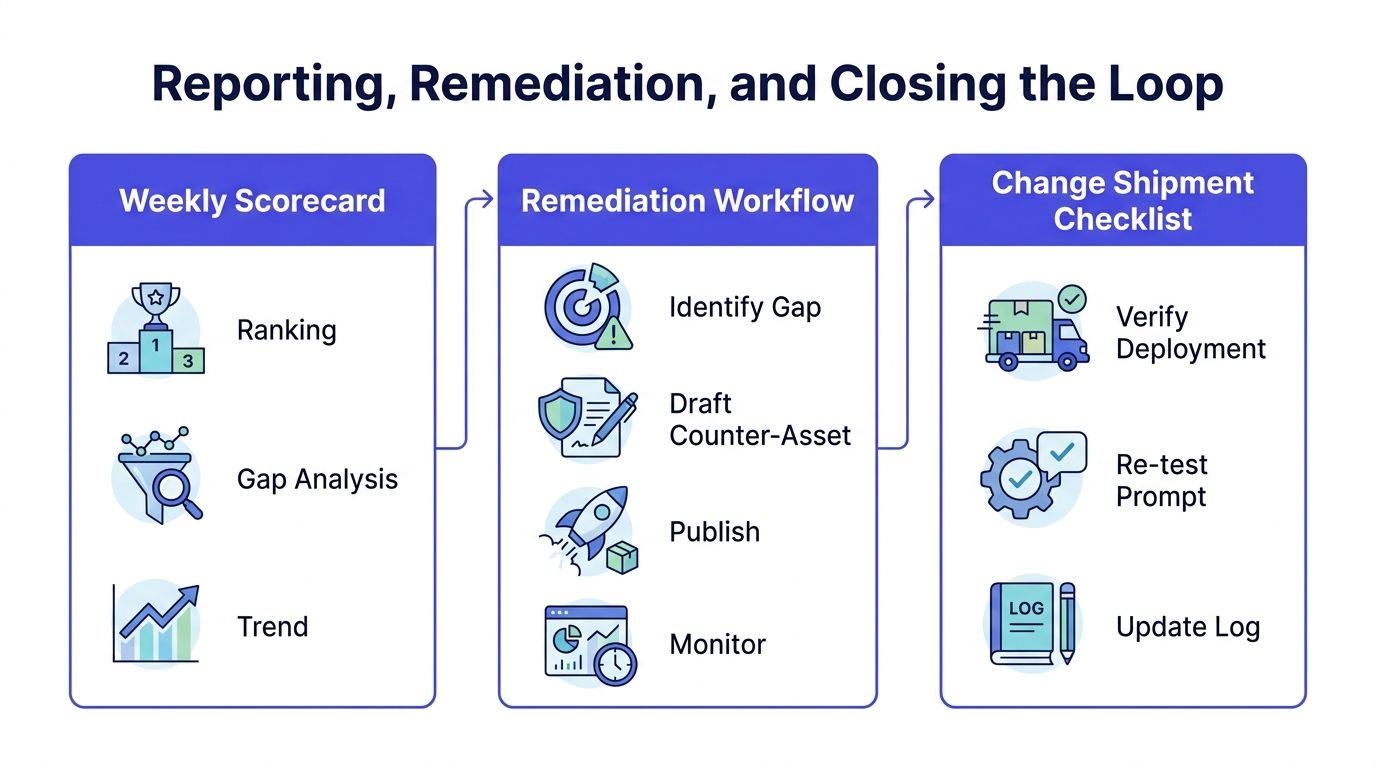
The weekly scorecard should arrive every Monday and answer three questions quickly: did our visibility move, where did it move, and which competitor caused the change?
Include the top-line share-of-voice delta against each per-prompt shortlist, the engine-by-engine gap matrix, and the three competitors that gained or lost the most mention share. Add the prompt archetype and product line to every movement, so a leadership reader can distinguish a pricing issue from an integration issue.
Move from gap to counter-asset
A visibility report becomes useful when it assigns work. Use this sequence:
- Triage the gap: Identify the prompt archetype, engine, product line, and competitor that gained the mention.
- Assign ownership: Route the issue to the content, product marketing, brand, or partnerships owner.
- Choose the counter-asset: Use a comparison page for evaluation gaps, a source-of-truth dataset for factual questions, an expert quote block for authority gaps, or an outreach target when an independent domain drives the citation.
- Set a ship date: Record the change in the same system as the prompt and capture history.
- Reserve a rerun: Schedule a probe rerun seven to fourteen days after shipment, allowing the content and citation environment time to update.
The counter-asset should answer the prompt directly. If a competitor wins “best analytics platform for multi-brand teams,” a generic product announcement won't address the decision. Build the comparison evidence, implementation detail, and qualification criteria the answer needs.
Verification checklist
Before calling a change successful, confirm:
- The deployment is live: Check that the intended page, markup, dataset, or reference update shipped.
- The prompt is unchanged: Compare the current text with the frozen prompt version.
- The citation is substantive: Don't attribute competitive leadership to a brand that appeared only in a footnote.
- The cache window is plausible: Avoid rerunning immediately after publication and treating an unchanged answer as a failed experiment.
- The engine metadata is present: Log the model and version hash so an engine update isn't mistaken for a content win.
- The parser version is stable: Verify that extraction rules didn't change between the baseline and the follow-up.
Ship the fix, reserve the rerun, and record the interpretation. Without all three, the team has an observation, not a learning loop.
GetIntel measures AI answer-engine visibility with buyer-prompt probes, competitor share-of-voice comparisons, citation-source intelligence, and daily refreshes across supported engines. For a team turning a large rival list into prompt-level benchmarks and action queues, visit GetIntel to evaluate how its tracking and workflow features fit your operating process.