A growth lead opens ChatGPT before a pipeline review and asks about the company's flagship product. The competitor appears in the recommendation, Perplexity cites its comparison page, and the company's own product line is missing. Organic rankings look healthy, so nobody can explain why buyers are receiving a different shortlist from answer engines.
AI visibility monitoring for a single product line is the practice of tracking how one specific product, not the whole brand, appears, is cited, and is recommended across ChatGPT, Perplexity, Claude, Gemini, and Google AI Overviews. That situation calls for exactly that: a focused operating loop connecting the buyer prompts that matter, the engines that answer them, the citations that shape those answers, and the small artifacts your team can ship each week, rather than another brand-wide dashboard.
Table of Contents
- Why a Single Product Line Deserves Its Own AI Visibility Program
- Focus creates an accountable shipping loop
- How Do You Scope a Prompt Library to One Product Line?
- Tag every prompt before the first run
- Configuring Probes and Running Daily Tracking
- Make the data comparable
- What Do Answer Rate, Share of Voice and Citation Rank Tell You?
- Split every KPI before interpreting it
- Which Citation Gaps and Sources Should You Chase?
- Find the sources that move the line
- Turn observations into a one-page gap report
- Shipping Gap-Closing Artifacts and Wiring Them Into Your Stack
- Keep implementation smaller than the diagnosis
- Reporting Cadence, Sample Prompts, and Common Pitfalls
Why a Single Product Line Deserves Its Own AI Visibility Program
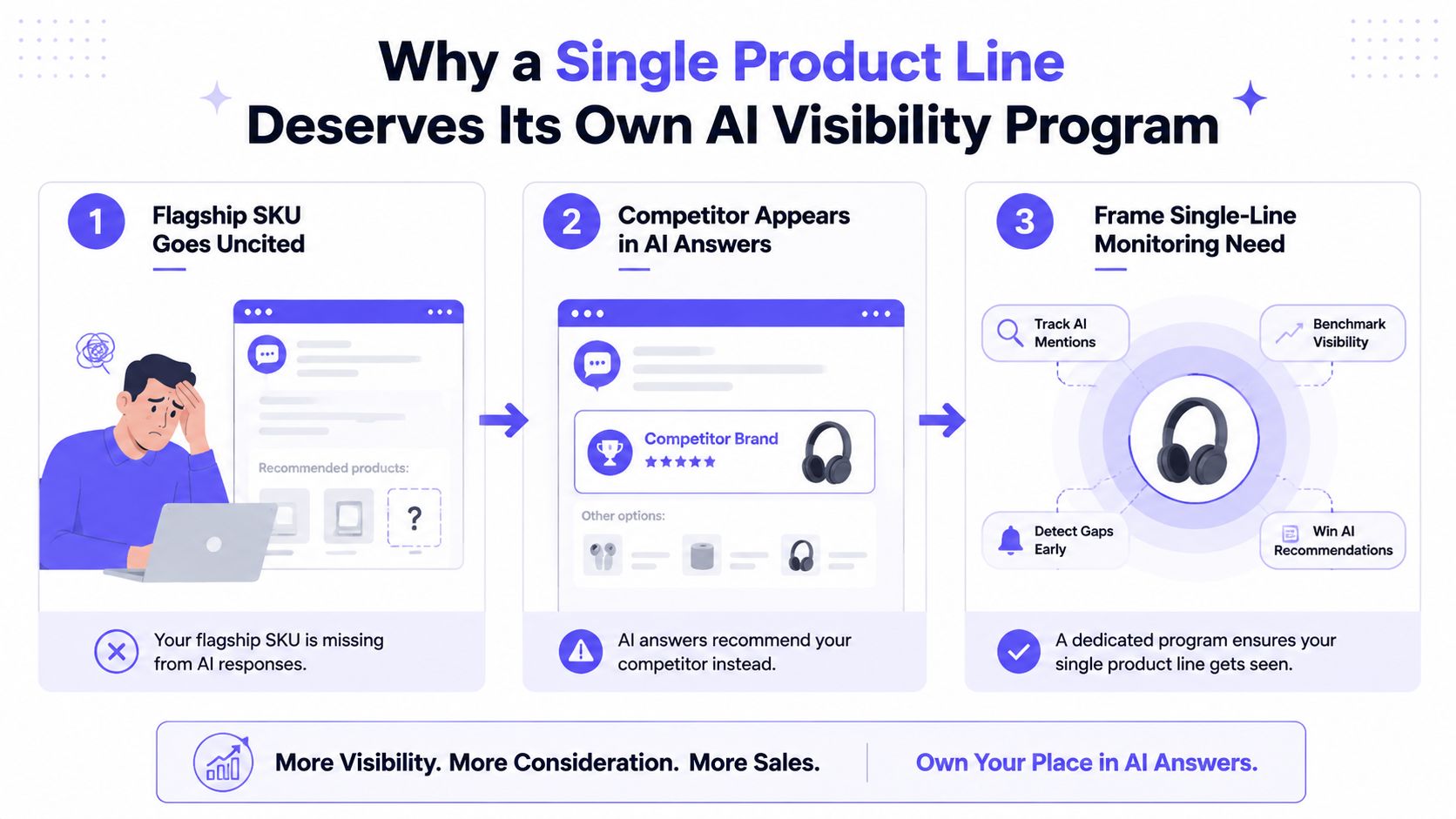
Reviewed 19 September 2026. A single product line deserves its own AI visibility programme because a large portfolio creates a measurement problem. If one dashboard mixes unrelated products, category questions for a mature platform can hide a visibility loss for a newer module. The growth team sees a stable brand score while the flagship SKU disappears from the prompts that influence evaluations.
A product-line program fixes that dilution. It gives one owner a defined surface area, a controlled prompt set, and a direct connection between visibility movement and the revenue attached to that line. The program doesn't need to represent every product the company sells. It needs to answer whether buyers can find this product when they ask about pricing, alternatives, implementation, and the best options in its category.
The risk is more serious than a conventional ranking decline. A 2025 Tow Center study summarized by Nieman Lab found that AI search engines failed to retrieve correct information in more than 60% of 1,600 test queries. Performance varied sharply, with Perplexity missing the correct information 37% of the time and Grok-3 Search missing it 94% of the time. For a single product line, that means the monitoring question isn't only “are we mentioned?” It's also “does the engine cite the right source and represent the product accurately?”
Focus creates an accountable shipping loop
Focus creates an accountable shipping loop: a narrow library produces a cleaner signal than a broad list diluted across unrelated product lines. The owner can review uncited prompts, identify the missing source, assign the smallest corrective artifact, and recheck the result without waiting for a portfolio-wide SEO project.
The program should still use a meaningful prompt set, but the exact count should come from the product's buyer journey rather than an arbitrary company-wide quota. A single product line can often be spot-checked with a prompt set in the low dozens, while a full brand-wide program tends to need closer to a hundred prompts across topics, competitors, and regions. That supports a compact program, not an unstructured one.
For comparison, teams managing several brands can use the broader operating principles described in enterprise multi-brand AI visibility monitoring. A single-line team should take the opposite approach: remove unrelated prompts, retain revenue-critical questions, and make every result actionable.
How Do You Scope a Prompt Library to One Product Line?
Scope the prompt library to one product line by starting with the buyer questions that can change demand for it. Don't copy the full brand keyword universe into an AI tracker. Pull language from sales calls, product marketing, support tickets, comparison pages, and the questions buyers ask before they request a demo.
Use three intent buckets. Branded prompts test whether the engine understands the product and its positioning. Category prompts test whether the line enters broader recommendations. Product-intent prompts test buying decisions such as alternatives, pricing, integrations, and “best of” comparisons.
| Intent Bucket | Prompt Count | Example Query |
|---|---|---|
| Branded | 20 to 30 | “What is [Product Line], and who is it for?” |
| Category | 40 to 60 | “What are the best tools for [category problem]?” |
| Product-intent | 15 to 25 | “What are the best alternatives to [Product Line]?” |
Suggested prompt distribution by intent bucket for a single product line.
Combining branded, category, and product-intent prompts produces a focused library of 75 to 115 prompts. Treat that range as a planning structure, not a universal requirement. If a product has fewer meaningful use cases, cut prompts that don't map to a decision. If buyers regularly compare deployment models, integrations, security, or pricing, add those variants within the same product-line boundary.
Tag every prompt before the first run
Each prompt should carry enough metadata to explain movement later:
- Buyer stage: Awareness, evaluation, comparison, or purchase.
- Intent type: Branded, category, product, problem, or competitor.
- Competitor set: The brands that commonly appear in that answer.
- Business priority: Revenue-critical, strategic, or diagnostic.
- Engine relevance: Which answer engines matter for that question.
Prune prompts when they produce repetitive answers, no longer reflect the product, or have no plausible connection to pipeline. Refresh the library after a launch, repositioning, pricing change, or competitor shift. A prompt library should stay narrow, but it shouldn't become stale.
The useful methodology is to separate presence rate, citation share, and rank-position changes rather than collapsing them into one score. Repeated measurements with paraphrase variants, controls, human validation, and interference checks are more reliable than a one-off snapshot, as described in the independent citation-selection and citation-absorption framework.
Configuring Probes and Running Daily Tracking
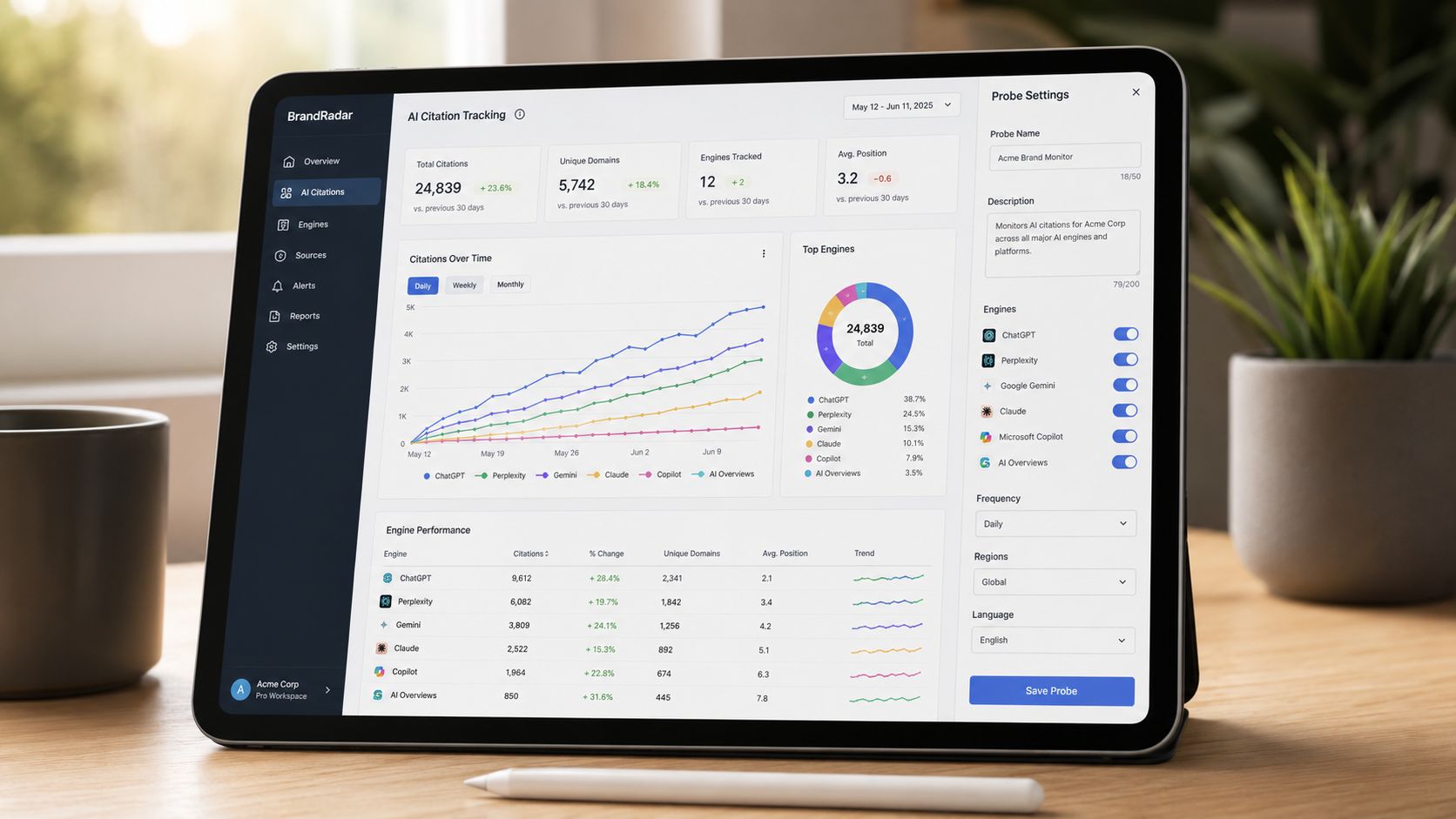
Daily monitoring works when every probe is repeatable. Store the prompt, engine, locale, timestamp, product-line identifier, competitor set, and run status in the payload. Keep the request simple enough that a second person can understand exactly what was tested and why.
Run the same prompt set against ChatGPT, Perplexity, Claude, and Gemini. Add Google AI Overviews where the query triggers that surface. The objective isn't to collect a list of URLs. Capture the full answer rendered in the live interface, including product mentions, recommendation order, claims, and every visible citation.
A raw answer archive lets you distinguish several different events:
- The product wasn't mentioned.
- The product was mentioned but not cited.
- The product was cited from a weak or outdated page.
- A competitor displaced the product.
- The answer changed because the prompt wording changed.
- The engine produced a materially different response.
Make the data comparable
Schedule runs at the same UTC hour and retain both raw responses and parsed citation URLs. Normalize URLs before deduplication, but don't discard the original answer. The original text is the audit trail for claims, ordering, and context.
A daily run is valuable because it creates a trendline. A single answer can change with wording, model behavior, or competitor activity, so don't turn one missing citation into an emergency. Use a rolling baseline to compare current performance with recent behavior. A practical baseline is daily monitoring for active categories and weekly monitoring for stable categories, with immediate checks after launches, rebrands, pricing changes, and reputation events.
For a single product line, daily checks remain appropriate when the prompts are commercially important. A reasonable operating rule is to escalate to daily tracking once a loss, inaccurate claim, or competitor displacement shows up on more than one platform, repeats across consecutive checks, or touches a meaningful share of a priority prompt cluster. A defined threshold like that turns noise into a defined operating decision, rather than a judgment call made fresh every time.
What Do Answer Rate, Share of Voice and Citation Rank Tell You?
A product-line dashboard should separate three questions.
Answer Rate asks whether the product appears at all. Break it into prompt coverage, the share of tracked prompts where the SKU is mentioned, and engine coverage, the share of monitored engines that return it for those prompts. A product can have strong prompt coverage but weak engine coverage, which points to a platform-specific issue rather than a broad content failure.
Share of Voice measures competitive presence within the answers you collect. For a fixed prompt set, calculate the product's mention count against total mentions across the top five cited brands. Read the movement in context. If Answer Rate stays flat while Share of Voice rises, the product may still be gaining because competitors are losing more ground.
Average Citation Rank shows how prominently the product's sources appear. Rank one is the strongest position, ranks two and three can still support discovery, and citations beyond rank five deserve scrutiny because they may have little practical influence. Treat this KPI separately from mentions. A product can be named in an answer while its supporting page sits low in the citation list.
Split every KPI before interpreting it
Break the metrics down by prompt cluster and engine. A ChatGPT regression can disappear inside an overall average if Perplexity improves at the same time. Product-intent prompts should also remain separate from category prompts because a gain in broad awareness doesn't necessarily improve purchase-stage visibility.
| KPI | Current Value | 7-Day Change | By Engine Split | Action Trigger |
|---|---|---|---|---|
| Answer Rate | Product-line baseline | Directional change | ChatGPT, Perplexity, Claude, Gemini, Google AI Overviews | Repeated absence in priority prompts |
| Share of Voice | Competitive baseline | Gain or loss | Product and competitor mentions by engine | Competitor displacement in a priority cluster |
| Average Citation Rank | Citation-position baseline | Movement toward or away from rank one | Cluster and engine | Weak rank paired with high-intent visibility |
A single product line's KPI dashboard, split by engine and prompt cluster.
Keep the dashboard compact. Ten lines are enough: overall Answer Rate, branded Answer Rate, category Answer Rate, product-intent Answer Rate, overall Share of Voice, competitor Share of Voice, Average Citation Rank, engine-level rank, citations gained, and citations lost.
Ahrefs' 75,000-brand analysis found branded web mentions correlated at 0.664 with AI Overview visibility, compared with 0.218 for referring domains. That doesn't prove that mentions cause visibility, but it does justify tracking unlinked product mentions and citation-source domains alongside backlinks.
Which Citation Gaps and Sources Should You Chase?
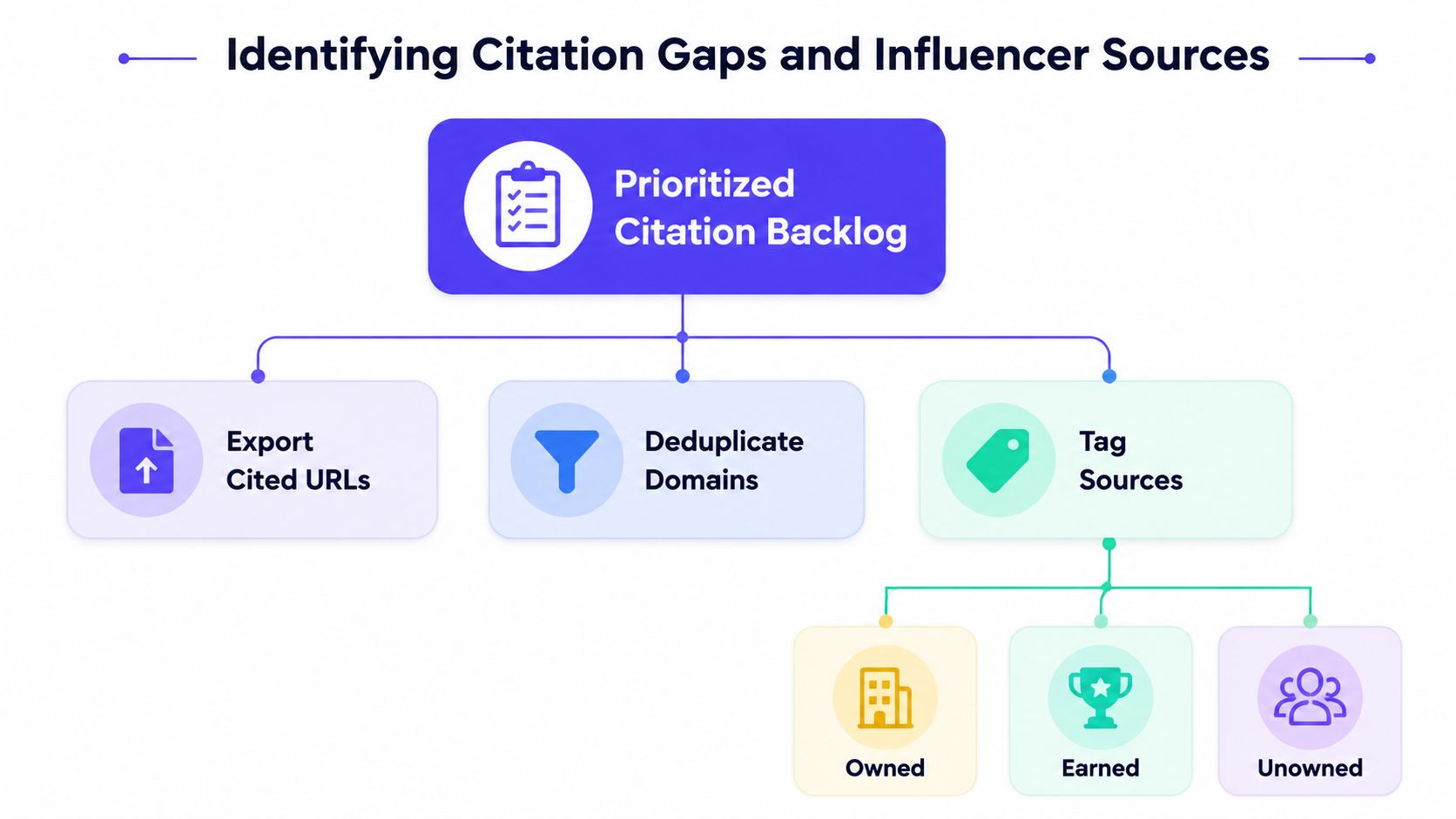
A single product line can have strong brand visibility and still disappear from buying conversations. Start with the raw citation inventory. Export every URL returned for the product-line prompt set, normalize and deduplicate the domains, then label each source as owned, earned, community, or reference. The narrow scope makes manual review practical, and manual inspection often exposes issues hidden by an aggregate score.
Look for asymmetry across the prompt set. If a competitor appears repeatedly in a comparison publication, review site, or community discussion while the product line never appears there, add that domain to the backlog. If the product is cited but the page uses outdated positioning, the gap concerns source quality and message control rather than presence.
Find the sources that move the line
Weight each domain by the number of distinct prompts that cite it and its average citation rank. Then surface the five sources with the greatest influence on the product line's Share of Voice. The list may include editorial sites, reference domains, Reddit discussions, G2 reviews, or comparison posts.
AI systems use more than vendor pages. Community platforms such as Reddit and Quora regularly show up alongside brand domains in AI-cited source lists, and the split between the two varies by engine, with Google AI Overviews in particular leaning more on brand-owned pages than some other answer engines do. The practical conclusion is to compare owned and external sources by engine, using your own citation export for the product line rather than assume one source type performs consistently everywhere.
Check the community layer separately:
- Reddit threads: Identify recurring objections, feature questions, and product comparisons.
- G2 reviews: Look for missing use cases, inaccurate category labels, and buyer language worth addressing.
- Comparison posts: Find pages where a competitor controls the framing.
- Reference sources: Check whether the product's entity, category, and terminology appear consistently.
Turn observations into a one-page gap report
Rank each gap by revenue impact, prompt frequency, competitor advantage, source influence, and ease of correction. Record the missing domain, affected prompts, cited competitors, proposed artifact, and owner. A useful report names the buyer question you want to change and the source most likely to affect it. “More mentions” is not an actionable task. The compact loop is prompt evidence, source diagnosis, and a clearly assigned correction.
Shipping Gap-Closing Artifacts and Wiring Them Into Your Stack
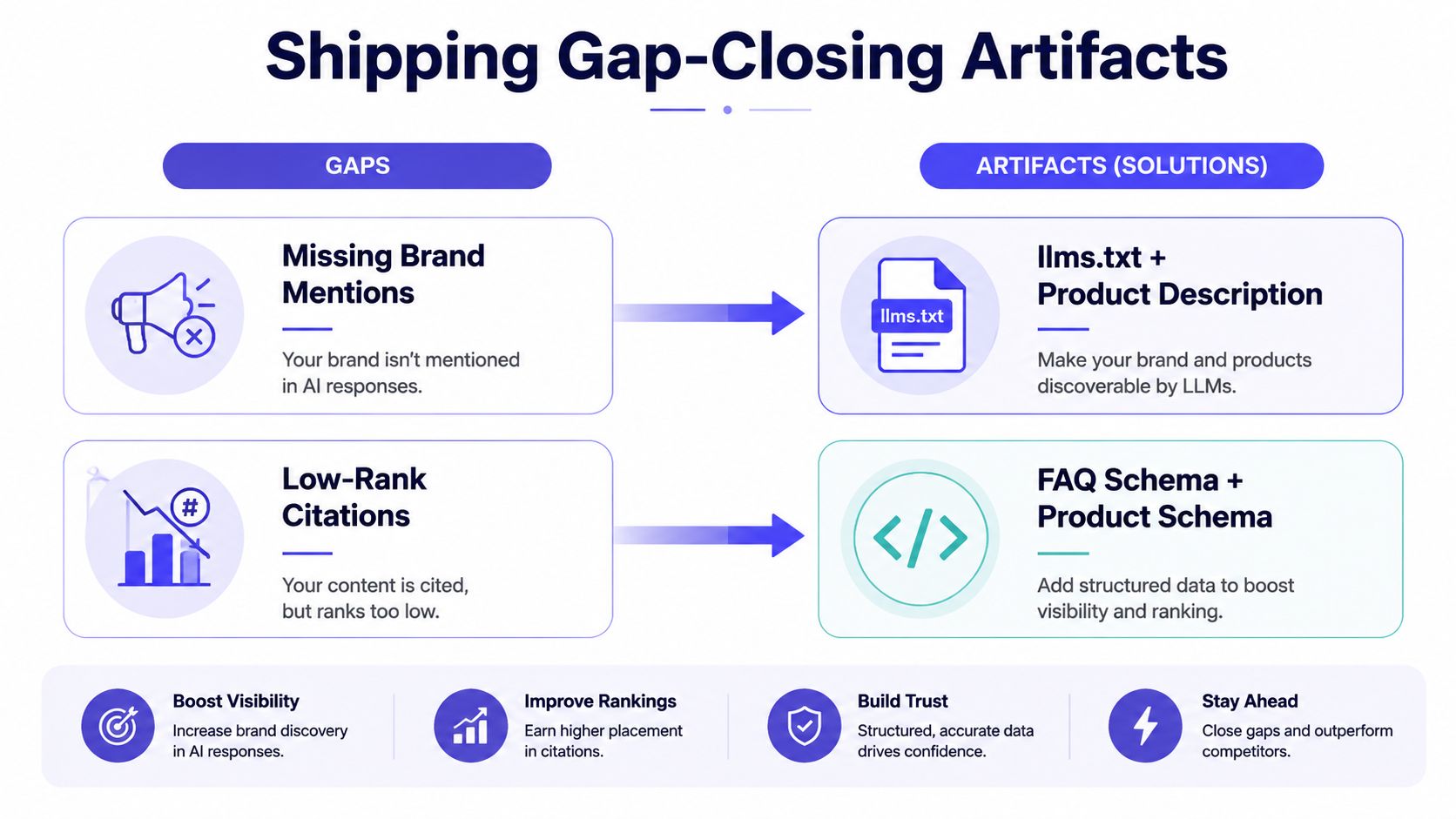
The fastest teams match each observed gap to the smallest artifact that can address it. A missing brand mention may need an llms.txt entry and refreshed product description. Low-rank citations may call for clearer FAQs supported by FAQ schema and Product schema. Entity confusion may require a Wikidata item update, while unfair competitor framing may need a counter-article or comparison page.
Use outreach for the sources that owned content can't replace. Prepare a short email batch for the top three influencer domains where the product line doesn't appear, with a specific correction, data point, review resource, or expert contribution rather than a generic request for a link.
Keep implementation smaller than the diagnosis
A single product line keeps the artifact loop manageable. A sprint can focus on a handful of changes, each tied to a prompt cluster and a source gap. Feed the artifact specification to a coding agent such as Claude Code or Cursor, review the diff, and publish through the CMS API or a Notion-to-Webflow bridge. Don't redesign the entire site because one answer engine preferred a competitor's comparison page.
A practical workflow includes:
- Write the issue: Include the exact prompt, answer, citation, and competitor framing.
- Specify the artifact: Name the page, schema, entity update, or outreach action.
- Review the change: Check product claims, links, structured data, and editorial accuracy.
- Publish through the existing stack: Avoid a separate publishing process.
- Verify retrieval: Confirm the page is indexable and parsable.
- Re-probe after publication: Schedule the check 48 hours after publish, then continue daily tracking.
For teams comparing supporting platforms before wiring this process into their stack, a broader AI content optimization software comparison can help organize the tooling decision. The tool matters less than the handoff. Monitoring that never produces a reviewed, shippable correction becomes another reporting exercise.
A gap framework should connect each artifact to its expected measurement change, such as improved presence, stronger citation rank, or corrected product language. The AI citation gap framework provides a useful reference for structuring that backlog.
Reporting Cadence, Sample Prompts, and Common Pitfalls
Keep the operating rhythm light enough to survive a busy launch cycle:
- Daily: Spend five minutes checking Answer Rate, Share of Voice, citation rank, and material answer changes.
- Monday: Review the trendline, engine splits, and priority prompt losses.
- Friday: Send stakeholders the movement, source changes, and shipped artifacts.
- Monthly: Give leadership a short memo connecting visibility changes with product-line pipeline signals.
Use prompts that mirror actual buyer language:
- “What is [Product Line] used for?”
- “Who should consider [Product Line]?”
- “What are the best tools for [category problem]?”
- “What are the alternatives to [Product Line]?”
- “How does [Product Line] compare with [Competitor]?”
- “Which product is best for [problem-intent use case]?”
- “How much does [Product Line] cost?”
- “What should a buyer check before choosing a [category] tool?”
- “Which [category] products integrate with [relevant system]?”
- “Is [Product Line] suitable for a team with [specific constraint]?”
| Section | Metric | This Week | vs. Last Week | Notes |
|---|---|---|---|---|
| Coverage | Answer Rate delta | Record the current change | Compare with prior period | Split by prompt cluster |
| Competition | Share-of-Voice shift | Record product and competitor movement | Identify displacement | Name the affected engine |
| Position | Average Citation Rank | Record current position | Note rank movement | Separate high-intent prompts |
| Sources | Gained or lost citations | List domains | Compare source changes | Tag owned, earned, community, reference |
| Delivery | Shipped artifacts | List completed fixes | Compare backlog status | Include re-probe date |
Weekly reporting template for a single product line's AI visibility loop.
Avoid five traps. Tracking too many prompts dilutes ownership. Chasing one-off engine quirks creates false urgency. Ignoring citation-source decay leaves competitors in control of the evidence. Shipping artifacts without re-measuring breaks attribution. Reporting raw mention counts instead of answer inclusion gives leadership a vanity metric.
Keep reporting as disciplined as the monitoring itself. If outbound outreach supports the source-gap plan, an email deliverability check can help validate sending quality before a small campaign reaches influential publishers.
The result is a compact operating loop: curate the right prompts, probe daily, inspect the answer and citations, ship the smallest fix, and measure the next trendline.
GetIntel measures single-product-line visibility across ChatGPT, Perplexity, Gemini, and Google AI Overviews, with daily Answer Rate, Share of Voice, and Average Citation Rank tracking, plus a ranked task list for closing citation gaps. Visit GetIntel to see how the platform can turn your product-line prompts and source gaps into a repeatable monitoring and improvement workflow.