A workable AI citation gap framework has three moves: run buyer-prompt probes, diagnose the structural cause, and ship the matching fix. In a 2026 empirical study, pages with a GEO score of at least 0.70 and at least 12 pillar hits reached a 78% cross-engine citation rate, showing that citation visibility can be audited rather than guessed.
A B2B SaaS marketing lead usually discovers the problem in an uncomfortable way. A prospect asks ChatGPT or Perplexity for the best tool in a category, and the answer names three competitors. One rival appears in two cited sources. Your product gets no citation, no mention, and no obvious explanation. Your Google rankings look healthy, your product pages are polished, and the team still can't tell whether the failure comes from weak content, missing entity signals, or a source ecosystem that doesn't include you.
That uncertainty is the actual operational problem. A narrative post about why AI skips a brand can make the diagnosis feel familiar, but it doesn't give a team a repeatable way to identify, score, and close the next gap. The AI citation gap framework turns each missing citation into a logged prompt, a classified cause, and a reviewable artifact.
Table of Contents
- The Moment Your Brand Disappears From the Answer
- What the AI Citation Gap Framework Actually Is
- Which Three Metrics Power the Diagnosis?
- Running Multi-Engine Probes That Actually Produce Decision-Grade Data
- What Is the Structural Cause Behind Each Gap?
- What Do You Ship to Close Each Kind of Gap?
- Which Gaps Should You Fix First?
- From First Audit to Weekly Operating Cadence
The Moment Your Brand Disappears From the Answer
The probe was supposed to be routine. A demand-generation lead copied a question from a sales call, removed the customer's company name, and asked several answer engines which platforms were strongest for a specific workflow. The response was clear enough to screenshot and send to the product marketer.
Three competitors appeared. One showed up as a recommendation near the top and was supported by two source links. Another appeared in a comparison paragraph. The team's brand, despite serving the same audience and owning a relevant product page, was absent.
The first reaction was familiar: check rankings, search the brand name, inspect Search Console, and compare backlink profiles. None of those checks answered the buyer's question. They showed how the company performed in conventional search, not whether an answer engine could retrieve, verify, and confidently cite it in a recommendation.
The practical failure isn't simply low visibility. It's having no record of the prompt, engine, cited URL, or missing evidence needed to explain the result.
A second probe produced a different answer. A review site described a competitor's use case in plain language, while a community discussion supplied implementation details. Your own site had more product information, but it was spread across feature pages, release notes, and documentation. The engine could find fragments, yet it didn't have a clean source to attach to the recommendation.
That distinction matters for lean teams. A content writer may propose another category article. A developer may suggest adding schema. A PR lead may start outreach. Without a gap classification, all three can work on the wrong bottleneck.
The framework below is built for that exact handoff. It doesn't ask whether your brand is generally authoritative. It asks where a real buyer prompt produces a competitor citation, what prevented your source from winning, and which artifact can change the next probe.
What the AI Citation Gap Framework Actually Is
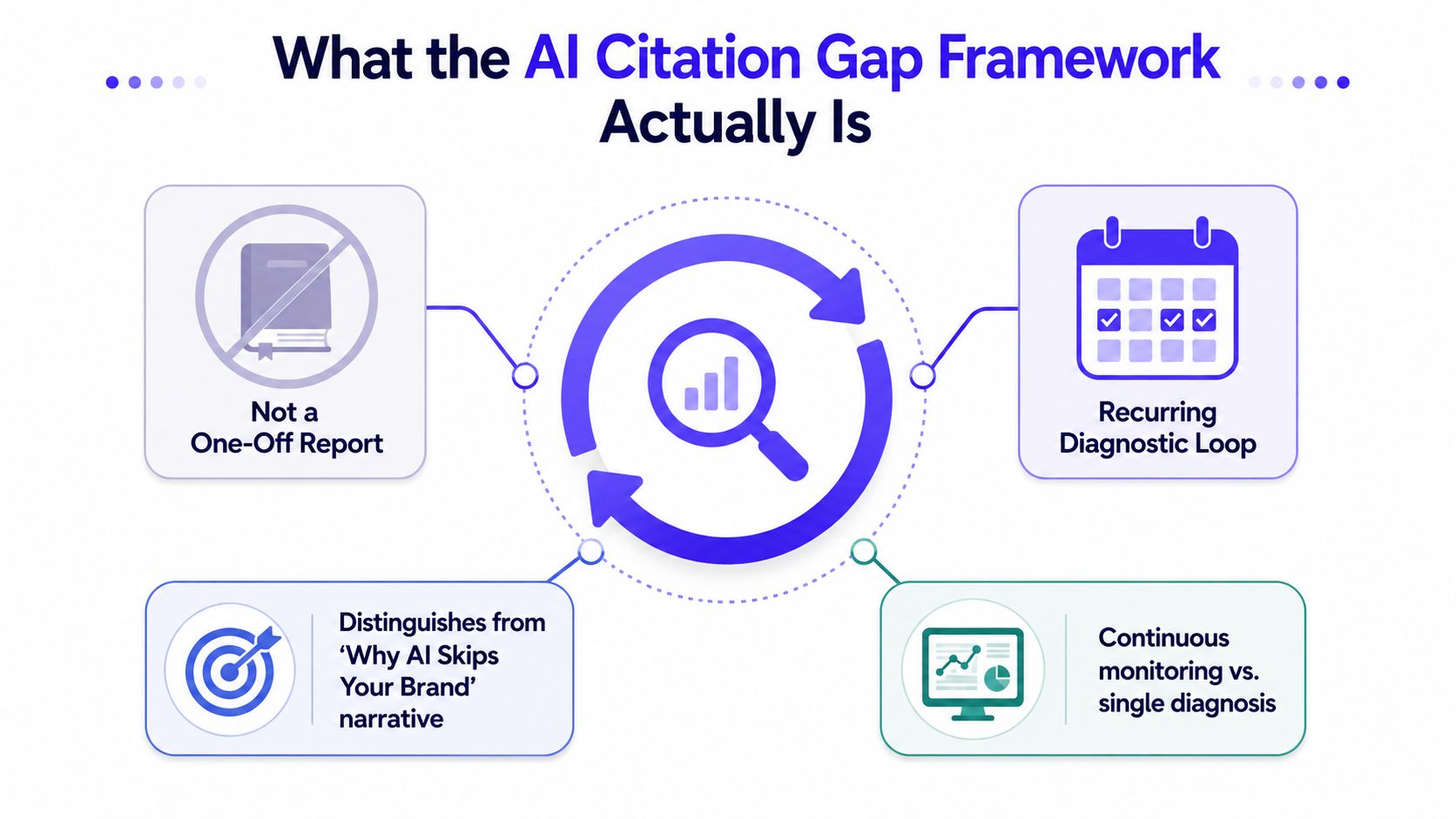
Reviewed 19 September 2026. The AI citation gap framework is a recurring diagnostic loop, not a one-off report. A report gives you a snapshot of missing prompts. A loop connects measurement to diagnosis, ships a correction, and checks whether the correction changed retrieval or citation behavior.
It also differs from a narrative “why AI skips your brand” article. That kind of article can explain one failure mode. This framework gives a reusable system that a marketing lead, SEO strategist, developer, or agency team can redraw on a whiteboard:
- Run real buyer-prompt probes across engines to find where competitors are cited and the brand isn't.
- Diagnose the structural cause, such as missing structured data, thin third-party presence, or absent content.
- Ship the matching gap-closing artifact, such as a schema update, counter-article, or outreach target, rather than stopping at diagnosis.
The first step prevents teams from optimizing for abstract keyword lists. The prompt is the unit that reflects the buyer experience, and the engine plus cited source must be logged alongside it. A useful primer on the broader discipline is AI search engine optimization, but the operating decision here is narrower: identify the exact answer where a rival has evidence and you don't.
The second step prevents random production. A missing citation can result from a crawlable page lacking semantic clarity, an absent third-party reference, or no page that directly answers the use case. Those causes look similar in a dashboard but require different owners and deliverables.
The third step makes the audit accountable. A schema edit, Wikidata entry, counter-article, or outreach brief can be reviewed by the right person and placed in the repository or CMS. If you stop after naming the gap, the spreadsheet grows while visibility stays unchanged. If you ship artifacts without re-probing, you can't distinguish progress from coincidence.
Which Three Metrics Power the Diagnosis?
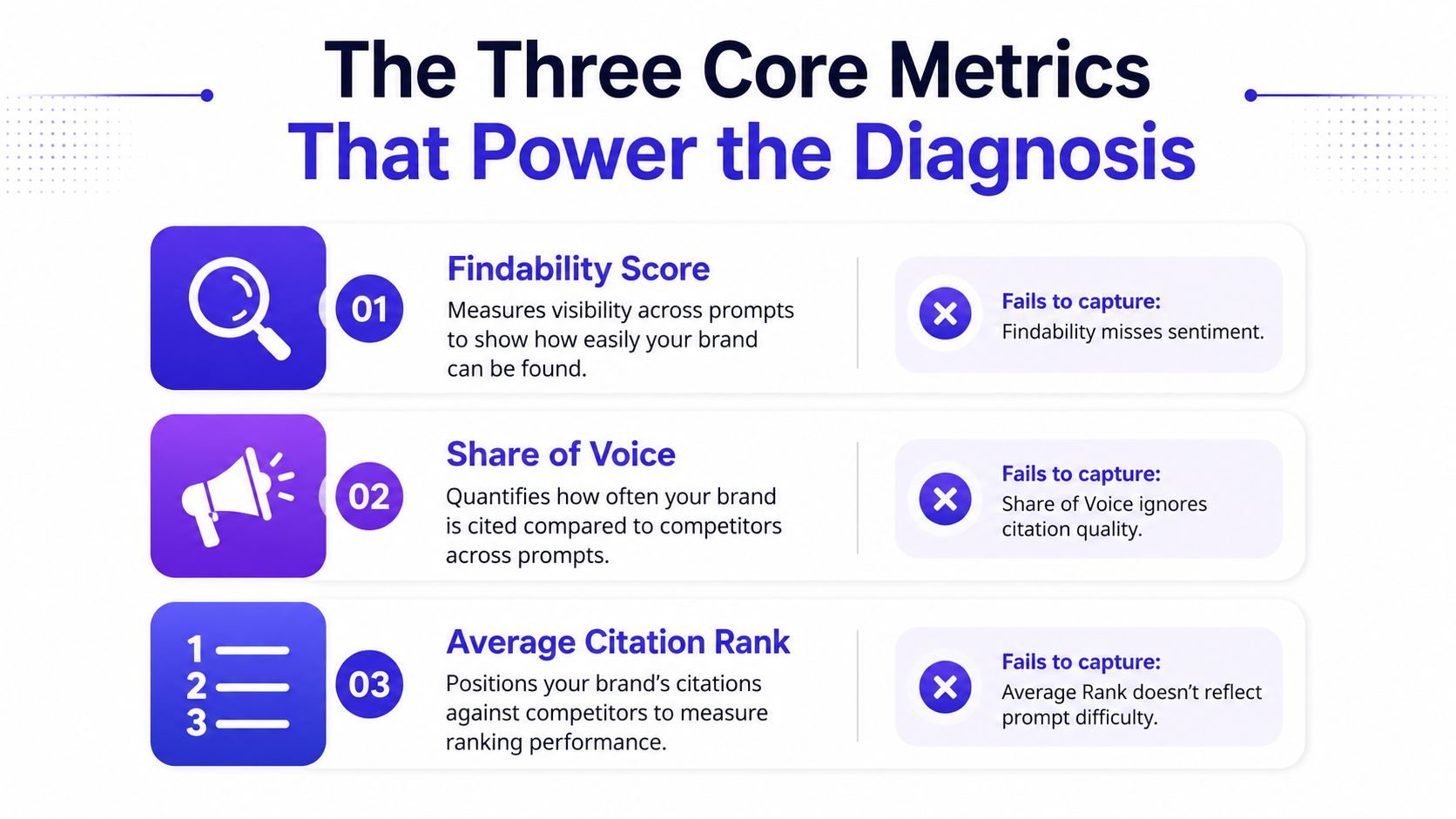
A citation-gap audit becomes actionable when each probe produces comparable measures. The three working metrics are Answer Rate, Share of Voice, and Average Citation Rank. Each isolates a different failure mode. None, on its own, proves that a brand is authoritative or that an answer is commercially useful.
Answer Rate
Answer Rate summarizes how consistently a brand appears across the tracked buyer prompts and engines. It shows whether visibility extends across the question set or remains concentrated in one query type. GetIntel, for example, scores buyer questions grouped into topics daily across ChatGPT, Perplexity, Gemini, and Google AI Overviews, and compares the resulting answer states with competitors.
Use the score to measure coverage, not quality. It does not explain why a brand is absent, whether a mention is favorable, whether the cited page supports the answer, or whether the prompt represents a meaningful buying moment. A composite can rise while pricing or implementation prompts remain weak because informational questions carry the total.
The empirical study of AI answer engines demonstrates why prompt-and-source records matter. It analyzed 70 product-intent prompts and found 1,702 citations from 1,100 unique URLs across Brave Summary, Google AI Overviews, and Perplexity. A rolled-up score is useful for monitoring, but the underlying prompt, engine, URL, and cited passage are the reviewable evidence.
Share of Voice
Share of Voice measures how often your brand or domain receives citations relative to competitors across the same prompt set. It answers which vendors are capturing available citation opportunities. It does not show whether a citation is relevant, prominent, favorable, or useful to the generated answer.
A brand can gain citations while losing commercial visibility if a competitor receives the first recommendation, appears across more high-intent prompts, or provides stronger evidence for the claim being answered. The metric also changes with the prompt mix. Preserve the same buyer questions and engine set before comparing periods or competitors.
Review Share of Voice by prompt category, not only as one total. A strong category-selection result can conceal weak alternative, pricing, or implementation coverage. That breakdown turns a broad competitive signal into an addressable work queue.
Average Citation Rank
Average Citation Rank records where a brand appears when the engine cites it. A lower average position may indicate that the brand is present but seldom selected as the primary source or recommendation. The measure does not adjust for prompt difficulty, answer length, or whether the cited passage supports the surrounding claim.
Retrieval and citation therefore require separate fields in the audit. Engines can retrieve a broad candidate set, then select fewer sources for the final response. Citation recall asks whether the answer is fully supported by the cited passages, while citation precision asks whether those passages are relevant, as explained in citation recall and precision research.
A competitor may appear in the retrieved corpus while your brand loses the final selection. Log both layers when the tooling exposes them, then inspect the cited span. That review often points to the next artifact, such as a clearer answer page, a schema change, or a third-party evidence target, rather than another generic content brief.
For ongoing monitoring, RankEngine's AI visibility monitoring provides a reference for tracking these measures over time.
For ongoing monitoring, RankEngine's AI visibility monitoring provides a reference for tracking these measures over time. The dashboard matters less than stable prompts, engine coverage, source logging, and interpretation rules that let the team connect a score change to a specific shipped artifact.
Running Multi-Engine Probes That Actually Produce Decision-Grade Data
The audit starts with prompts buyers ask, not terms that only exist in a keyword export. Use 25 to 30 buyer prompts as a practical starting set, covering pricing, alternatives, best-of questions, implementation, and use-case variants (published citation-gap playbook). Keep the wording intact once the baseline is established. Small changes in qualifiers, audience, or use case can alter which sources an engine retrieves and cites.
Build the prompt set around decisions
A strong library includes questions such as:
- Category selection: Which tools are best for a specific workflow?
- Competitive alternatives: What are the alternatives to a named platform?
- Use-case fit: Which product suits a team with a particular constraint?
- Commercial evaluation: What should a buyer compare before choosing a vendor?
- Implementation risk: Which options integrate with an existing stack?
Run the same prompts across the engines that matter to your buyers. The verified 2026 study examined Brave Summary, Google AI Overviews, and Perplexity, while GetIntel's stated coverage includes ChatGPT, Claude, Perplexity, Gemini, and Google AI Overviews. Engine coverage should follow audience exposure and operational capacity, not a desire to collect every possible output.
Capture the rendered interface rather than relying only on API responses. The interface shows the answer, citation placement, linked URL, visible recommendation order, and surrounding language that a buyer sees. Perplexity citation-source data is useful context when building source-level logging for that engine.
Test stability before acting
A single response is an observation, not a conclusion. Prompt wording, engine state, personalization, and repeated sampling can move citation shares, so record the run date and preserve the answer capture. The 2026 statistical work on AI visibility metrics warns that single-run measurements can look more precise than they are and recommends uncertainty estimates and sample-size guidance (statistical guidance for AI visibility measurement).
Use a simple decision rule: don't act on a gap until the ordering of competing sources has plateaued and the spread in citation shares exceeds the observed uncertainty. If a rival leads in one run and the result reverses in the next, classify the signal as unstable and collect more observations rather than commissioning a new article.
For example, teams using Sales Navigator AI by Pipecorn can use buyer and account research as an input to prompt design, while keeping the actual citation test independent from the prospecting tool.
A prospecting workflow can help turn sales questions into a disciplined prompt library. For example, teams using Sales Navigator AI by Pipecorn can use buyer and account research as an input to prompt design, while keeping the actual citation test independent from the prospecting tool.
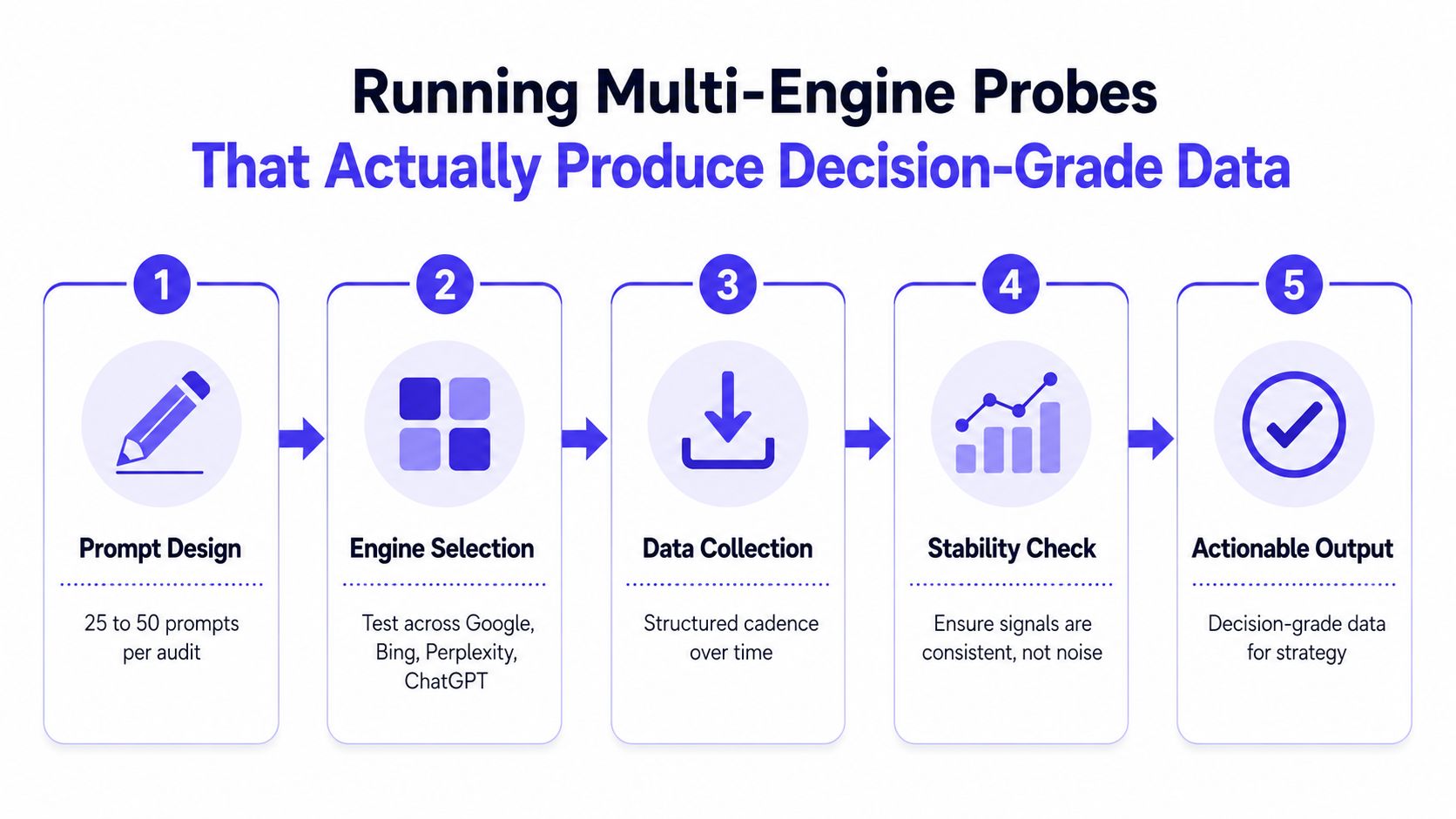
A practical setup uses a fixed prompt library, interface-rendered answer captures, daily refreshes for active monitoring, and source-level rows in a spreadsheet or database. Log the prompt, engine, timestamp, brand status, competitor citations, cited URLs, citation position, and the passage that appears to support the answer. That record turns a vague visibility complaint into evidence a content, engineering, or authority owner can review.
What Is the Structural Cause Behind Each Gap?
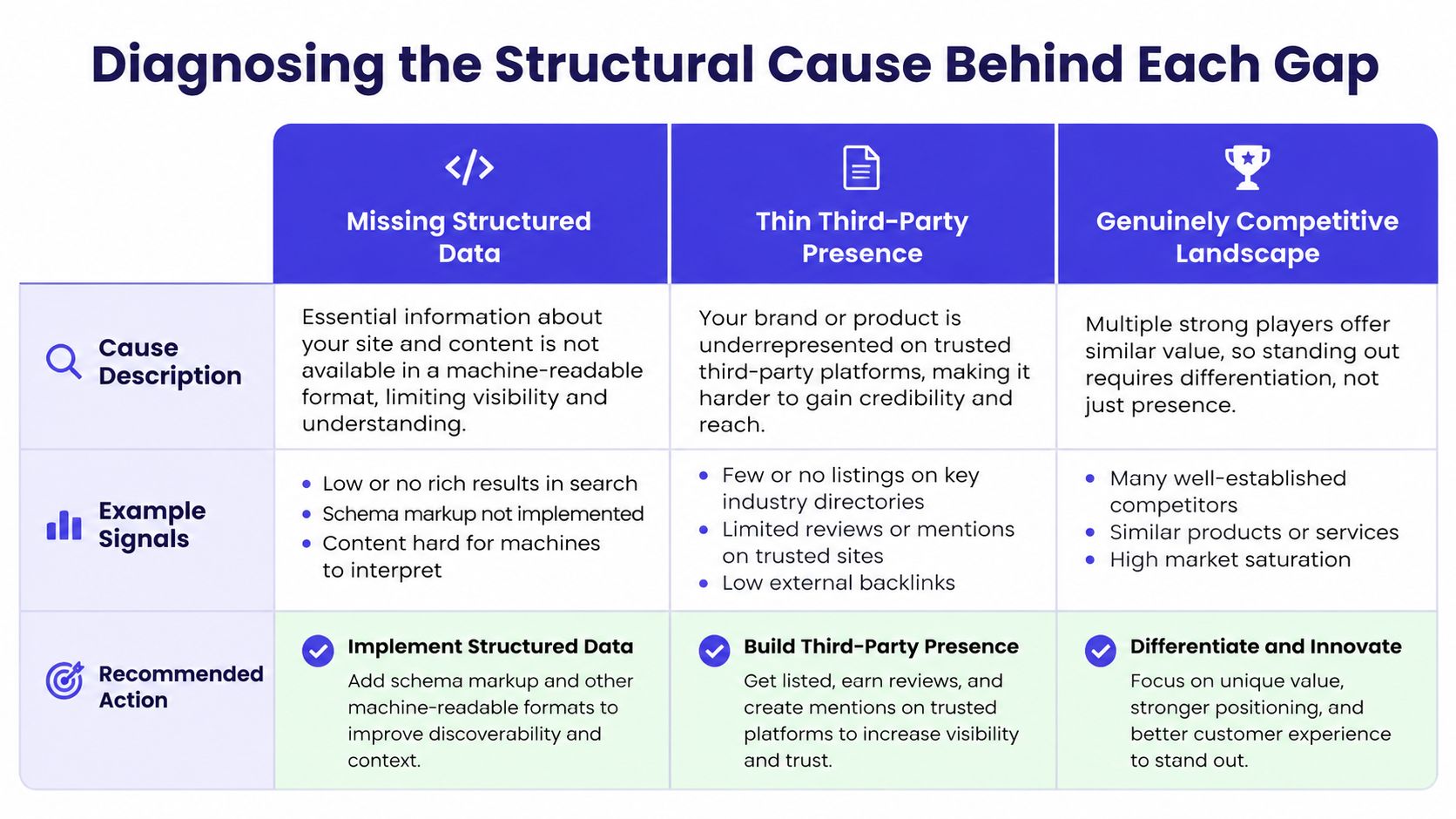
Once a missing prompt is confirmed, classify the cause before assigning work. Most gaps fit three categories: missing structured data, thin third-party presence, or absent content. A fourth condition, a highly competitive field, can overlap with any of them. Record it when several credible sources compete for the same answer, because the remedy then requires sharper positioning rather than more publishing volume.
Missing structured data
Begin with the page that should have been cited. Check whether an engine can identify the organization, product, category, author, and relationship between the page and the buyer's question. Inspect semantic HTML, Schema.org markup, title and description metadata, canonical signals, visible headings, and freshness indicators.
The GEO-16 study used a 16-pillar audit framework normalized from 0 to 1 and identified metadata and freshness, semantic HTML, and structured data as strong citation predictors. It also reported an overall page-quality odds ratio of 4.2 for being cited. Use those findings to order technical checks, not to promise that schema alone will produce a citation. The practical test is whether the markup makes the entity and its relationships easier to interpret without introducing claims the page does not support.
Thin third-party presence
A clear owned page can still lose citations when competitors appear repeatedly in independent sources. That pattern points to authority distribution. One published guide estimates that 90% to 95% of AI citations come from external sources and that brands are 6.5 times more likely to be cited through third-party sources than through their own domains (third-party AI citation sources).
Audit where the entity appears across review sites, comparison publishers, Wikipedia or Wikidata, Reddit, news, and relevant communities. Count source quality, not mentions alone. A useful source must be retrievable, relevant to the prompt, and capable of supporting the recommendation with specific evidence. The output should identify which missing source or relationship an outreach, editorial, or entity-maintenance task can address.
Genuinely absent content
Sometimes the answer does not exist on the site or within its authority network. A narrow gap calls for one focused page or counter-article that answers the missing question directly. A deeper gap calls for a topic cluster, since the engine lacks the central answer as well as supporting definitions, comparisons, and use-case evidence.
A competitive environment changes the brief. If several rivals already have strong sources, avoid publishing a generic category page and hoping volume wins. Define an angle the product can substantiate, then connect it to an entity page, a comparison, and external validation. This separates a diagnosable content gap from a retrieval problem that needs stronger references.
What Do You Ship to Close Each Kind of Gap?
Diagnosis becomes valuable only when it produces a deliverable another person can review and ship. I use a small artifact library because it prevents every gap from turning into a vague “improve authority” task.
For structured data gaps
Create a schema change request with the page URL, entity relationships, required properties, and validation notes. A developer can adapt a pattern such as:
- Schema.org pattern: connect
Organization,SoftwareApplication,Product, orWebPageentities only where the visible page supports those relationships. - Wikidata pattern: record the entity label, official website, aliases, category relationships, and independent references for editorial review.
- Acceptance check: confirm that the markup reflects visible content and that the page's headings and metadata use the same entity terminology.
Don't paste invented properties into production just because a checklist includes them. The artifact should make the relationship clearer to machines without making a claim the page can't substantiate.
For thin third-party presence
Build an outreach brief around a specific source and prompt. A concise email can read:
Subject: A source for your comparison of [category]
Your page covers [buyer question], but the implementation trade-off around [specific issue] is missing. We can provide [evidence, expert input, or product-neutral explanation] for review, along with a source that documents [verifiable point]. If it fits your editorial standards, would you consider evaluating it?
Prioritize sources based on recurring citation evidence, not prestige alone. Review sites, Wikipedia or Wikidata, Reddit, Product Hunt, and comparison publishers can each serve a different role, but an outreach target must be relevant, influenceable, and editorially appropriate.
A disciplined email process also benefits from a reusable system for research, personalization, approvals, and follow-up. High-Performance Email System offers a useful reference for structuring that operational layer, but the citation-gap artifact still needs a source-specific reason for contact.
For absent content
Write a counter-article brief with the exact prompt, intended reader, answer thesis, competitor sources, evidence your team can support, and links to related pages. If one article can't answer the surrounding questions, map a cluster with a central category page, use-case pages, comparison content, implementation guidance, and a maintained FAQ.
Coding agents can place schema edits, drafts, and content maps into the brand's repository or CMS through an approved workflow. Keep review explicit. Nothing should auto-post just because a gap was detected.
Which Gaps Should You Fix First?
A long gap list is not a strategy. Rank each prompt by buyer-prompt frequency, competitor citation rate, and addressability. Citation rate means competitor mentions divided by total prompts, while addressability separates sources your team can influence from sources that are effectively off-limits.
A practical score is:
Priority Score = prompt frequency × competitor citation rate × addressability
The addressability principle matters because a missing citation from a source you can realistically improve deserves more attention than one controlled by an inaccessible publisher. One published framework estimates that roughly 33% of cited sources are addressable and recommends collapsing URLs to domains, classifying them, and ranking gaps by prompt value and expected impact (addressable citation-gap framework).
The table below uses illustrative scores, not market measurements. The values show how to apply the method to your own normalized dataset.
| Buyer Prompt | Frequency | Competitor Citation Rate | Addressability | Priority Score |
|---|---|---|---|---|
| Best platform for workflow automation | 0.80 | 0.75 | 0.70 | 0.42 |
| Alternatives for a named competitor | 0.55 | 0.80 | 0.60 | 0.264 |
| Emerging use case with sparse demand | 0.20 | 0.90 | 0.80 | 0.144 |
The first prompt wins because buyers ask it often, a rival appears consistently, and the likely source gap is influenceable. The third sounds urgent because the competitor rate is high, but its low frequency makes it a weaker use of limited production capacity.
Prompt prioritization guidance supports focusing first on high-intent prompts where a named rival appears repeatedly while your brand is absent. Keep the score attached to the prompt record so the queue can be recalculated when buyer research, citation behavior, or source addressability changes.
From First Audit to Weekly Operating Cadence
Turn the framework into a 90-day operating rhythm. In week one, establish the buyer prompts, engine list, capture method, baseline metrics, and source taxonomy. During weeks two through four, ship artifacts against the top five gaps, assigning each fix to the specific gap it closes.
After the initial sprint, re-probe priority prompts weekly and refresh competitor benchmarks monthly. Log the exact change, owner, deployment date, affected pillar, and subsequent movement in Answer Rate, Share of Voice, or Average Citation Rank. That history helps the team distinguish a schema change from a new counter-article or an external reference campaign.
Keep measurement humility in the process. Citation selection and citation absorption can operate independently, according to a 2026 analysis of 21,143 citations across ChatGPT, Gemini, and Perplexity (citation selection and absorption analysis). A citation may appear without materially shaping the answer, so review prominence, absorbed language or evidence, and fidelity alongside citation presence.
The weekly checklist is simple:
- Probe: rerun the fixed buyer questions across the selected engines.
- Inspect: separate retrieval, citation, mention, and absorption signals.
- Classify: assign each gap to structure, third-party authority, absent content, or unstable variance.
- Ship: create and review the matching artifact.
- Recheck: compare the result only after repeated observations support a stable direction.
Don't let a one-off snapshot decide a quarter of work. Treat uncertainty as part of the metric, and make the next probe the final stage of every fix.
GetIntel helps teams measure Answer Rate, Share of Voice, and Average Citation Rank across buyer prompts and major AI answer engines, then turns citation gaps into a ranked task list across on-page, off-page, UGC, and technical fixes that a coding agent can work through. Run your first buyer-prompt audit and see where competitors are cited instead by visiting GetIntel. For turning this framework's repeated probes into a stakeholder-facing report, see how to measure GEO ROI, and for applying this same loop to one flagship SKU instead of a whole brand, see AI visibility monitoring for a single product line. For running this same framework in a thin-footprint B2B niche where keyword tools show almost no demand, see AI visibility for niche, low search volume industries.