A marketer opens ChatGPT, pastes five buyer questions, searches Perplexity for the same answers, and screenshots anything that looks important. The team compares this week's screenshots with last week's, notices a competitor appearing more often, and reports that AI visibility has changed.
That workflow feels practical because it produces visible evidence quickly. It also creates false trendlines. Phrasing, session state, and even time of day can change what a chat engine returns for the identical question, so a different answer may reflect the test rather than a real change in brand visibility.
The move from manual ChatGPT checks to automated AI visibility monitoring is therefore less about buying another dashboard and more about changing the unit of measurement. You need preserved prompts, repeatable runs, captured answers, cited sources, competitor comparisons, and scores that remain comparable across engines and time. How many reruns it takes before an automated number means anything is a separate question, measured in how many reruns before an AI visibility number means anything.
Table of Contents
- Why Manual ChatGPT Spot-Checks Are Failing Your Team
- The screenshot is not the measurement
- What Is Wrong With Ad-Hoc Prompting?
- Variability enters before the answer
- The search surface changes too
- How Do You Design a Buyer-Intent Probe Library?
- Rank prompts by commercial consequence
- Standardize without flattening the market
- Capturing Live Answers and Scoring Visibility
- Use a two-stage verification pipeline
- Define the scorecard before collecting data
- Turning Monitoring Gaps into Shipped Content Artifacts
- Match the artifact to the evidence gap
- Log every change against the score
- What Does the Workflow Look Like for a Team or Agency?
- A workable operating rhythm
- Keep humans in the approval loop
- Your Migration Checklist and Next Steps
Why Manual ChatGPT Spot-Checks Are Failing Your Team
Many early-stage SaaS teams still use the same basic routine: a founder or marketer pastes a handful of prompts into ChatGPT or Perplexity once a week, reads the answer, takes screenshots, and calls the exercise AI visibility research. It's useful for an initial qualitative read. You may discover that a competitor is being recommended, that your category is described inaccurately, or that an unexpected publication is being cited.
The problem starts when leadership asks a quantitative question. Is visibility improving? Which competitors are gaining ground? Which domains do the engines trust? Did last month's content change affect recommendations? A few manually selected answers can't answer those questions reliably because the inputs, environment, and review process drift from one check to the next.
ChatGPT's scale makes that weakness more consequential. OpenAI reported growth from 100 million weekly active users in November 2023 to 300 million in December 2024 and 400 million in February 2025, expanding the number of potentially relevant buyer queries by roughly four times in just over a year, as covered by TechCrunch's report on ChatGPT usage growth. ChatGPT Search also rolled out on October 31, 2024, reached logged-in users on December 16, 2024, and became available to all users on February 5, 2025. Search behavior inside the assistant became a repeatable discovery surface, not merely an occasional conversational experiment.
The screenshot is not the measurement
A screenshot preserves what one person saw. It usually doesn't preserve the exact prompt version, account state, location, model configuration, prior conversation context, retrieval behavior, or complete citation metadata. Without those controls, the team can't tell whether a brand disappeared because its visibility fell or because the test conditions changed.
Manual checks also bias attention toward memorable answers. Reviewers tend to record dramatic recommendations, obvious errors, or prominent competitors, while ignoring ordinary responses that would matter more in aggregate. That creates an anecdotal narrative rather than a stable sample.
Practical rule: Treat a manual check as reconnaissance. Treat a standardized probe run as measurement.
A production-grade process stores the prompt exactly, runs it on a defined cadence, captures the complete answer and visible citations, identifies every named brand, and applies the same scoring rules across engines. Daily reruns help reveal movement, while weekly review gives a human team enough context to decide what action is justified.
The shift is from “Are we visible right now?” to “How consistently do we appear across the buyer questions and engines that matter?” That's the difference between a screenshot archive and an auditable trendline.
What Is Wrong With Ad-Hoc Prompting?
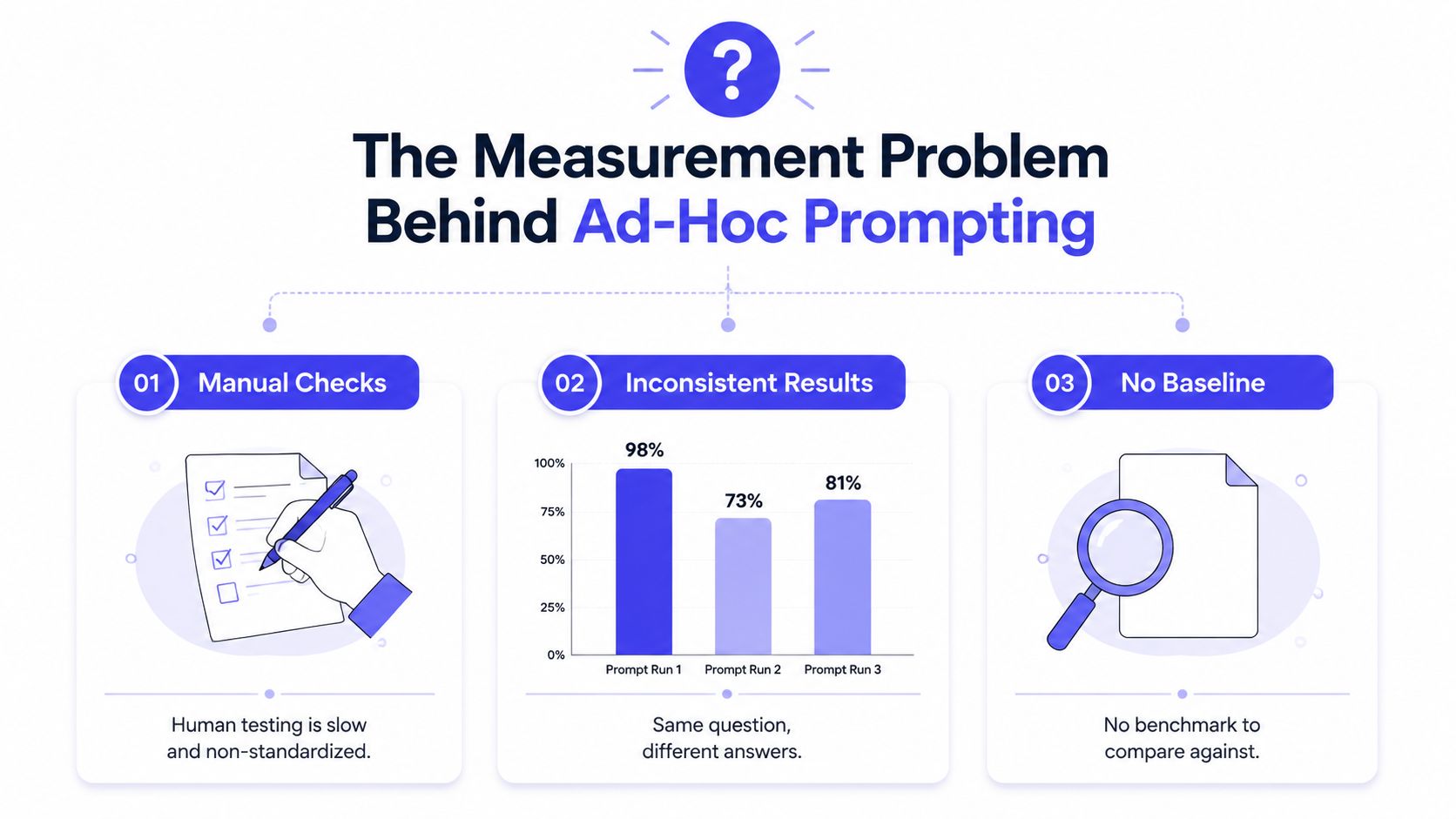
The underlying issue is not just that people test manually. The same test can produce different observations, even when the person believes they're asking the same question. Prompt architecture research has shown that order, labels, framing, and requests for justification can create methodological artifacts and statistical bias, so casual rewording changes the experiment itself, as documented in this 2025 study of prompt architecture and LLM evaluation.
A separate clinical reliability study asked the same question five times across models and found Fleiss' kappa values ranging from -0.002 to 0.984, with overall consistency below 50% for many prompt and model combinations. Those figures don't mean every commercial buyer query will behave identically, but they do establish why one person asking a question “again” isn't a dependable longitudinal method. The result may reflect output variability rather than a market change, as shown in the clinical reliability study of repeated LLM answers.
Variability enters before the answer
A person may ask “What are the best analytics tools for SaaS?” one week and “Which analytics platform should a B2B SaaS team choose?” the next. Those prompts overlap semantically, but they don't necessarily retrieve or rank the same evidence. A different session may include prior context, while a fresh session may not. A search-enabled answer can also reflect changing retrieval results.
Stylistic variation affects informational content, not only tone. A benchmark on stylistic prompt variation found that reformulating prompts changes what models communicate, while another study found instruction style shifted accuracy by up to 16.7 percentage points across ten LLMs and four reasoning benchmarks, according to this benchmark of instruction style and LLM accuracy. A later analysis also found substantial variation across same-task, same-setting runs and concluded that teams should examine distributions across independent runs, because even temperature-zero configurations can produce different conclusions, though we cannot name the study this comes from, so treat it as a caution rather than a citation.
The search surface changes too
AI visibility doesn't happen in a static environment. Reviewed against its sources on 19 September 2026. Google AI Overviews are widely reported to have appeared for 13.14% of queries in March 2025 against 6.49% in January, though we have not traced that pair of figures to whoever measured them, so read the doubling as the point rather than the decimals. Other datasets reported AI summaries on about 18% of searches, while a sample across five states found them on roughly 30% of queries. Ahrefs measured AI Overviews on about 12.8% of Google searches in June 2025, and Conductor found 18% of analyzed keywords triggered them in July, summarized in this review of AI search visibility statistics.
These differences are not contradictions to smooth away. They show that coverage varies by query class, geography, engine, and measurement window. A monitoring system needs a fixed probe library and a defined sampling method so it can distinguish real movement from changing coverage and test noise.
The practical answer is simple: preserve the exact inputs, rerun them on schedule, store the raw outputs, and score the same fields every time. Manual checks can still help interpret anomalies, but they shouldn't carry the burden of proving a trend.
How Do You Design a Buyer-Intent Probe Library?
Automation doesn't rescue a weak prompt set. If your library contains only branded questions such as “What is Acme?” you'll learn whether the model recognizes Acme, not whether buyers discover it while comparing solutions.
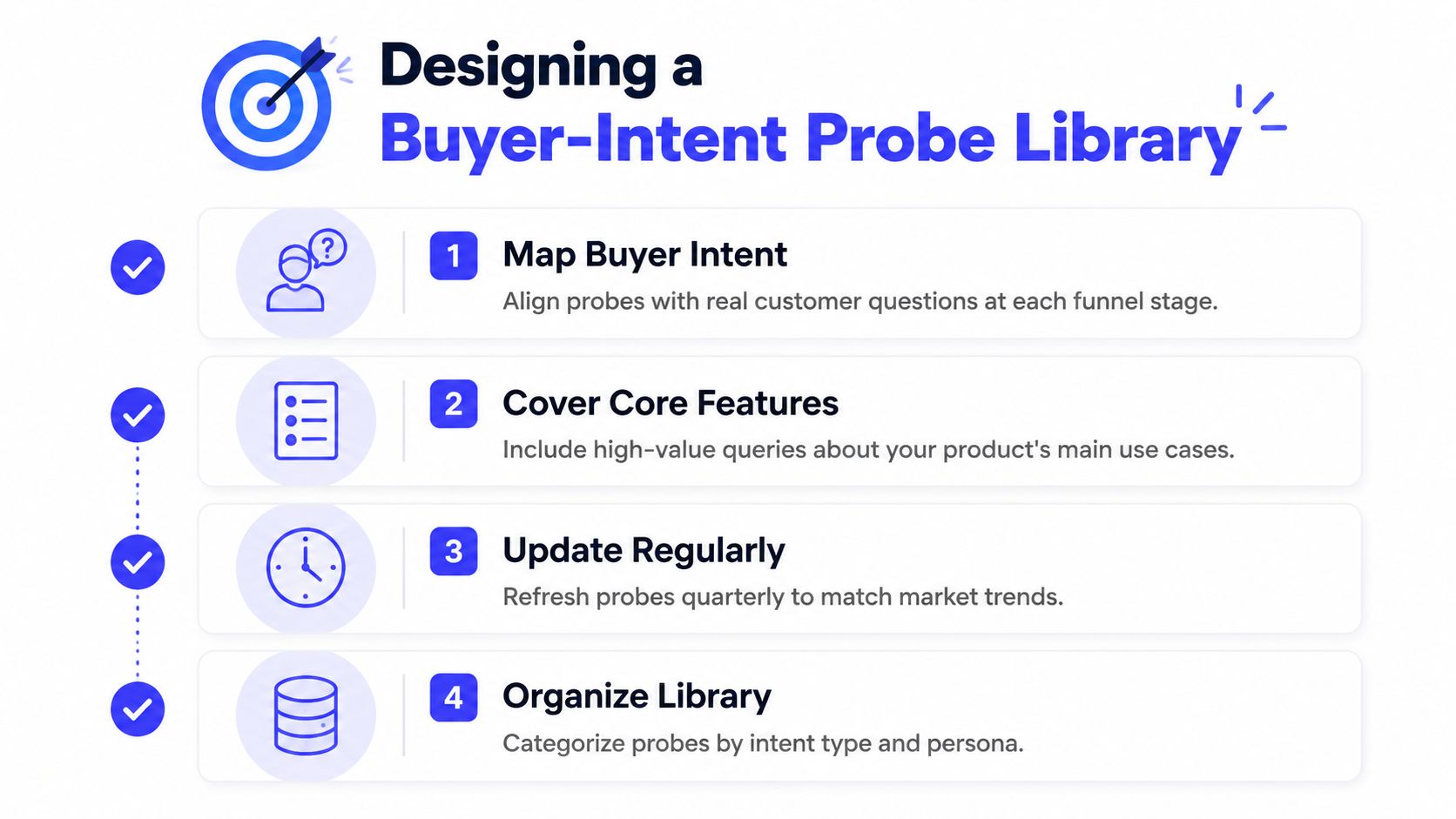
Start with the questions that precede a purchase. Pricing, alternatives, best-of lists, category definitions, implementation concerns, integrations, and problem-led searches usually reveal more commercial context than broad awareness prompts. The library should include both branded probes, where the buyer names your company, and unbranded probes, where the buyer describes the problem without knowing your product exists.
Rank prompts by commercial consequence
Don't begin by trying to represent every topic in your market. Begin with a narrow set of prompts tied to revenue paths, sales objections, and product positioning.
A useful prompt record includes:
- Intent type: Pricing, alternatives, comparison, best-of, category, or problem-led.
- Persona: For example, growth lead, product marketer, technical founder, or enterprise buyer.
- Buying stage: Discovery, shortlist, evaluation, or replacement.
- Competitor set: The brands you lose against, not every company in the category.
- Expected evidence: Product documentation, comparison pages, review platforms, community discussions, or reference sources.
- Business owner: The person responsible for interpreting or acting on the result.
This structure lets you prioritize prompts that can change pipeline conversations. A question that repeatedly produces a competitor recommendation deserves more attention than a low-intent educational question that never reaches a shortlist.
You can generate an initial set with a buyer prompt generator for structured intent research, then edit every prompt against real sales language. Customer interviews, call transcripts, support tickets, and lost-deal notes are better inputs than generic keyword lists because they reflect how buyers describe the problem.
Standardize without flattening the market
Use a canonical prompt for each intent, then create controlled variants. For example, keep the underlying task constant while varying persona or company size in a separate field. Don't let reviewers improvise wording during a weekly check, because that makes the results incomparable.
Run the same canonical probes across ChatGPT, Claude, Perplexity, Gemini, and Google AI Overviews where the query format supports it. The aim isn't to force identical answers. Each engine has different retrieval and presentation behavior. The aim is to compare how often your brand appears, where it appears, which competitors appear, and which sources support the answer under consistent inputs.
This is also where the source-selection problem becomes visible. A brand may have strong product content but remain absent because engines repeatedly cite comparison publishers, community threads, review profiles, or reference pages that don't mention it. The right response may be an earned-media effort or an entity correction, not another generic blog post.
Capturing Live Answers and Scoring Visibility
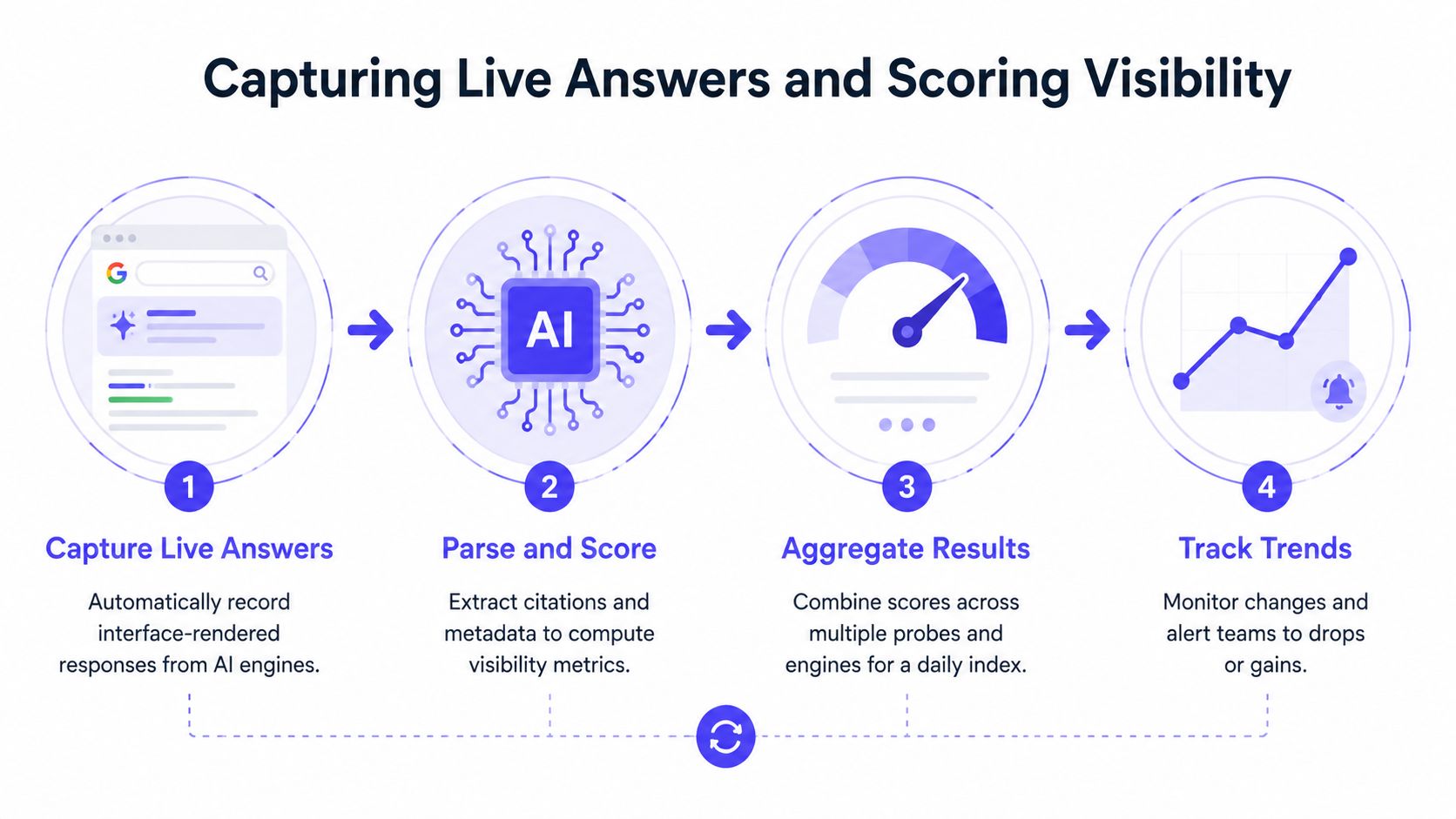
An automated system should capture what buyers see, not only what a model returns through a clean API response. Interface-rendered answers can include search summaries, visible citations, recommendation order, linked sources, and presentation details that sanitized outputs may omit.
The capture record should include the engine, probe identifier, timestamp, exact prompt, rendered answer, cited URLs, named entities, recommendation order, and any retrieval or session metadata available to the system. Keep the raw answer unchanged. Parse a separate structured record for scoring so later rule changes don't destroy the original evidence.
Use a two-stage verification pipeline
The first stage captures the live answer and extracts citations and entity mentions. The second stage verifies whether each cited source supports the relevant statement. That distinction matters because a visible citation next to a brand mention doesn't prove that the page caused the mention or supports the exact wording.
A 2025 evaluation framework found that 50% to 90% of LLM responses were not fully supported by cited sources. Even GPT-4o with web search had about 30% unsupported individual statements, and nearly half of responses weren't fully supported, according to the reference-grounded evaluation framework. A monitoring workflow that records only whether a citation exists will overstate source quality.
Specialized retrieval-based detectors perform better than generic model judgments on citation tasks. CiteCheck reached 88.7 macro-F1 and 88.9% accuracy on its test set, while other attribution benchmarks reported fine-tuned GPT-3.5 at 80% macro-F1 and citation-matching accuracy as low as 4% to 18%, detailed in this citation detection benchmark.
Define the scorecard before collecting data
Your scorecard should answer distinct questions rather than collapse everything into one opaque number.
- Answer Rate: How consistently does the brand appear across the selected prompts and engines?
- Mention rate: How often is the brand named at all?
- Recommendation position: Where does it appear when the answer recommends multiple options?
- Share of Voice: How much of the tracked answer space does the brand occupy relative to named competitors?
- Average Citation Rank: How prominently do the brand's cited sources appear among the answer's references?
Store scores at the probe, engine, competitor, and time-window levels. A category average can conceal a major loss on a revenue-critical pricing prompt, while a single dramatic answer can exaggerate a minor gain.
Entity resolution is a frequent failure point. Variations in company names, product names, parent brands, abbreviations, and similarly named companies need explicit matching rules. Don't treat raw model confidence as proof. Verify the entity and the source independently, flag ambiguous cases for review, and keep an audit trail from score to captured answer.
Turning Monitoring Gaps into Shipped Content Artifacts
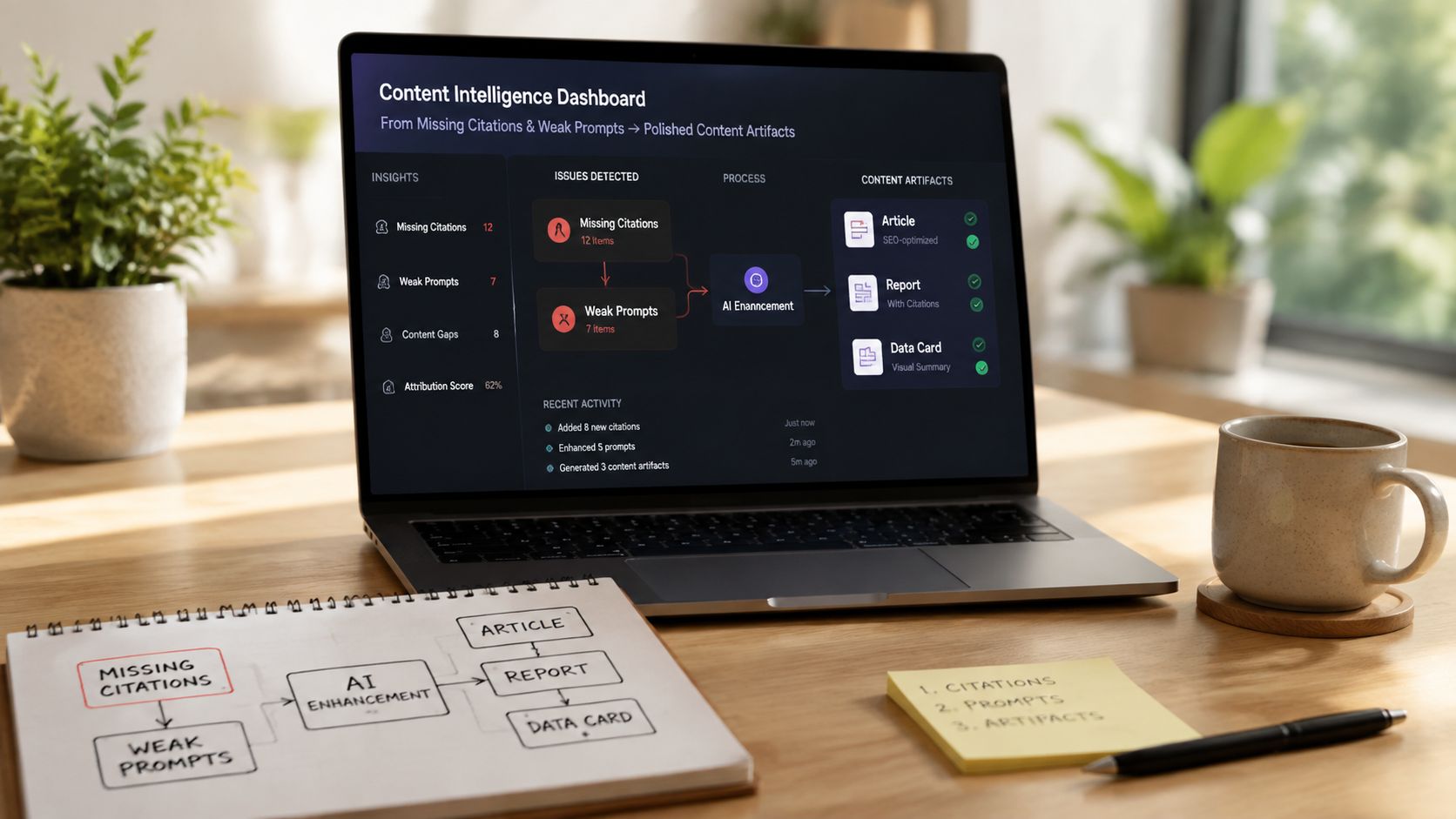
A visibility dashboard becomes useful only when it produces work someone can ship. “Publish more content” is too broad to guide a team. The actionable question is, which missing evidence would address which prompt, and where should that evidence live?
Suppose a competitor appears for an alternatives prompt because several comparison pages explain its use cases, integrations, and limitations. Your response might be a neutral counter-article that compares the relevant approaches, a product page with clearer machine-scannable facts, or targeted outreach to the publishers the engines already cite. The answer depends on the observed gap, not on a generic content calendar.
Match the artifact to the evidence gap
Use the citation record to choose the intervention:
- Foundation: Improve crawlable, structured product facts and consider an
llms.txtfile where it fits your technical approach. - Brand: Correct inconsistent naming across profiles, reference pages, and public discussions.
- Authority: Pursue coverage from the domains that repeatedly appear in relevant answers.
- Content: Build comparison pages, use-case explainers, pricing context, and counter-articles for uncovered buyer questions.
- Rankings: Strengthen the pages and external references that compete for citation placement.
Schema.org markup can clarify entities and relationships. Wikidata entries can help address public-knowledge gaps. Reddit and X monitoring can reveal recurring customer language and discussions that deserve an accurate, useful response, but neither channel guarantees inclusion in an AI answer.
A practical content workflow starts with the missing prompt, lists the competitors and cited domains, records the unsupported or incomplete claim, and assigns one artifact to an owner. A draft should include its intended prompt coverage and evidence sources before it reaches review.
Log every change against the score
Create a change record with the artifact, publication date, affected prompts, target engine, intended pillar, reviewer, and follow-up result. Don't claim causation from one movement. Compare the relevant prompt history, competitor movement, citation changes, and timing together.
This turns monitoring into an experiment ledger. Leadership can see that a source outreach campaign targeted specific cited domains, that a comparison article addressed named alternatives, or that an entity correction was designed for branded prompts. The team can then decide whether to iterate, expand, or stop based on observed evidence rather than another screenshot.
What Does the Workflow Look Like for a Team or Agency?
A lean SaaS team doesn't need everyone watching a dashboard all day. It needs a dependable cadence with clear ownership.
Run the probe capture daily when the category or campaign is moving quickly. Review anomalies and newly cited sources during a weekly working session. Use a monthly report to explain trend movement, competitor changes, shipped artifacts, unresolved risks, and the next decisions.
A workable operating rhythm
Daily automation should capture live answers, citations, entity mentions, recommendation position, and errors. Alert only on meaningful events, such as a sustained visibility drop, a competitor entering a priority probe, a citation source disappearing, or an answer making a materially inaccurate claim.
Weekly review belongs to a growth or product marketing owner. Compare branded and unbranded probes, inspect changed citations, validate the most important answer-level findings, and assign artifacts. Connect referral observations from Google Search Console and Ahrefs without pretending those tools reveal every prompt or recommendation.
Monthly reporting should show trend histories and competitor benchmarks. Slack notifications, Zapier workflows, webhooks, CSV exports, and API or MCP access can route findings into the systems the team already uses.
Keep humans in the approval loop
Gap-closing drafts can move to Claude Code or Cursor through MCP for implementation in a repository. A CMS workflow can prepare content for WordPress, Ghost, or Webflow, but review should remain explicit. Automated publication without source verification can turn a visibility effort into a factuality problem.
Agencies need a separate operating model. Multi-brand work requires isolated prompt libraries, competitor sets, source records, permissions, and reporting views. Eligible plans may support unlimited seats, while scheduled white-label reports help standardize client communication. The important control is not the seat count. It's whether every recommendation can be traced to a captured answer and a defined action, as outlined in this guide to AI visibility monitoring for enterprise multi-brand portfolios.
Your Migration Checklist and Next Steps
You've outgrown manual checks when different people use different prompts, screenshots can't be compared, leadership asks for trendlines, or nobody can explain why a competitor appears more often. Start with a focused library of high-intent branded, category, alternatives, pricing, and best-of probes. Add the competitors buyers consider, then standardize the wording and run it across the engines that influence your audience.
Your minimum viable monitoring system should:
- Preserve evidence: Store exact prompts, rendered answers, citations, timestamps, and entity matches.
- Score consistently: Track Answer Rate, mention rate, Share of Voice, recommendation position, and Average Citation Rank.
- Verify support: Check whether cited sources support the claims instead of counting citations blindly.
- Ship fixes: Turn prompt gaps into reviewed artifacts, then log each change against the metric it's meant to move.
- Report movement: Benchmark against competitors cited by the engines, not abstract keyword estimates.
A platform such as GetIntel measures exactly that, runs daily cross-engine probes, benchmarks competitors, and turns the gaps into a ranked task list a coding agent can work through in your own codebase. The objective isn't to eliminate human judgment. It's to give that judgment reliable evidence.
GetIntel turns manual ChatGPT and Perplexity checks into daily, cross-engine probe runs with captured answers, citation tracking, competitor benchmarks, and reviewable gap-closing artifacts. Visit GetIntel to evaluate whether your current process is ready for auditable AI visibility monitoring.