The popular advice is simple: move a large share of your SEO budget into GEO before competitors get ahead. That sounds decisive, but it often produces a familiar failure pattern. Teams reduce investment in technical SEO, authority building, or commercial content, then struggle to prove that the new AI-search work influenced pipeline.
A better approach to GEO vs traditional SEO budget allocation treats GEO as a distinct measurement-and-experimentation function, not merely another content label. Traditional SEO still supports discovery, rankings, and much of the infrastructure that AI systems rely on, while GEO helps your brand appear in generated answers, recommendations, and citations. The right split depends on category, buying stage, technical maturity, and the prompts your buyers use.
| Decision area | Traditional SEO | GEO | Budget implication |
|---|---|---|---|
| Primary outcome | Visibility in ranked search results | Visibility in AI-generated answers and citations | Fund both surfaces, but assign separate outcomes |
| Core work | Technical SEO, content, internal links, authority | Prompt testing, citation monitoring, entity work, experimentation | GEO shouldn't silently consume the content budget |
| Main KPIs | Rankings, organic traffic, conversions | Citation rate, prompt coverage, share of voice | Use channel-specific metrics before revenue analysis |
| Measurement maturity | Established platforms and workflows | Emerging, fragmented, interface-dependent tracking | Reserve money for instrumentation |
| Typical starting posture | Majority allocation | Minority allocation | Shift only when buyer behavior and evidence justify it |
Table of Contents
- Why the SEO Is Dead Framing Misses the Point
- Where the budget pressure is real
- What Did Search Budgets Look Like Before GEO?
- What the old budget actually funded
- Pre-AI Search Budget Allocation Baseline
- How Do GEO and Traditional SEO Compare?
- Where each dollar goes
- What works and what doesn't
- Sample Budget Mixes by Company Stage and Category
- Early-stage B2B SaaS
- Mid-market e-commerce
- Enterprise SaaS and category variation
- Which Measurement Layer Do Budget Models Miss?
- Why measurement deserves a line item
- Build or buy
- A Reporting Template That Ties Both Channels to Revenue
- Define the metrics before collecting them
- Your First 90 Days of Reallocation
- Days 1 to 30
- Days 31 to 60
- Days 61 to 90
Why the SEO Is Dead Framing Misses the Point
Declaring SEO dead misreads a split in search behaviour as a replacement, and budgets set on that reading tend to cut the channel that still delivers most of the traffic. Before splitting a budget it is worth knowing what each engine tier actually buys: on our own coverage data the second engine carries almost all the value, and the tools in this category are priced very differently.
“SEO is dead because of AI” is the kind of claim that appears in planning meetings when a genuine shift needs a dramatic headline. AI Overviews and answer engines can reduce the need to click for some informational queries, but that doesn't eliminate the search results page. Buyers still use traditional SERPs to compare vendors, inspect product pages, evaluate pricing, read documentation, and request demos.
That distinction matters most in B2B SaaS. A buyer asking an AI assistant to explain a category may accept a synthesized answer without visiting a website. A buyer comparing implementation requirements, security documentation, integrations, or contract options still needs reliable commercial evidence. Those journeys may begin in an AI interface, but they often return to websites, review platforms, and conventional search results before a purchase conversation.
The practical definition of GEO vs. SEO makes the difference clear. SEO improves how a site is crawled, understood, indexed, and ranked. GEO focuses on whether AI systems select, summarize, mention, or cite a company when generating an answer. The surfaces overlap, but the operating questions aren't identical.
The working rule: GEO expands your search visibility. It doesn't replace the infrastructure that makes your information discoverable in the first place.
Where the budget pressure is real
Search behavior is splitting across classic engines and AI answer systems. A 2025 industry summary reported 2 billion monthly users for Google AI Overviews, 100 million monthly active users for Google AI Mode, and 31% of Gen Z completing searches on AI platforms (industry summary of generative search behavior). Those figures justify experimentation, especially in categories where buyers ask recommendation and comparison questions.
They don't justify an automatic all-in pivot. Traditional organic search still drives 50% to 75% of total search traffic, according to a 2024 budgeting guide (search budget guidance from AccuraCast). In practice, the strongest programs preserve SEO's majority role while creating a clearly owned GEO test budget.
The mistake isn't investing in GEO. The mistake is funding GEO as if visibility in an answer engine were just another keyword ranking, then cutting the foundational work that supports both channels.
What Did Search Budgets Look Like Before GEO?
GEO should not begin as a line item carved out of SEO. Traditional SEO still carries most of the acquisition load, while GEO needs a separate budget for measurement and controlled experimentation. The right split depends on category maturity and how often buyers use recommendation, comparison, and problem-solving prompts.
Before AI search entered annual planning, B2B teams grouped SEO spending around established activities. Content production, technical improvements, authority development, and reporting competed for a defined organic-search budget. Paid search usually sat in a separate performance category because its buying mechanics and reporting paths were familiar.
A 2024 marketing budget snapshot placed SEO at 10% of digital channel allocation and paid search at 14% (SEO budget snapshot). These figures are a reference point, not a prescription. They show that traditional SEO already held a meaningful position in digital budgets before teams had to fund prompt monitoring, citation analysis, or answer-engine tests.
Reviewed against its sources on 19 September 2026. An unnamed 2025 survey of search marketing budgets is widely quoted as finding that 56% of companies dedicated 10% to 40% of total marketing spend to SEO and PPC, with monthly allocations fragmented: 25% under $500, 32% between $500 and $2,000, 16% between $2,000 and $5,000, and 10% above $5,000. We have not been able to trace that survey to whoever ran it, so treat the split as indicative rather than measured. By our own four-check test for a usable statistic, a figure you cannot trace to someone who measured it does not pass. That distribution limits how quickly a company can create a new channel budget. GEO generally has to prove its value inside an existing search program before finance approves a larger standalone allocation.
What the old budget actually funded
A traditional search budget funded a consistent set of things, whatever the split. The exact mix differs by company, but the operating pattern holds:
- Content production: Research, briefs, editorial work, product education, comparison pages, and updates.
- Technical SEO: Crawlability, indexation, templates, structured data, performance, and technical tooling.
- Authority and distribution: Digital PR, partnerships, link acquisition, and third-party coverage.
- Measurement: Search Console, analytics, rank tracking, dashboards, and conversion reporting.
GEO adds work that does not fit neatly into article production. Teams need prompt libraries, live answer capture, citation-source intelligence, entity consistency checks, structured-data validation, and experiment logs. Without a separate cost center, leadership cannot distinguish an asset built for search demand from work intended to improve AI retrieval, sales enablement, or all three.
Gartner forecast that worldwide generative AI spending would reach $644 billion in 2025, up 76.4% from 2024. That is Gartner's own published forecast rather than a measurement of what was spent. The broader point is budgeting discipline. AI investment is being evaluated as its own category, so GEO can be presented as a measurement and experimentation program rather than an unexplained reduction in SEO capacity.
Pre-AI Search Budget Allocation Baseline
| Budget Category | SEO % of Total | Paid Search % of Total | Primary Activities |
|---|---|---|---|
| Content and landing pages | Core share | Core share | Search-intent content, commercial pages, ad destinations |
| Technical infrastructure | Core share | Supporting share | Crawlability, templates, tracking, feed and landing-page health |
| Authority and distribution | Core share | Limited direct role | Digital PR, partnerships, link acquisition |
| Analytics and reporting | Core share | Core share | Search Console, analytics, rank and conversion reporting |
| GEO experimentation | Not separately defined | Not separately defined | Prompt tests, citation tracking, entity and answer-engine analysis |
Create a GEO experimentation and measurement bucket beside established SEO activities. Keep shared technical foundations funded jointly, then shift the GEO share according to category maturity and buyer-prompt behavior. Content should not lose its base allocation merely to make an emerging channel appear funded.
How Do GEO and Traditional SEO Compare?
Budget allocation improves when teams compare operating realities instead of arguing over channel labels. SEO and GEO use some of the same inputs, yet they influence different buyer moments. SEO measures whether a page can earn visibility and a click. GEO measures whether an answer engine treats the company as a credible source or recommendation.
| Criterion | Traditional SEO | GEO, Generative Engine Optimization | Budget implication |
|---|---|---|---|
| Primary goal | Rank for relevant searches and earn visits | Appear in generated answers, recommendations, or citations | Fund the surface that influences the category |
| KPIs | Rankings, impressions, organic traffic, conversions | Citation rate, prompt visibility, citation position, share of voice | Keep GEO out of rank-only reporting |
| Time to impact | Compounding and competitive | Early signals can appear, while consistency requires testing | Fund learning before demanding scale |
| Measurement maturity | Established tools and attribution conventions | Fragmented, platform-specific, and interface-dependent | Give measurement its own budget |
| Cost structure | Content, technical work, links, and established tooling | Monitoring, prompt libraries, analysis, entity work, and targeted content | GEO may need fewer assets but more specialist analysis |
| Main risk | Crowded SERPs and declining clicks on some informational results | Unclear attribution and unstable answer behavior | Use controlled experiments and conservative claims |
| Strategic advantage | Proven demand capture and durable infrastructure | Early visibility in an underdeveloped measurement environment | Test where buyer prompts show real exposure |
Where each dollar goes
Traditional SEO usually deserves the next dollar when a site has technical debt, weak commercial coverage, or limited authority. Prompt testing cannot compensate for product pages that search engines and crawlers cannot reliably access. Technical improvements, useful content, internal linking, and credible third-party references support conventional rankings while also giving answer engines stronger material to evaluate.
GEO earns a larger allocation as category questions appear regularly in AI-generated answers and competitors recur in those responses. The work includes building prompt sets around pricing, alternatives, integrations, implementation, and “best” queries, then monitoring what each engine says and cites. The focus is clear, verifiable, structured expertise that appears in the sources answer engines use, rather than pages written to sound machine-generated.
Treat GEO as a separate measurement-and-experimentation budget, not a content line item carved out of SEO. Shared technical foundations remain jointly funded, while GEO spending should rise or fall with prompt exposure, citation quality, and evidence of buyer influence. The guide to B2B budget allocation provides useful context for connecting channel investment to pipeline economics instead of vanity exposure.
What works and what doesn't
A practical GEO program often starts with pages and sources that already have authority. Teams can then test clearer definitions, stronger evidence, structured data, and consistent entity information. The review must extend beyond owned content, since AI systems may draw from review sites, communities, industry publications, and reference sources.
Generic “AI-optimized” article batches tend to waste budget when the team has not identified the prompts that matter or checked whether any engine cites the resulting pages. Reporting mentions without separating a passing brand reference from a recommendation on a high-intent buyer prompt creates the same problem. The GEO content scorer can support editorial review by assessing content quality, but its score cannot replace live-answer observation or revenue analysis.
Traditional SEO still carries most of the load for demand capture. GEO should receive more funding only where buyer-prompt behavior creates measurable exposure and the team can test whether that exposure contributes to qualified pipeline.
Sample Budget Mixes by Company Stage and Category
A single global percentage is convenient for planning and usually wrong in execution. The allocation should reflect how much conventional search infrastructure the company has, how often buyers ask AI systems category questions, and whether competitors already occupy those answers.
| Company Stage | Traditional SEO % | GEO % | Primary Focus Areas | Shift Triggers |
|---|---|---|---|---|
| Early-stage B2B SaaS | 85% | 15% | Technical foundation, useful content, authority, prompt baseline | Competitors appear consistently in important buyer prompts |
| Mid-market e-commerce | 70% | 30% | Product and category SEO, structured data, shopping-answer tests | AI assistants influence product comparisons and discovery |
| Enterprise SaaS | 60% | 40% | Mature SEO maintenance, entity authority, answer-engine coverage | High-intent prompts show sustained competitor visibility |
Early-stage B2B SaaS
An early-stage SaaS company with limited domain authority should begin at 85% traditional SEO and 15% GEO. Most of the SEO allocation belongs in crawlable architecture, foundational product and problem content, internal linking, technical cleanup, and credible distribution. The GEO portion should fund prompt research, manual answer capture, citation detection, and a baseline for branded and non-branded questions.
The shift trigger isn't a fashionable AI announcement. It's evidence that buyers are asking questions the company can credibly answer and that competitors are being named while the company is absent. If the site still has major indexation or positioning problems, move the next dollar to the foundation.
Mid-market e-commerce
An established e-commerce brand can justify 70% SEO and 30% GEO. SEO continues to support category pages, product discovery, internal linking, merchandising content, and technical health. GEO work can focus on product schema, comparison language, availability signals, reviews, and the questions shoppers ask assistants before selecting a product.
The balance should move only when answer-engine monitoring shows meaningful product-category exposure. If AI systems can't identify the brand, product attributes, or differentiators, improve the underlying entity and product information before scaling content experiments.
Enterprise SaaS and category variation
A mature enterprise SaaS company may test a 60/40 split because it has already built much of the conventional search foundation. The GEO allocation can support multi-engine prompt coverage, competitive citation analysis, original research, digital PR, entity work, and experimentation around complex buying questions.
Category changes the model further. Local services may need more GEO attention around map visibility, recommendations, and voice-style queries, while complex B2B solutions still depend heavily on long-tail commercial content and technical credibility. Practitioner frameworks range from 55% traditional SEO, 30% GEO, and 15% measurement or experimentation to approximately 65% to 70% SEO and 25% to 35% GEO, reflecting the absence of a universal split (independent 2026 allocation framework).
Which Measurement Layer Do Budget Models Miss?
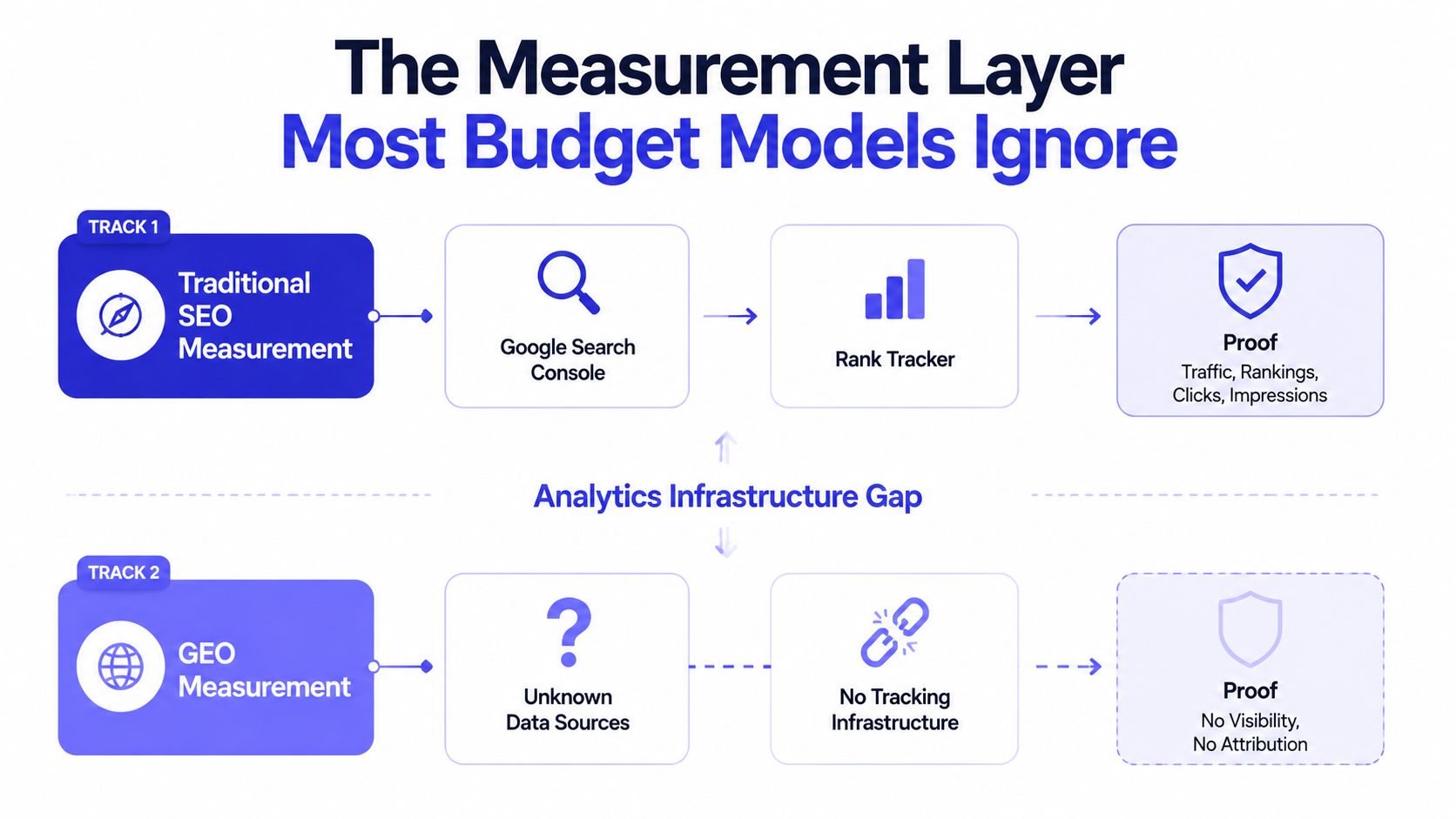
GEO fails financially when the team funds visibility work but not the system that records whether visibility changed. Traditional SEO has familiar reference points in Google Search Console, rank trackers, analytics platforms, and CRM attribution. GEO requires teams to observe live answers, repeat prompts, compare engines, inspect cited sources, and record changes over time.
The measurement layer should include:
- Citation tracking: Record whether ChatGPT, Claude, Perplexity, Gemini, and Google AI Overviews mention or cite the brand for defined prompts.
- Prompt-based research: Capture how buyers phrase category, alternative, pricing, implementation, and comparison questions.
- Sentiment and accuracy review: Check whether models describe the company correctly and whether recommendations include the right strengths and limitations.
- Competitive share of voice: Compare brand presence with the competitors named in the same answer sets.
- Change logs: Tie each technical, content, PR, or entity change to later visibility observations.
Why measurement deserves a line item
The market has no settled view on whether GEO belongs in content, PR, SEO, or analytics. Some guidance recommends 70% to 80% core SEO and 20% to 30% AI-search optimization, while other frameworks recommend 80% to 90% SEO and 10% to 20% GEO (practitioner budget guidance). The disagreement isn't only about channel maturity. It reflects a missing ownership model.
A team that funds GEO content without measurement creates a vicious cycle. Leadership sees uncertain attribution, compares it with clearer SEO reporting, and moves the budget back to traditional work. The answer is to classify monitoring and experimentation as an operating cost of GEO, not as overhead that gets removed when budgets tighten.io/blog/direct-mail-roi) for ideas about assigning campaign identifiers and connecting activity to downstream outcomes.
Build or buy
Build a lightweight system when the company has a narrow category, a small prompt set, and technical capacity to store answer captures and review them consistently. Buy or adopt a dedicated platform when the company operates across several engines, regions, brands, or complex buyer journeys. The decision should follow the cost of missed visibility and the number of prompts that require repeat observation, not a preference for a particular dashboard.
GetIntel is one option for teams that need daily AI visibility tracking, buyer-prompt probes, citation-source intelligence, competitor benchmarks, and implementation-ready artifacts across supported answer engines. Whether a team uses it or another system, the budget principle remains the same. If no one owns the evidence, no one can defend the allocation.
A Reporting Template That Ties Both Channels to Revenue
The monthly report should prevent two common errors. First, it shouldn't treat every AI mention as a qualified lead. Second, it shouldn't count the same opportunity once as organic-sourced and again as GEO-influenced because the buyer used several research surfaces.
Use three reporting tiers.
- Channel-specific visibility: SEO reports rankings, impressions, click-through rate, landing-page sessions, and conversions. GEO reports prompt coverage, citation rate, answer position, source-domain presence, and competitor share of voice.
- Shared engagement quality: Both channels feed content consumption, return visits, assisted conversions, demo quality, sales acceptance, and opportunity progression.
- Unified revenue attribution: The CRM records sourced pipeline, influenced pipeline, customer acquisition cost, sales cycle movement, and closed revenue using one attribution policy.
| Metric Category | Traditional SEO KPIs | GEO KPIs | Shared Business Metrics | Reporting Cadence |
|---|---|---|---|---|
| Visibility | Rankings, impressions, indexed pages | Prompt coverage, citation rate, answer presence | Branded demand and category reach | Monthly |
| Engagement | Organic sessions, CTR, landing-page actions | AI referrals, cited-source visits, direct response signals | Engaged accounts and content consumption | Monthly |
| Quality | Lead-to-opportunity rate, sales acceptance | Prompt-level intent and recommendation context | Qualified pipeline and opportunity progression | Monthly |
| Revenue | Sourced organic pipeline and closed revenue | Sourced or assisted AI pipeline where identifiable | CAC, influenced deals, revenue | Monthly and quarterly |
| Operations | Technical fixes, content releases, link activity | Prompt tests, citation-source changes, experiments | Cost per outcome and resource utilization | Quarterly |
Define the metrics before collecting them
An AI Citation Rate can be defined as the percentage of relevant monitored prompts where the brand appears in the top three generated responses. Keep the prompt set stable enough to compare periods, record the engine and date, and separate cited, mentioned, and absent outcomes. A citation without a relevant or accurate description shouldn't receive the same interpretation as a strong recommendation on a commercial prompt.
Use UTMs for identifiable AI referrals, but don't assume every answer-engine visit will preserve referral data. CRM tagging should record the declared first-touch or source context, while a separate influence field can capture whether an AI answer was part of the buyer's research. This preserves a single sourced-pipeline number without erasing the role of GEO in a multi-touch journey.
A useful executive summary answers three questions:
- Efficiency: What did we spend per AI citation, and what did we spend per organic click?
- Quality: Which channel produced more sales-accepted or opportunity-qualified pipeline?
- Decision: Which experiment should continue, stop, or receive additional funding?
Review the full allocation quarterly. Increase GEO funding when high-intent prompt coverage improves, competitor presence remains material, and branded or direct demand moves in a direction consistent with the experiments. Keep GEO at maintenance level when visibility is low because the category has limited AI exposure, the prompts lack commercial relevance, or the measurement system can't distinguish signal from noise.
Your First 90 Days of Reallocation
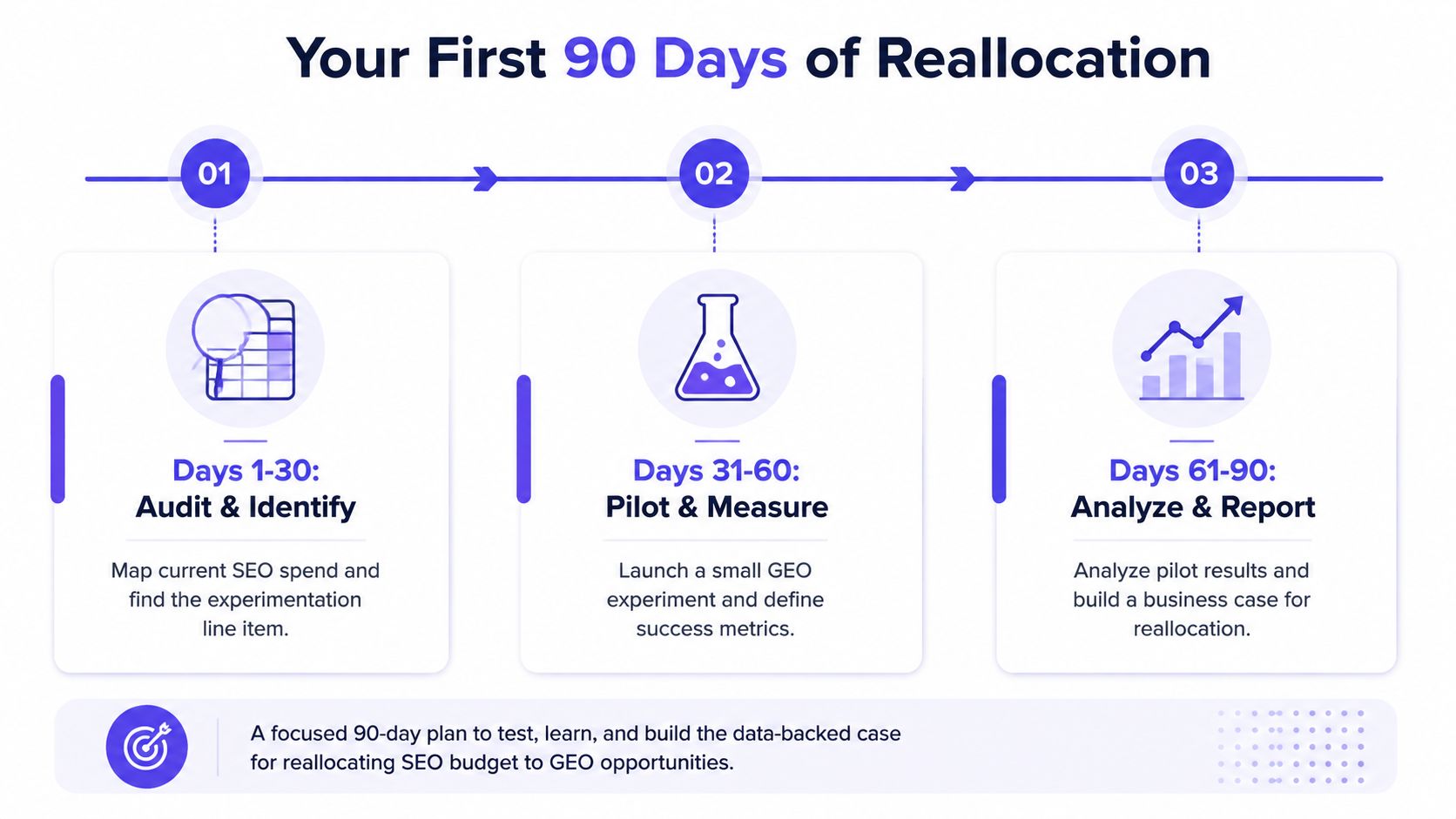
The first 90 days shouldn't be a content sprint. Treat GEO as a controlled operating experiment with a named owner, a fixed prompt set, documented changes, and a decision date.
Days 1 to 30
Audit every existing SEO line item and separate shared foundations from channel-specific work. Identify which pages, reviews, publications, and community discussions already appear in AI-generated answers. Build a baseline for prompt coverage, citation presence, competitor mentions, answer accuracy, and identifiable AI referrals.
Don't start by rewriting the entire blog. Start with the buyer questions that influence evaluation, including alternatives, pricing, implementation, integrations, and category recommendations.
Days 31 to 60
Run a focused pilot on a small group of authoritative pages. Reformat important answers for clear extraction, improve headings and semantic structure, verify structured data, strengthen evidence, and correct inconsistent company or product information across external sources.
Record every change and rerun the same prompts across the relevant engines. Look for directional relationships between improved AI visibility, branded searches, direct visits, qualified conversations, and sales feedback. Treat correlation as a reason to investigate, not as proof of revenue causation.
Days 61 to 90
Hold a formal budget review. Compare the GEO pilot with traditional SEO outcomes using the same commercial standards, including qualified pipeline, sales acceptance, content-assisted progression, and cost per meaningful visibility outcome. Scale when buyer prompts show sustained category relevance, competitors continue to occupy valuable answers, and the measurement layer records repeatable movement.
Keep GEO as a maintenance and learning line when prompts have little buying intent, the company lacks foundational authority, or results can't be reproduced. Redirect funds to technical SEO, commercial content, or authority development when those investments address a clearer constraint.
The biggest mistake is funding GEO content creation without funding the analytics layer that proves whether it works. Create the evidence first, then let evidence determine the split.
GetIntel helps growth teams measure how ChatGPT, Claude, Perplexity, Gemini, and Google AI Overviews present their brands, with buyer-prompt probes, citation-source intelligence, competitor benchmarks, and implementation workflows. Visit GetIntel to establish a defensible GEO baseline before reallocating more of your traditional SEO budget.