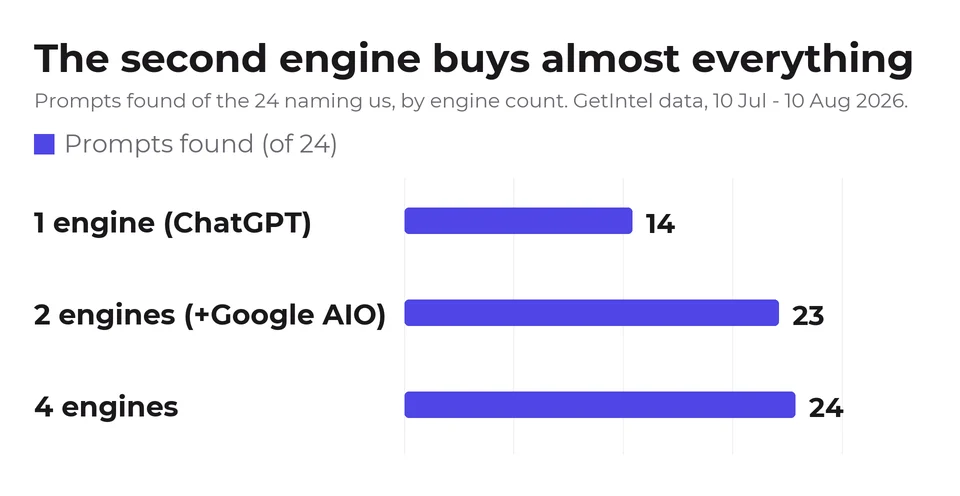
Most AI visibility tools price by how many engines they track, so the question worth asking is what each additional engine is actually worth. On our own coverage data, the second engine carries almost all of it: one engine finds 58.3% of the questions we are named on, two find 95.8%, and the third and fourth add 4.2 points between them.
That matters because the pricing steps do not follow the value curve. They tend to jump from one engine to three, which prices the cheap part of the improvement together with the expensive and nearly worthless part.
GetIntel publishes this and is one of the two products in it. We quote only published prices, we have not tested the other product, and the dataset is published.
What does each extra engine actually buy?
The second engine buys almost all of the extra coverage: one engine finds 14 of the 24 prompts that name us, two find 23, and all four find 24.
| engines tracked | prompts found, of 24 |
|---|---|
| 1, ChatGPT only | 14 (58.3%) |
| 2, ChatGPT + Google AI Overviews | 23 (95.8%) |
| 4, all we track | 24 (100%) |
The reason is that coverage barely overlaps. Half the prompts naming us appear on exactly one engine, so a single-engine view is a slice rather than a sample. We measured that separately in our piece on tracking all engines together.
The corollary is the part vendors do not advertise: past two engines you are paying for completeness rather than information. That is a legitimate thing to buy, particularly if compliance or reporting requires it. It is not a discovery upgrade.
What do the tiers cost?
Engine tiers ran from $29 to $399 a month across the vendors compared here, read from each vendor's own pricing page on 11 August 2026. The coverage figures above come from probe data through 10 August 2026, so the two dates differ by a day: prices were checked live when this was written, the measurement window had already closed. Prices change and these will go stale, so re-check before relying on them.
| engines | prompts | price | |
|---|---|---|---|
| Profound (withdrawn Sep 2026) | ChatGPT only | 50 | $99/month billed yearly |
| Profound (withdrawn Sep 2026) | 3 answer engines | 100 | $399/month billed yearly |
| GetIntel | 4 engines | 25 | $29/month |
| GetIntel | 4 engines | 60 | $79/month |
| GetIntel | 5 engines incl. Claude | 120 | $149/month |
We are obviously not a neutral party to that table. What we can say without being self-serving is the structural point: a one-engine tier caps you near 58% of your findable questions by our coverage figures, and the step to three engines is a four-fold price increase with no two-engine option in between. The pricing ladder and the value curve are not the same shape.
Profound's enterprise tier is quoted on request, so it is not in the table. Profound has since withdrawn the $99 and $399 self-serve tiers shown above entirely, confirmed against its live pricing page on 17 September 2026, so those two rows are a record of August 2026 pricing rather than a current quote. Prompt allowances are also not equivalent units between vendors, because how often a prompt runs matters as much as how many you get.
Is a cheaper tool actually the same thing?
A cheaper AI visibility tool is not the same thing as a dearer one, and we are not going to pretend price is the only axis.
We have not tested Profound's product. We do not know its data quality, its answer-capture method, its reporting depth or its support, and none of that is visible from a pricing page. A comparison built only on published prices is a comparison of published prices.
What we would tell a buyer to compare instead is what each tool stores per run: the full cited source list, the raw answer text, run counts on every figure and a prompt set that cannot be silently rewritten. Those are answerable on a demo call and they determine whether any of the numbers you are paying for can be checked.
What should I actually pay for?
Pay for runs before engines, and prompts before either.
If a budget forces a trade, more runs on fewer engines beats fewer runs on more. A single check on a prompt that varies is off by 33 percentage points on average, so an under-sampled four-engine number is less useful than a well-sampled two-engine one. The arithmetic is in our work on how many reruns a number needs.
A fuller breakdown of what each tier costs across the category, including the hidden costs of monitoring-only tools, is in our pricing guide. Prompt count matters for a different reason: it sets how much of your buyer's question space you can see at all. Our own 60 prompts left 36 with no mention, and a 30-prompt allowance would have hidden half of those gaps rather than fixed them.
Engine count is the axis vendors price on and the one with the flattest return past two. How that splits against a traditional SEO budget is worked through in GEO versus traditional SEO budget allocation.
Does this mean a $99 one-engine tier is bad value?
A $99 one-engine tier is not inherently bad value, and the honest answer depends on which engine it covers.
If your buyers are overwhelmingly on ChatGPT, a ChatGPT-only tier tracks the surface that matters and the missing 41.7% is coverage you may not need. The problem is that you cannot know whether that describes you until you have measured more than one engine, which is the circularity in buying a one-engine tool first.
Our suggestion is to use a free trial or a manual pass across two or three engines before committing to a tier that fixes the answer. That is cheap advice for us to give since we have a free tier, so weigh it accordingly.
What doesn't this comparison prove?
This comparison does not prove the coverage curve generalises. It is ours, from 60 prompts in one category over one month. A brand whose citations sit mainly on Perplexity would find the second engine somewhere else entirely, and the 58.3% figure would not transfer.
We have quoted prices from public pages on a single day and they will change. Nothing here should be treated as current pricing after that date.
And we have compared what is published, not what is delivered. A pricing table cannot tell you whether a tool's numbers are trustworthy, which is the thing that actually matters and the thing neither of us can demonstrate from a table.