Yes, track them in one place, and no, not every engine earns its slot. Across our 60 tracked prompts between 10 July and 10 August 2026, 24 named us on at least one engine. ChatGPT and Google AI Overviews together found 23 of those 24. Perplexity and Gemini added one prompt between them, and Gemini found nothing the other three had not already found.
The reason to want a single view is not that four numbers are better than two. It is that half the prompts naming us are found on exactly one engine, so any single-engine check silently misses most of your coverage.
To answer the question directly first: GetIntel tracks ChatGPT, Google AI Overviews, Perplexity and Gemini in one dashboard, per prompt and per engine, which is where every number in this article comes from. Each engine also has a tracker page of its own, including ChatGPT brand tracking and Perplexity brand tracking. Several other tools track multiple engines too and the alphabetical list of the eighteen appearing in our own citation data is in our piece for agencies, and what engines actually name when a founder asks is measured separately.
Separately, and this is the uncomfortable part for us: the data below argues you may only need two of those four. We sell the four. The dataset is published so you can check the argument against us.
How much does each engine actually add?
Less than a four-engine dashboard implies, and the second engine matters far more than the third or fourth.
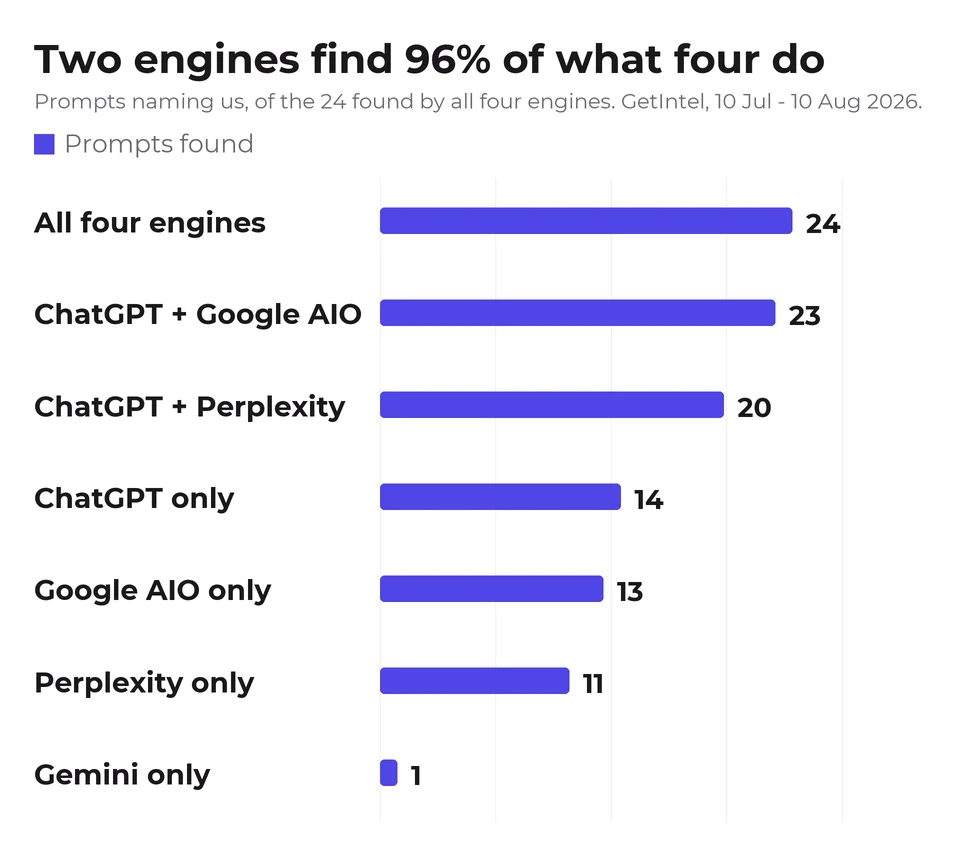
| view | prompts found, of 24 |
|---|---|
| All four engines | 24 |
| ChatGPT + Google AI Overviews | 23 |
| ChatGPT + Perplexity | 20 |
| ChatGPT only | 14 |
| Google AI Overviews only | 13 |
| Perplexity only | 11 |
| Gemini only | 1 |
No single engine sees more than 58.3% of the prompts we are named on. The best pair sees 95.8%. Going from two engines to four buys one additional prompt, and Gemini contributes none that another engine had not already surfaced.
So the honest version of "track everything in one place" is that the one place matters and the everything does not, at least for us.
Why does a single-engine check miss so much?
A single-engine check misses so much because coverage barely overlaps between engines.
Of the 24 prompts that name us, 12 are found on exactly one engine, 10 on exactly two, and only 2 on three or more. Half of our visibility exists on a single surface at a time.
That is the same pattern we found looking at sources rather than prompts: engines answering the same question cite almost entirely different domains, sharing as little as 4.8%. Different sources produce different brand mentions, so the prompts you appear on differ too.
Seven of our 24 are visible only on ChatGPT, four only on Google AI Overviews and one only on Perplexity. Check one engine and you are seeing a slice, not a sample.
Which two engines should I start with?
On our data ChatGPT and Google AI Overviews, but the honest answer is that you cannot know yours without measuring all four once.
Our pairing works because those two happen to hold the most prompts unique to them, seven and four. Perplexity stays in the dashboard either way; the question here is which engines earn the attention, not which get dropped from tracking. A brand whose citations concentrate on Perplexity would get the opposite answer and would be badly served by copying ours.
Vendors price on engine count, which is the axis with the flattest return past two - what that costs is worth doing the arithmetic on. So the sequence that makes sense is to measure all four for a month, look at which engines hold prompts nothing else finds, then drop the ones contributing nothing and keep the budget on frequency instead. That is a better use of the same money than four engines checked half as often.
Should I pay for four-engine tracking?
Only if the fourth engine holds prompts the others do not, and you will not know that without a first measurement.
Our own Gemini coverage is one prompt of 24, the same prompt three other engines already find. On these numbers we are paying to track a surface that has told us nothing new so far.
That conclusion rests on a single observation though, and by our own standard elsewhere one occurrence is not enough to rule much in or out. What makes it more than a hunch is the history behind it: Gemini went 1,080 runs without naming us at all before that first mention on 10 August, which we wrote up Gemini's zero in 919 answers, when the count was still zero.
The useful framing when a vendor sells you engine count is to ask what each engine adds that the others do not, which is answerable from any tool that stores per-prompt per-engine results. If it can only show you a blended score, it cannot answer the question and the engine count is unverifiable.
What does one place actually need to show?
One place needs to show four things, and the first is the one blended scores destroy: per-engine results kept separate.
- Per-engine presence per prompt. Not a combined score. Without this you cannot tell whether an engine is earning its place, and a blended number can be reported ten different ways.
- Which prompts are unique to which engine. This is the entire argument for multi-engine tracking and almost nothing surfaces it directly.
- Run counts per engine. Coverage differs partly because engines return citations at different rates, so presence and sampling get confounded easily.
- The raw answers. Whatever the dashboard says, the answer text is where a disagreement between engines gets explained.
What doesn't this establish?
Our two-engine result is ours. It reflects where our content happens to be findable, and the same measurement on a different brand could easily rank Perplexity first. Treat the method as transferable and the specific pairing as not.
We also measured presence as any-run, so a prompt naming us once counts equally with one naming us consistently. That flatters thin coverage, and given 11 of our 24 covered prompts sit under a 10% mention rate, just under half, some of the 24 are thin indeed.
And four engines is a small field to be drawing coverage conclusions from. If an engine we do not track holds prompts none of these four surface, nothing here would reveal it. For how the probes themselves run, see how it works.