There is no consensus answer, and the data says so plainly. We took the 11 of our 60 tracked prompts that frame the asker as a founder, bootstrapped or solo, pooled every citation the four engines returned on them between 10 July and 10 August 2026, and ranked the results. Those four are ChatGPT, Perplexity, Gemini and Google AI Overviews. Claude is not among them: our product can query Claude on demand, but it is not part of this recurring measurement, so nothing here describes what Claude recommends. 643 distinct domains split 3,325 citations, and the most-cited holds 2.65% share of voice. The entire top fifteen accounts for under 27%.
So any product describing itself as the tool founders use is not describing what the engines actually say. Including us: on these questions we rank 55th.
GetIntel is one of the tools in this comparison and we come out of it badly. That does not make the other fourteen rankings correct, and it is not offered as proof of anything: it is here because omitting our own position from a ranking we published would be the obvious way to make it dishonest. The dataset is published.
What do engines actually name when a founder asks?
Fifteen domains split the citations on founder-framed questions, led by therankmasters.com at 2.65%, llmpulse.ai at 2.53% and reddit.com at 2.08%, though the shares are so close that the ordering is not worth much.
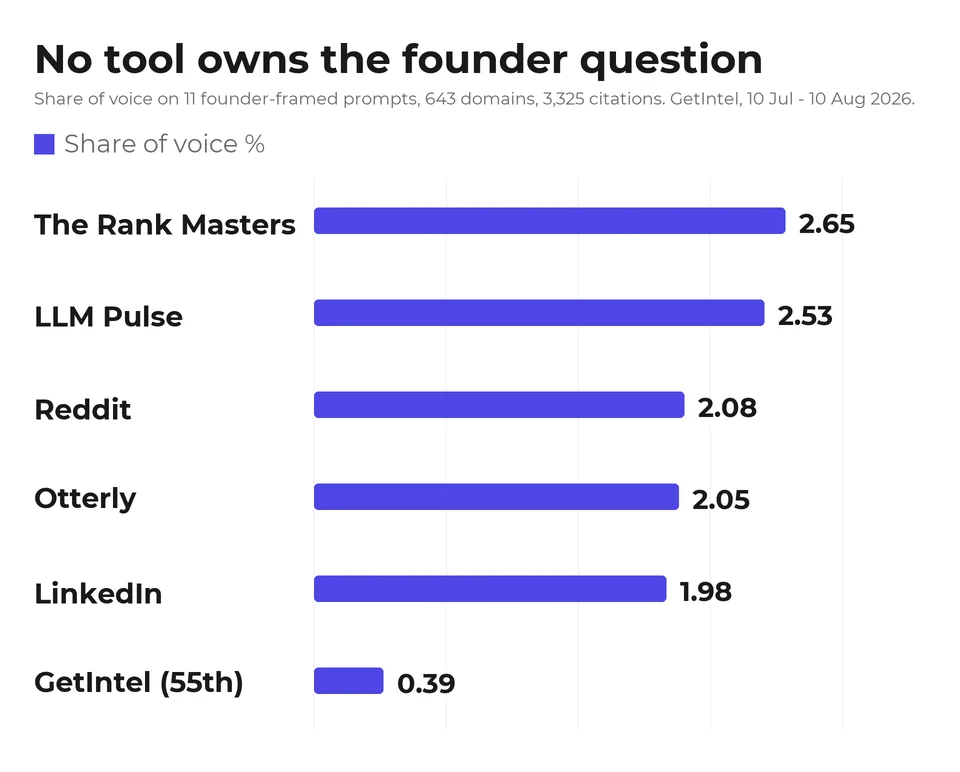
| rank | domain | share of voice |
|---|---|---|
| 1 | therankmasters.com | 2.65% |
| 2 | llmpulse.ai | 2.53% |
| 3 | reddit.com | 2.08% |
| 4 | otterly.ai | 2.05% |
| 5 | linkedin.com | 1.98% |
| 6 | zapier.com | 1.92% |
| 7 | tryprofound.com | 1.80% |
| 8 | aiclicks.io | 1.80% |
| 9 | trustmary.com | 1.68% |
| 10 | semrush.com | 1.68% |
| 11 | arxiv.org | 1.65% |
| 12 | dageno.ai | 1.38% |
| 13 | trysight.ai | 1.26% |
| 14 | rankability.com | 1.26% |
| 15 | techradar.com | 1.26% |
Notice what is in there. Reddit at third and LinkedIn at fifth are not tools at all, and Zapier at sixth is not an AI visibility product. When a founder asks which tool to use, roughly a third of the top ten is not a direct answer to the question.
We are 55th with 13 citations, a 0.39% share. That is worth stating in a piece where we are one of the options, and it is the honest context for anything else we say here.
Why is there no clear winner?
No AI visibility tool wins clearly among founders because the category is young and the engines have no strong signal to concentrate on.
643 domains splitting 3,325 citations is extreme fragmentation. For comparison, the top fifteen together hold under 27%, meaning three-quarters of citations go to a long tail of sources mentioned once or twice. That is what a market looks like before anyone has earned a default position.
It also means the ordering above is noise-sensitive. The gap between first and tenth is under a point of share, well inside the range that moves between measurement periods with nothing changing. Do not read the ranking as a leaderboard.
So how should a founder actually choose?
A founder should choose an AI visibility tool on what it stores, not on where it ranks in a comparison table.
- Per-engine results, not a blended score. Our own rank moves from 10th to 377th depending on the engine, so any single number hides more than it shows.
- Run counts on every figure. A single check on a prompt that varies is off by 33 percentage points on average.
- The raw answer text. It is the only place a competitor's mention gets explained.
- A prompt set that cannot be rewritten without you knowing. Anything that changes the prompt wording resets your history. In our case it was not a person editing prompts: an automated weekly job reread our own pricing page, silently rewrote the targeting profile behind the prompt set, and invalidated 23.4 days of comparison. That specific pathway was fixed on 10 August 2026, but the question to ask a vendor is what in their system can change your prompts without a human deciding to.
Those four are answerable on any demo call. None of them is what a ranking like the one above measures.
Which tool would we actually recommend?
We would recommend GetIntel, obviously, and you should discount that accordingly: we publish this comparison and sell one of the tools in it.
What we would say more usefully is that the free version of this exercise is real. Take ten buyer questions, run them by hand in ChatGPT, Perplexity and Google AI Overviews across a couple of weeks, and record which name you. Our claim, and it is a claim rather than something we have measured, is that this gets you the same first insight a paid tool would: the list of questions you are absent from. What a tool adds after that is consistency, which is a different thing from insight.
Buy a tool when doing that by hand has become the thing you stop doing. That is a real and common failure, and it is the honest case for paying for anything here.
Do any of these tools help you compete with better-known brands?
No AI visibility tracker helps you compete directly, and it is worth being clear about what one can and cannot do.
A tool tells you which questions you are absent from and which sources the engines used. It does not make you cited. The work after that is producing something worth citing on the specific questions where you are not, which no tool does for you and which is where the actual difficulty lives. Whether that justifies paying for software at all is the question we take apart in is an AI visibility tool overkill for a small marketing team.
Better-known brands do not dominate here in the way the phrase implies. On our data, only 27 of 60 prompts have any domain appearing in even half their answers, so the field is more open than brand recognition would suggest.
What this comparison does not do
This founder-framed citation comparison does not rank product quality. It ranks how often a domain is cited when a founder-framed question is asked, which rewards publishing about the category and says nothing about whether the software is good. We rank 55th and would not accept that as a verdict on our product either.
The founder classification is ours, applied by looking for founder, bootstrapped, solo, small team or indie in the prompt wording. Eleven prompts is a small slice of a small set.
And the citations are pooled across four engines, so an engine returning more citations pulls the ranking toward its own preferences rather than being averaged out. The founder-shaped version of the product is at GetIntel for founders.