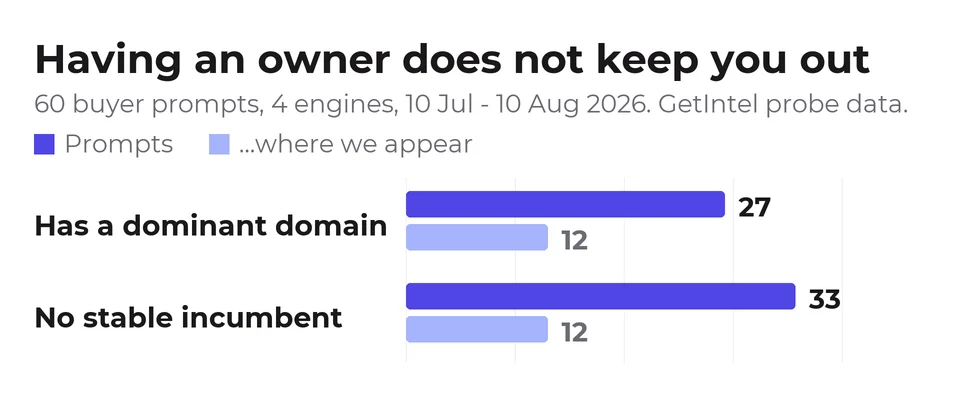
Start by checking whether anyone consistently wins the question at all, before you start asking why they beat you. We took 60 buyer-intent prompts, ran them repeatedly against ChatGPT, Perplexity, Gemini and Google AI Overviews between 10 July and 10 August 2026, and looked for a domain that showed up in at least half of each prompt's answers. Only 27 of the 60 had one. On the other 33 there is no incumbent to explain, so the question "who is beating me" has no answer to find.
To do this in GetIntel, see Win back a topic from a competitor.
That matters because the usual diagnostic instinct runs backwards. You see a competitor named, you assume they have something you lack, and you go looking for what it is. Roughly half the time the honest finding is that the engine named somebody different last week and will name somebody else next week.
The figures below come from our own tracking between 10 July and 10 August 2026, across those four engines on 20 distinct run days. Claude is not in this dataset. Our tracked set runs on the unattended daily path, where Claude is not one of the four; it runs on the on-demand path instead. So if you came here asking specifically why Claude names a competitor, the procedure below transfers, but these particular numbers were not measured on it. GetIntel sells an AI visibility tracker, so read the recommendation with that in mind. The underlying data is published and every number here recomputes from it.
Step 1: find out whether the question has an owner
Step one is finding out whether the question has an owner at all. For each prompt, count how many of its citation-returning runs each domain appears in, then look at the single most frequent one. If it clears 50%, the prompt has an incumbent. If it does not, the prompt is contested.
Across all 60 prompts, measured between 10 July and 10 August 2026, the median prompt's most-cited domain appeared in 48.4% of that prompt's citation-returning runs. The typical question, in other words, sits right on the boundary: even the strongest source on a given prompt is absent from half the answers.
This is the step people skip, and skipping it is what turns a five-minute check into a month of chasing a competitor who was never actually there.
Step 2: if nobody owns it, stop looking for a competitor
If nobody owns a prompt, stop looking for a competitor to beat. On the 33 contested prompts there is no stable answer to "who is being recommended instead of me", because the engine does not have a stable answer either. Anything you conclude from a single check on one of these is an artefact of the day you checked.
The useful move here is not competitive research. It is to establish what normal looks like on that prompt over several weeks before you act, which is the same reason a single spot-check is unreliable in the first place.
If you want a diagnosis on a contested prompt, the question to ask is not who is winning. It is whether you appear at all, at what rate, and whether that rate is moving.
Step 3: if someone does own it, check what kind of source it is
If someone does own the prompt, check what kind of page did it. This is where the diagnosis gets genuinely useful, because the 27 owned prompts are not owned by 27 competitors. They are spread across 20 different domains, and the biggest holder is not a company that sells anything in our category. Turning that spread into a repeatable audit is what the AI citation gap framework is for.
| domain | prompts it dominates |
|---|---|
| reddit.com | 4 |
| llmpulse.ai | 3 |
| github.com | 2 |
| tryprofound.com | 2 |
| 16 further domains | 1 each |
Reddit holds more of these questions than any vendor does, and GitHub holds two more. Among the sixteen domains holding a single prompt each are a general marketing blog and a vendor's own documentation site. When something genuinely owns a buyer question in this category, it is frequently not a product page at all, but a forum thread or a repository that happens to answer the question directly.
That changes the fix entirely. Where the owner is a competitor's own page, the work is the ordinary one of making your own pages the better answer. You cannot out-feature a Reddit thread. You can be present in the conversation it represents, or you can write the thing the thread is a poor substitute for.
One of the 27 is ours, which is a useful calibration on how thin this kind of ownership is. Owning a single prompt out of 60 is not a moat.
The fix depends on which of the two cases you are in, and they are not interchangeable. Where a competitor's own page owns the prompt, you are in a normal content contest: their page answers the buyer's question more directly than yours does, and the work is to write the page that answers it better. Where a forum thread or a repository owns it, there is no page to outrank. Reddit holds 4 of our 27, and this data does not say why. Our own reading, which is a hypothesis rather than a finding, is that a thread of people comparing tools answers "what do people actually use" in a way a vendor page structurally cannot. If that reading is right, the realistic options are to be present in that conversation, or to publish the thing the thread is a poor substitute for, which usually means real numbers rather than another feature list. If it is wrong, the measurement still stands and only the remedy changes.
Either way, check the owner before choosing the fix. Writing a better landing page to beat a Reddit thread is a good way to waste a quarter.
Step 4: do not prioritise by how strong the competitor looks
Do not prioritise by how strong the competitor looks. The obvious next move is to go after the contested prompts first, on the theory that an entrenched incumbent is harder to displace. We tested that and it does not hold.
We appear on 12 of the 27 owned prompts, a rate of 44.4%. We appear on 12 of the 33 contested prompts, a rate of 36.4%. If anything we do slightly better where an incumbent exists, which is the opposite of what the theory predicts.
So whatever determines whether you get named, the strength of the leading competitor is not it. Prioritising your work by "which competitor looks weakest" is sorting on a variable that does not move the outcome.
A better sort has three steps and uses only things you control.
Start from the prompts where you never appear at all, not the ones where you appear sometimes. Across the 60 prompts we tracked between 10 July and 10 August 2026 we are named on 24, which leaves 36 where we have never been cited once. Those 36 are the whole opportunity; the other 24 are a retention problem, not an acquisition one.
Then sort those by how often the prompt runs, because frequency is a proxy for how often a real buyer asks it. Then weight by how close the question sits to a purchase decision, which no dataset can tell you and you can judge in about a second per prompt.
Worked through on ours, that turns 60 prompts into a ranked list of 36, and the ownership column never enters the calculation. Of those 36 we are absent from 21 contested prompts and 15 owned ones, and on this evidence there is no reason to prefer the 21 to the 15.
Step 5: turn the diagnosis into the right kind of fix
Turning the diagnosis into work means matching the fix to the finding. The four steps above tell you what you are looking at. They also tell you what kind of work closes it, and the four outcomes need genuinely different work. This is the part worth getting right, because picking the wrong one is how a quarter disappears into the wrong layer.
Nobody owns the question. On our own set that was 33 of 60 prompts, so this is the most common case and the cheapest. There is no incumbent to displace. The answer is unformed, and the work is simply to be the clearest, most extractable answer available: a page that answers the question in its first two sentences, structured so a model can lift one passage without the rest of the page around it.
A third-party source owns it. A Reddit thread, a review site, a listicle somebody else wrote. Editing your own pages does nothing here, and this is the failure mode that wastes the most time. Across 9,007 answers we probed, 87% of citations pointed at third-party sources rather than at any vendor's own domain, so this case is far more common than the instinct to go fix your own site suggests. The work is outreach, or getting into the thread, or earning the mention.
A competitor's own domain owns it. This is the winnable one and the rarest. The engine has decided their page is the best available answer to that question. A better page can take it, and here the content work actually is the fix.
Several competitors are cited together. The answer is crowded, a sixth name changes little, and the honest call is usually to deprioritise rather than fight for it.
Only the third case is fixed by writing on your own site, and only the second needs outreach. If you are working from a tool that reports a score without the cited URLs, you cannot tell these apart, which means you cannot pick. For what the artifacts look like once you know which you need, see shipping AI visibility fixes without an engineering backlog.
What this does not tell you
It does not tell you why any individual answer named who it named. Concentration is a property of a prompt measured over many runs, not an explanation of one response.
It also does not transfer between categories. Ours is young and thin, which is exactly why 20 domains split 27 prompts and no vendor holds more than three. That split between vendor and platform is our own reading rather than something in the data; reddit.com and github.com are counted as platforms here because neither sells a tool in this category. A mature category with two dominant players would produce a very different table, and the same procedure would give you a very different answer at step one.
And it says nothing about causation. We know ownership does not predict our absence. We do not know from this data what does.
Running the check
The procedure is four fields and a group-by, and it works on any tracking data that stores the cited URLs per run rather than just a score. For each prompt, count distinct runs per cited domain, divide by the number of runs that returned citations, and sort.
The denominator is the part worth being careful about. Runs that returned no sources at all cannot cite anyone, and including them understates concentration. We had this wrong in an earlier version of the published dataset, which reported 18 owned prompts instead of 27 because empty citation lists were being counted in the denominator. The corrected figures are the ones above.
GetIntel stores the cited URLs on every run and aggregates them by domain, which is what makes this computable, though nothing here needs our product specifically. It needs per-run citation data and about ten lines of grouping logic. If your current tool only gives you a score, it cannot answer step one, and step one is the question that decides whether the rest of the investigation is worth starting. The gap-to-page mapping this diagnosis produces is Content.