You're probably not asking whether AI visibility matters. You're asking whether your team should buy yet another dashboard when you're already stretched thin, the pipeline is small, and nobody wants a tool that creates more reporting than action.
My blunt answer, it depends on how often AI answers shape buyer research and whether someone on the team can act on what the tool finds. If you only need occasional reassurance, manual spot-checks are enough. If you need repeatable evidence on a narrow set of high-value prompts, a dedicated tool starts to make sense. For a broader overview of the market, discover AI-driven marketing solutions can help you compare categories before you commit.
Table of Contents
- Deciding Whether AI Visibility Is Overkill
- Understanding AI Visibility for Lean Teams
- Is a Dedicated Tool Better Than Checking by Hand?
- When Should You Buy, Scale or Skip?
- What Does AI Visibility Really Cost a Small Team?
- A Quick Buyer-Fit Scorecard
- Running a Lean AI Visibility Trial
Deciding Whether AI Visibility Is Overkill
Reviewed 19 September 2026. A dedicated AI visibility tool is not overkill just because your team is small. It becomes overkill when you pay for continuous monitoring but only need an occasional pulse check, or when nobody has time to turn findings into shipped improvements.
The cleanest decision rule is simple. If your team needs repeated, comparable evidence from a defined set of buyer-intent prompts, and someone can review the results and act on them, software earns its keep. If the channel still barely matters to your buyers, or you only want a casual sanity check once in a while, skip the heavy platform and keep the process manual.
The category is still new enough that teams should be selective. AI visibility tracking emerged as a distinct marketing category only after generative AI became a mainstream discovery channel, and vendors were already pitching daily monitoring across ChatGPT, Claude, Perplexity, Gemini, and Google AI Overviews as standard capability, alongside share of voice and citation rank (Semrush). That matters because this is a new layer on top of marketing, and new layers should prove they can support real decisions before they get budget.
Practical rule: buy when the tool helps you make a recurring decision. Skip it when it would only produce another report.
If you want a broader look at AI marketing tools before narrowing into visibility, discover AI-driven marketing solutions can help you compare categories before you commit. Yalc's overview of GTM intelligence is a useful companion read too, especially if you are trying to connect discovery data to sales motion (GTM intelligence overview).
If you want a broader look at AI marketing tools before narrowing into visibility, discover AI-driven marketing solutions can help you compare categories before you commit. Yalc's overview of GTM intelligence is a useful companion read too, especially if you are trying to connect discovery data to sales motion (GTM intelligence overview).
Understanding AI Visibility for Lean Teams
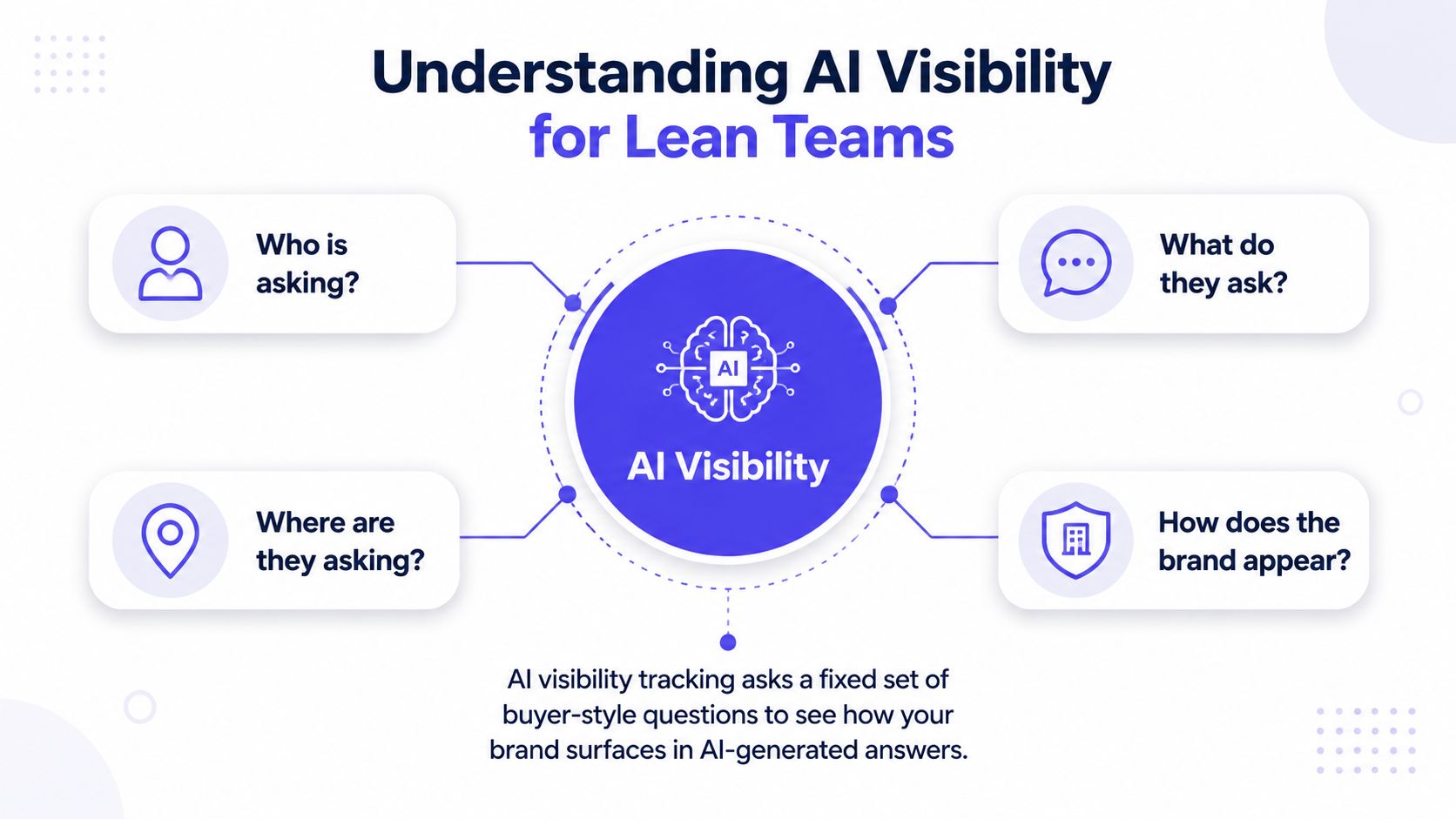
For a lean team, AI visibility is a structured way to ask the same buyer-style questions repeatedly, then record whether your brand appears in the answer, how prominently it shows up, which competitors are named, and what sources get cited. That is different from a one-off prompt check in a browser tab dressed up as strategy.
The measurement workflow that effectively helps
The measurement workflow works like a smoke detector rather than a walk round the building. A manual check tells you whether you see smoke right now, but consistent monitoring tells you whether the warning keeps repeating and whether your changes are improving the result. For lean teams, that difference is the whole point.
The useful workflow focuses on a small set of recurring prompts, not a giant dashboard. You want a daily Answer Rate, Share of Voice, Average Citation Rank, buyer-prompt probes, live answer capture, citation-source intelligence, and trend histories only if your team can review the output and act on it. Value lies in the Answer Rate trendline for the few buyer-intent prompts that drive pipeline, not broad coverage for the sake of looking complete.
Consistency beats breadth. A small team gets more value from five serious prompts than from fifty unfocused ones.
AI visibility measurement essentials
| Buyer Question | Useful Measurement | Why It Matters |
|---|---|---|
| Are we showing up on the prompts that matter? | Answer Rate trendline | Tells you whether visibility is improving on pipeline-relevant queries |
| Are we cited more than competitors? | Share of Voice | Shows whether your brand is winning space in answers |
| Are we appearing near the top of the answer? | Average Citation Rank | Indicates prominence, not just presence |
| What sources are shaping the answer? | Citation-source intelligence | Shows which domains the engines trust |
| Is this changing over time? | Trend history | Separates one-off noise from real movement |
If you are trying to connect visibility work to sales motion, the broader framing around GTM insights by Yalc is a useful complement, especially for teams that need buyer research and outreach to line up.
Is a Dedicated Tool Better Than Checking by Hand?
Manual spot-checking is fine when the prompt set is small, query volume stays low, and someone records what they see. It falls apart once the team starts juggling multiple engines, competitors, and repeat checks without a clean way to compare results over time. What that transition actually involves is set out in from manual ChatGPT checks to automated AI visibility monitoring. If you reach that point, our rundown of AI visibility tools for B2B SaaS covers what the category actually offers.
Where manual checks still win
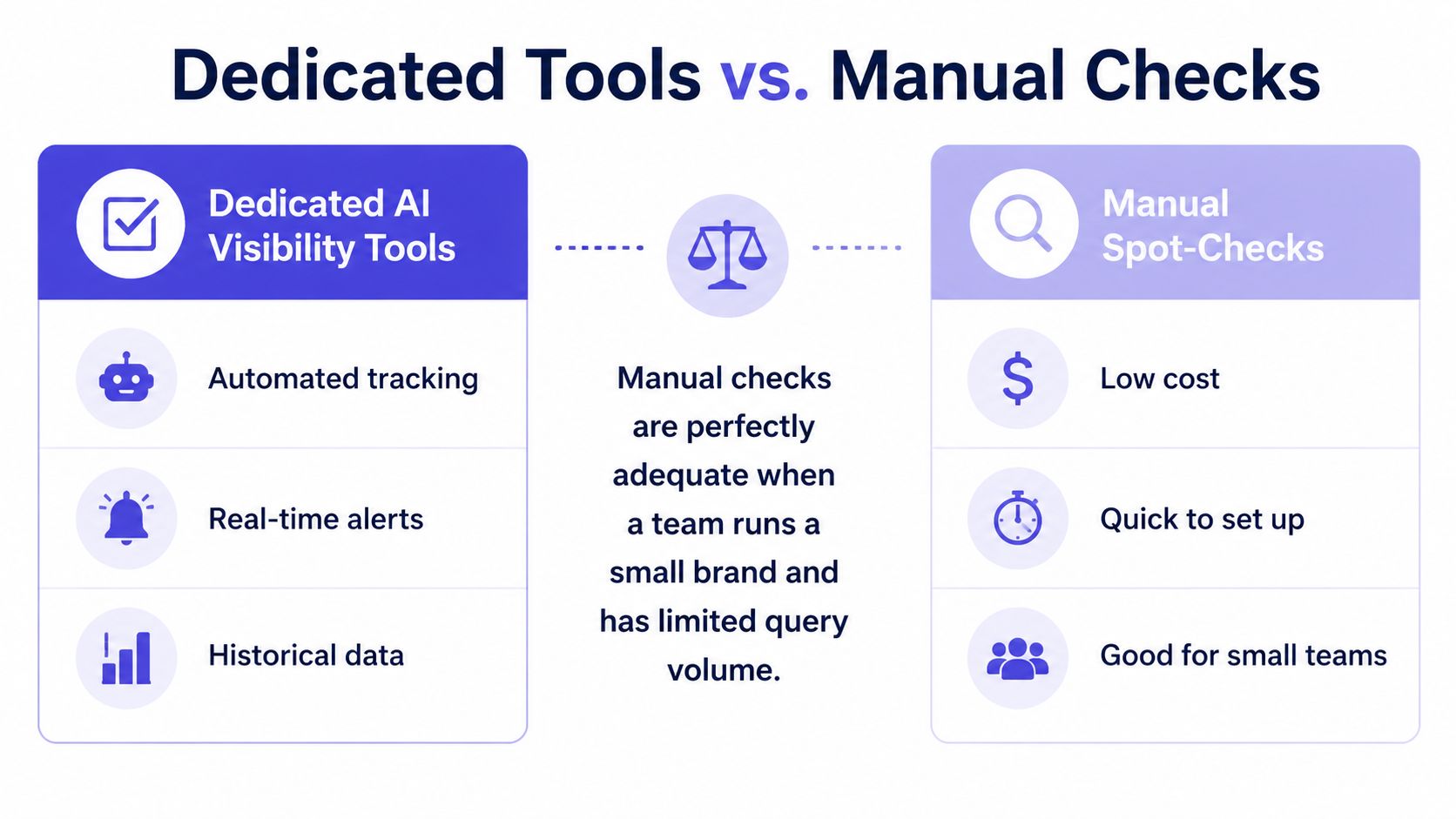
Manual checks are cheap, fast, and honest about scope. If you are only testing a few prompts once in a while, a spreadsheet and a repeatable checklist can tell you enough to avoid waste. That makes a light process the smarter move until the work starts turning into a recurring chore.
Where dedicated monitoring pulls ahead
Once your team needs daily, multi-engine monitoring, the math changes. AI answers can move from day to day, and sometimes faster, so weekly checks are the bare minimum if you want data that means anything over time. Without automation, teams drift into random prompt checks, and that gets messy as soon as you are tracking several engines and competitors (SEOCheese).
Manual checks work fine for a small brand with limited query volume.
The internal choice is simple. If you want a manual-friendly setup, start with a constrained operating model instead of a big platform, like this manual marketing alternative.
A dedicated tool makes sense when repeated checking would consume analyst time or produce inconsistent snapshots. It does not make sense just because “AI” is part of the category name. More dashboards will not save you if your team cannot review them and act on the findings.
When Should You Buy, Scale or Skip?
A small B2B SaaS team should buy when the same buyer questions keep showing up and AI answers are part of the shortlist process. At that point, checking five high-intent prompts every day is sensible, because the core question is whether your brand appears when prospects compare tools.
Skip the heavy spend when AI referrals are occasional and all you need is a quarterly health check. A spreadsheet and manual probes are enough in that case. You do not need enterprise habits for a problem that shows up a few times a quarter.
Buy nothing yet if the visibility issue is real but the team has no bandwidth to act on it. That is the trap. Software alone will not help if nobody can review findings, rewrite pages, update structured data, or push technical changes. In that situation, the tool has to produce usable actions, not just charts.
The small-team buy signal
The clearest reason to buy is the need to track specific buyer-intent prompts over time, because AI visibility tools are built to show how often and how prominently a brand appears in generated answers rather than only following traditional rankings or traffic (ButtonBlock). That is the test. If consistency on a few prompts matters to pipeline, the tool has a job.
GetIntel's Monitor tier is a useful example of a constrained approach, because it is scoped for a small number of tracked brands and prompts rather than broad enterprise coverage. That is the right shape for a lean trial, since you are not paying for capacity you will not use.
A quick scenario filter
- Buy: when the same buyer questions keep deciding whether you get shortlisted.
- Trial: when the problem is real, but you need proof before expanding.
- Skip: when the issue is interesting, but it will not change a recurring business decision.
Broader small-business buyer guides put entry plans in a range that keeps the decision tied to scope rather than ambition. The point is simple. Small teams should buy only when the signal is already tied to revenue.
What Does AI Visibility Really Cost a Small Team?
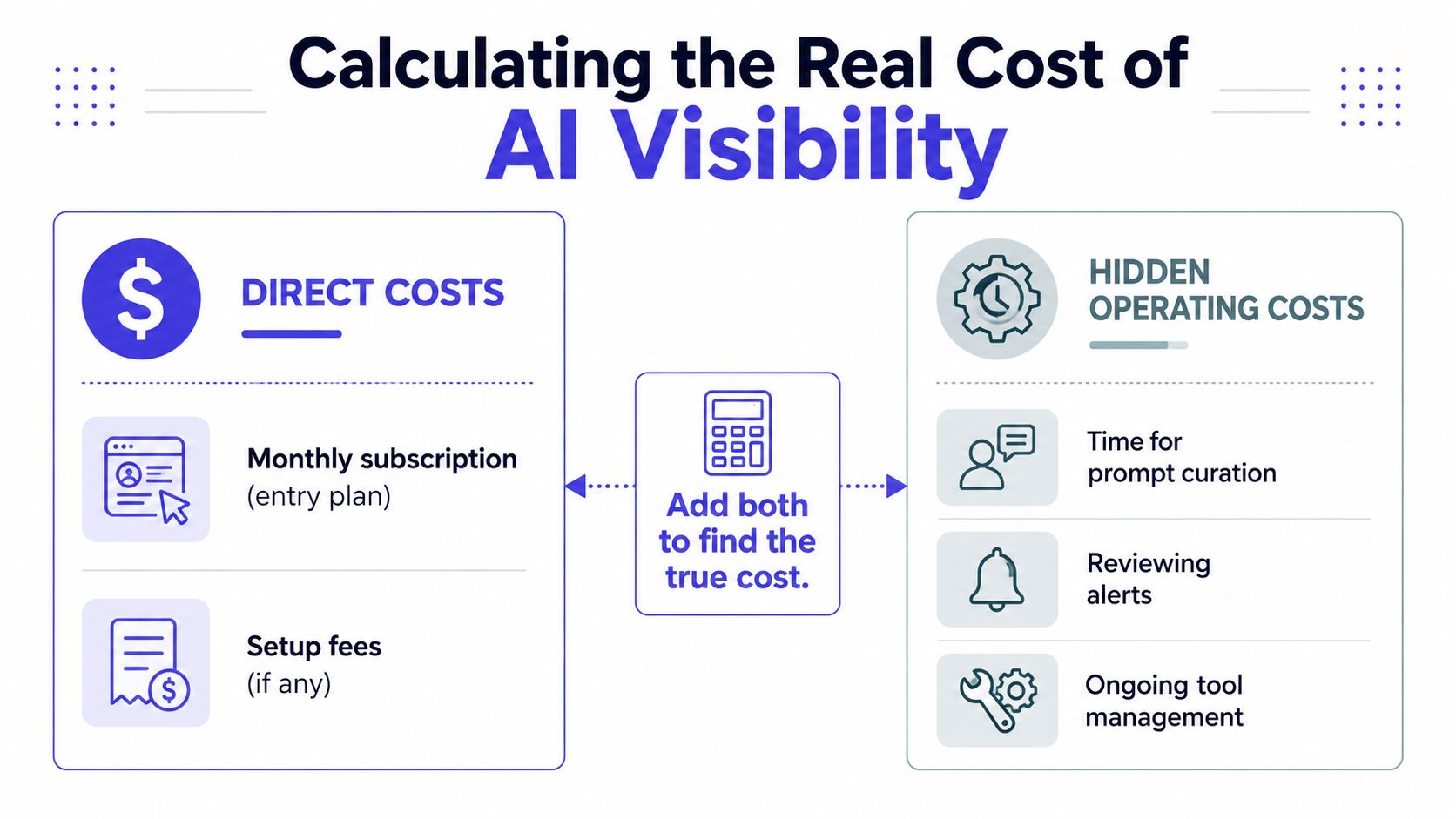
Subscription price is only the starting point. The actual cost also includes prompt selection, alert review, content coordination, technical edits, and the time it takes to confirm whether those changes affect visibility.
Direct cost versus hidden work
A low-cost tool can still drain budget if it creates more work than your team can carry. A fitness tracker only helps when someone changes behavior based on the data, and AI visibility works the same way. If the platform highlights gaps but leaves your team to interpret them, the workload goes up instead of down.
That is why measurement plus action matters. A platform that produces gap-closing drafts, hands work off to coding agents, and keeps a record of shipped changes tied to score movement gives a small team a tighter operating loop than a dashboard that stops at reporting. For a lean team, that is more useful than a prettier chart.
Budget the decision, not just the tool
If you are comparing entry costs across adjacent AI tools, check pricing on a live plan page and treat that as only one line item. The monthly fee never tells the full story. You also need to account for the value of repeated decisions, like which comparison page gets fixed next, instead of trying to assign every visibility gain a separate revenue number.
Consider the following:
- Direct cost: the plan itself.
- Hidden cost: the hours spent reviewing, fixing, and validating.
- Opportunity cost: the work you will not do if reporting starts eating the team's time.
The ROI framework in GetIntel's proof guide is a practical reference if you need to show why measurement should stay tied to action, not sit in a vanity dashboard.
A tool that exposes a problem but does not help close it becomes a drain. A tool that helps a small team ship a focused fix is much easier to justify.
A Quick Buyer-Fit Scorecard
Use this as a blunt gate, not a philosophical exercise. If most of these are true, the tool belongs in your stack. If they aren't, keep the process manual until the situation changes.
Scorecard questions
| Question | Why It Matters | Decision Signal |
|---|---|---|
| Do AI answers influence active buyers? | Visibility only matters if the channel shapes research | If yes, keep going |
| Can you define a short list of pipeline prompts? | Narrow scope makes the data usable | If yes, lean tools fit better |
| Does consistency matter more than one-time results? | Trendlines matter more than snapshots | If yes, software helps |
| Are competitors frequently named? | Competitive gaps are the point of measurement | If yes, monitoring has leverage |
| Can one person review findings? | Unused data is wasted spend | If no, skip or delay |
| Can the team ship a few improvements? | Action is where value shows up | If yes, the tool can pay off |
How to read the score
If you can answer yes to most of the questions above, buy or run a constrained trial. If your answers are mixed, keep manual checks and revisit later. If the underlying problem is bandwidth, solve that first.
A few counterweights should override enthusiasm quickly. Low prompt volume, no clear owner, and no ability to implement changes are all reasons to pause. In those cases, the subscription is competing against a much cheaper habit, and that habit may be enough.
The right decision isn't “tool or no tool.” It's “will this change what the team ships?”
Running a Lean AI Visibility Trial
A lean trial should be small enough that nobody needs a project plan to manage it. Pick 3 to 5 buyer-intent prompts, one brand, a short competitor set, and one owner who will review the results and push changes.
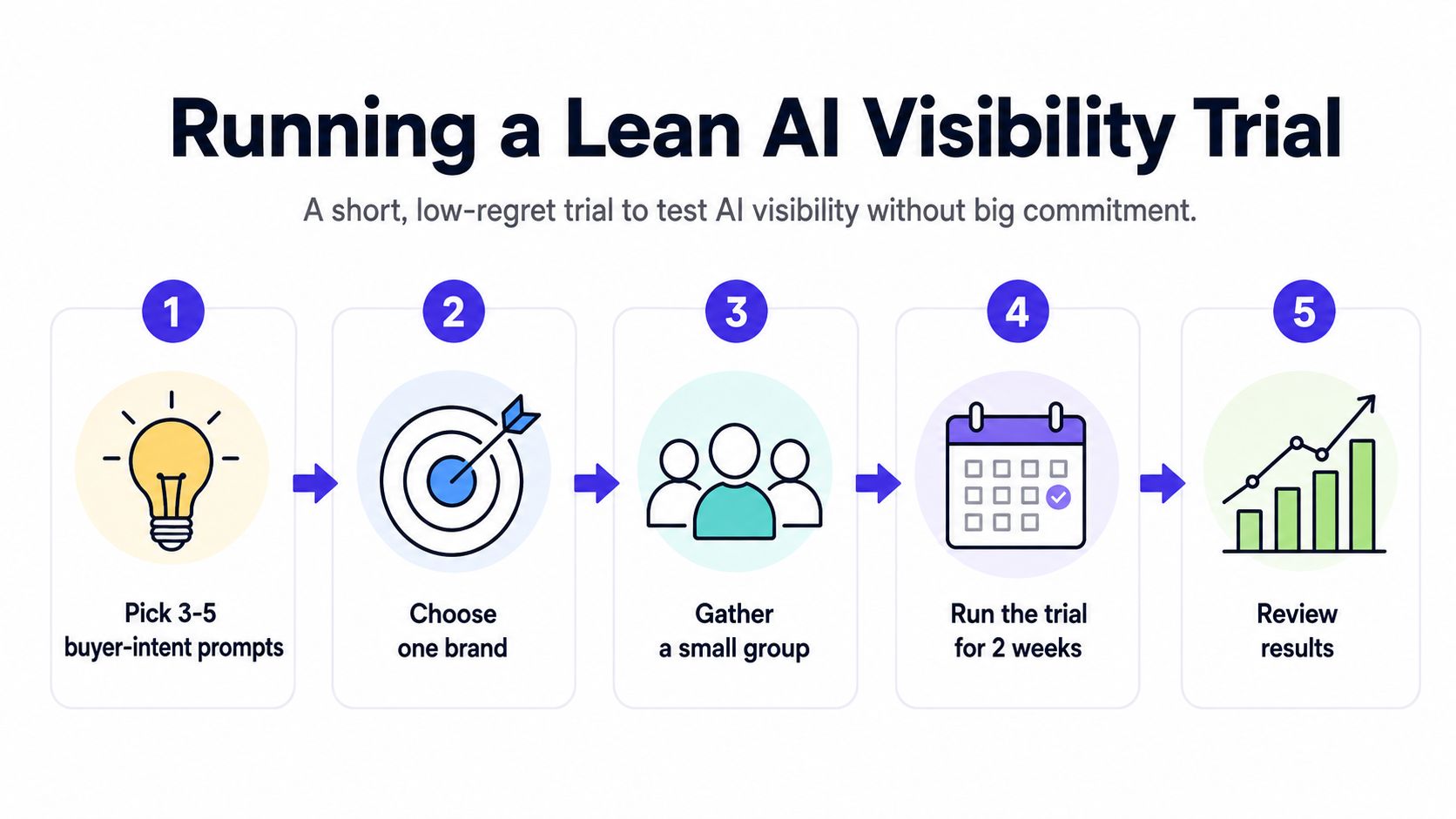
What to test
Use the trial to compare the Answer Rate trendline, per-engine presence, competitor gaps, and citation sources before and after a limited set of actions. That gives you a better read than staring at a dashboard and hoping the pattern explains itself. If the platform also helps you ship one or two gap-closing changes, that is the signal you want.
GetIntel's Monitor approach fits this kind of test because it is built around a limited set of brands and prompts instead of broad enterprise coverage. That keeps the trial honest. You are testing a decision, not buying a monument.
What success looks like
Success is not a bigger dashboard. Success is a clearer recurring decision, one or more shipped changes, and movement on a prompt that matters to pipeline. If the prompts do not influence buyers, or nobody can act on the findings, stop the subscription.
Use a short review window and decide fast. If the tool helps the team make better calls on the same buyer questions every week, keep it. If it only adds noise, stop it.
If you want a lean platform that measures visibility across major answer engines and ties findings to fixes, GetIntel is built for that workflow. Start with a narrow prompt set, test whether the data changes what your team ships, and keep only what earns its place.