On 3 August 2026, GetIntel quietly archived 70 of its own tracked prompts and minted 60 replacements, 70 seconds after rewriting the targeting profile it reads them from. Every visibility number before that date and every number after it came from a different questionnaire. The chart drew one continuous line through the break. We found it on 4 August 2026. The cause was a weekly job that re-reads our own website and writes what it finds back into the profile our prompts are generated from, and the trigger was our own marketing copy. The fix shipped, and ran for the first time on 10 August 2026, holding two changes that would have destroyed the history again (GetIntel production database, read-only queries).
Disclosure: this is a defect in the product we sell, found by us, published with the timeline as CSV and JSON.
In this article
- What actually broke?
- Which number is our AI visibility?
- What did the undated number cost?
- Did the fix work?
- What is still broken?
- How to check this on any tool you use
What actually broke?
On 3 August 2026 at 05:06:15, a weekly job inside GetIntel rewrote the profile it stores about GetIntel. At 05:07:25, seventy seconds later, 70 tracked prompts were archived and 60 new ones created, taking 23.4 days and 2,800 recorded runs with them.
That job re-reads your homepage and pricing page, compares them to the stored profile, and updates it when the site has clearly moved on. Sensible on its own. The problem is that five of the nine fields it can update also feed the hash identifying your prompt set. Both lists ship in the dataset above. Write one of them and every prompt is archived and reissued.
The trigger was our own marketing copy. The pricing page described the Pro tier as "for solo SaaS founders", the job read that back, wrote it into the stored profile as a targeting change, and the prompt set went with it.
Improving the site reset our ability to measure whether improving the site had worked.
Which number is our AI visibility?
Five different numbers all described GetIntel's own AI visibility at once: four surfaced on 4 August 2026 and a fifth on 6 August. All were live for GetIntel's own brand, all correct, all measuring different things:
| what it counts | value on 6 August 2026 |
|---|---|
| Composite visibility score | 21 / 100 |
| Share of prompt-and-engine cells naming us | 8.0% |
| Share of voice against tracked competitors | 3.3% |
| Share of all citations pointing at our domain | 1% |
| An older one-off leaderboard, undated | 0% |
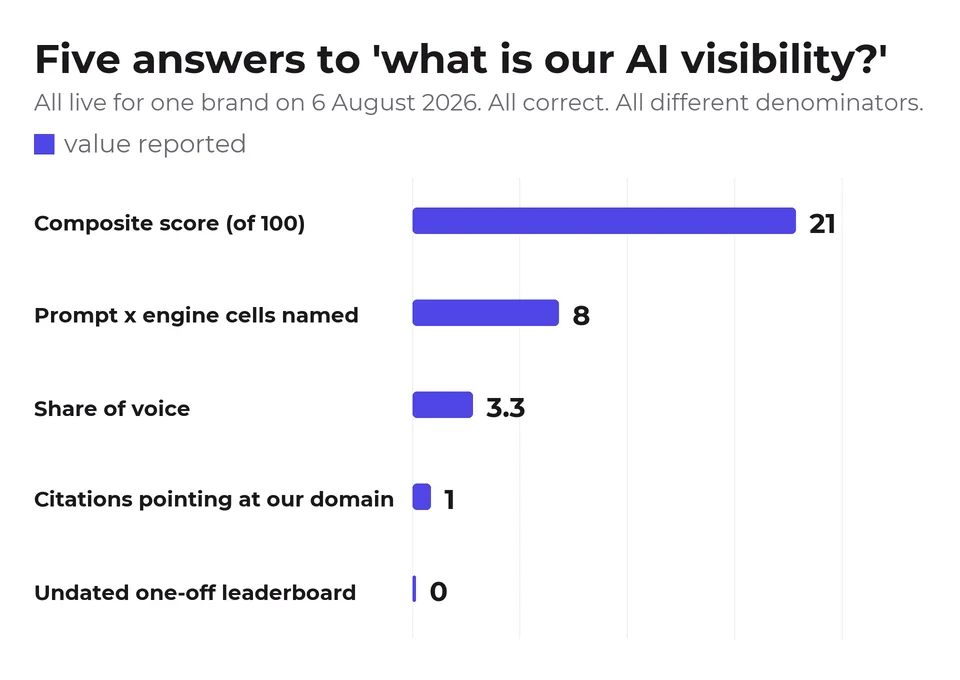
None is wrong. Each answers a different question, and the gap between the top and bottom rows is the whole argument. A visibility figure without its denominator, its prompt set and its date is not a measurement, it is a number.
We had published that thesis about other vendors' statistics on 3 August 2026. We found four of them in our own dashboard on 4 August, one day later. The fifth surfaced on 6 August, when it cost us something.
What did the undated number cost?
An undated leaderboard in GetIntel's own research notes made us accuse a writer of inventing data.
An article written for us quoted our dashboard: SE Ranking at 15.8%, GetIntel at 0.8%. Both figures are still in this repository at the original commit. Audited against a stale leaderboard sitting undated in our research notes, they looked invented, so the article was scored 21 out of 100 for fabricating first-party data and rewritten with the older numbers. A false rule about fabrication was recorded alongside it.
The precise version matters, because it is this article's own thesis. Those figures are not identical to the board we read the same day, which showed SE Ranking at 15.1% and GetIntel at 8.0%. The article was published at 12:25 and corrected at 17:18 on 6 August 2026, about five hours apart, and we cannot establish from any record we kept exactly when or from which view the original pair was read. That is the whole problem. The undated leaderboard was the dangerous artefact, and the missing timestamp on a real measurement is what let us mistake it for an invented one.
The audit score of 21 we gave that article is unrelated to the visibility score of 21 in the table above. Two different 21s from the same day, 6 August 2026, which is its own small lesson about unlabelled numbers.
Two rounds of audit did not catch it. The founder did, by opening the live dashboard.
Nobody outside your company can falsify your first-party numbers. That is exactly why an undated one is dangerous: it survives on authority instead of evidence, including inside the company that produced it.
Did the fix work?
The fix worked, confirmed by a real GetIntel grounding run on 10 August 2026 rather than by a test.
The five fields that would archive a prompt set are no longer applied automatically. Drift in them is recorded, the customer is told once, and nothing changes until they decide.
The job ran at 05:03:54 on 10 August 2026 and logged five drift entries across four distinct fields, value_propositions appearing twice. It applied the one safe field, price_point, so this was not a quiet no-op. It flagged value_propositions for review, and it held two outright:
| field held on 10 August 2026 | confidence | what changed |
|---|---|---|
| product_description | 0.98 | word seven: "tool" became "platform" |
| pain_points | 0.88 | one of five items gained the phrase "X posts," |
Under the old code, adding two words to one bullet in one field would have archived 60 prompts and ended the history a second time.
One qualification, since this piece argues against under-qualified numbers. That is one run, on one GetIntel account. The fix deployed on 6 August 2026 at 10:59 UTC and this run followed under four days later. It is the run that mattered, because it found real drift and held it rather than finding nothing to do. It is not a fix confirmed across many accounts, and we will not call it one until it is. The same refusal to trust a single blended figure is why we now report each engine separately, and why Gemini naming us in zero of 919 answers was invisible in our headline number. The prompt set is untouched: ids 3702 to 3761, all still created on 3 August 2026, nothing archived since.
What is still broken?
Four things remain broken in GetIntel as of 10 August 2026, stated because a fix post that lists only successes is marketing.
The chart still draws through the break. GetIntel suppresses nothing across a re-mint boundary, so the invalid line from July to August 2026 is still on the History page.
There is no audit trail on the single action that invalidates all longitudinal data. We reconstructed 3 August 2026 from timestamps, not from a log.
The job is right about something we have not fixed. Its note on the change it held on 10 August 2026 reads: "Stored profile implies all 5 engines on all plans; live pricing page explicitly gates Claude to Growth tier only." Confidence 0.98. That is a genuine error in our stored profile, correctly identified, and still sitting there.
Approved edits still re-mint even when the new prompts mean the same thing. The August 2026 replacements were paraphrases: "mentions my SaaS brand" became "recommends my SaaS or a competitor". What that cost was 23.4 days and 2,800 recorded runs, for rewording.
How to check this on any tool you use
Check any AI visibility tool by asking its vendor three questions. When did my prompt set last change, and does the tool tell me. Which denominator is this percentage. Does the chart draw through a change in what was measured.
Worked on our own numbers, those questions separate a 21 from an 8.0% from a 3.3%: the first is a composite score out of 100, the second the share of prompt-and-engine cells naming GetIntel on 6 August 2026, the third its share of voice against tracked competitors on the same day. Three correct answers to three different questions, and none of them is "our AI visibility".
GetIntel could not answer the first two questions about itself on 3 August 2026. If a tool cannot answer them, its trend line is decoration.
A fourth question worth asking before any of these: were the prompts in that set actually validated for real demand before they were tracked, or just generated to sound plausible. A prompt set can survive a re-mint intact and still have never measured anything real.
If you want the per-engine version of your own numbers rather than one blended figure, our AI visibility tracking reports each engine separately, and you can start free.