Practical AI visibility monitoring budgets typically range from $99 to $500+ per month for mainstream B2B SaaS teams. Entry-level tools start around $29 to $49 per month, while enterprise suites can exceed $2,000 per month.
That range is wide because “monitoring” can mean anything from checking a small set of prompts to continuously tracking multiple answer engines, competitors, regions, citation sources, and remediation workflows. The subscription is only one part of the purchase. The more useful question is what your team needs to measure, how often it needs to measure it, and who will turn the findings into changes that improve visibility.
Table of Contents
- AI Visibility Tool Pricing Tiers for 2026
- What each tier usually includes
- What Unit Are You Actually Buying?
- Per-seat pricing
- Per-prompt pricing
- Per-brand or per-domain pricing
- What Does a Monitoring-Only Tool Really Cost?
- The labor behind an alert
- Monitoring plus remediation
- Estimating Total Cost of Ownership and ROI
- A practical calculator
- Calculate cost per insight
- Vendor Evaluation Checklist and Negotiation Tactics
- Test the data before comparing price
- Ask commercial questions directly
- What Should You Budget at Your Stage?
AI Visibility Tool Pricing Tiers for 2026
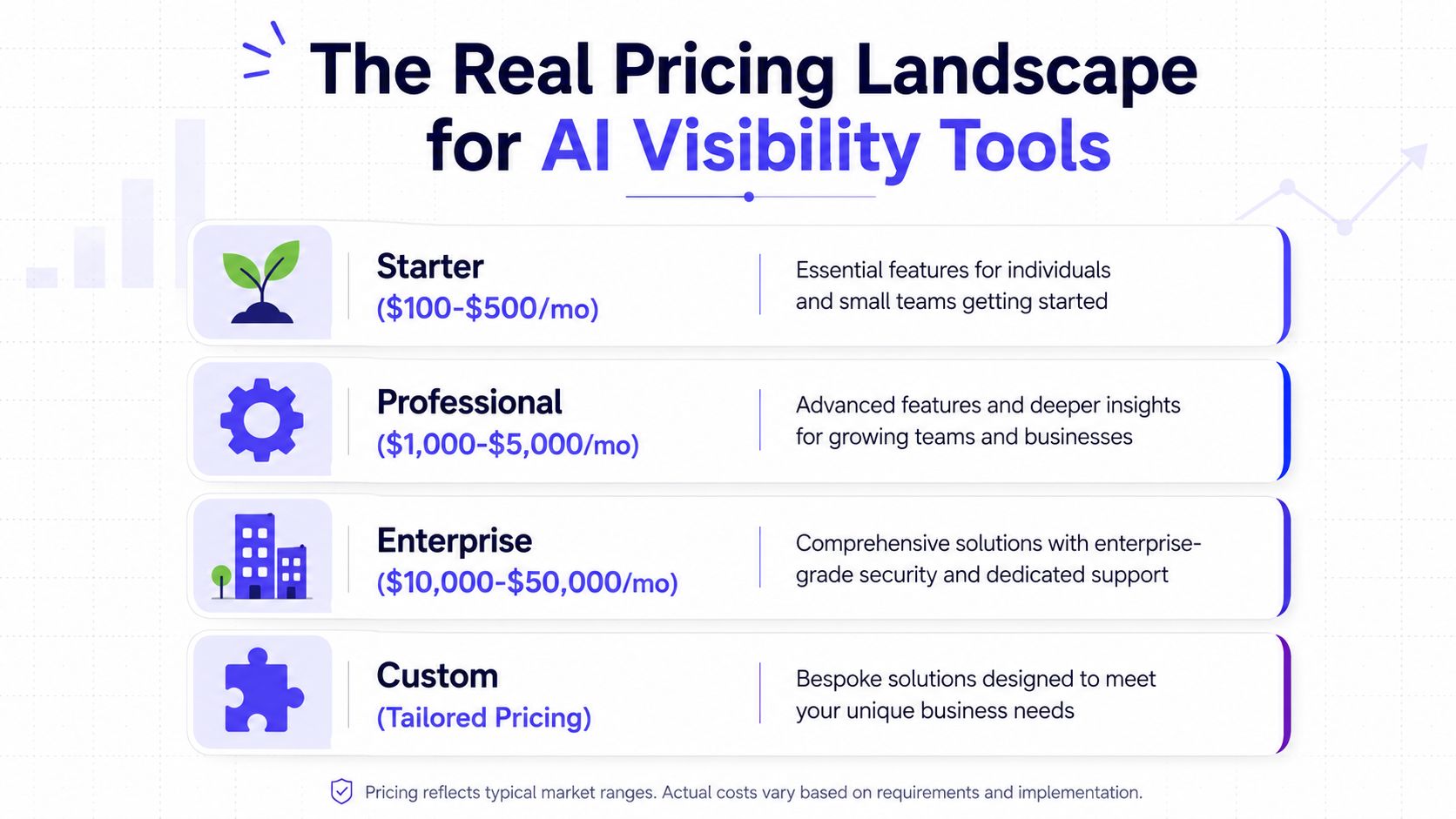
Pricing tends to cluster into four practical bands, although vendors measure usage differently. A 2026 guide places Starter plans at $49 to $149 per month, Professional at $150 to $499, Business at $500 to $2,000, and Enterprise at $2,000 to $15,000 or more per month. It also reports an average mid-tier price of $347 per month. Treat these figures as procurement benchmarks, not guaranteed quotes. (AI visibility monitoring pricing benchmarks)
Entry points for smaller teams sit well below those bands, and these are read from each vendor's own page rather than from another roundup. Otterly.AI is $29 a month on Lite for 15 prompts with daily tracking, read 19 September 2026. Semrush sells its AI Visibility Toolkit separately at $99 per domain per month, billed annually, read 27 August 2026. Ahrefs includes the market-wide Brand Radar index on its Lite plan at $129 and charges separately to track your own prompts, from $199 a month, read 24 September 2026. SE Ranking bundles prompt tracking into its SEO platform at $129 a month on Core, or $103.20 on annual billing, with Growth at $279 and $223.20, read 26 August 2026 and re-verified 17 September.
Two of those figures were wrong on this page until 24 September 2026, and both were wrong in the same way: they came from someone else's roundup rather than the vendor. Otterly was listed at $25 rather than $29, and SE Ranking's annual Growth rate at $233.20 rather than $223.20. Neither error was large, and that is the point: a borrowed price is not checkable, so a small transcription slip survives indefinitely. We audited this failure across the category and then committed it ourselves.
What each tier usually includes
A Starter plan generally suits a founder or marketer testing brand mentions, a small prompt set, and basic history. Its limits often appear in engine coverage, prompt volume, competitor data, or reporting. That makes it useful for learning, but a narrow sample can give B2B teams an incomplete view of market visibility.
The Professional tier is a common fit for established B2B teams. It typically adds prompts, answer engines, competitor comparisons, trend history, exports, and reporting. One market review places self-serve tools around $79 to $399 per month, with budget products near $15 to $60 per month and managed or enterprise offerings reaching custom four- and five-figure contracts. (AEO monitoring tools pricing review)
Profound started at $99 per month, read from its own pricing page on 22 August 2026 and withdrawn since, for a Starter tier that tracks ChatGPT only with 50 prompts. Its Growth tier was $399 for three answer engines, and Enterprise is quoted on a call. Both self-serve tiers were billed yearly, and Profound has since removed both from public pricing, confirmed on its live page on 17 September 2026. A figure of $499 circulates in third-party roundups and does not appear anywhere on Profound's pricing page, which is worth knowing before budgeting from a secondhand number.
Ahrefs offers a different buying experience. Current coverage describes its AI visibility capabilities as using enterprise or custom pricing, rather than a simple public rate. A quote-based package may support broader requirements, but it gives buyers less price certainty during initial planning. (Ahrefs pricing coverage)
The subscription tier is only half of the decision. Monitoring-only products can identify lost mentions, weak citations, and competitor gains, while remediation features help teams assign fixes, test new content, and track whether changes improve visibility. Buyers should compare the cost per tracked prompt with the cost per brand or domain, then account for the staff time required to act on findings.
What Unit Are You Actually Buying?
AI visibility tools are sold by seat, by brand or by prompt, and the price only makes sense once you know which unit you are buying. AI visibility vendors commonly meter access by seat, prompt, brand, domain, run, engine, or a combination of these units. Two products with similar monthly prices can create very different costs once your team adds brands, prompt coverage, or reporting requirements.
Per-seat pricing
Per-seat pricing is familiar from traditional SaaS. You pay according to the number of people who need access, which makes forecasting simple when one specialist owns the program. It becomes less attractive when findings need to reach content, product marketing, SEO, engineering, and leadership.
Unlimited seats can be a meaningful commercial advantage because visibility findings often affect several functions. A per-seat model may look inexpensive for one user, then become expensive as the company turns monitoring into a shared operating process. Always ask whether viewers, editors, report recipients, and API users count as seats.
Per-prompt pricing
Per-prompt pricing ties the bill to the number of questions you track. Semrush's public material illustrates this model. Its base toolkit includes one domain, one user, and 25 prompts, with additional users and broader toolkit scope charged separately. (Semrush AI Visibility Toolkit documentation)
This structure is logical when your team has a clearly defined prompt set. It also creates a planning problem. Your initial list may cover brand, category, pricing, alternatives, and competitor questions, but prompt coverage expands as product lines, personas, and markets grow. A low prompt allowance can force teams to choose between breadth and frequency.
Per-prompt pricing is strongest when you need precise control over monitoring volume. It's less suitable when the team wants broad discovery, automated prompt suggestions, or extensive competitor benchmarking without constantly managing consumption.
Per-brand or per-domain pricing
Per-brand pricing is easier for agencies and portfolio teams to understand. Each monitored entity receives its own visibility profile, prompt set, competitors, and history. It aligns cost with the number of businesses you manage, but it can hide operational complexity when each brand needs several regions, product categories, or client reports.
The right calculation depends on the workload:
- For one brand: Compare the cost of the included prompt volume with the number of business-critical questions you'll monitor.
- For several brands: Calculate the subscription cost per managed brand, then add reporting, review, and implementation time.
- For global programs: Price engines, languages, and markets separately if the vendor treats them as scope expansions.
- For agencies: Include white-label reports, collaboration, client permissions, and historical retention in the unit economics.
The market increasingly favors metered plans because prompt volume and monitored entities map more closely to usage than seats do. That doesn't automatically make usage pricing fair. Ask for overage rules, unused-capacity treatment, engine limits, and the exact definition of a tracked prompt before signing.
Our own roundup of the tools in this category carries the prices we could verify, with the date we checked each one: see the AI visibility tools comparison.
Accuracy note, updated 24 September 2026: the four tier BANDS above come from third-party pricing roundups rather than vendor pages, and are kept because no vendor publishes a market-wide range. Every named vendor price on this page now comes from that vendor's own page with the date we read it, replacing figures previously taken from other roundups. Our own analysis of why these numbers disagree is in the AI visibility numbers everyone cites are wrong, and the verified Profound tiers are in Profound pricing 2026.
What Does a Monitoring-Only Tool Really Cost?
A low monthly price can be economical if the tool answers a narrow question and someone already owns the follow-up work. It becomes expensive when the platform produces a dashboard full of visibility gaps and leaves your team to decide what matters, write the response, update the site, coordinate engineering, and verify whether the change worked.
The labor behind an alert
Suppose a monitoring report shows that competitors appear for a high-intent comparison prompt while your brand doesn't. The report is useful, but it isn't the deliverable. Someone still has to inspect the cited sources, determine why the competitor is being selected, choose the correct response, and assign the work.
That work can include:
- Research: Review answer captures, citations, competitor pages, community references, and product documentation.
- Strategy: Decide whether the gap needs a comparison page, stronger entity information, a technical change, or third-party outreach.
- Production: Draft content, Schema.org markup, an llms.txt file, reference updates, or outreach messages.
- Implementation: Coordinate with content, SEO, product marketing, and engineering teams.
- Validation: Rerun the relevant probes and compare the result with the previous baseline.
Monitoring-only software is often the right choice for teams that can perform these tasks efficiently. It isn't automatically the right choice for teams that bought the tool because they lack the time or expertise to do them.
Practical rule: Price the person-hours required to close the gap, not just the software that identifies it.
Monitoring plus remediation
A monitor-plus-remediation platform can reduce handoffs by connecting findings to reviewable outputs and delivery workflows. That might include draft counter-content, structured data suggestions, entity updates, technical artifacts, coding-agent delivery, CMS publishing options, or change histories.
The higher subscription is justified only when those outputs are specific enough to use and fit your existing process. A vague “optimize your content” recommendation doesn't remove much labor. A grounded draft tied to a named prompt, competitor citation, and reviewable source gap can remove a meaningful part of the workflow.
GetIntel is one example of this approach. Its platform scores buyer questions grouped into topics daily, tracks Share of Voice, and Average Citation Rank across supported AI answer engines, then turns gaps into a ranked task list that connected coding agents can work through. Treat that as a workflow comparison point, not a guarantee of results. The relevant procurement question is whether the tool shortens the path from signal to shipped change to measured outcome.
Estimating Total Cost of Ownership and ROI
Estimating what AI visibility monitoring really costs starts with total cost of ownership rather than the sticker price. The subscription is the visible line item, but the full program also includes internal review time, implementation work, integrations, training, reporting, and the cost of acting on findings.
Start with a simple equation:
TCO = software subscription + internal labor + implementation and integration costs + external services
Then define the outcome you're trying to influence. A citation is not revenue by itself. For a B2B SaaS company, the measurement chain might run from visibility for a buyer prompt, to branded search or direct visits, to demo requests, to qualified pipeline. Keep those stages separate so stakeholders don't mistake an exposure metric for a closed deal.
A practical calculator
A practical total-cost calculator starts with qualitative ranges, then replaces them with your own payroll or contractor assumptions. The framework below is intentionally designed for internal planning rather than invented industry averages.
| Cost Factor | Low-End Estimate | High-End Estimate | Impact on ROI |
|---|---|---|---|
| Software subscription | Published self-serve plan | Enterprise or custom contract | Sets the fixed operating cost |
| Prompt and engine coverage | Narrow priority set | Broad multi-engine program | Determines measurement confidence |
| Internal analysis | Occasional marketer review | Cross-functional recurring program | Can outweigh the subscription |
| Content and technical remediation | Existing team capacity | Dedicated specialists or agency support | Determines whether findings become changes |
| Integrations and setup | Standard exports | API, CMS, agent, or reporting integration | Affects launch speed and maintenance |
| Reporting and governance | Shared dashboard | Scheduled executive or client reporting | Adds recurring operations work |
Calculate cost per insight
Count the number of findings your team can realistically evaluate and act on during a billing period. Divide total monthly TCO by the number of actionable insights, not raw alerts. If a plan generates many observations but your team can only validate a small portion, the effective cost per insight rises.
Next, estimate break-even with a conservative business value. For example, assign a value to an incremental qualified opportunity based on your existing pipeline model, then determine how many additional opportunities the program would need to influence to cover TCO. Don't claim that every citation caused a conversion. Use assisted-conversion notes, branded search movement, CRM source fields, and buyer surveys as supporting evidence.
For broader context on evaluating adjacent content software spend, this cost benefit analysis of Surfer SEO in 2026 offers a useful reminder: software value depends on adoption and execution, not the feature list alone.
Vendor Evaluation Checklist and Negotiation Tactics
A vendor demo should answer how the data is collected, what the team can do with it, and how the contract changes as your program expands. Don't accept “AI coverage” as a complete answer. Ask which engines, interfaces, regions, languages, prompt types, and competitor views are included in the quoted plan.
Test the data before comparing price
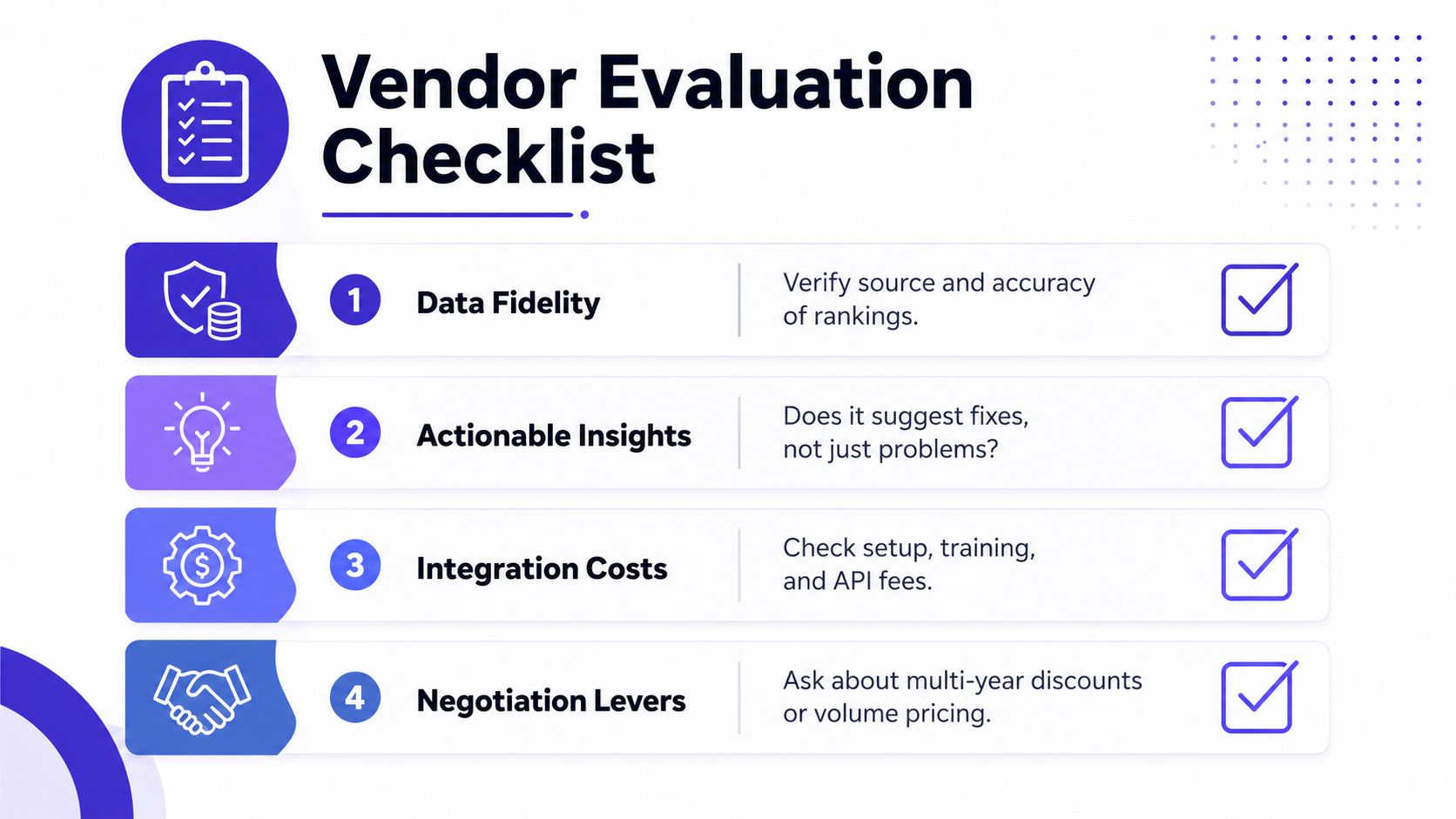
Data fidelity comes first. Ask whether the vendor captures answers from live user-facing interfaces or relies on APIs and sanitized outputs. Live-interface capture can better represent what buyers see, but you still need to understand sampling, geography, personalization, refresh timing, and reproducibility.
Check whether the report shows the full answer, citations, prompt wording, engine, timestamp, and competitor context. An aggregate visibility score without the underlying evidence makes it hard to challenge an inaccurate result or decide what to change.
The next test is actionability. Can the product identify the cited page, explain the gap, and recommend a specific next action? Does it generate a reviewable artifact, or does it summarize the problem? A dashboard that no one can operationalize becomes a reporting expense.
Ask commercial questions directly
Use these questions in procurement:
- What exactly counts as a prompt? Clarify variants, reruns, failed requests, scheduled checks, and manual tests.
- What happens at the limit? Ask whether monitoring pauses, overages apply, or the account moves automatically to another tier.
- How long is history retained? Trend analysis is less useful if the vendor limits historical access or charges for exports.
- Are seats unlimited? Confirm whether report viewers, clients, contractors, and API users count.
- How are brands and domains counted? Agencies should ask about portfolio pricing, white-label reporting, permissions, and scheduled delivery.
- What costs extra? Check setup, integrations, API access, additional engines, analyst support, and onboarding.
- Can the contract scale gradually? Request volume pricing, upgrade flexibility, and a clear cancellation process.
For agencies, multi-brand operations deserve their own analysis. This guide to AI visibility monitoring for enterprise multi-brand portfolios focuses on the operational issues that a simple per-domain comparison can miss.
Finally, review the broader SaaS contract, not only the AI feature price.
What Should You Budget at Your Stage?
An early-stage B2B SaaS company usually shouldn't begin with an enterprise suite. Start with a focused set of buyer prompts, a small number of engines, and a clear owner who can review findings and ship changes. A budget around the lower self-serve market is reasonable when the goal is learning which queries matter and establishing a baseline.
A growth-stage company needs broader coverage and more consistent operations. Budgeting in the $99 to $500+ monthly range is a practical anchor for mainstream B2B SaaS teams, based on the public Semrush and Profound reference points. (Market pricing comparison for AI visibility tools) Prioritize competitor benchmarking, prompt expansion, historical trends, exports, integrations, and recommendations that content or engineering teams can implement.
Agencies and multi-brand teams should stop using a single-domain subscription as their primary benchmark. Calculate cost per managed brand, then add the labor required for client reporting, QA, white-label delivery, and cross-account analysis. A plan with unlimited seats may be more economical than a cheaper per-user product if several client-facing and internal stakeholders need access.
| Company stage | Sensible budget posture | Feature priority |
|---|---|---|
| Early-stage SaaS | Lean self-serve monitoring | Priority prompts, daily or regular tracking, basic history |
| Growth-stage SaaS | Professional monitoring plus workflows | Multi-engine coverage, competitors, integrations, actionable remediation |
| Agency or portfolio team | Portfolio-based commercial review | Per-brand economics, white-label reports, collaboration, retention |
| Enterprise | Custom procurement assessment | Governance, broad coverage, security, APIs, support, implementation |
The central budgeting decision is simple. If you only need to know whether your brand appears, monitoring may be enough. If visibility is tied to pipeline and your team needs help closing gaps, price a performance program that includes the workflow, labor, and measurement needed to turn evidence into shipped improvements.
GetIntel gives B2B teams a way to track AI answer-engine visibility, competitor citations, prompt-level findings, and daily trend data while connecting identified gaps to reviewable remediation workflows. Visit GetIntel to evaluate whether its brand and prompt-based plans fit your monitoring budget and execution capacity.