Update, 17 September 2026. Profound has since removed its public self-serve tiers. Its pricing page now shows only a free Trial and an Enterprise plan at custom pricing. The trial widened between the two readings: in August it was limited AI Marketer credits and 10 prompts run once against ChatGPT alone, and on 23 September 2026 it ran 50 prompts daily for 7 days across ChatGPT, Gemini and Google AI Overviews. We captured the $99 Starter and $399 Growth tiers on 2 August 2026, confirmed their removal in a site capture on 15 September 2026, and verified it again against the live page on 17 September 2026. Everything below describes the pricing as published in August, which is now a record of what changed rather than a current quote. If you are evaluating Profound today, expect a sales call rather than a checkout.
Profound published two self-serve tiers until September 2026, when both were withdrawn: Starter at $99 a month and Growth at $399, both billed yearly with two months free, alongside a custom Enterprise plan that is now the only way in. Checked on their own pricing page on 18 August 2026. The number that matters is not either price, it is the engine count: Starter tracks ChatGPT only, Growth tracks three.
Disclosure: GetIntel is an AI visibility tool and competes with Profound, so treat the comparison accordingly. Every Profound figure below was read from tryprofound.com/pricing on 18 August 2026. Our own coverage data is published and linked so you can check the reasoning rather than take it.
Pricing pages in this category almost all key on engine count, and Profound's is the clearest example of it. The gap between the two self-serve tiers is not features in the usual sense. It is how much of the answer layer you are allowed to see.
What do the tiers actually include?
Profound published three tiers before withdrawing the first two: $99 for ChatGPT only, $399 for three engines, and a custom Enterprise plan reaching nine.
| Starter | Growth | Enterprise | |
|---|---|---|---|
| Price | $99/month | $399/month | Custom |
| Billing | Yearly, 2 months free | Yearly, 2 months free | Tailored |
| Answer engines | ChatGPT only | 3 tracked | Up to 9 |
| Prompts tracked | 50 | 100 | Tailored plan |
| Agents credits | 100/month | 400/month | Tailored |
| Support | Standard | Dedicated Slack | |
| Compliance | Not listed | Not listed | SSO/SAML, SOC2 |
Profound tier structure and pricing, read from tryprofound.com/pricing on 18 August 2026.
The three engines on Growth are ChatGPT, Perplexity and Google AI Overviews. Profound states 9,000 responses monthly against 100 unique prompts at daily frequency, which is the volume that makes the prompt number meaningful.
Enterprise adds multi-company tracking, which is the tier an agency lands on rather than the $399 one.
Is the $99 tier a real entry point?
The $99 tier was a real price for a partial view, and whether that was useful depended on a number Profound's page does not give you.
Starter tracks ChatGPT only. GetIntel tracks 60 buyer questions across four engines and is named on 24 of them. Across those 24, one engine surfaces 14 of them, 58.3 percent, and the best two surface 23, or 95.8 percent. The third and fourth engines add the last prompt between them.
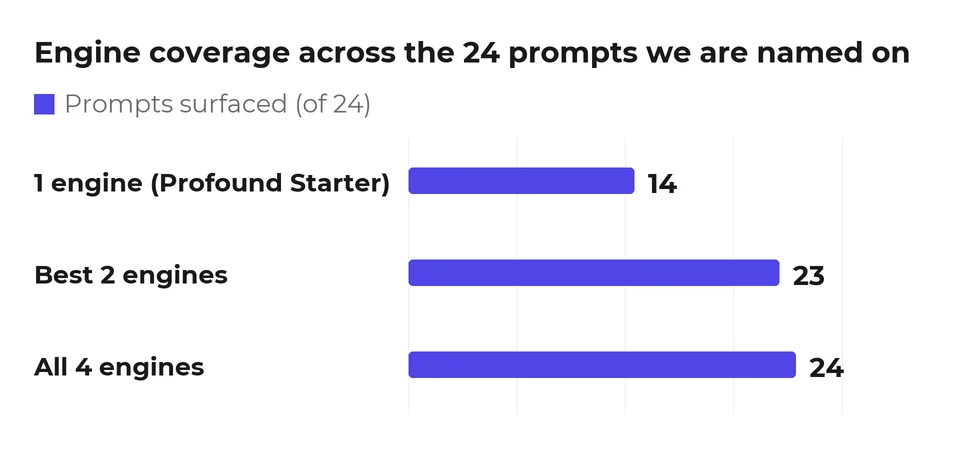
Apply that to the tier boundary. A ChatGPT-only view is a little over half the picture by our measurement, and the step that closes most of the remaining gap is the step from $99 to $399. That is a four-fold price increase to move from roughly 58 percent coverage to roughly 96 percent.
Whether that is worth it depends entirely on whether you are buying a number to report or a number to act on. The reasoning behind those coverage figures is set out in what engine tiers actually buy.
What does it cost per prompt?
Growth cost less per prompt and four times more in absolute terms, which is the tension buyers actually face.
- Starter: $99 for 50 prompts on one engine. That is 50 engine-and-prompt combinations, so $1.98 per combination per month.
- Growth: $399 for 100 prompts on three engines. That is 300 combinations, so $1.33 per combination per month.
So the expensive tier is about a third cheaper per unit of coverage. That is normal software pricing and it is not a criticism. It matters because the per-unit figure is the one that makes Growth look obvious and the absolute figure is the one that decides whether a bootstrapped team buys anything at all.
If your budget is $99 and the alternative is nothing, Starter is not a bad purchase. If your budget is $99 and you assumed it bought a full view, the tier boundary is the thing to understand before you sign.
Who is each tier actually for?
Starter is for small companies monitoring visibility, Growth for growing companies who also want to create content, and Enterprise for large companies and agencies. Profound's own descriptions are unusually honest about this and are worth reading literally.
Starter is described as being for small companies who want to monitor and understand their brand's visibility. Growth is for growing companies who want to monitor visibility and create AEO optimized content, which is where the Agents credits jump from 100 to 400. Enterprise is for large companies and agencies orchestrating campaigns, and it is the only tier listing multiple companies tracked, SSO/SAML and SOC2.
The agency read is straightforward. Multi-company tracking is not on either self-serve tier, so an agency managing a client roster is on a sales call rather than a credit card, whatever the $399 headline suggests.
How does this compare with the rest of the category?
Profound sits at the enterprise end of a market whose self-serve entry points cluster far below it.
Entry prices published by other vendors, re-read since this article first ran: Otterly from $29 (19 Sep 2026), GetIntel at $29 (17 Sep 2026), LLM Pulse from 49 euros (23 Sep 2026), Peec AI from $95 monthly or $80 billed annually (17 Sep 2026), Dageno at $79 (22 Aug 2026).
One of those moved in a way worth naming. Peec was captured at 70 euros on 2 August 2026 and now publishes dollars, so the figure changed currency as well as amount. A price quoted without the date it was read cannot express that, which is the whole argument of why the numbers in this category disagree.
Before it was withdrawn, Profound's $99 Starter was the most expensive entry tier among them and the only one limited to a single engine, since the others included three or more at or below that price. We have not re-checked those vendors' top tiers, so we are not claiming where $399 sat against their ceilings.
That is a positioning choice rather than a flaw. Profound is built for larger brands buying through procurement, and its Enterprise tier reaching nine engines is a genuine capability the cheaper tools do not match.
The honest framing for a buyer: if you are a solo founder comparing $99 against $29, you are not comparing like with like in either direction. You are comparing a one-engine view from an enterprise-grade platform against a multi-engine view from a smaller one. Both trades are defensible.
What does the pricing page not tell you?
Profound's pricing page left three things unstated, and they are the three worth asking on a call.
- What happens at the prompt limit. 50 and 100 tracked prompts are stated. Whether exceeding them blocks, queues or upsells is not.
- What an Agents credit is worth. 100 and 400 per month are stated without a unit definition, so the credit line cannot be compared against another vendor's usage metering.
- Monthly billing. Both self-serve tiers are quoted billed yearly with two months free. A monthly option may exist, but it is not published, so the real entry commitment is a year.
None of that is unusual for the category. It is simply the set of things a published price does not settle.
Is $399 good value in this category?
Profound's $399 Growth tier, withdrawn in September 2026, sat well above every entry price in the category while it was on sale, so what it bought is worth working out explicitly.
At that budget you are choosing between one enterprise-grade platform at its middle tier and a smaller vendor's plan with money left over, given the entry prices listed above. What $399 buys at each competitor specifically is not something we have verified tier by tier, so treat this as a comparison of entry points rather than of equivalent plans.
What Profound gives you for the difference is real and worth naming. Nine answer engines on Enterprise is broader coverage than the smaller tools offer. The Agents layer is a genuine product rather than a feature bullet. Procurement, SSO/SAML and SOC2 exist because larger buyers require them, and a tool without them is disqualified before price is discussed.
What the smaller tools give you instead is more engines earlier. Most of them include three or four on their entry plan, which is the coverage Profound gates behind $399.
Neither is the obviously correct purchase. The question is whether your constraint is coverage breadth or procurement readiness, and those two constraints rarely sit in the same company.
What happens when you outgrow Starter?
Outgrowing Starter meant moving to Growth or moving vendor, and the pricing page made the first option a four-fold step.
There is no published intermediate. A team on Starter that wants a second engine cannot buy one engine more; the next tier is three engines, twice the prompts and four times the price. For a small team that discovered its buyers use Perplexity, that is a real decision rather than an upgrade click.
This is worth flagging because it is where published pricing shapes behaviour. A tier boundary that wide tends to produce two outcomes: teams who stay on the partial view longer than they should, and teams who re-evaluate the whole category at renewal rather than upgrading in place.
How did we check this?
Every Profound figure here was read from tryprofound.com/pricing on 18 August 2026 and reflects the brands view of that page rather than the agencies view. Prices change, and this article carries its date for that reason.
The coverage percentages are GetIntel's own. The denominator is the 24 prompts we are named on, drawn from 60 tracked buyer questions across four engines, so the percentages describe how concentrated our own citations are rather than a universal truth about engine overlap. A brand whose citations sit mainly on Perplexity would find its second engine somewhere else and the 58.3 percent figure would not transfer. A different category with different source dynamics could distribute differently.
We compete with Profound, which is why the tier table is quoted rather than summarised, and why the comparison section names its strengths rather than only its price. If you want the head-to-head instead of the price breakdown, that lives in GetIntel vs Profound, and six other options are compared in Profound alternatives. For another enterprise-tier comparison where the vendor won't publish its own middle-tier prices at all, see AirOps pricing. For how Profound and the rest of this category actually get cited by AI engines, not just what they cost, see the best AEO tools.