
The best AEO tool depends on whether you need to measure or to produce. For founders and small teams we would start with GetIntel at $29/month, which tracks four engines and drafts the fix; for marketing teams that want the most-cited vendor on these questions, Peec AI from $95/month; for enterprise procurement, Profound or Conductor. Below is the reasoning, the pricing we could verify, and what AI engines themselves say when asked this question - which is not the same answer.
Disclosure: GetIntel sells an AI visibility tool and appears first in this list, which is what 16 of 17 vendor roundups do, including ours. Read the ordering with that in mind and check the competitors' own pricing pages before buying.
That difference is the useful part. AEO is the work of getting chosen by an answer engine; AI visibility tracking is the measurement that tells you whether it happened. Buyers treat the two as one category and the engines evidently do not.
GetIntel publishes this and sells a tracker, so we are a party to the comparison and not a referee. The dataset is published with all 20 prompts in it.
Which AEO tools do AI engines actually name?
Peec AI leads on 15 citations, Conductor and Profound tie on 13, and Ahrefs follows on 11, measured across three AEO-specific questions run on ChatGPT, Perplexity, Gemini and Google AI Overviews. The eight tools below are the ones worth a buyer's time out of that set.
| Tool | Best for | Price, with the date it was read | Engines tracked |
|---|---|---|---|
| GetIntel | Founders and small teams who want the gap and the fix in one place | $29/mo, $79, $149, billed monthly, no contract, 17 Sep 2026 | ChatGPT, Perplexity, Gemini, Google AI Overviews (Claude weekly on the $149 tier) |
| Peec AI | Marketing teams and agencies wanting per-engine source detail | $95/mo (50 prompts), $245 (150), $495 (350); annual billing brings those to $80, $205 and $420, 17 Sep 2026 | 3 models per plan, chosen by you |
| Profound | Larger brands buying through procurement | Enterprise-only, custom pricing since September 2026 | Up to 9 answer engines on Enterprise |
| Conductor | Enterprise SEO teams already on the platform | Not published, sales-led | Answer-engine modules on an existing suite |
| AirOps | Teams that need drafts produced at volume | Free tier $0, everything above it marked Custom; $200 and $2,000 reported second-hand, 29 Aug 2026 | Content workflow rather than engine tracking |
| Ahrefs | Anyone already paying for the Ahrefs suite | Index included on Lite and up; tracking your own prompts from $199/mo, packages $50 to $250, 24 Sep 2026 | AI module attached to the existing product |
| Semrush | Anyone wanting AI visibility as its own purchase | AI Visibility Toolkit $99/mo per domain, 27 Aug 2026 | Standalone product, not a tier unlock |
| AIOSEO | WordPress sites wanting AEO features in-place | We could not verify a current figure, 12 Aug 2026 | Plugin, not a standalone tracker |
| Scrunch AI | Enterprise brand teams | Core $250/mo, 26 Aug 2026 | Enterprise answer-engine coverage |
Where the price column says we could not verify a figure, that is literal: the vendor quotes on request, renders it behind JavaScript we could not read, or had no current public page on the day. We would rather leave a gap than publish a number we have not checked, having spent this week correcting one we inherited.
How we measured this, and why there is no leaderboard
We measured this by putting three buyer questions to four engines, returning 269 citations across 100 domains. The questions were "what are the best AEO tools", "what is the best tool for generative engine optimization" and "what is answer engine optimization and what tools help with it".
We also measured which vendors the engines name on those questions, and the full ranking is published in the dataset under aeo_subset. We cite individual placings below where they are relevant to a tool, but we are not reproducing the leaderboard itself, because ranking competitors above ourselves is not what a buyer's guide is for. It is worth knowing what the measurement rewards before reading it: citation counts track how long and how much a vendor has published about the category, so they favour incumbents and say little about fit. The unfiltered list also includes arXiv, an agency and an ecommerce platform out-citing several actual products, which is the clearest sign it is not a quality ranking.
Why the AEO list differs from the tracking list
The AEO list differs from the tracking list because the engines treat them as two different shopping questions, and the vendor sets barely overlap. Compare the same engines answering the broader tracking question, where Semrush and Ahrefs lead on 63 citations each and Otterly sits fifth. On AEO questions Otterly does not reach the top nine at all, while Conductor, HubSpot and AIOSEO appear from nowhere.
One caveat that matters more than the ranking: this is three prompts. It is enough to show the two lists differ and not enough to separate fourth place from seventh. Read the grouping, not the order.
What is actually an AEO tool rather than a tracker?
An AEO tool differs from a tracker in that it is meant to change the outcome rather than report it. The split the data implies is between measuring and doing.
A tracker tells you which questions you are absent from and which sources the engines used. An AEO tool is supposed to change that outcome: produce the content, fix the markup, restructure the page so a passage can be lifted. Most products in this category do some of both and market themselves as all of it, which is why the category name is a mess.
Tracking which sources an engine read before answering is a narrower job again, and one the large platforms lose to small tools - we ranked them separately in the best AI citation tracking tools. The practical test when someone calls their product an AEO tool: ask what artefact it produces. If the answer is a dashboard, it is a tracker. If it produces a draft, a schema block or a file you can ship, it is doing AEO work. Neither is better, but they are different purchases and they fail differently.
The tools worth looking at
Eight AEO tools are worth a look, ranked below by how often AI engines cite each vendor's own domain rather than by our opinion of the products. Prices and engine coverage sit in the comparison table above.
1. GetIntel
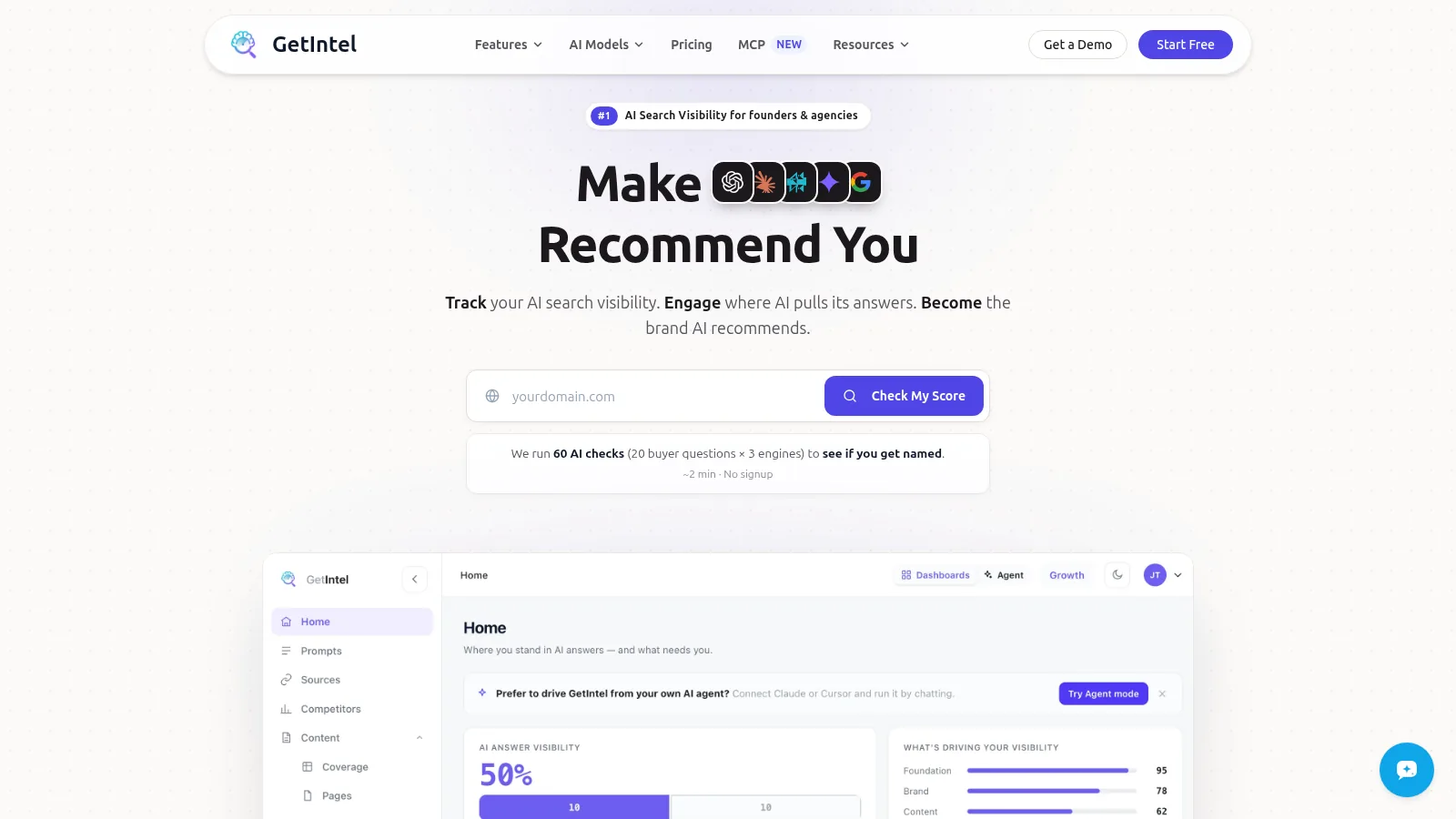
GetIntel tracks which buyer questions name your brand, on which engine, and which sources the answer pulled from, across ChatGPT, Perplexity, Gemini and Google AI Overviews, refreshed daily. The full AEO tracker breakdown covers what it does with a gap once it finds one.
Plans are $29, $79 and $149 a month as of 17 September 2026, billed monthly, no contract, with Claude weekly on the $149 tier. The 7-day trial takes a card and charges on day 8.
On the doing-versus-measuring split we sit mostly on the measuring side, with generated llms.txt files and schema snippets as the fix artefacts. We will not oversell that half: our own testing found no measurable citation effect from either.
We put ourselves first, as every vendor-written roundup does. What we offer that most do not is the underlying counts, including our own, so you can check the ordering rather than trust it. If you need fixes written and shipped at volume, the products above on the doing side answer that better.
2. Peec AI
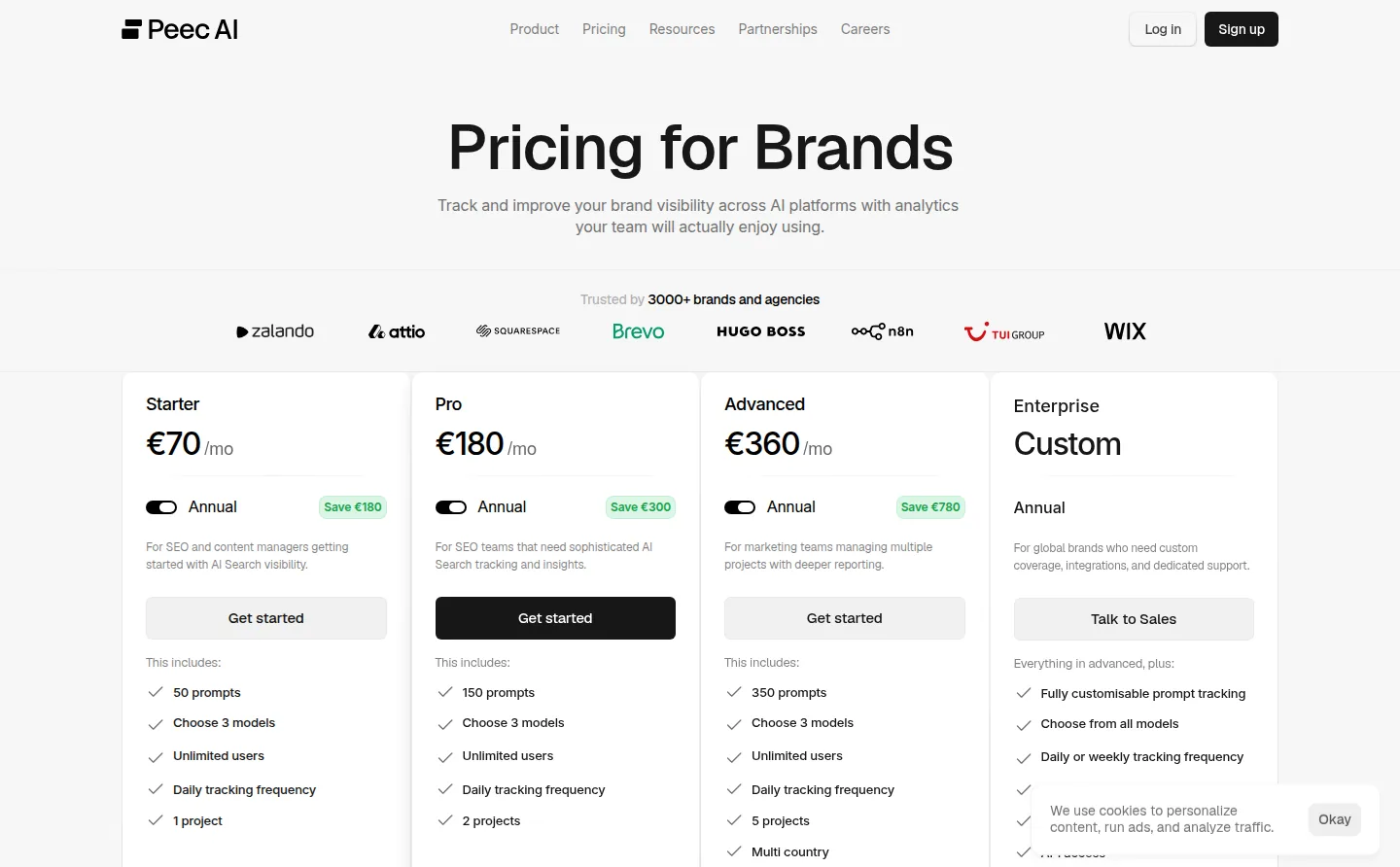
Peec AI is an AI search analytics platform aimed at marketing teams and agencies. It is the most-cited vendor on AEO questions in our measurement. Read from their own pricing page on 12 August 2026 and re-checked live on 17 September 2026: Starter at $95/month for 50 prompts, Pro at $245 for 150 prompts, Advanced at $495 for 350 prompts, with annual billing bringing those to $80, $205 and $420. The August reading showed the same amounts in euros, which is where the €70/€180/€360 figures in older comparisons come from. Enterprise is quoted on request. We previously said every tier includes unlimited users, which we could not source: read on 24 September 2026, Peec's pricing page lists "Team users" as a feature with no number attached to any tier, so neither unlimited nor a cap is published. It is not a reason to choose Peec until Peec says so.
3. Conductor
Conductor is an enterprise SEO platform that added answer-engine modules to an existing suite, and it is the joint second-most-cited vendor on these questions, tied with Profound on 13 citations.
The pricing is the part worth knowing before you book a call. We read conductor.com/pricing on 26 August 2026: it lists three tiers, Essentials, Growth and Enterprise, each with specific feature quotas, and not one dollar figure anywhere on the page. Every tier routes to "Try for Free", "Request a Demo" or "Contact Sales". That is a deliberate choice rather than an oversight, and it means you cannot size this against the rest of the list without entering a sales process. The full read is in Conductor and Bluefish AI pricing, which also separates it from the unrelated company it gets confused with.
4. Profound
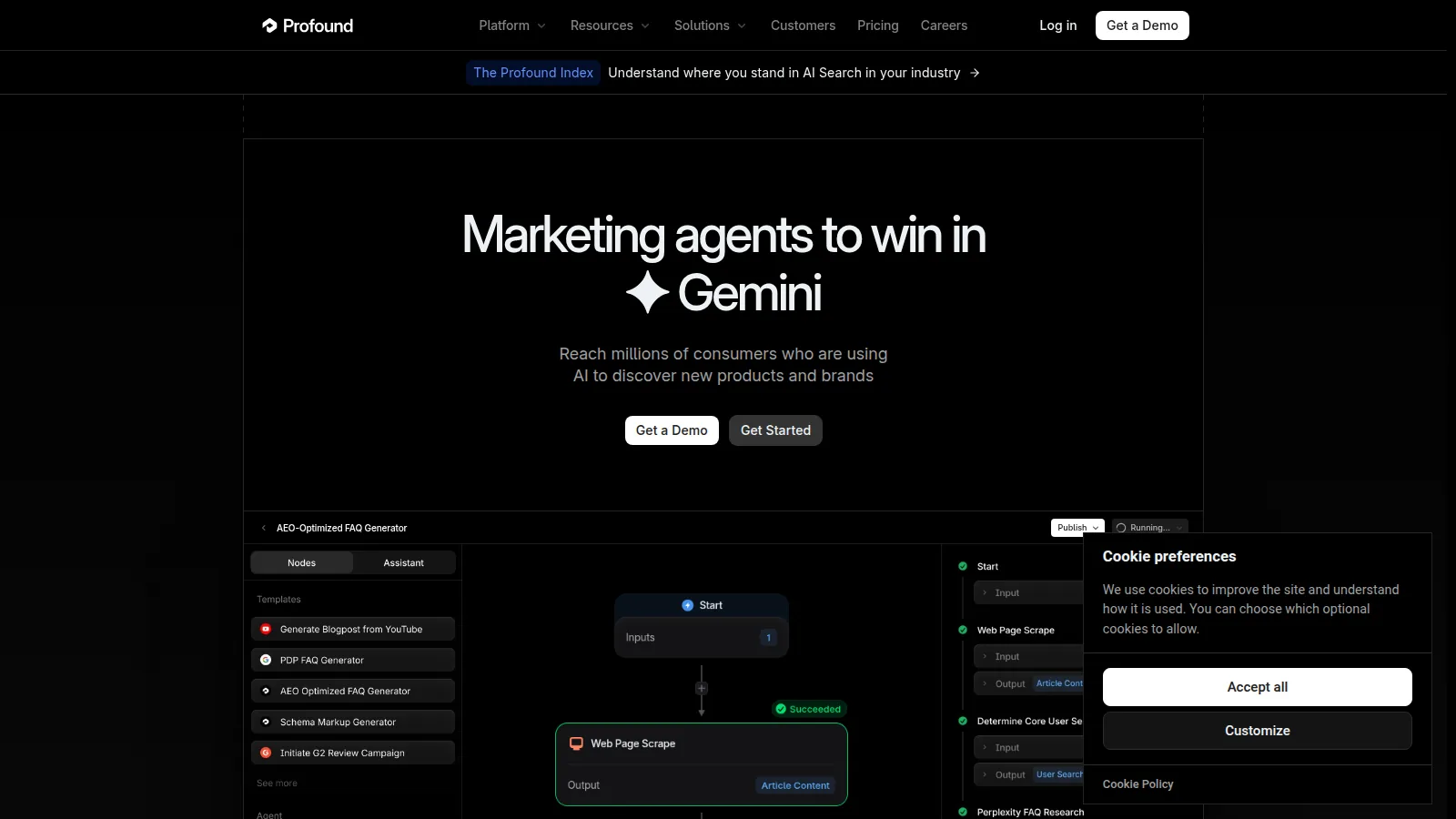
Profound is an AI answer-engine monitoring product aimed at larger brands. It ties with Conductor on AEO questions and is fourth on tracking questions.
The thing a buyer needs to know about Profound changed in September 2026: it withdrew self-serve pricing entirely. We captured $99/month for ChatGPT-only tracking and $399/month for three engines on 2 August 2026, confirmed their removal in a site capture on 15 September, and checked the live page again on 17 September. It now offers a free trial and a custom Enterprise plan, nothing between them. Up to 9 answer engines are quoted at the Enterprise tier. If you are a self-serve buyer, Profound is no longer a product you can buy without a sales call, which is the single biggest change in this list since August.
5. AirOps
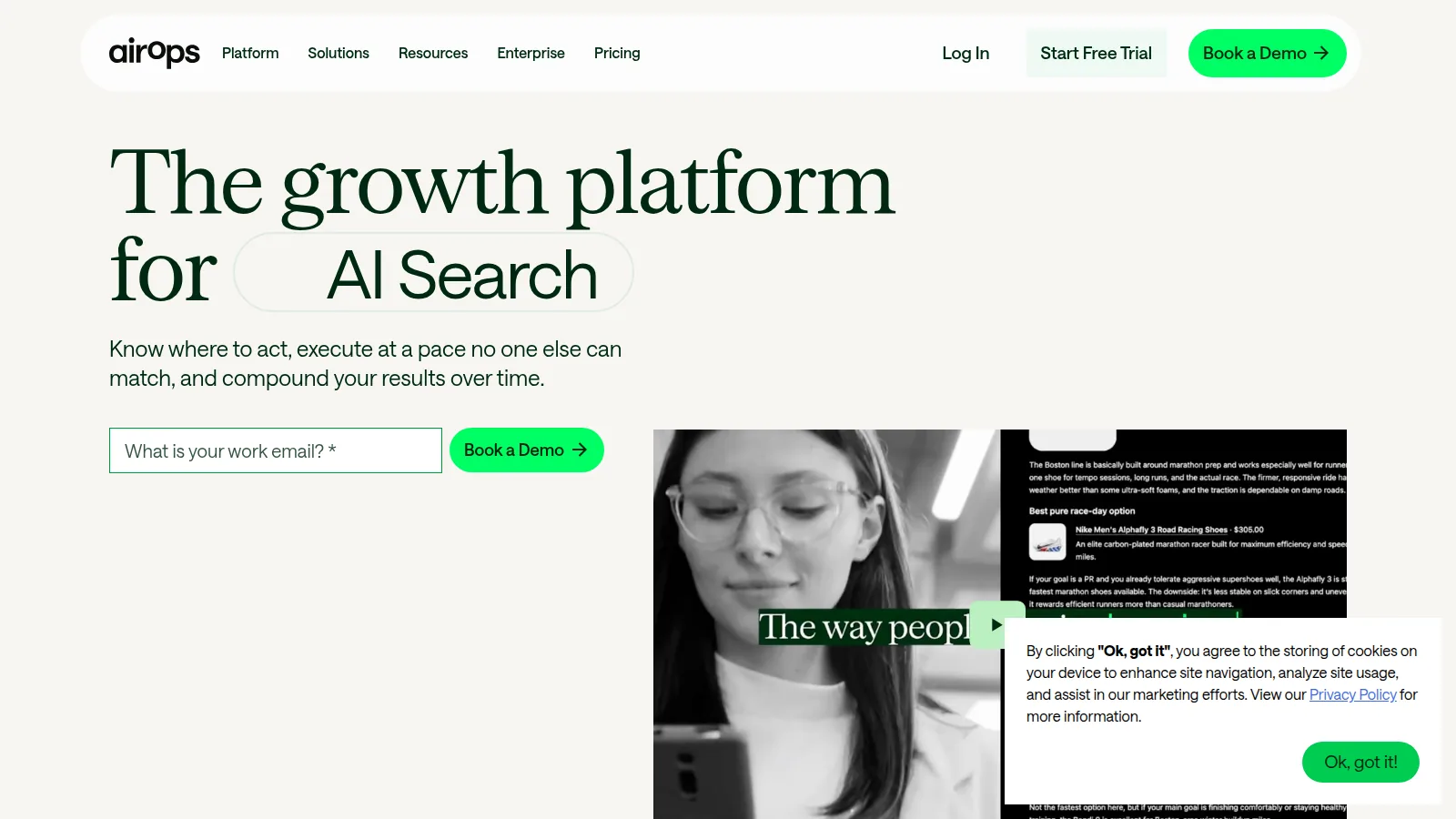
AirOps publishes a $0 Insights tier and marks every plan above it "Custom", with no figure attached, read 29 August 2026. Two independent reviews published in 2026 put Solo at $200 a month and Pro at $2,000, a tenfold step for the tier that adds more than one engine. We are repeating those rather than confirming them, because AirOps does not show them: the full read is here. It positions itself on the doing side rather than the measuring side: per its own site, a content workflow product that produces drafts at volume. We have not used it, and the doing-versus-measuring labels throughout this section are our read of public positioning, not something the citation counts prove. It appears on AEO questions and not on tracking ones, which is the pattern you would expect if the engines have understood the distinction.
6. Ahrefs
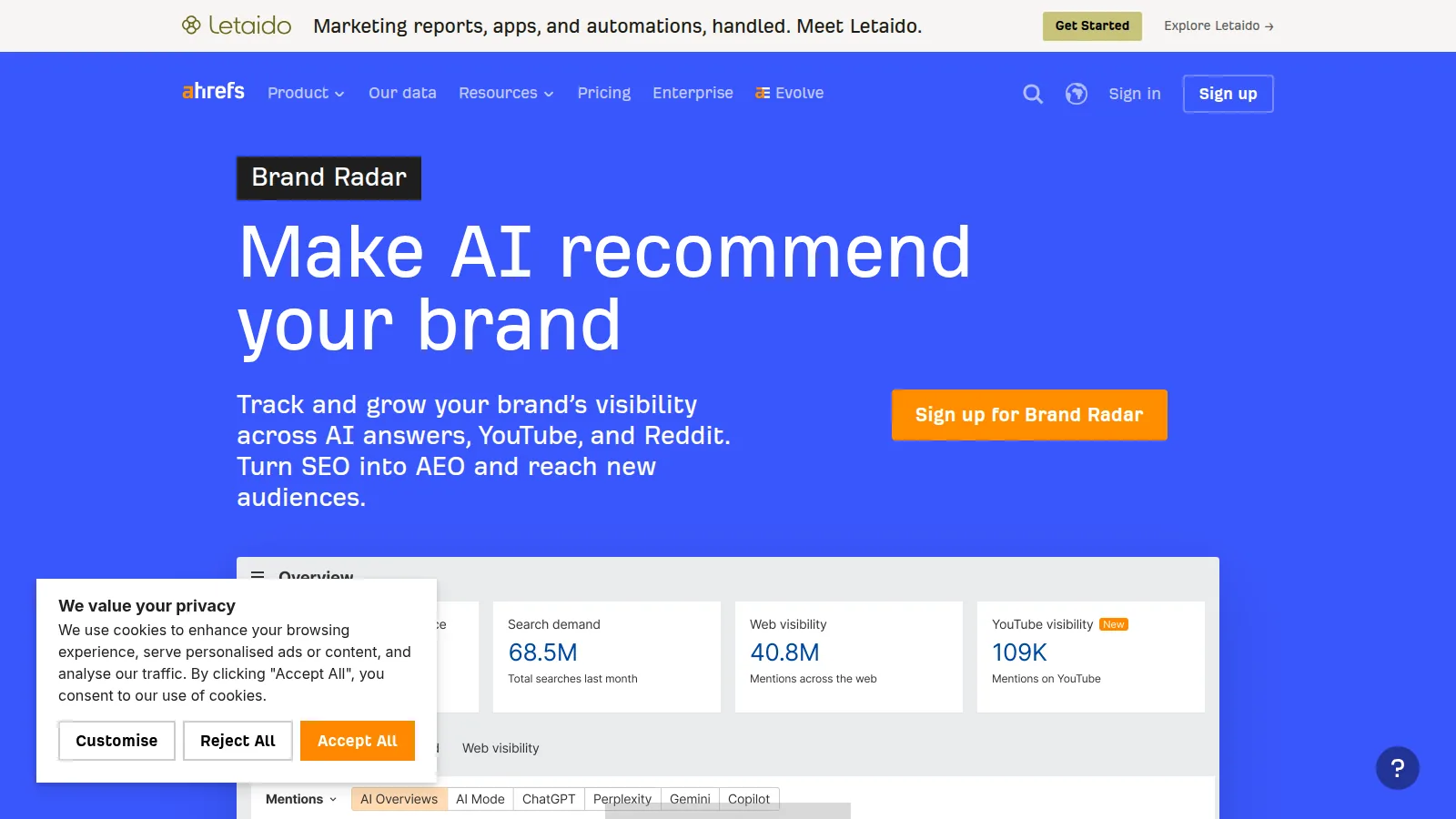
Ahrefs is an established SEO suite whose Brand Radar module covers AI visibility, and it is fourth-most-cited on these questions on 11 citations.
If you already pay for Ahrefs, Brand Radar looks like the cheapest option on this page, because the marginal cost reads as zero. That reading is half right, and the half it gets wrong is the half you are buying. The market-wide index is included on the Lite, Standard and Advanced plans. Tracking your own prompts is a separate purchase: the AI Visibility Index starts at $199 a month for 83 prompts a day, with custom prompt packages at $50, $100 and $250 a month, read from ahrefs.com/pricing on 24 September 2026.
The other catch is one we hit on our own account rather than read about. On 2 August 2026 we had a Brand Radar report configured and tracking ChatGPT daily, and the endpoints that actually return its data, brand-radar-ai-responses and brand-radar-cited-pages, both returned Missing addon: Brand Radar. Configuring the report and licensing the add-on that makes it return anything are separate purchases, and the interface does not say so. The full account is in the addon we couldn't use, and it is the practical evidence that "included in your plan" and "returns data" are different statements.
7. Semrush
Semrush is an SEO suite with an AI visibility toolkit attached. It draws 6 citations on these questions, joint ninth, while tying for first on the broader tracking questions, which is the sharpest illustration on this page that the two questions are not the same market.
The assumption worth correcting: the AI Visibility Toolkit is not something that unlocks at a higher Semrush tier. It is sold as its own product at $99 a month per domain, with its own checkout, on top of whatever Semrush plan you already pay for, confirmed on Semrush's own pricing page as of 27 August 2026 (full breakdown). So unlike Ahrefs, where the module may already sit inside a plan you hold, here the answer to "does my subscription already cover this" is no.
HubSpot, AIOSEO and Scrunch AI
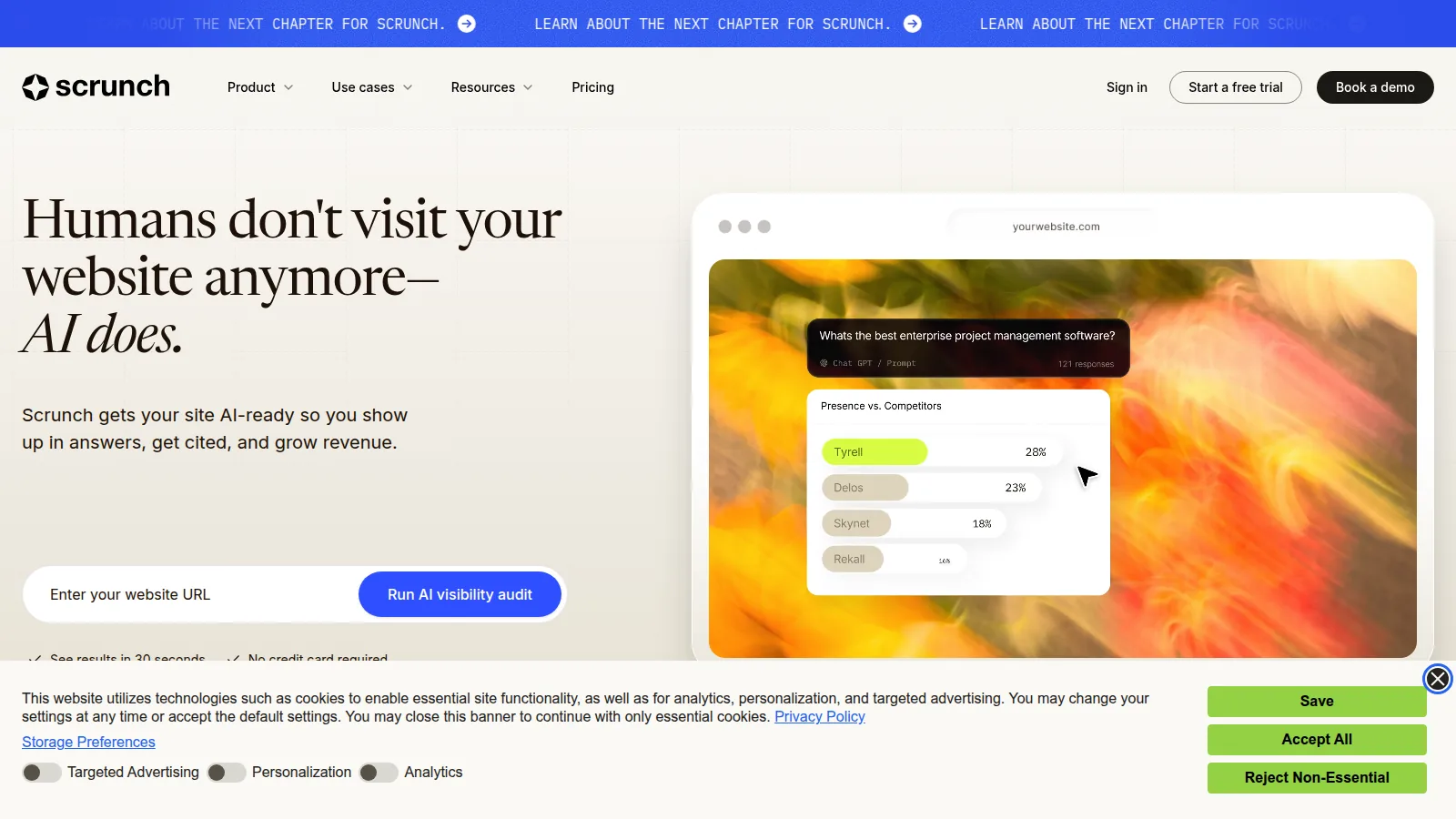
HubSpot, AIOSEO and Scrunch AI all appear in the ranking above and are worth naming even though we have not used them. HubSpot is a CRM and marketing suite that has added an AEO product; AIOSEO is a WordPress SEO plugin that added AEO features, which makes it the only entry here a WordPress site can install directly; Scrunch AI is an enterprise-oriented brand-visibility platform.
Scrunch is the one of the three with a public number now. It stopped being sales-led this year and publishes Core at $250 a month for 125 prompts and one brand workspace, read 26 August 2026, with Enterprise quoted on request (the tier detail is here). That makes it the highest entry price on this page, which is a positioning statement rather than a fault. We could not verify current pricing for HubSpot's AEO product or AIOSEO on 12 August 2026. All three are worth a look for a specific reason rather than in general: HubSpot if you already run its CRM, AIOSEO if the site is WordPress and you want the work done in place, Scrunch if you are buying for an enterprise brand team through procurement.
Why is GetIntel first if the ranking is not by citations?
The order of the tools on this page is not the citation order. The citation table measures how often AI engines name each vendor when asked, which rewards how long and how much a company has published about the category: a popularity signal with a long memory, not a verdict on which tool fits you. Our order is a judgement about fit, price and fix workflow, made by a company that sells one of the tools, and you should weigh it knowing that. The full dataset is published for anyone who wants to check the counts behind the table.
Who actually gets cited when AI engines answer about AEO tools?
Mostly not the vendors. In GetIntel's own source tracking across its tracked buyer prompts, 5,130 filtered citations read on 29 August 2026, 91% of the citation share went to third-party sites, and the vendors' own websites shared the rest.
| Source | Citation share | Type |
|---|---|---|
| 22% | Third-party (UGC) | |
| YouTube | 18% | Third-party (UGC) |
| Semrush | 12% | Vendor |
| 11% | Third-party (UGC) | |
| Otterly.AI | 10% | Vendor |
| LLM Pulse | 10% | Vendor |
Top sources by citation share, 5,130 filtered citations across GetIntel's tracked buyer prompts, read 29 August 2026.
Reddit and YouTube alone hold 40% of that share. So most "best AEO tool" answers are built from threads, comparison videos and LinkedIn posts written by people outside these companies, not from vendor product pages. For a buyer, that means the shortlist an AI engine gives you mostly reflects what other people have written about these tools. For a vendor, it means the lever is being discussed on those third-party sites, not publishing more pages on your own.
How should you choose between them?
Judge them on four things: what the tool actually produces, which engines it covers and how often, whether you can see the denominator behind its numbers, and what it claims about markup.
- What does it produce? A dashboard or a shippable change. Decide which problem you have before comparing features.
- Which engines, and how often? Coverage past two engines adds less than vendors imply, and run frequency matters more than engine count because a single check on a question whose answer moves is off by a wide margin.
- Can you see the denominator? Share-of-voice figures are not comparable between vendors: the same underlying data yields anywhere from 0.94% to 40% depending on what gets divided by what.
- What does it claim about markup? If a tool sells schema or llms.txt as a citation lever, ask for its evidence. Ours found no measurable effect for either.
What this does not tell you
This measurement does not rank product quality. Citation counts measure how often an engine names a vendor when asked, which rewards publishing about the category and says nothing about whether the software works.
Three prompts is a small base for the AEO-specific split, and two runs is enough to see a pattern rather than to pin down an order. A different day would reshuffle the middle of that table.
And two gaps in the price column are still real. Conductor publishes no figure anywhere and routes every tier to sales, and we could not verify a current one for HubSpot's AEO product or AIOSEO. AirOps' $200 and $2,000 are reported by others rather than shown by AirOps, and are marked as such. Everything else now carries the date it was read.
Those dates are the point rather than decoration. Profound withdrew two published tiers between August and September, and our own reading of what Ahrefs bundles was wrong until this week. Prices in this category move faster than a roundup gets refreshed, so check the vendor's own page before deciding, and treat any undated figure you find elsewhere as unknown rather than current.