We fetched 17 "best AI visibility tools" roundups published by companies that sell an AI visibility tool. Sixteen rank their own product first. The seventeenth ranks itself second. None goes lower. An eighteenth, seOptimer's, blocked our fetch, so we left it out. Together those 17 pages carry 992 citations from AI engines (GetIntel source report, 6 August 2026).
Disclosure: GetIntel sells an AI visibility tool. We do a version of this too, and we count ourselves in Do we do this as well? below. The full per-page table ships as CSV and JSON so you can check every row.
In this article
- Who ranks themselves first?
- Does disclosing it change anything?
- What do independent lists pick instead?
- Do we do this as well?
- Why this matters for what AI tells you
- How did we measure it?
Who ranks themselves first?
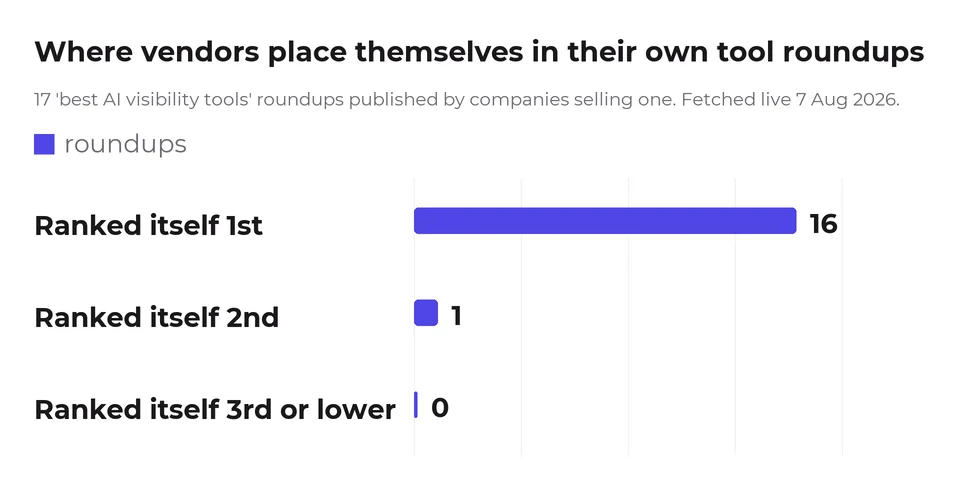
Almost every vendor ranks itself first: 16 of 17 vendor-published roundups put their own product in position one, and the remaining one put itself second. Fetched live on 7 August 2026, this is where each publisher placed itself:
| where the publisher put itself | roundups |
|---|---|
| Position 1 | 16 |
| Position 2 | 1 |
| Position 3 or lower | 0 |
Sixteen first-place finishes out of seventeen self-assessments. The single exception is Ahrefs, which ranks Waikay first and its own Brand Radar second.
These are not obscure blogs. The list includes Semrush, Profound, Ahrefs, HubSpot, Otterly.ai, Frase, Rankability, ZipTie, Dageno, KIME, Omnia, Geoptie, AIclicks, Foglift, GrowthOS, LLM Pulse and LLMrefs. These are the pages AI engines actually reach for: Semrush's carries 114 citations, Frase's 91, Otterly's 88.
LLMrefs is the awkward case. It publishes an alphabetical directory, not a ranked list, and still sits at the top, ahead of the entries beginning with A. We counted that as first. Move it if you disagree; the pattern survives either way.
Does disclosing it change anything?
Disclosing that the publisher sells one of the tools changes nothing about the ranking. You learn more about the publisher, and the order stays exactly where it was.
Three of the 17 vendor-published roundups disclose the conflict outright. ZipTie is the clearest: "Full Disclosure: This guide is published by ZipTie, ranked #1 below." Rankability writes "Rankability is our platform, so we're obviously closest to it." LLMrefs says it built the directory because "we are in this space ourselves."
Two more, AIclicks and Ahrefs, make ownership plain in the body copy without calling it a disclosure.
That leaves 12 of 17 with no disclosure at all.
All three vendors who disclose still place themselves first. So disclosure operates as a courtesy rather than a constraint. It tells you whose list you are reading. The order stays exactly where the publisher put it, which is why a disclosure should raise your view of the publisher and leave your view of the ordering alone.
What do independent lists pick instead?
Independent roundups, written by publishers that sell no AI visibility tool, disagree with each other completely. We checked four from publishers that sell nothing in this category:
| independent publisher | its number one | citations |
|---|---|---|
| Zapier | Profound | 154 |
| Trustmary | Semrush | 150 |
| TheRankMasters | Temso AI | 106 |
| TechRadar | HubSpot AEO | 100 |
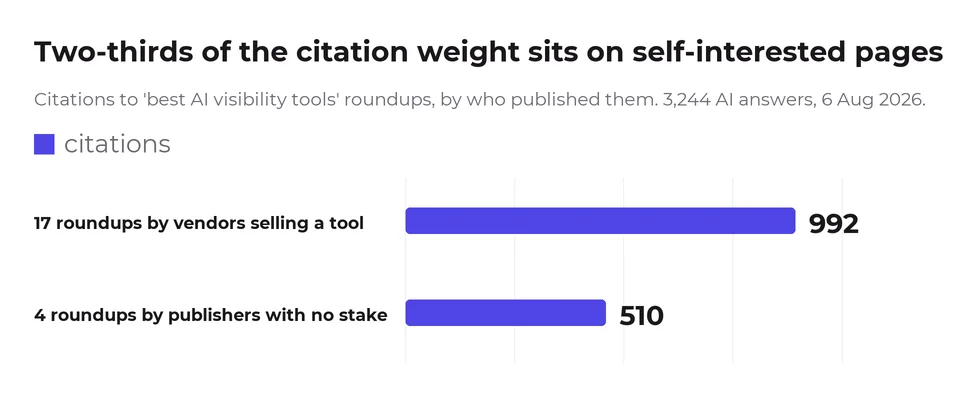
Four independent lists, four different winners, no overlap. Those four pages carry 510 citations between them.
All four were fetched live on 7 August 2026, alongside the 17 vendor roundups, by the same method. They are also the most-cited pages in the sample. Zapier's and Trustmary's carry 304 citations between them, beating every vendor roundup here, so having no stake in the answer seems to cost a page nothing in reach.
That scatter is the useful control. A genuinely contested young category should produce exactly this: four editors, four answers. Put a stake in the publisher's hands and the answer comes back identical 16 times out of 17. The consistency is what gives it away.
Do we do this as well?
GetIntel ranks itself first in ten of its own twelve roundups, so this article is describing us too.
When this piece went up on 7 August 2026 we did not publish a numbered ranking of the category. That stopped being true within a week, and it has kept getting worse.
Counted on 24 September 2026, this site now publishes twelve ranked roundups. GetIntel is first in ten of them: best AEO tools, best AI citation tracking tools, AI visibility tools for B2B SaaS, best AI visibility tools, best Perplexity trackers, best ChatGPT rank trackers, best AI Overviews trackers, best AI search monitoring tools and best LLM SEO tools (both merged into the AI visibility tools roundup on 26 September), and AI visibility tools for agencies. So the count at the top of this article understates us rather than anyone else.
Two of the twelve do not put us first, and they are the two where we would have had to lie. Best free AI visibility checkers leads with Ahrefs, because our free check is not the most generous one. Best white-label SEO software leads with AgencyAnalytics at $20 per client, because we are not the cheapest. That is the whole rule we appear to follow: we rank ourselves first everywhere the ordering is arguable, and only step aside where a number makes it indefensible.
We have since added the disclosure line to each of them, which is the thing this article says separates the five honest roundups from the twelve that say nothing, but it does not change our position in our own lists.
Before that, on 3 August 2026, we also wrote a "Best AI SEO Tools 2026" roundup for another site, and GetIntel appears first of the five tools covered. It has not been published anywhere yet, so you cannot go and check that; take it or leave it. The list runs in price order at $29, $29, $95, $99 and $129, as those five vendors were priced on 3 August 2026, so first place is partly arithmetic. Except Otterly.ai was also $29 on 3 August 2026, and we put ourselves ahead of it. We broke the tie in our own favour.
Our comparison pages have the same shape: every one is GetIntel versus a competitor, written by us, and we are not the ones who come off badly.
So the story here isn't that other people are dishonest. Ranking your own product first is what every vendor does, this one included. What the data shows is that the AI engines cannot see the difference. A self-ranking and an independent assessment arrive as the same kind of page.
Why this matters for what AI tells you
Ask an engine which AI visibility tool to buy and it composes an answer from these pages. The 17 vendor roundups carry 992 citations; the 4 independent ones carry 510. Two-thirds of the citation weight in this sample (992 of 1,502) sits on pages where the author was competing in the list they wrote.
Nobody is gaming anything. Vendors write listicles because listicles get read, and in a category two years old there is not much else on the shelf. We measured the wider version on 6 August 2026, and half of AI's tool advice comes from tool vendors: 51.7% of all citations in the category point at companies selling into it.
For a buyer the consequence is small and specific. When an engine names a "best" tool, ask it where that came from. If the source is a roundup, check whether the publisher appears in its own list. It takes ten seconds, and it tells you how much the recommendation is worth.
How did we measure it?
We fetched 21 roundups live on 7 August 2026 and recorded the position each publisher gives its own product in its own list. Citation counts come from GetIntel's source report covering 3,244 AI answers across ChatGPT, Perplexity, Gemini and Google AI Overviews on 6 August 2026.
What counts as a self-rank. Position in the publisher's own ordering. Some lists organise "by use case" instead of ranking strictly. Position one is still position one, and LLMrefs' alphabetical directory is flagged above as the exception.
What we could not check. seOptimer's roundup carries 82 citations and returned HTTP 403 to our fetch, which matches its documented block on headless browsers. We left it out instead of estimating, so the real vendor sample is 18 and we verified 17.
Limits. One category, and an unusually vendor-dense one because its buyers are marketers. Citation counts ignore how prominently a source was used in an answer. Our disclosure classification is a judgement call, so the exact sentences are quoted above and every row ships in the CSV. This is also a snapshot. These pages get rewritten, so the 7 August figures will drift.
What we are doing about it
We are doing nothing that fixes vendor-ranked roundups, because we publish them too. We can make our own claims checkable. Every research piece we publish ships its raw data, dates its figures, and names what it could not verify. The same refusal to average shows up in Google's own surfaces, which do not behave like one product. If you want to see which sources an engine pulled when it answered a question about you, our source tracking shows that, and you can start free. We publish our own category listing with the underlying data attached, at the AI software index.