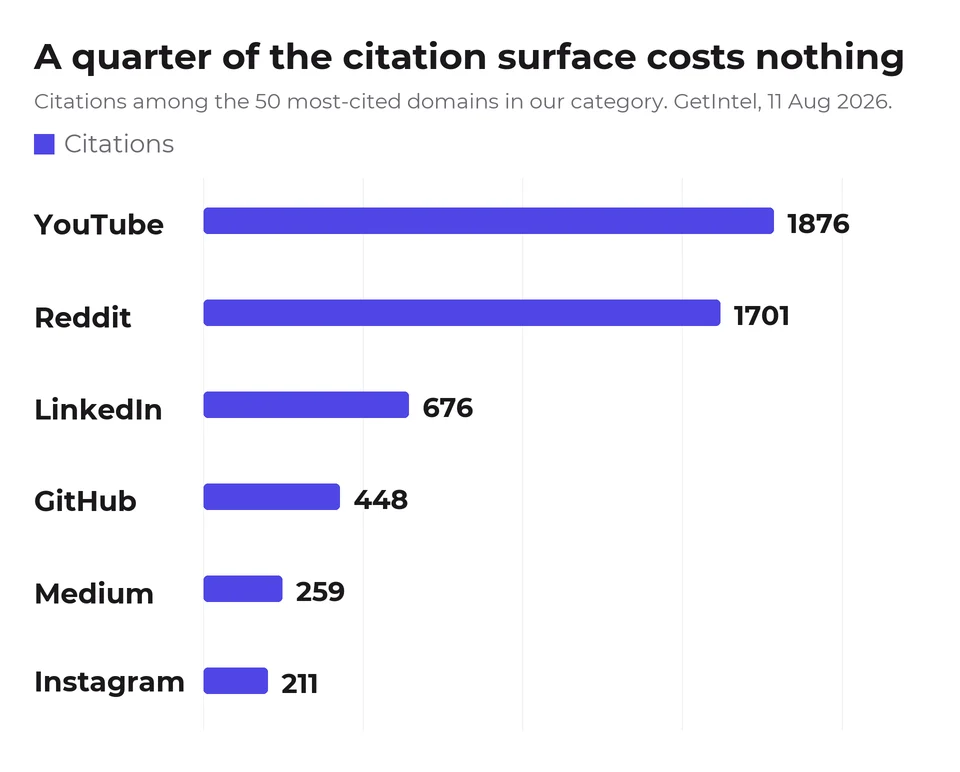
To improve a B2B SaaS brand's citation rate without an agency, do three things in this order: list the buyer questions where you are never named, publish where the citations already sit, and deprioritise the markup work. Across the 50 most-cited domains in our category, meaning AI visibility and GEO tooling, 26.4% of citations sit on six platforms anyone can publish to at no cost: YouTube, Reddit, LinkedIn, GitHub, Medium and Instagram. Category vendors hold 40.0%.
The first step is the one that costs nothing but an afternoon: run each buyer question several times, record which ones never return your name, and work that list. On our own 60 prompts that produced 36 with no mention at all. This applies equally to a solo founder and to a B2B SaaS team that has engineers and a founder doing marketing but no dedicated marketer, because the constraint in both cases is attention rather than money.
That framing matters because most of what gets sold as AI visibility work is either unmeasured or measured and found not to work, and we have tested several of those things on ourselves.
GetIntel sells a tracker, so treat the recommendation with that in mind. The dataset is published, including the classification you may want to argue with.
Where do the citations in a category actually live?
Citations in this category land less exclusively on vendor blogs than you would guess.
| where citations sit | share |
|---|---|
| Six open platforms | 26.4% |
| Category vendors | 40.0% |
| Everything else | 29.8% |
| arXiv, counted separately | 3.8% |
We held arXiv out rather than folding it into the open-platform number. It is free, but it is an academic preprint server and not realistically available to most SaaS companies, and including it would have inflated the headline by nearly four points for no honest reason.
One thing this does not mean: publishing on those platforms does not earn a citation. These are the domains engines cite, not evidence that anything you post there will be cited. The narrower and defensible claim is that a large part of the citation surface in this category is not gated behind a budget.
What should I do first with no budget?
Find the questions where you are absent, because everything else is guesswork until you have that list.
Run the questions your buyers actually ask, in their words, several times each, and record which ones never name you. On our own set that produced 36 prompts of 60 with no mention at all, and a further 11 that name us in under 10% of runs, which a covered-or-not metric would have counted as wins.
That list is the whole plan. It costs an afternoon and no money, and without it you are optimising against a guess about which questions matter.
What can I safely deprioritise?
Deprioritise the two things most commonly sold as quick wins, llms.txt and schema. Deprioritise rather than skip: both have real uses, neither has a measured effect on citations.
llms.txt shows no measurable effect: among the 50 most-cited domains, the 29 publishing one rank no better than the 21 that do not, and the two most-cited domains in the whole corpus publish no file at all. Schema markup shows the same: pages carrying JSON-LD averaged 118.3 citations against 121.3 for pages without.
Both are worth doing for their real purposes and neither belongs at the top of a visibility plan. If an agency's proposal leads with either, that proposal is ordered by what is easy to deliver rather than by what the evidence supports.
We sell the tooling that generates both, which is exactly why saying this is worth something.
What actually seems to work?
What seems to work is having a page that answers a specific question someone asks, and being present in the places engines already read.
On our own site, 12 posts hold every citation our blog has earned and 71 earn nothing. What separates them is measurable, at least in part: we compared each post title against the 60 tracked prompts and the cited posts overlap the nearest question about twice as much, a median of 0.182 against 0.083, with 8 of the 9 we could parse sitting above the uncited median. The comparison is published. Read it with the sample size in mind: nine cited posts is few enough that one unusual title would move that median noticeably.
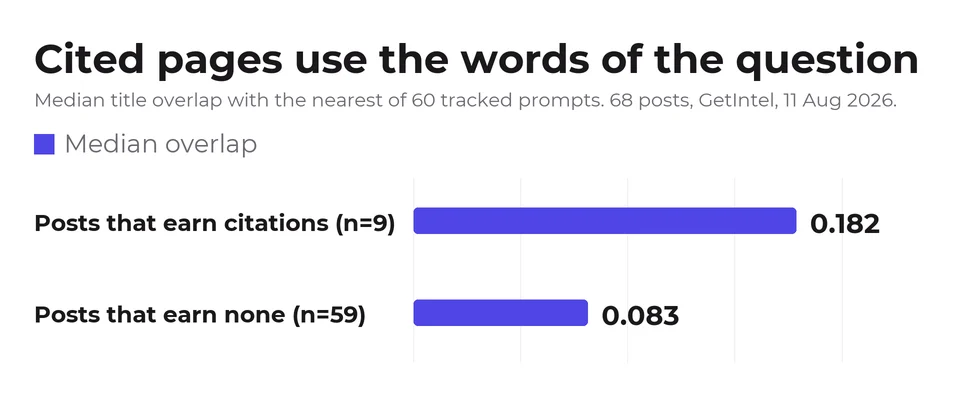
Two honest limits on that. The posts and the prompts both come from the same product framing, so some of the overlap is structural rather than earned, and this is an association rather than proof that rewording a title earns a citation. And we tried to test whether cited posts are simply longer, then abandoned it: our legacy posts do not parse reliably and only one of the twelve extracted, so we have no length comparison to offer and are not going to assert one.
What survives is that the difference looks like targeting rather than production volume, which is the cheap thing to act on.
The second half is being where the citations are. Reddit alone holds 1,701 citations among the 50 most-cited domains and dominates more individual buyer questions in our category than any vendor does. A founder can participate there honestly. An agency cannot do it for you convincingly.
How long should I expect this to take?
Expect this to take longer than a fortnight, and expect not to be able to tell early.
The cleanest publication-to-first-citation lag we can measure on our own site is 13 days, from one post, so treat it as an existence proof rather than a schedule. What we can say more firmly is that reading anything into the first week is a mistake, because the answers themselves move constantly.
Set the review point at a month, on a fixed prompt set, and count how many prompts name you at all rather than watching a percentage.
When is an agency actually worth it?
When the constraint is production capacity rather than knowing what to produce.
Nothing above needs an agency. Finding your invisible prompts is an afternoon. Deciding what to write is judgement about your buyers that an outsider has less of, not more. Publishing on Reddit under an agency's account is worse than not publishing.
For a B2B SaaS team without a dedicated marketer, the calculation differs slightly from a solo founder's. You usually have people who can write, they are just not marketers, and the useful division is that engineers and founders answer the buyer questions in their own words while nobody has to become an SEO. The failure mode for a team is not lack of capacity, it is that the work has no owner and drifts. Assign the prompt list to one person and review it monthly.
Where outside help earns its money is volume: if the list of absent prompts is 40 long and you can write two pages a month, that is roughly twenty months and someone else writing eight of them a month is a real service. Buy capacity, not strategy, and hold whoever you hire to reporting per engine on a fixed prompt set.
What doesn't this evidence prove?
Our classification of a domain as an open platform is editorial. Reasonable people would argue about Medium and about whether LinkedIn's reach is genuinely free. The per-domain classification is published so you can disagree with the specific calls.
We also have not tested whether posting on those platforms produces citations. We measured where citations sit, which is a different question, and the honest answer to the causal one is that we do not know.
And this is one category. A category dominated by trade publications rather than forums would produce a different split and a different plan. We have since run the same measurement on 30 real ecommerce shopping questions, and the split there is far more lopsided: retailers took 1.41% of the citations and publishers took almost all the rest. One no-budget lever worth working through is directory presence: we keep a checked list of 234 SaaS directories.