You tell by counting citations rather than clicks, and by accepting that most of what you publish will earn neither. Over 28 days to 10 August 2026 this site earned 103 Google clicks, 67 of the 73 that Google attributes to a named query being people typing our brand name. Over the same period we earned 276 citations in AI answers. Set against the six non-brand clicks, that is a factor of 46, and only one of the two scoreboards is measuring what the work is for. Six of those 103 clicks came from non-brand searches, which is the entire non-branded human demand this site converted in four weeks. The citation number, over the same window and the same content, was 276 across 5,120 probe runs. Nothing about the publishing changed between the two measurements; only the instrument did.
This is the question people actually ask, usually some version of "our AI visibility is up but traffic is flat, so is any of this real". The honest answer has three parts, and the last one is the uncomfortable one.
Everything here is our own data. GetIntel sells an AI visibility tracker, so we have an obvious interest in telling you citations matter. The dataset is published, including the numbers that make us look bad.
Why is my traffic flat when my AI visibility is up?
Traffic stays flat while AI visibility rises because AI citations mostly do not produce clicks, and were never going to.
When an engine cites you inside an answer, the reader usually has their answer. The citation is a credibility marker, not a doorway. Expecting clicks from it is like expecting clicks from being quoted in a newspaper: it happens, but it is not the mechanism.
Our own numbers over those 28 days:
| measure | value |
|---|---|
| Google clicks | 103 |
| ...that were our brand name | 67 of 73 attributed |
| ...that were non-brand queries | 6 |
| Google impressions | 13,274 |
| Site-wide clickthrough rate | 0.78% |
| Citations in AI answers | 276 |
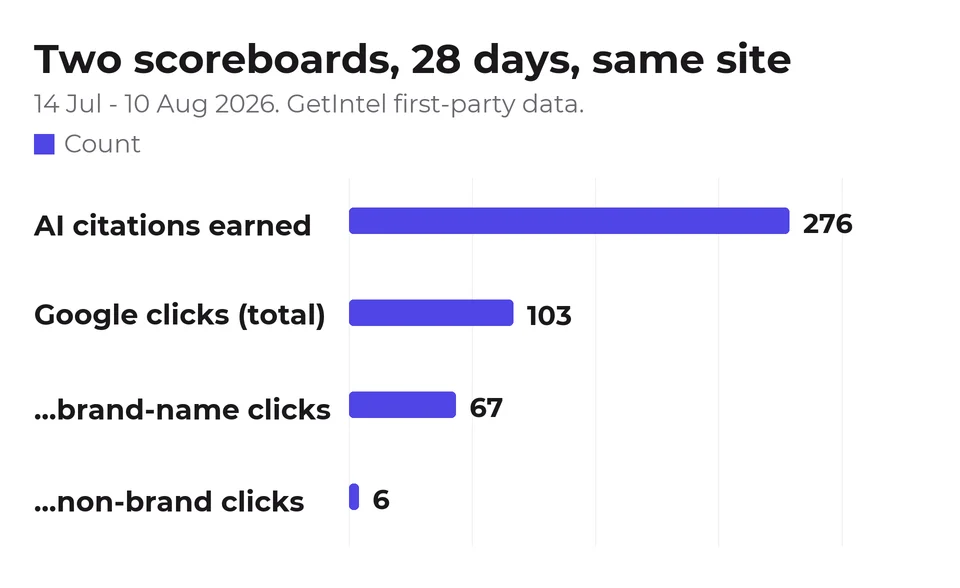
Six non-brand clicks in four weeks. The six queries were ai findability, directory finder, most cited domains in ai, quota attainment calculator, saas directories and sequenzy. That is the entire non-branded human search demand this site converted in a month.
One honesty note on that table. Google withholds rare queries for privacy, so the query breakdown never sums to the site total: 73 of our 103 clicks are attributed to a named query and the other 30 sit in queries Google will not show us. We are reporting the gap rather than quietly using whichever number flatters the argument.
Your impressions are probably not people
Before concluding your content is failing to convert, check whether the impressions were human.
In our top 45 queries by clicks, 16 carried an identical 11-domain exclusion list appended to a phrase, of the form -site:reddit.com -site:twitter.com -site:x.com -site:wykop.pl ... continuing through eleven domains in the same order every time. No person types that. The presence of wykop.pl, a Polish forum, in every single instance marks it as one tool's fixed configuration rather than a search anybody performed.
Those 16 queries produced zero clicks between them, which is exactly what you would expect from software. One caveat on proof: we publish the count but not the 45 raw query strings, so you can check that our file says 16 without re-deriving it. That is a weaker standard than the click and citation figures, which you can recompute in full.
This matters because a 0.78% site clickthrough rate looks like a content problem and is not one. If a meaningful share of your impressions are scrapers and assistants, then impressions, position and clickthrough rate are all measuring a population that was never going to click. Fixing your titles will not move them.
The test takes two minutes: pull the query dimension in Search Console rather than the page dimension, and read the actual strings. Operator syntax, trailing instructions like "my location is usa", or twenty near-identical permutations of one phrase all mean the same thing.
So what should I count instead?
Count citations instead of traffic, and specifically citations on questions your buyers actually ask.
A citation means an engine chose your page as evidence when answering a real buying question. That is the event you are paying for. It is upstream of any click and it is the only one of these numbers that reflects the mechanism you are actually trying to influence.
The practical version is three counts, checked monthly rather than daily:
- How many of your tracked prompts name you at all. Not a score, a count out of a fixed denominator. Ours is 24 of 60, measured on 11 August 2026. Record it as a rate per prompt rather than a flag, because a binary hides how thin the coverage is: six of those 24 named us exactly once in roughly 39 runs.
- How many distinct pages earn citations. This is the one that tells you whether your publishing is working, and it is where our own numbers stop being comfortable.
- Whether either number moved. If you report to clients rather than to yourself, fix the definition before you see the result: the same brand reads anywhere from 0% to 40% depending on choices nobody discloses. Against a fixed prompt set, because changing the prompts resets the comparison and it is easy to do by accident.
How much of my content is actually earning citations?
Less than a sixth of it. Measured across 5,120 probe runs to 10 August 2026, we had 83 posts published on or before that date.
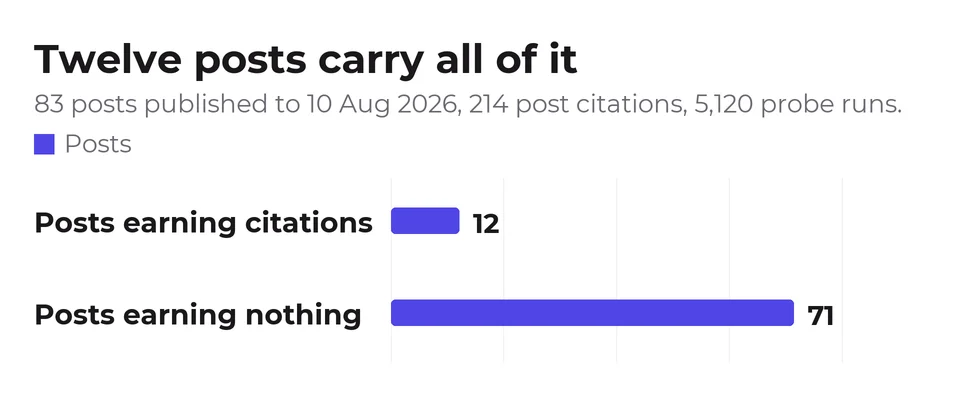
/blog/ paths, but 7 of those are on the blog index page rather than any post, leaving 214 across 12 posts. The remaining 55 of our 276 total sit on product, feature, comparison and solution pages.
That is the number most vendors would not print, including us on a braver day. It means the honest answer to "is my content working" is usually no for most of it, and the useful question is not whether the programme works but which fraction of it does.
It also reframes what a flat traffic line means. If 71 of 83 pages earn no citations and no clicks, the problem is not that citations fail to convert. The problem is that most pages are not being cited in the first place, and a traffic chart cannot tell you which ones, because the pages that work and the pages that do not both send you approximately zero visitors.
We found this by counting citations per URL, the same way we found that only 27 of those same 60 prompts have a consistent winner, which is a different cut of the same prompt set rather than a second visibility figure. It took one query and it changed what we publish. No amount of staring at Search Console would have surfaced it.
How long before any of this shows up?
Expect this to show up longer than a week out and sooner than people fear.
The cleanest lag we can measure on our own site is 13 days: single-ai-visibility-score-all-engines was published on 20 July 2026 and first cited on 2 August 2026. Both dates and every other post's first-citation date are in the dataset.
That is one observation, not a distribution. Citations in our corpus only begin on 28 July, so every post first cited on 28 or 29 July is censored by when we started measuring rather than by its own lag. This single post is the only one whose first citation falls clearly after that boundary with a known publication date. Treat 13 days as an existence proof that it is not instant and not a quarter, and nothing more.
What this rules out is reading anything into the first few days. Our own working rule is that a month of publishing with no movement in the count of cited pages is worth acting on while a week of it is not, but that is a hunch we operate by rather than something these data establish. One observation cannot license a threshold.
That lag is a different question from the one most people are really asking, which is how long until an already-visible site sees the number improve. We cannot answer that one from our data yet and neither, honestly, can anyone selling you a tool: it depends on how many of your prompts are already covered, and covering a prompt that has no page is a different job from displacing an incumbent on a prompt that does. What we can say is that the count of distinct cited pages is the thing to watch, because it moves when new pages land and stays flat when they do not.
What would tell you it is genuinely not working
Three things, in order of how much they should worry you.
No page has ever been cited. Not a slow month, an actual zero across a tracked prompt set over several weeks. That usually means the pages answer questions nobody in your set is asking, which is a targeting problem rather than a quality one.
Citations exist but sit entirely on prompts with no commercial intent. A related trap is spending the quarter on tactics nobody has checked: we measured whether publishing llms.txt correlates with being cited and could not detect an effect across the 50 most-cited domains in our category. Being cited on definitional questions while absent from every buying question is a real failure that a headline visibility percentage will hide completely.
The count of citing pages is flat while you publish. If you added twelve pages and the number of distinct cited URLs did not move, those twelve pages are not landing, whatever the aggregate score does.
None of those three is visible in a traffic chart, which is the actual answer to the question. Traffic was never the instrument. It is measuring a different thing, badly, on a population that is partly not human. To separate AI crawlers and AI visitors from the impressions that are not people, see AI Traffic.