ChatGPT now has more than 1.2 billion weekly users, Google's AI Overviews reach 2.5 billion people a month, and yet Google still handles about nine in ten searches. The shift to AI search is real, it is happening mostly inside Google's own results, and it is changing who gets clicked, cited and recommended.
This page collects 112 statistics on AI search, each traced to the organisation that produced it, with a link to the original and the date of the data. Around a third come from GetIntel's own measurements: the AI Software Index of 9,978 buyer questions on ChatGPT and Gemini, daily tracking of AI citations, and tests of the tactics most often recommended for AI visibility. The rest come from the companies and researchers who published them, never from a statistics roundup. It is updated monthly.
Disclosure: GetIntel makes an AI visibility tracking tool. Statistics from GetIntel's own studies are labelled GetIntel and link to the study or dataset behind them.
AI search statistics at a glance
- About half of US adults now report using AI chatbots, up substantially from the summer of 2024, including roughly one-in-four who use them daily (Pew Research Center, Jun 2026).
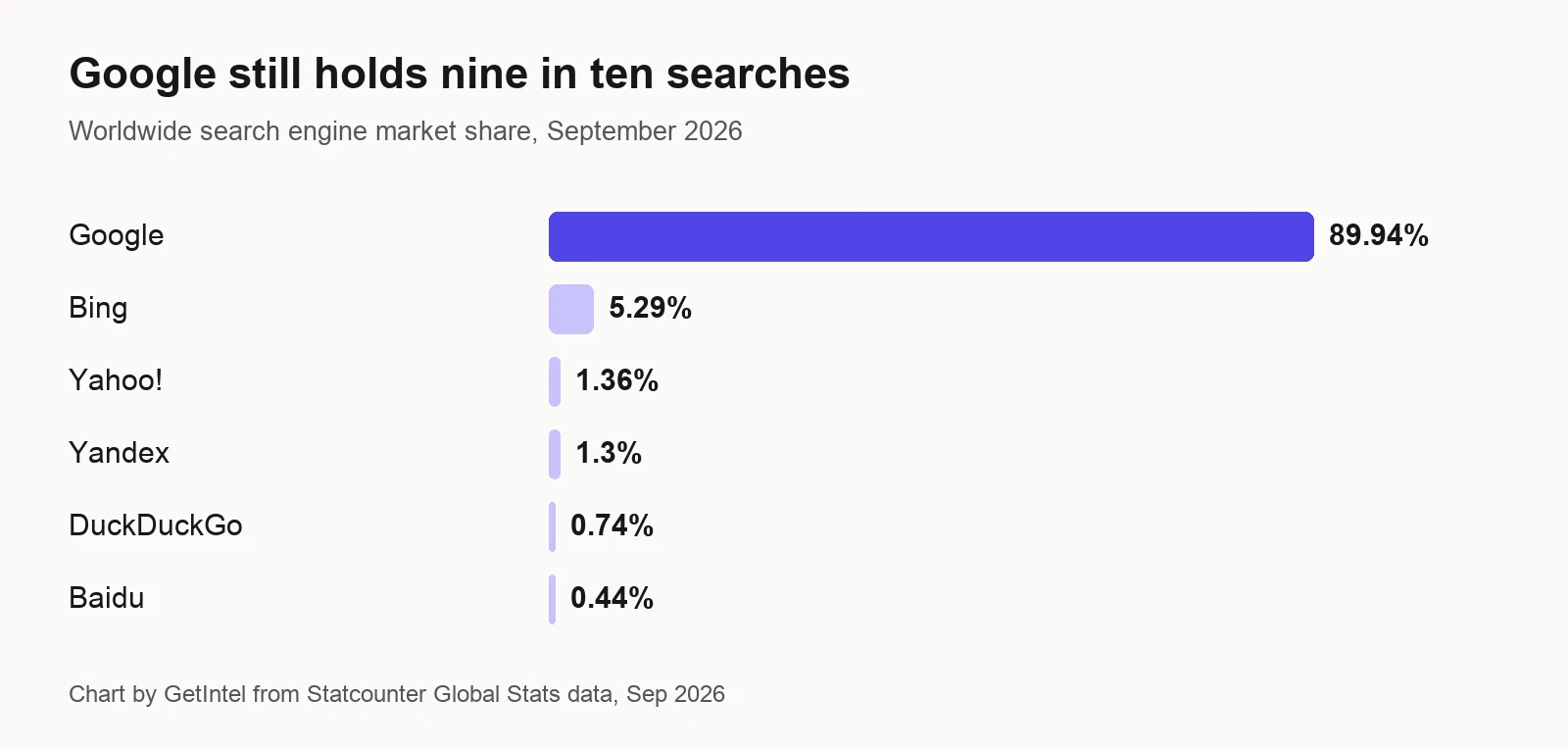
- Google holds 89.94% of worldwide search engine market share, with Bing at 5.29%, Yahoo! at 1.36%, Yandex at 1.3%, DuckDuckGo at 0.74% and Baidu at 0.44% (Statcounter, Sep 2026).
- Alphabet's Google Search & other revenue grew 19% year over year to $60.399 billion in Q1 2026 (Alphabet, Apr 2026).
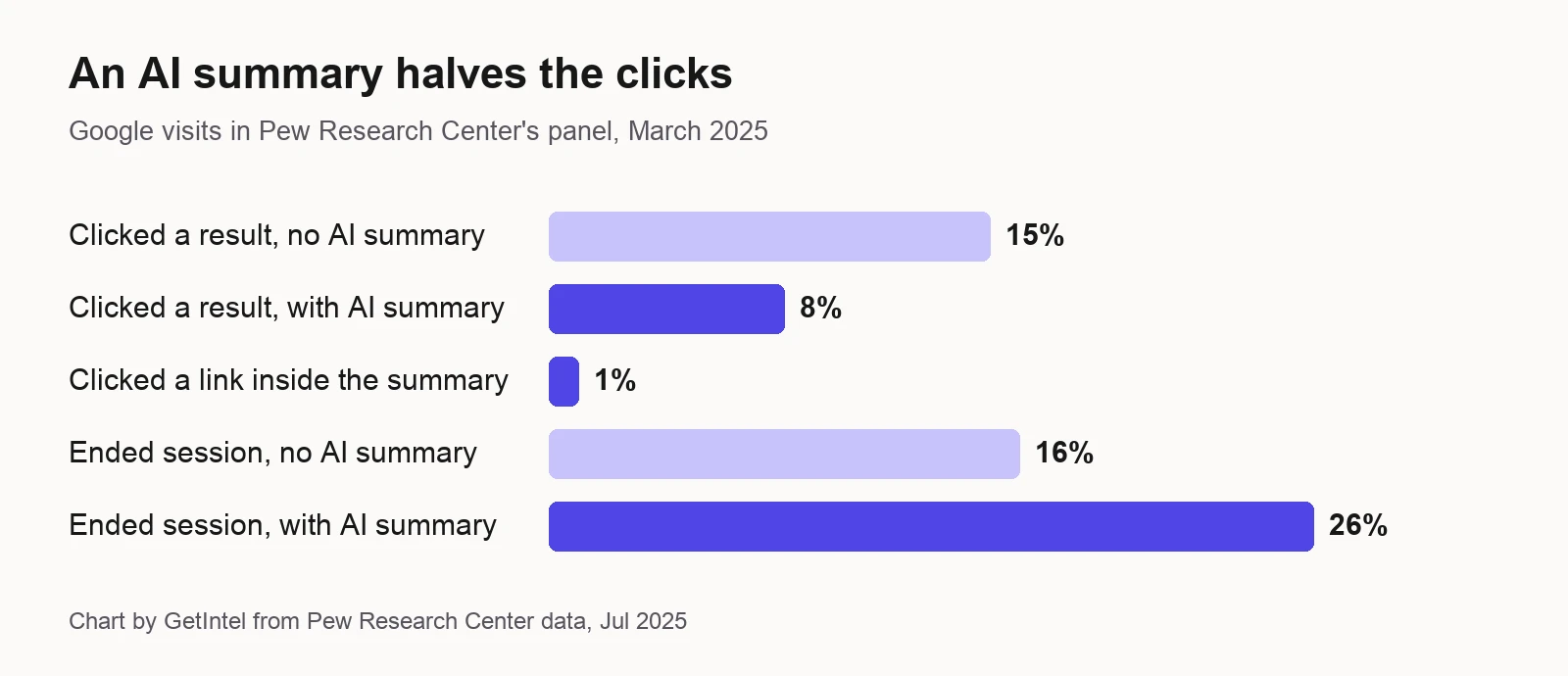
- Google users clicked a traditional search result in 8% of visits that produced an AI summary, compared with 15% of visits that did not (Pew Research Center, Jul 2025).
- 68.01% of US Google searches ended without any click in the first four months of 2026, up from 60.45% in 2024 (Similarweb, Jun 2026).
- AI referrals converted 31% more than other traffic sources during the 2025 holiday season, nearly double the prior year's conversion advantage (Adobe, Jan 2026).
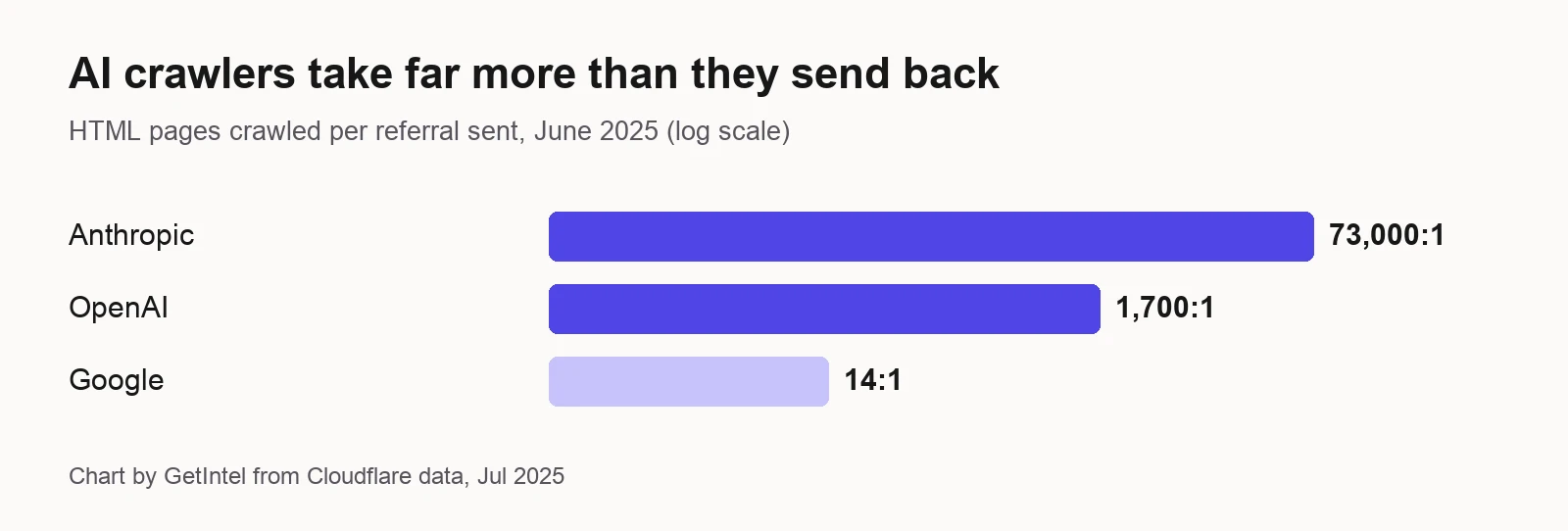
- Anthropic's crawl-to-refer ratio was 73,000 HTML page requests for every one referral it sent to a website in June 2025, falling to 38,065.7:1 by July 2025, an 86.7% drop from January 2025's 286,930.1:1 (Cloudflare, Aug 2025).
- In GetIntel's tracking of 12,276 AI answers in the AI visibility software category, 87% of cited sources were third-party sites and 12% belonged to vendors selling in the category (GetIntel, Oct 2026).
- Asked the same 30 questions three times about 20 minutes apart, ChatGPT returned a different set of sources on 93.3% of consecutive runs (GetIntel, Aug 2026).
- 573 of 1,150 software brands checked published an llms.txt file, almost exactly half (GetIntel, Sep 2026).
- The typical brand AI names was mentioned in just 17.5% of the answers in its category (GetIntel, Aug 2026).
How many people use AI search?
AI search is no longer an early-adopter habit. The assistants now count their users in the billions, and the fastest growth is inside the products people already used for search.
How many people use ChatGPT every week?
OpenAI has published several counts. The newest comes first, and the 1 billion figure covers all of OpenAI's products rather than ChatGPT alone.
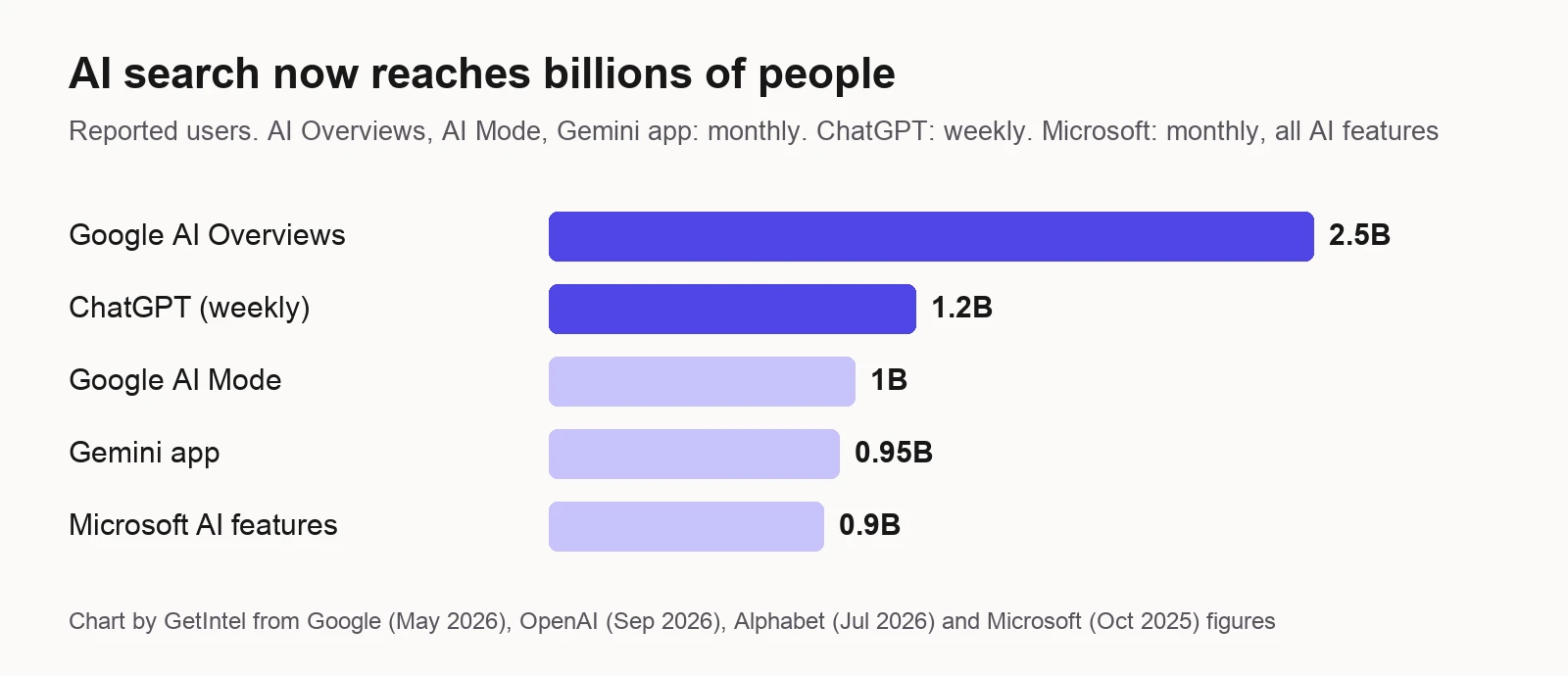
- OpenAI said ChatGPT reaches more than 1.2 billion weekly users, a figure it cited while opening ChatGPT as a shared surface for developers at DevDay 2026 (OpenAI, Sep 2026).
- Three weeks before DevDay, OpenAI said its products reach more than one billion weekly active users and 2.5 million businesses (OpenAI, Sep 2026).
- OpenAI says ChatGPT is the leader in consumer AI with more than 900 million weekly active users and over 50 million subscribers (OpenAI, Mar 2026).
How many people use Google's AI Overviews and AI Mode?
- Google says AI Overviews now has over 2.5 billion monthly active users (Google, May 2026).
- Google's AI Mode surpassed 1 billion monthly active users within a year of launch, according to Sundar Pichai (Google, May 2026).
How many people use the Gemini app?
- Alphabet's SEC filing for Q2 2026 states the Gemini App has 950 million monthly active users (Alphabet, Jul 2026).
- Alphabet's Q1 2026 results say Gemini Enterprise's paid monthly active users grew 40% quarter on quarter (Alphabet, Apr 2026).
How many people pay for Google's AI-linked subscriptions?
- Alphabet said its paid subscriptions (led by YouTube and Google One) reached 350 million in Q1 2026, its strongest quarter ever for consumer AI plans, driven by the Gemini App (Alphabet, Apr 2026).
How many people use Microsoft Copilot?
- Microsoft says it now has 900 million monthly active users of its AI features across its products (Microsoft, Oct 2025).
- Microsoft's first-party family of Copilots has surpassed 150 million monthly active users across information work, coding, security, science, health and consumer (Microsoft, Oct 2025).
- GitHub Copilot is, in Microsoft's words, the most popular AI pair programmer, now with over 26 million users, and more than 90% of the Fortune 500 use Microsoft 365 Copilot (Microsoft, Oct 2025).
- Microsoft says daily users of its Copilot consumer app increased nearly 50% quarter over quarter (Microsoft, Oct 2025).
How fast is Claude Code growing?
- Anthropic says Claude Code's run-rate revenue grew to over $2.5 billion, more than doubling since the start of 2026, while its weekly active users also doubled since January 1 (Anthropic, Feb 2026).
- Anthropic's overall run-rate revenue reached $14 billion, growing more than 10x annually in each of its first three years, with more than 500 customers now spending over $1 million a year, up from a dozen two years earlier (Anthropic, Feb 2026).
Which AI chatbot do Americans use most?
- ChatGPT remains the most-used chatbot: 44% of US adults now report using it, up from 34% a year earlier and more than double the share in 2023 (Pew Research Center, Jun 2026).
What do people use AI chatbots for?
- About four-in-ten US adults say they use chatbots for information searching, and 38% of employed adults use chatbots for tasks at work, based on a survey of 5,119 US adults conducted Feb 17-23, 2026 (Pew Research Center, Jun 2026).
Which AI chatbot has the biggest worldwide user share?
- ChatGPT holds 80.48% of worldwide AI chatbot market share, ahead of Google Gemini (10.91%), Perplexity (5.85%), Microsoft Copilot (1.79%) and Claude (0.95%) (Statcounter, Sep 2026).
How many people use AI chatbots for news?
- Weekly use of AI chatbots such as ChatGPT, Perplexity and Gemini for news rose from 7% to 10% of people surveyed year on year, reaching 17% among 18-24 year-olds (Reuters Institute for the Study of Journalism, Jun 2026).
Is AI search replacing Google?
The loudest prediction about AI search was that it would hollow out Google. The data so far says Google absorbed the change rather than losing to it, which moves the fight to inside Google's own results.
Did Gartner's 2024 prediction about search volume come true?
- In February 2024, Gartner predicted that by 2026, traditional search engine volume would drop 25%, with search marketing losing share to AI chatbots and other virtual agents (Gartner, Feb 2024).
Is Google's own search volume actually shrinking?
- Responding to press reports of an Apple-disclosed Safari search decline, Google said it continues to see overall query growth in Search, including an increase in total queries from Apple's devices and platforms (Google, May 2025).
Is Google Search revenue still growing despite AI search?
- Alphabet's Google Search & other revenue grew 17% year over year to $63.271 billion in Q2 2026 (Alphabet, Jul 2026).
What happens to clicks when AI answers?
The real cost of AI answers is not lost rankings, it is lost clicks. When an answer satisfies the question on the page, fewer people visit any site at all, including the ones it cites. Our zero-click search fact-check traces where the most-quoted figures come from.
Do people click the links inside the AI summary itself?
- Only 1% of all visits in Pew's sample ended with a click on a link inside the AI summary (Pew Research Center, Jul 2025).
Does seeing an AI summary make people stop searching altogether?
- Users ended their browsing session right after a search with an AI summary 26% of the time, versus 16% for searches without one (Pew Research Center, Jul 2025).
How often does a Google search actually trigger an AI summary?
- AI summaries appeared in about 18% of the nearly 69,000 Google searches Pew tracked across its panel in March 2025 (Pew Research Center, Jul 2025).
How many searchers run into an AI summary at all in a given month?
- About 58% of the panel made at least one Google search that produced an AI summary during the March 2025 study period (Pew Research Center, Jul 2025).
Is the AI Overview CTR crash turning around in 2026?
- Organic CTR on queries with an AI Overview climbed from a floor of 1.3% in December 2025 to 2.4% in February 2026, an 85% rebound (Seer Interactive, Apr 2026).
Does being cited inside the AI Overview actually win more clicks?
- Pages cited inside an AI Overview earn about 2.1% CTR, versus roughly 0.9% for ranking pages that are not cited, a 2.3x gap (Seer Interactive, Apr 2026).
How much of the historical top-spot click share has disappeared?
- Position-1 CTR on AI Overview keywords fell from 0.073% in December 2023 to 0.016% in December 2025, a 58% reduction versus the non-AIO baseline (Ahrefs, Feb 2026).
What did the original Ahrefs CTR study find, before the 58% update?
- In April 2025, Ahrefs found the presence of an AI Overview correlated with a 34.5% lower average clickthrough rate across 300,000 keywords (Ahrefs, Apr 2025).
Does the CTR hit differ for branded versus non-branded searches?
- Amsive found AI Overviews cut CTR 19.98% on non-branded keywords but lifted branded-keyword CTR 18.68%, against a 15.49% average decline overall (Amsive, Apr 2025).
What happens when an AI Overview and a featured snippet both show up?
- Amsive found CTR losses reached 37.04% when an AI Overview appeared alongside a featured snippet on the same query (Amsive, Apr 2025).
Has overall Google click-through rate fallen since AI Overviews launched?
- BrightEdge found Google search impressions up 49% year over year while click-through rates fell nearly 30% in the year after AI Overviews launched (BrightEdge, May 2025).
Does Google's AI Mode send out even fewer clicks than classic search?
- Google AI Mode generates external referrals on just 1.6% to 2.5% of queries, versus roughly 17% to 19% for traditional Google search (Similarweb, Jun 2026).
What does Google itself say about clicks from AI Overviews?
- Google says total organic click volume to websites has stayed relatively stable year over year and that average click quality has increased (Google, Aug 2025).
Does AI search traffic convert?
AI sends less traffic than search, but the traffic it does send arrives ready to act. Every measurement of AI referrals so far finds them engaging and converting better than the average visitor.
How much will AI retail traffic grow this holiday season?
- Adobe forecasts AI-platform traffic to US retail sites will rise 130% year over year during the November 1 to December 31, 2026 holiday season (Adobe, Sep 2026).
Which shopping days see the biggest AI-traffic spikes?
- Adobe expects holiday AI traffic to jump 159% on Thanksgiving, 95% on Black Friday, and 88% on Cyber Monday, all year over year (Adobe, Sep 2026).
Do AI-assisted holiday shoppers feel better about what they bought?
- 77% of surveyed shoppers who used AI for online shopping say it made them more confident in their purchase, and 69% say they are less likely to return it (Adobe, Sep 2026).
How much did AI retail traffic grow over the 2025 holidays?
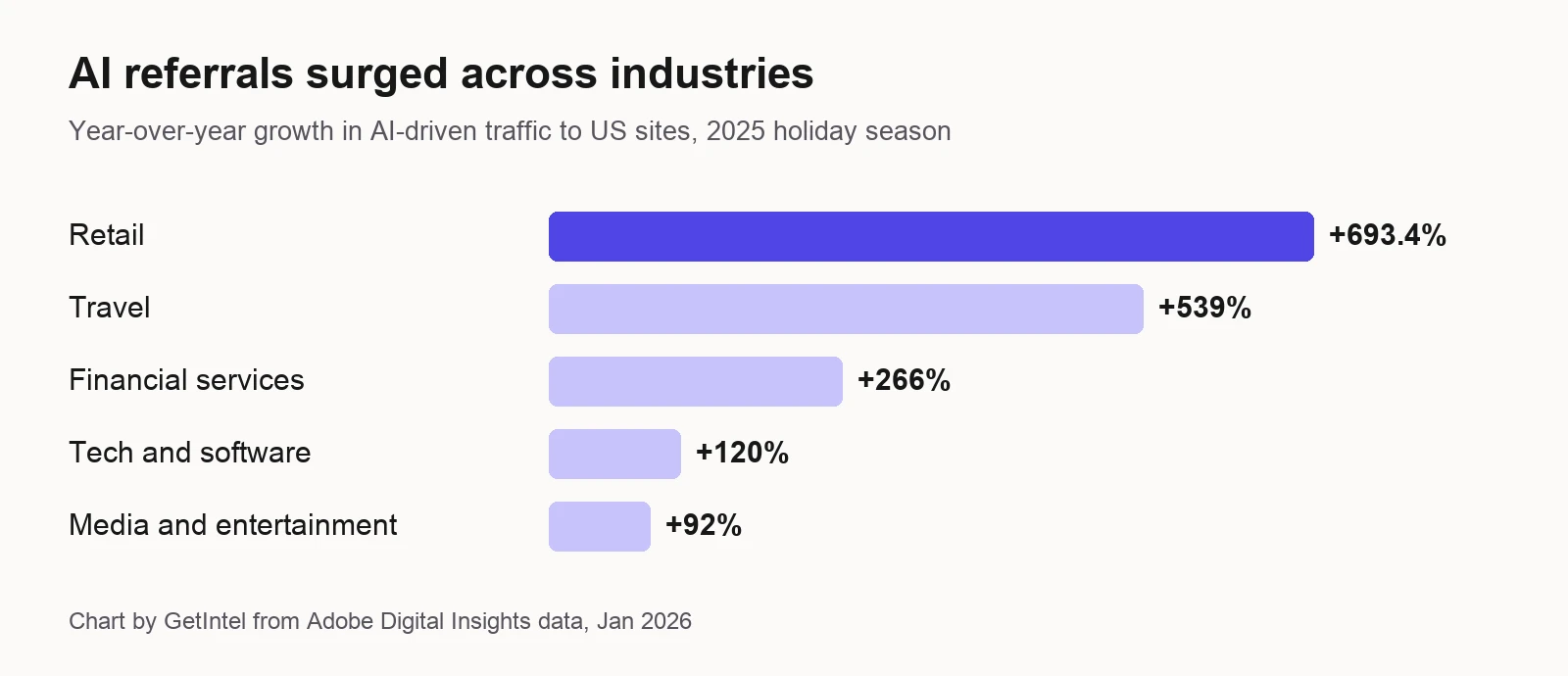
- AI-driven traffic to US retail sites grew 693.4% year over year during the 2025 holiday season (November and December) (Adobe, Jan 2026).
Did other industries see the same AI-traffic surge over the holidays?
- Beyond retail, 2025 holiday AI traffic grew 539% for travel, 266% for financial services, 120% for tech and software, and 92% for media and entertainment (Adobe, Jan 2026).
How much more revenue does an AI-referred visit generate?
- AI-driven revenue per visit was up 254% year to date as of the 2025 holiday season (Adobe, Jan 2026).
Does the conversion gain hold on the single biggest shopping days?
- AI referral conversions were 54% higher than non-AI traffic on Thanksgiving and 38% higher on Black Friday during the 2025 holiday season (Adobe, Jan 2026).
Do shoppers who arrive via AI stick around longer on the site?
- Shoppers arriving from generative AI assistants were 33% less likely to leave immediately, spent 45% more time on site, and viewed 13% more pages per visit (Adobe, Jan 2026).
How fast did AI referral traffic grow from mid-2024?
- US web traffic from AI-driven referrals grew more than tenfold between July 2024 and February 2025, with retail traffic specifically up 12x (Adobe, May 2025).
Which industry saw the fastest AI-referral growth outside retail?
- AI-driven traffic to travel sites rose 17x between July 2024 and February 2025, and those referrals generated 80% more revenue per visit than non-AI traffic (Adobe, May 2025).
Did the AI conversion gap in retail close over time?
- Retail's AI-referral conversion gap narrowed from 43% less likely to convert than other traffic in July 2024 to just 9% less likely by February 2025 (Adobe, May 2025).
Is AI referral traffic growing faster than search, social, or direct?
- AI referral traffic grew 155.6% over eight months, versus 24.0% for search, 21.5% for social, and 14.9% for direct, while staying under 1% of total traffic (Microsoft Clarity, Nov 2025).
Does AI referral traffic convert into sign-ups better than search does?
- Across 1,277 domains, AI referral traffic converted to sign-ups at 1.66%, versus 0.15% for organic search, roughly an 11x difference (Microsoft Clarity, Nov 2025).
What does AI referral traffic look like on a B2B SaaS company's own site?
- 0.5% of Ahrefs' own traffic came from AI search over a 30-day window, yet it drove 12.1% of signups, a 23x higher conversion rate than organic search (Ahrefs, Jun 2025).
Where do AI answers get their sources?
Most of what AI engines say about a category is built from other people's pages, not the vendors'. The engines also disagree with each other far more than most tracking assumes.
How often does a citation include the brand's name?
- 61.7% of AI citations are 'ghost citations' that link to a source without ever naming the brand in the answer text; ChatGPT cites a source in 87% of its domain appearances but names the brand in only 20.7% of them; Gemini does the reverse, naming the brand in 83.7% of appearances while citing a source in only 21.4% (Semrush, Jun 2026).
Which sites does ChatGPT lean on most for citations?
- In a 13-week study of over 230,000 prompts and 100 million+ citations, Reddit and Wikipedia were ChatGPT's two most-cited domains, each appearing in close to 60% and roughly 55% of responses respectively before a mid-September 2025 shift cut them to around 10% and under 20% (Semrush, Nov 2025).
Do AI Overview citations still come from top-10 Google rankings?
- Only 37.9% of URLs cited in Google AI Overviews also ranked in the top 10 search results as of a March 2026 study of 863,000 keywords and 4 million AI Overview URLs, down from 76% in a July 2025 study on the same methodology (Ahrefs, Mar 2026).
How many AI Overview citations don't rank in Google at all?
- 36.7% of pages cited in Google AI Overviews did not rank in the top 100 organic results for that query at all, based on Ahrefs' March 2026 analysis of 863,000 keyword SERPs (Ahrefs, Mar 2026).
Which single domain is cited most across Google AI Overviews?
- YouTube is the single most-cited domain in Google AI Overviews, capturing 22.9% of citation mention share across more than 3 million US queries, ahead of Reddit (18.5%), Facebook (10.1%) and Google.com (8.8%) (Ahrefs, Sep 2026).
Which sites do AI answers cite most?
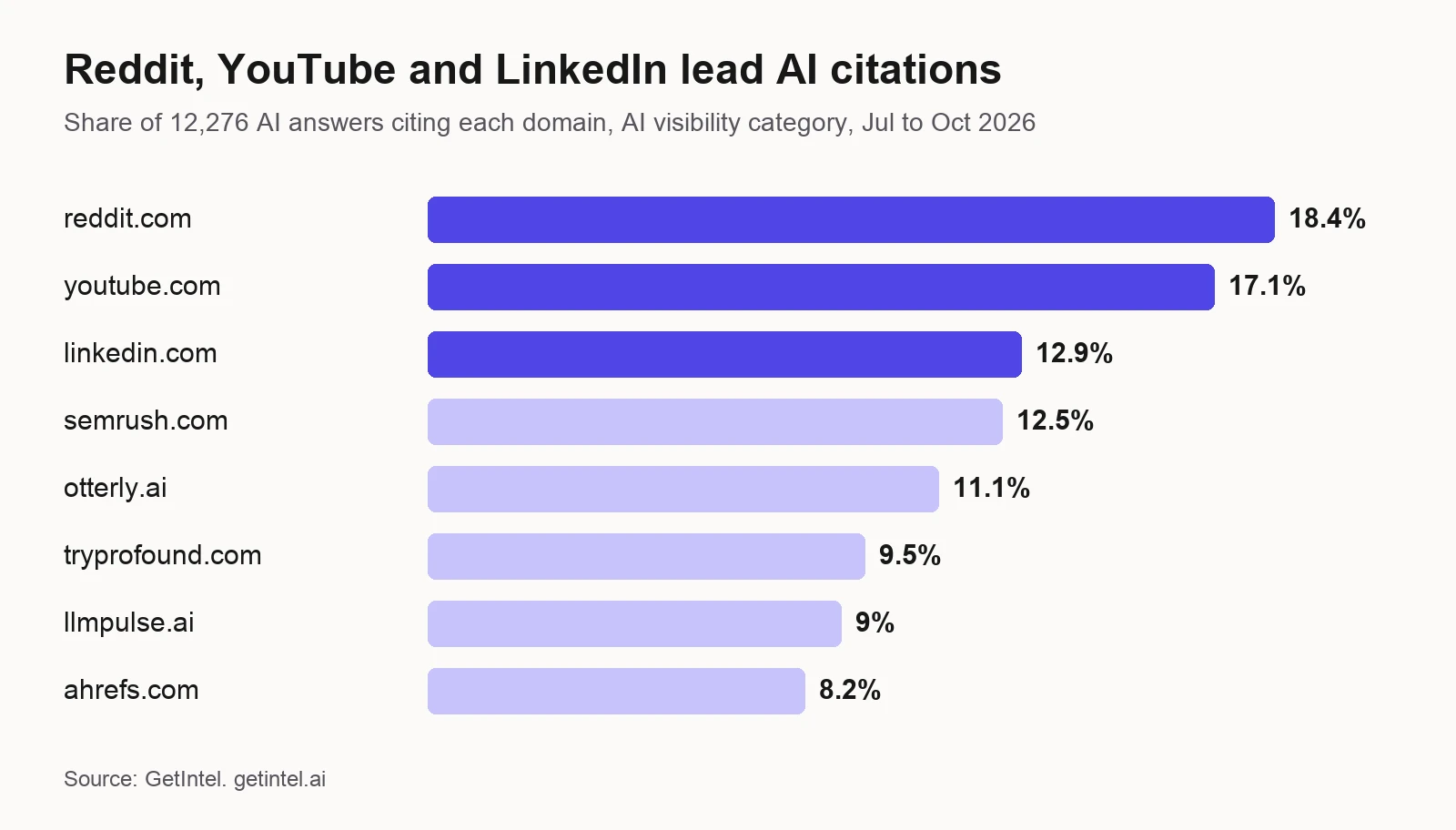
- Reddit was cited in 18.4% of those answers, YouTube in 17.1% and LinkedIn in 12.9%, ahead of every vendor site (GetIntel, Oct 2026).
- By type, 59% of cited sources were corporate sites, 17% editorial and 11% user-generated communities (GetIntel, Oct 2026).
- In the same category, 96% of YouTube's citations (1,154 of 1,197) traced to a single video (GetIntel, Aug 2026).
Do AI engines cite the same sources?
- Across 491 answers from ChatGPT, Claude, Perplexity, Gemini and Google AI Overviews, two-thirds of the 1,283 cited domains appeared on exactly one engine, and just 14 (1.1%) were cited by all five (GetIntel, Aug 2026).
- Pairwise overlap between engines' cited domains ranged from 4.8% to 15.7%, so winning citations on one engine predicts little about another (GetIntel, Aug 2026).
How many sources does each engine cite?
- On the same 100 buyer questions, Google AI Mode cited 16.38 unique domains per answer, AI Overviews 10.17 and Gemini 3.43, a 4.8x spread across three Google surfaces (GetIntel, Aug 2026).
- Perplexity cited a median of 9 unique domains per answer across 100 buyer questions, and no answer cited between one and five (GetIntel, Aug 2026).
How much of AI's tool advice comes from vendors?
- Across the 40 most-cited domains in the AI visibility category, 51.7% of 9,049 citations pointed at companies selling a product in that category, and independent journalism accounted for 5.7% (GetIntel, Aug 2026).
- Of 17 "best AI visibility tools" roundups published by tool vendors, 16 rank their own product first and the seventeenth ranks itself second (GetIntel, Aug 2026).
Which brands do AI engines recommend?
Being named by AI is rare and uneven. Most brands appear in a minority of answers, and which brand comes first depends heavily on the engine and the category.
How often do AI engines name a given brand?
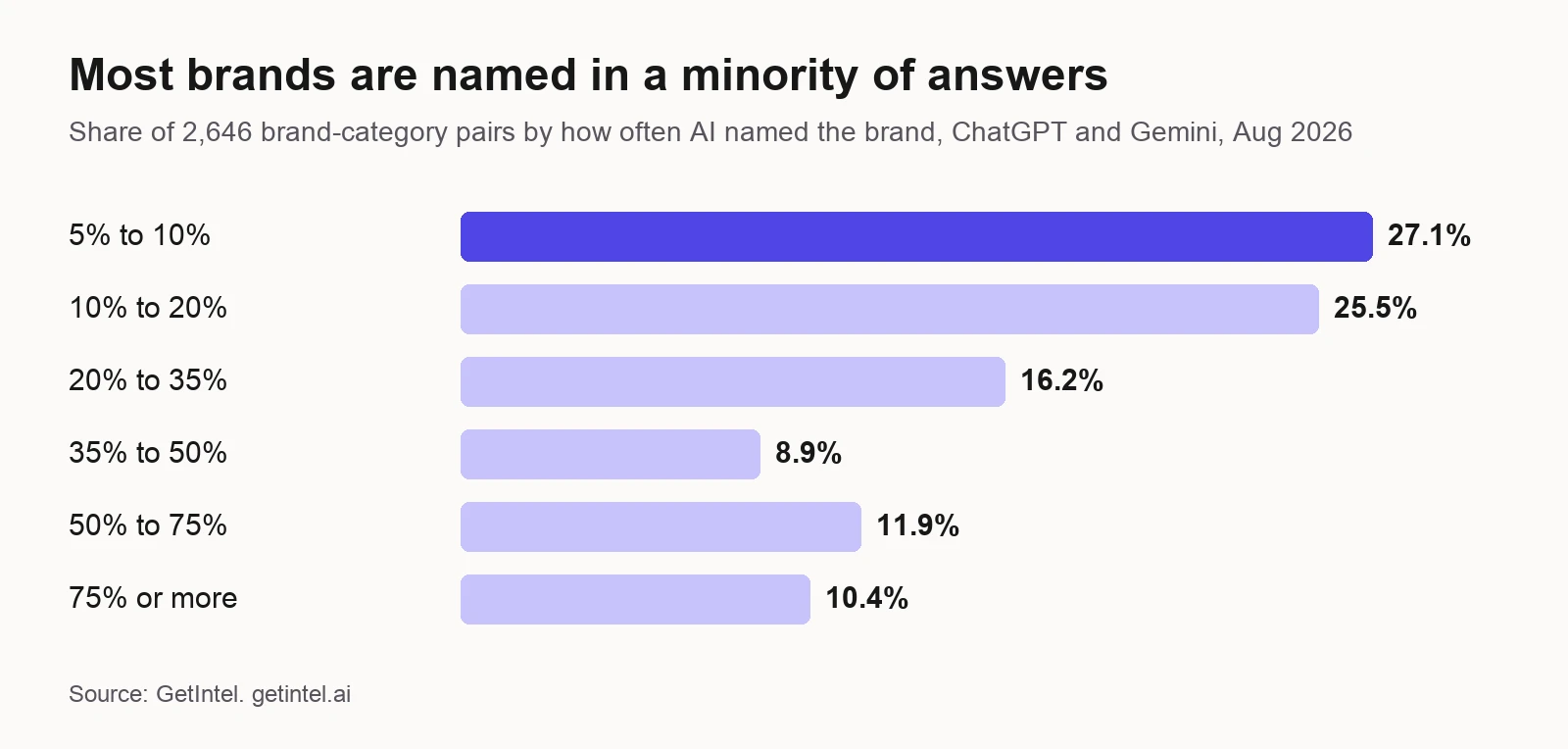
- In the AI Software Index, 9,978 buyer questions asked on ChatGPT and Gemini across 126 software categories, a quarter of named brands never reached 10% of answers in any category they compete in (GetIntel, Sep 2026).
- 22.2% of brand-category pairs were named in half the answers or more (GetIntel, Sep 2026).
- 46.1% of brand-category pairs were never named first in any answer (GetIntel, Sep 2026).
Does the category change the odds?
- The median named brand appeared in 46.2% of answers in customer data platforms but 8.9% in CRM software (GetIntel, Sep 2026).
Do ChatGPT and Gemini recommend the same brands?
- In 38 of the 125 categories where both engines answered, ChatGPT and Gemini put a different product first most often (GetIntel, Aug 2026).
- On 10 questions about AI visibility tools, ChatGPT, Perplexity and Gemini named a different tool first on eight (GetIntel, Sep 2026).
How many brands does each engine name?
- ChatGPT named 5.28 brands per answer while citing 3.66 sources; Google AI Overviews named 3.59 brands while citing 10.05 (GetIntel, Aug 2026).
How stable are AI answers?
An AI answer is a sample, not a ranking. The same question asked twice often comes back with different sources, which makes a single check a weak basis for any decision.
Does ChatGPT give the same answer twice?
- Across 4,220 consecutive runs a median of 24 hours apart, ChatGPT cited a different set of sources 99.7% of the time (GetIntel, Aug 2026).
Can one check tell you where you stand?
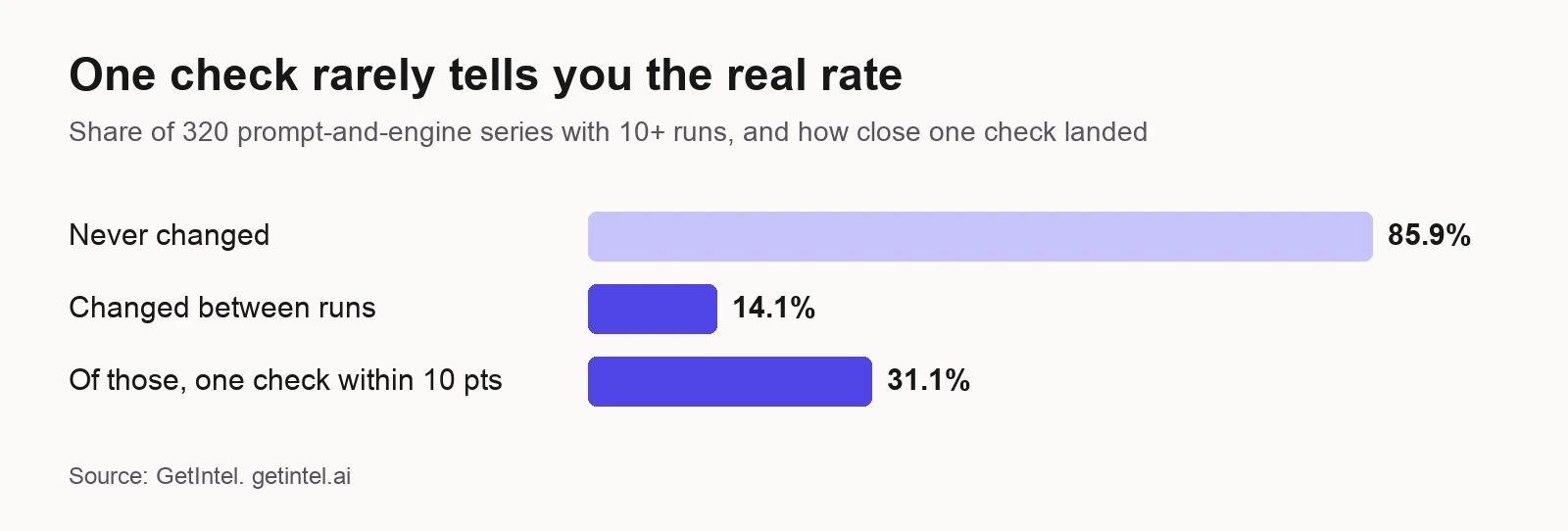
- Of 320 prompt-and-engine series with at least ten runs, 275 never changed their answer (GetIntel, Aug 2026).
- On the 45 series that did vary, a single check was off by 32.7 percentage points on average and landed within 10 points of the real rate only 31.1% of the time (GetIntel, Aug 2026).
Do API checks match what buyers see?
- The same prompts sent through the ChatGPT API and the ChatGPT interface shared 13.6% of their cited sources, against 16.7% for the interface compared with itself a day apart (GetIntel, Aug 2026).
What actually moves AI visibility?
Most of the popular AI visibility tactics have not survived measurement. The files and markup that get recommended most show little or no effect, while mentions across the web show the strongest link.
Do brand mentions predict AI visibility better than backlinks?
- Across 75,000 brands, branded web mentions correlate 0.664 (Spearman) with AI Overview brand visibility, roughly three times stronger than traditional backlinks at 0.218 (Ahrefs, May 2025).
How much more visibility do heavily-mentioned brands get?
- Brands in the top 25% for web mentions averaged 169 mentions in AI Overviews, more than ten times the 14 mentions averaged by brands in the next quartile (50-75%), while 26% of the 75,000 brands studied had zero AI Overview mentions (Ahrefs, May 2025).
Where do branded anchors and search volume rank as signals?
- Branded anchor text correlates 0.527 and branded search volume correlates 0.392 with AI Overview brand visibility, both stronger than Domain Rating (0.326) or raw backlink counts (0.218) in the same 75,000-brand study (Ahrefs, May 2025).
Does adding an llms.txt file actually increase citations?
- Across nearly 300,000 domains, only 10.13% had an llms.txt file, and both statistical correlation testing and a machine-learning model found no meaningful relationship between having one and being cited by AI models; removing llms.txt as a model input improved prediction accuracy (SE Ranking, Nov 2025).
What does Google itself say you need to do to appear in AI Overviews?
- Google states there are 'no additional requirements to appear in AI Overviews or AI Mode, nor other special optimizations necessary,' and that sites don't need to create machine-readable files, AI text files, markup, or special schema.org structured data to be eligible (Google, Dec 2025).
Does llms.txt work?
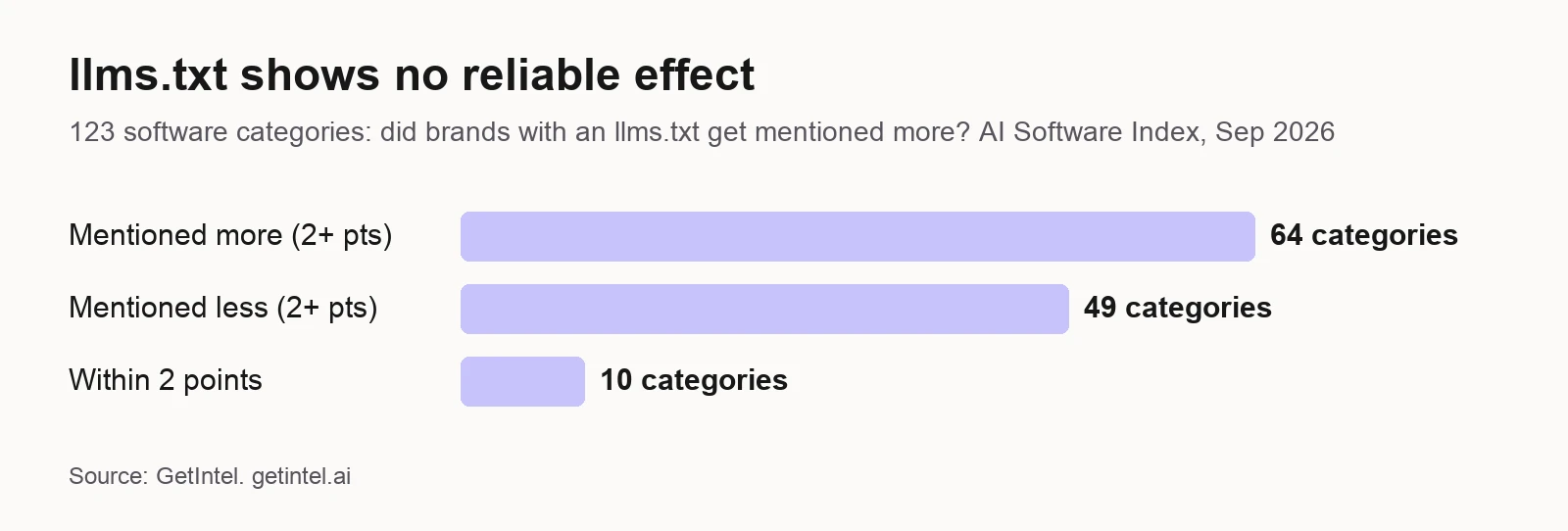
- Across 123 categories, brands with an llms.txt were mentioned more by over 2 points in 64 and less in 49, a split a sign test puts at p = 0.19, not a reliable difference (GetIntel, Sep 2026).
- Among the 50 most-cited domains in one category, the 29 with an llms.txt had a mean citation rank of 25.8 against 25.0 for the 21 without (GetIntel, Aug 2026).
Does schema markup help?
- Of 615 pages AI engines cited, heavily cited pages carried FAQPage schema more often (37.2% against 28.0%), but the gap disappeared once each publisher was counted once (GetIntel, Aug 2026).
- Across the 40 most-cited pages in one corpus, pages with JSON-LD averaged 118.3 citations against 121.3 for pages without it (GetIntel, Aug 2026).
Are sites blocking AI crawlers by mistake?
- None of the 37 most-cited pages in the AI visibility category blocked GPTBot, PerplexityBot, ClaudeBot or three other AI crawlers in robots.txt (GetIntel, Aug 2026).
Do directory listings get cited?
- Across 30 buyer questions on the real ChatGPT interface, none of 118 cited links pointed to a SaaS directory listing (GetIntel, Sep 2026).
- Only five review directories ever ranked among a category's eight most-cited sources in the AI Software Index, none in more than three of 126 categories (GetIntel, Aug 2026).
Can you trust the numbers vendors quote?
- Of 18 widely quoted AI visibility figures that measure the same thing, at least 12 were wrong on arithmetic, and only 3 of 33 figures recorded disclosed a sample size (GetIntel, Aug 2026).
How much do AI crawlers take?
AI crawlers read the web at a scale that dwarfs the traffic they send back. That gap is why the robots.txt decisions sites make now matter more than they did.
How much does OpenAI's GPTBot crawl versus refer?
- OpenAI's crawl-to-referral ratio was 1,700:1 in June 2025 and 1,091.4:1 in July 2025, down from 1,217.4:1 in January 2025 (Cloudflare, Jul 2025).
How much does Perplexity crawl versus refer?
- Perplexity's crawl-to-refer ratio rose 256.7% from 54.6:1 in January 2025 to 194.8:1 in July 2025, meaning it crawled more heavily relative to the traffic it sent back as the year went on (Cloudflare, Aug 2025).
How does Google's crawl-to-refer ratio compare?
- Google crawled websites about 14 times for every referral as of June 2025, and its ratio averaged 11.8:1 across January to July 2025, roughly 3,000 times more efficient than Anthropic's (Cloudflare, Jul 2025).
How fast is GPTBot's share of AI crawling growing?
- Among AI-only crawlers, GPTBot's share of traffic grew from 11.9% in July 2024 to 28.1% in July 2025, a 16.1 percentage-point gain, the largest of any AI crawler (Cloudflare, Aug 2025).
How fast is ClaudeBot's share of AI crawling growing?
- ClaudeBot's share of AI-only crawler traffic grew from 15% in July 2024 to 23.3% in July 2025, an 8.3 percentage-point increase, while across all search and AI bots combined its share rose from 6% to nearly 10% (Cloudflare, Aug 2025).
What share of AI crawling is for training versus answering?
- Training accounted for 79% to nearly 80% of AI crawling activity in July 2025, up from 72% a year earlier, while search-related crawling fell from 26% to 17% over the same period (Cloudflare, Aug 2025).
How many sites actually have a robots.txt file?
- Only about 37% of the top 10,000 domains on Cloudflare's network had a robots.txt file as of June 2025, meaning most sites take no formal stance on AI crawling at all (Cloudflare, Jul 2025).
What share of sites block GPTBot specifically in robots.txt?
- Of the top domains that do have a robots.txt file, GPTBot was disallowed in only 7.8% of them, Google-Extended in 5.6%, and anthropic-ai, PerplexityBot, ClaudeBot and Bytespider each in under 5% (Cloudflare, Jul 2025).
What share of websites does each AI crawler actually touch?
- GPTBot accessed 28.97% of websites protected by Cloudflare as of mid-2025 (down from 35.46% a year earlier), ahead of Meta-ExternalAgent (22.16%) and ClaudeBot (18.80%), while Bytespider's reach collapsed from over 40% of sites to just 9.37% (Cloudflare, Jul 2025).
How many site owners have blocked AI crawlers outright?
- More than 1 million Cloudflare customers had enabled the one-click 'block all AI bots' feature as of mid-2025, and Bytespider's traffic volume fell 71.45% since the first week of July 2024 as a result of blocking plus declining crawl activity (Cloudflare, Jul 2025).
What share of all web traffic is AI bots versus humans?
- AI bots averaged 4.2% of HTML request traffic across 2025 (peaking at 6.4% in late June), while human traffic reached 47% of HTML requests by December 2, 2025, with non-AI bots at 44% (Cloudflare, Dec 2025).
What share of verified bot traffic comes from AI crawlers?
- AI crawlers generated 20% of all verified bot traffic in 2025, compared with 40% from search engine crawlers, with Googlebot alone accounting for over 28% of verified bot traffic (Cloudflare, Dec 2025).
How much web data is already off-limits to AI training crawlers?
- An academic audit of robots.txt files across the C4, RefinedWeb and Dolma AI-training datasets found more than 5% of all C4 tokens, and over 28% of tokens from the most actively maintained sources, fully restricted from AI crawling by 2024, while 45% of C4 was restricted once Terms-of-Service language was counted too (Data Provenance Initiative, Jul 2024).
How often do AI crawlers visit a small SaaS site?
- getintel.ai logged 6,939 visits from AI assistants and their search crawlers in six weeks, from 17 August to 26 September 2026 (GetIntel, Sep 2026).
- ChatGPT-User, the agent that fetches pages while writing an answer, made 2,624 of those requests across 173 pages (GetIntel, Sep 2026).
Methodology and Sources
Every statistic on this page was traced to the organisation that first published it: a company announcement or filing, a research organisation's own study, or GetIntel's own published measurement. Each link was opened to confirm the number and its date are on that page; figures that only appear in roundups or news coverage were left out, including some widely repeated ones that no longer trace to a live primary source. Where a newer figure exists, the older one is kept only when it shows a trend. Figures from vendor studies, including GetIntel's, measure the vendor's own data set and are labelled with it. The page is reviewed monthly and each figure is replaced when its source publishes a newer one.
Glossary
AI Overviews: Google's AI-generated summaries at the top of search results. AI Mode: Google's conversational search mode. GEO (generative engine optimization): the practice of getting a brand named and cited in AI answers. AEO (answer engine optimization): an overlapping term for optimizing to be the answer an engine returns. Crawl-to-refer ratio: pages a company's crawlers fetch for each visit its products send back. Zero-click search: a search that ends without a click to any website. llms.txt: a proposed plain-text file that lists a site's key pages for AI tools. MAU / WAU: monthly and weekly active users.
Sources
Independent sources
- Adobe: AI traffic surges across industries, retail sees biggest gains (Jan 2026); Adobe: U.S. Holiday Shopping Season to Hit Record $275.1 Billion Online, Rising 6.7% YoY (Sep 2026); The explosive rise of generative AI referral traffic (May 2025)
- Ahrefs: AI Overviews Reduce Clicks (2026 update) (Feb 2026); AI Overviews Reduce Clicks by 34.5% (Apr 2025); Does AI Search Traffic Convert Better Than Traditional Search? For Ahrefs, Yes: 0.5% of Visitors Drove 12.1% of Signups (Jun 2025); Do AI Overviews Only Cite Pages That Rank in the Top 10? (Mar 2026); The 50 Most-Cited Websites in Google AI Overviews (Sep 2026); An Analysis of AI Overview Brand Visibility Factors (75K Brands Studied) (May 2025)
- Alphabet: Alphabet Inc. Form 8-K, Exhibit 99.1, Q1 2026 (Apr 2026); Alphabet Inc. Form 8-K, Exhibit 99.1, Q2 2026 (Jul 2026)
- Amsive: Google AI Overviews: New CTR Study Reveals How to Navigate Negative SERP Impact (Apr 2025)
- Anthropic: Anthropic raises $30 billion in Series G funding at $380 billion post-money valuation (Feb 2026)
- BrightEdge: One Year Into Google AI Overviews, BrightEdge Data Reveals Google Search Usage Increases by 49% (May 2025)
- Cloudflare: The crawl-to-click gap: Cloudflare data on AI bots, training, and referrals (Aug 2025); Control content use for AI training with Cloudflare's managed robots.txt and blocking for monetized content (Jul 2025); The 2025 Cloudflare Radar Year in Review (Dec 2025)
- Data Provenance Initiative: Consent in Crisis: The Rapid Decline of the AI Data Commons (Jul 2024)
- Gartner: Gartner Predicts Search Engine Volume Will Drop 25% by 2026, Due to AI Chatbots and Other Virtual Agents (Feb 2024)
- Google: Google I/O 2026: Sundar Pichai's opening keynote (May 2026); Here's our statement on this morning's press reports about Search traffic (May 2025); AI in Search is driving more queries and higher quality clicks (Aug 2025); AI Features and Your Website (Dec 2025)
- Microsoft: Microsoft Fiscal Year 2026 First Quarter Earnings Conference Call (prepared remarks) (Oct 2025)
- Microsoft Clarity: AI Traffic Converts at 3x the Rate of Other Channels (Nov 2025)
- OpenAI: DevDay 2026 Recap (Sep 2026); The Work Now Within Reach (Sep 2026); OpenAI raises $122 billion to accelerate the next phase of AI (Mar 2026)
- Pew Research Center: Americans and AI 2026: Chatbots, Smart Devices and Views on Impact (Jun 2026); Google users are less likely to click on links when an AI summary appears in the results (Jul 2025)
- Reuters Institute for the Study of Journalism: Digital News Report 2026 (Jun 2026)
- SE Ranking: LLMs.txt: Why Brands Rely On It and Why It Doesn't Work (Nov 2025)
- Seer Interactive: AIO Impact on Google CTR: 2026 Update (Apr 2026)
- Semrush: Ghost Citations: Why 62% of AI Citations Never Mention Your Brand (Jun 2026); The Most-Cited Domains in AI: A 3-Month Study (Nov 2025)
- Similarweb: Zero-Click Marketing: What the 2026 Data Means (Jun 2026)
- Statcounter: Search Engine Market Share Worldwide (Sep 2026); AI Chatbot Market Share Worldwide (Sep 2026)
GetIntel's own studies
GetIntel makes an AI visibility tracking tool. These are the studies and datasets behind its figures on this page; each linked page states its method and sample.
- Where AI answers get their sources: 12,276 answers, July to October 2026 (dataset) (Oct 2026)
- ChatGPT visibility tracker: 30 questions, three runs each (Aug 2026)
- Does llms.txt Work? We Checked 1,224 Software Brands Against What AI Recommends (Sep 2026)
- AI Software Index: 9,978 buyer questions on ChatGPT and Gemini across 126 categories (Aug 2026)
- Is YouTube Really the Top AI Citation Source? Not Once You Look Closer (Aug 2026)
- AI Citation Overlap: 1,283 Domains Across 5 Engines (Aug 2026)
- Google AI Mode vs AI Overviews vs Gemini: We Measured All 3 (Aug 2026)
- How Many Sources Does Perplexity Cite? 8 to 10, or Zero (Aug 2026)
- Half of AI's Tool Advice Comes From Tool Vendors (Aug 2026)
- 16 of 17 'Best AI Tools' Lists Rank Themselves First (Aug 2026)
- AI Findability: How Easily AI Finds, Names and Cites Your Brand (2026 Data) (Sep 2026)
- 12 Best AI Visibility Tools in 2026 (Compared on Engines, Price and Fixes) (Sep 2026)
- 5 AI Engines, 100 Buying Questions: What We Found (Aug 2026)
- How to Track Whether ChatGPT Recommends You or a Competitor (Aug 2026)
- How Many Reruns Before an AI Visibility Number Means Anything? (Aug 2026)
- Does Your AI Visibility Score Reflect the Real Interface? (Aug 2026)
- Does FAQ Schema Help AI Citations? 615 Pages Tested (Aug 2026)
- We Tested the AI Access Checklist on 37 Cited Pages (Aug 2026)
- 234 SaaS Directories in 2026: How Rarely ChatGPT and Gemini Cite Them (Sep 2026)
- The AI Visibility Numbers Everyone Cites Are Wrong (Aug 2026)