You're looking at the same ugly pattern over and over. Your product page is solid, your comparison pages are live, and buyers are still seeing ChatGPT name three competitors before it even acknowledges your brand. That doesn't usually mean your content is bad, it means the model found safer, better corroborated sources for the prompt in front of it.
That's why why ChatGPT cites competitors instead of your brand is usually a diagnosis problem, not a writing problem. The fix starts with finding which signal is missing, because ChatGPT often chooses the brand that looks most legible across its trusted sources, not necessarily the one with the best product.
Table of Contents
- The Moment ChatGPT Names Everyone Except You
- The Six Signals ChatGPT Uses to Pick Winners
- Diagnosing Your Specific Failure Modes
- Two Brands, Two Different Reasons for Losing
- The Prioritized Fix Playbook
- Measuring What Actually Moved
- A 30-60-90 Operating Rhythm for AI Visibility
The Moment ChatGPT Names Everyone Except You
A founder types, “best analytics tools for SaaS revenue teams,” and watches ChatGPT name three competitors. One is a category heavyweight, one has a noisy Reddit footprint, and one keeps showing up in listicles. Their own brand, which has a cleaner product and a sharper pricing page, is nowhere in sight.
That moment hurts because it feels unfair. But the failure usually isn't the page itself, it's the citation-selection layer. We can put a first-party number against this. Across 3,609 answers between 12 July and 8 August 2026, GetIntel's own domain was cited 190 times while its brand name appeared in the answer text only 45 times. Being in the evidence set and being the named recommendation are different outcomes, and the gap is roughly four to one against us.
Third-party aggregators (citing AirOps and BrightEdge, with no sample size or date published) circulate a specific citation-rate-versus-brand-mention-rate figure for ChatGPT that we are not repeating here: it carries a precision no unsourced number earns. What we can say with our own data is directional, and it matches the pattern those aggregators describe: a brand can sit in the evidence set without becoming the named recommendation, and a competitor wins by being surfaced more often in third-party sources, a pattern independent analyses of citation behavior describe the same way.

Practical rule: if your brand isn't named, don't assume the model rejected your product. Assume it found a more confident entity elsewhere.
The deeper issue is that answer engines don't work like classic search. They're selecting a few names from a much larger universe of candidates, and they lean hard on external corroboration.
The right response is to split “not cited” into separate failure modes. If you treat everything as one content problem, you'll waste weeks on pages that were never the blocker.
The Six Signals ChatGPT Uses to Pick Winners
ChatGPT picks winners on six signals, and a competitor does not need to outrank you on every query to take the citation. It only needs to be easier for the model to verify, classify, and repeat. In buyer prompts, that usually comes down to six signals, reference availability, entity resolution, authority and external corroboration, recency, prompt framing, and community signals.
Why repetition across sources matters
Repetition across sources matters because it builds entity confidence. When a brand shows up again and again in trusted sources, the model has less work to do linking that name to a category and a use case. That repeated-confirmation pattern is well documented elsewhere as one reason competitors keep getting named first.
A similar weighting shows up in independent SEO-agency research on brand recommendation logic: authoritative list mentions, awards and accreditations, and review coverage all outweigh owned-site signals. Treat the exact split with the same caution as any unattributed third-party figure, but the direction holds: citation loss usually starts outside your own site, inside the third-party footprint that answer engines trust more readily.
Practical rule: if a competitor appears in lists, reviews, and community threads, the model gets three chances to recognize it. Your owned pages give it one.
The six signals in plain English
The six signals in plain English start with reference availability: whether the engine can find enough usable evidence to work with. A buyer asking “best CRM for agencies” is harder to win if your product barely appears in the places the model already scans, even if your homepage is polished.
Entity resolution is whether your brand is clearly the same brand across your site, schema, Wikidata, and outside mentions. If the model cannot confidently map the entity, it slows down or picks a name that is easier to resolve.
Authority and external corroboration carry the most weight in practice. If third-party sources describe your competitor more often, the competitor looks safer to name, because the answer engine can point to more than one supporting source.
Recency matters when the prompt asks about current options, pricing, or what has changed. Older pages can still be accurate, but they lose when the engine is trying to answer with current market context.
Prompt framing shapes the result before the model even starts ranking names. “Compare X vs Y” and “X alternatives” expose citation gaps faster than broad educational prompts, because the engine has to commit to a narrower recommendation.
Community signals come from places like Reddit, Quora, Trustpilot, G2, and Capterra. Those sources often carry the evaluative language that model replies borrow for buyer questions, which is why an external footprint matters more than another product page. Gathering that evidence at any scale means scraping search results for competitor mentions rather than reading threads one at a time, because what you need is the frequency, not the individual post.
For teams that want to monitor these cues without guessing, GetIntel signals follows the same logic, isolate the weak pillar and fix the one that is suppressing citation rate first.
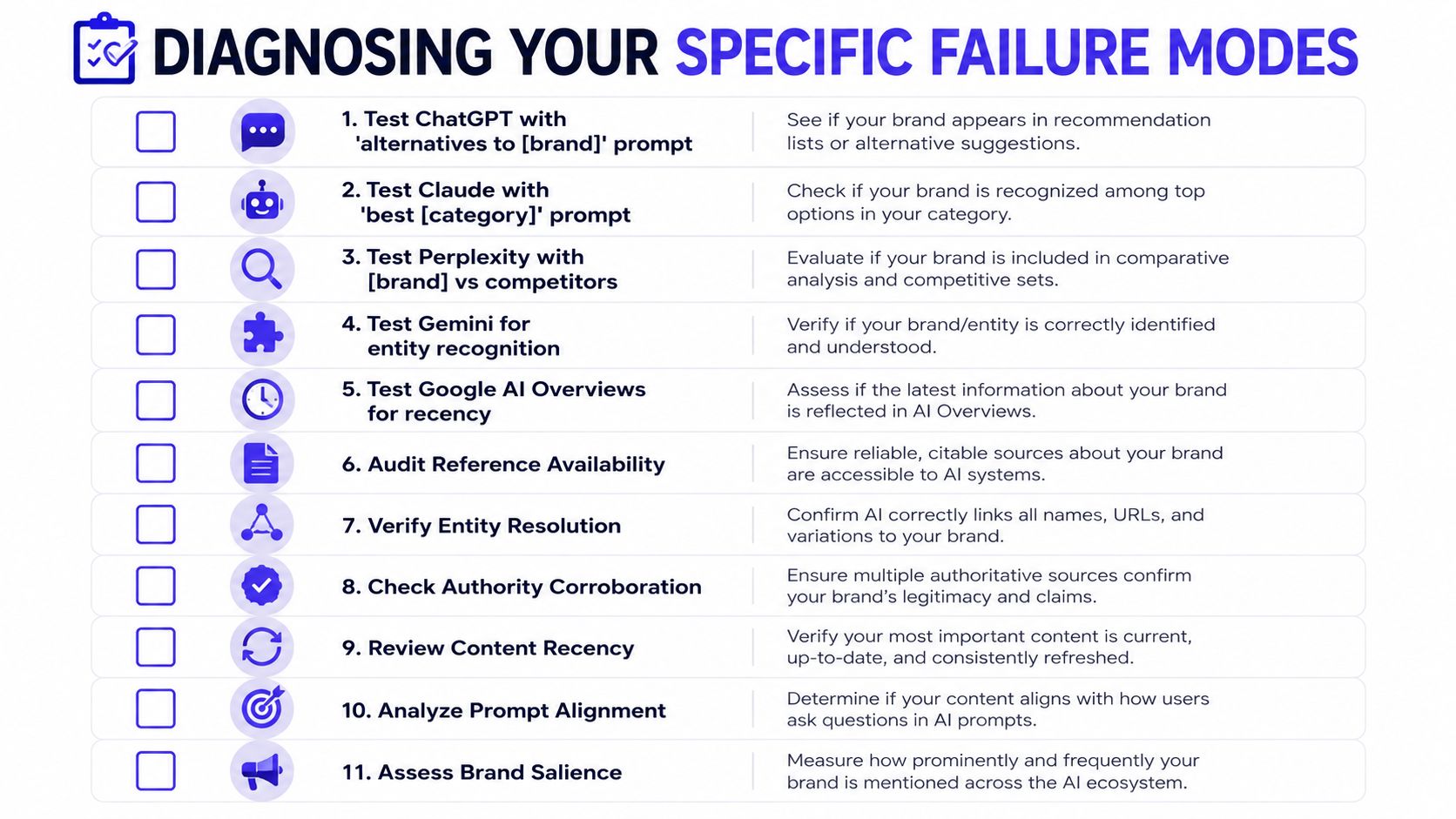
Diagnosing Your Specific Failure Modes
Start with the buyer prompts that decide citations, then test them across ChatGPT, Perplexity, Gemini and Google AI Overviews, with Claude on the Growth plan. Use queries like “best [category],” “[brand] vs [competitor],” “alternatives to [brand],” and “pricing for [category].” The goal is to see where the competitor appears, where your brand drops out, and which source domains the engine keeps trusting.
What to inspect first
Open the answer and read the cited domains, not just the response text. A brand can still lose the citation battle even when it is mentioned in the reply, because the engine may be pulling support from other sites. That pattern shows up repeatedly in independent coverage of AI citation behavior, where third-party domains often outrank the brand site itself for named recommendations.
Next, audit the base layer. Check whether your llms.txt exists and points crawlers toward the pages that matter most, especially product, comparison, and FAQ pages. Then inspect your Schema.org coverage for Organization, Product, FAQ, and HowTo. Fragmented markup makes it harder for an engine to resolve what the brand is and what it sells.
A weak diagnosis usually looks like a strong homepage and a weak entity graph.
Where the failure usually lives
Look at Wikipedia and Wikidata entries if they exist, then verify that the brand identity stays consistent across those sources. After that, review your third-party footprint across Reddit, G2, Capterra, Trustpilot, and Quora. Those sources often carry the evaluative language that model replies borrow for buyer questions, and broader citation patterns tend to favor brands that show up there with consistent mention volume. A practical way to map that footprint is GetIntel's competitor-finding workflow, which follows the same source-by-source approach used in buyer-prompt testing.
The failure mode usually shows up in one of a few places.
- If the competitor wins everywhere, external corroboration is usually the problem.
- If you show up in some engines but not others, prompt framing or source mix is often the blocker.
- If the model seems unsure who you are, entity resolution is the likely issue.
- If your answers feel stale, recency is probably hurting you.
Rank the fixes by citation-rate impact, not by effort. If the model cannot resolve the entity cleanly, fix that before you spend time on more content. If the entity is clear but the competitor still dominates, strengthen third-party corroboration before you add another comparison page.
Two Brands, Two Different Reasons for Losing
The first brand has strong owned content. Its product pages are clean, its llms.txt is live, its schema is complete, and its comparison pages are well structured. It still loses in ChatGPT because the competitor dominates Reddit threads, G2 reviews, and a couple of authoritative listicles. The site isn't the issue, the third-party footprint is.
The second brand has decent visibility in community channels. It shows up in forums, it has some review activity, and people do mention it. But the model still skips it because its Schema.org markup is fragmented, its Wikidata entry is wrong, and the brand entity isn't being resolved confidently. In that case, the problem isn't outreach, it's entity clarity.
Those two situations look similar from the outside, but they need different fixes. If you push reviews at the first brand, you might help, but the main battle is listicle and community dominance. If you spend months chasing Reddit for the second brand, you can still lose because the model can't reliably tell it's the same entity across sources.
This is why diagnosis matters more than activity. A lot of teams mistake motion for progress, then spend a quarter improving the wrong layer. The fastest path is the one that matches the failure mode, not the one that feels easiest to ship.
The Prioritized Fix Playbook
Start with the fixes that change citation likelihood the most, not the fixes that are fastest to launch. If the model can't find, resolve, and trust your brand, more blog content won't move the needle.
Tier 1, make the brand legible
Ship llms.txt so crawlers are pointed toward your most authoritative product, comparison, and FAQ pages. Then complete your Schema.org markup for Organization, Product, FAQ, and HowTo, and clean up inconsistent brand/entity data wherever it appears. Fixing Wikidata and Wikipedia entries belongs here too, because those are high-value entity anchors.
Tier 2, build the external proof layer
Get into the sources ChatGPT already likes to cite. That means real presence in Reddit threads, G2, Capterra, Trustpilot, Quora, and the editorial listicles that already rank in buyer-intent answers. The work here isn't spraying mentions everywhere, it's earning coverage where the model already expects to find independent evidence.
For teams that want a system to generate the fixes as artifacts, GetIntel sits in this part of the workflow. It measures visibility across ChatGPT, Perplexity, Gemini and Google AI Overviews, with Claude on the Growth plan, then produces draft outputs like llms.txt, Schema.org markup, Wikidata edits, counter-articles, and outreach emails. That's useful when the problem is not “write more,” but “ship the exact fix the diagnostic pointed to.”
Tier 3, target the prompt itself
Build counter-articles for the exact buyer questions competitors are winning. Add FAQ blocks, comparison tables, and extractable answer sentences that match the wording buyers use. If the prompt is “best analytics tools for finance teams,” your page needs to answer that cleanly at the top, not wander through a long brand narrative first.
- Comparison pages: Use them when the prompt is explicitly evaluative.
- Alternatives pages: Use them when a competitor is already occupying the shortlist.
- Prompt-shaped FAQs: Use them when the answer needs to be easy to quote.
- Outreach to existing list owners: Use it when the competitor is winning because the listicle itself is being cited.
The order matters. If entity resolution is broken, prompt-targeted content won't save you. If third-party corroboration is thin, a perfect comparison page can still get skipped.
Measuring What Actually Moved
Track citation share and mention share separately. Citation share tells you how often your domain appears in the sources the engine uses. Mention share tells you how often your brand is named in the answer itself. Those are related, but they're not the same outcome, and the gap between them usually tells you whether the model is merely discussing your category or actively recommending someone else.
What to measure every day
Use the same prompts across ChatGPT, Perplexity, Gemini and Google AI Overviews, with Claude on the Growth plan, then log per-prompt standings. A useful dashboard includes topic scores, Share of Voice, and Average Citation Rank, plus the exact domain cited for each buyer question. That lets you see whether a change helped the prompts you care about, instead of just creating noise.
| Signal | Metric to track | Healthy benchmark |
|---|---|---|
| Reference availability | Cited source presence across target prompts | Your brand appears in the source set for core buyer questions |
| Entity resolution | Consistent brand/entity match across engines | The same brand identity is recognized across major engines |
| Authority corroboration | Share of authoritative third-party citations | Competitors are not dominating the named source set |
| Recency | Freshness of cited pages and updates | Current pages are being surfaced for current questions |
| Prompt framing | Coverage on buyer-intent prompts | You appear on “best,” “alternatives,” and “compare” queries |
| Community signals | Mentions in Reddit, G2, Capterra, Trustpilot, Quora | Positive, repeated third-party discussion exists |
Measure the prompt, not the vanity metric. A clean weekly trend on the exact query a buyer asked is more useful than a broad dashboard full of unlinked mentions.
How to attribute movement
If visibility improves after a llms.txt update, log that change against the affected prompts. If a review-site push lifts your citation rate, tag that separately. If a Reddit thread starts getting cited, note the date, the prompt, and the engine.
The goal is to connect each score change to one shipped action. Without that link, teams end up celebrating movement they can't repeat, or blaming the wrong fix when nothing changes.
A 30-60-90 Operating Rhythm for AI Visibility
Days 1 to 30 are for diagnosis and foundations. Run the buyer prompts, log the competitor set, fix llms.txt, complete Schema.org, and clean up entity data in Wikipedia or Wikidata where needed. By the end of that window, you should know exactly which signal is failing and have a baseline for each engine.
Days 31 to 60 are for the external proof layer. Push into Reddit, G2, Capterra, Trustpilot, Quora, and the listicles that already shape answers in your category. Tie every outreach or review effort to the prompt cluster it should influence, then track the source mix as it shifts.
Days 61 to 90 are for prompt-targeted content and pruning. Ship comparison pages, alternatives pages, and extractable FAQ blocks for the exact prompts the competitor still wins. Cut the tactics that didn't move citation share, then double down on the ones that did.
AI citation is an ecosystem problem, not a content problem. The brands that win treat it like an operating discipline: diagnosis, source-building, and measurement running every week instead of once a quarter.
If you want a system that finds where competitors are being cited, shows which prompts you're missing, and turns those gaps into shipped artifacts, visit GetIntel. It's built for teams that need to diagnose AI visibility at the source level and move from guesswork to a repeatable operating loop.
To find out whether this is happening to you specifically, ChatGPT brand tracking runs your buyer questions daily and records which brands come back. Two measured versions of this problem from our own tracking: 16 of 17 vendor-written "best tools" lists rank their own product first, and 51.7% of citations in this category point at companies selling into it.