GetIntel and Peec AI both tell you whether AI engines name your brand, but they sell different jobs. Peec AI is a measurement and benchmarking platform starting at $95/month that tracks three AI engines of your choosing. GetIntel starts at $29/month, tracks four engines on every plan, and drafts the fix once it finds a gap. If your team can already turn findings into published work, the cheaper answer is the measurement tool. If that handoff is where your work stalls, it isn't.
Disclosure: GetIntel publishes this comparison and sells one of the two products in it. Every Peec AI figure below carries a note on where it came from, so you can weigh ours accordingly.
In this article
- Why does this comparison come down to workflow, not features?
- How does each tool collect its data?
- Which AI engines does each tool actually track?
- What do the metrics mean?
- What does each tool hand you after the diagnosis?
- What do GetIntel and Peec AI cost?
- Who should pick which?
- How do you switch without losing your baseline?
Why does this comparison come down to workflow, not features?
This comparison comes down to workflow because both tools answer the same question and then stop at different points. Peec AI tells you where you stand against competitors. GetIntel tells you the same thing and then drafts the artifact meant to change it.
That sounds like a feature difference. In practice it is a staffing question. A monitoring tool assumes someone on your team will read the finding, decide what to publish, and ship it that week. When that person exists, monitoring is the cheaper and often better buy. When they don't, the report becomes a backlog. Scanning a broader map of AI rank trackers makes the point quickly: plenty of tools will show you the problem, and far fewer help you resolve it.
Peec AI is a serious product in this category, GetIntel's own tracker named it in 35.3% of 238 category probes over the seven days to 6 August 2026, third behind Otterly.ai and Profound, which is why we compared against it rather than a tool nobody is evaluating. That is a live trailing figure and it moves. That figure is ours, measured on the 100-prompt set we run against our own category.
How does each tool collect its data?
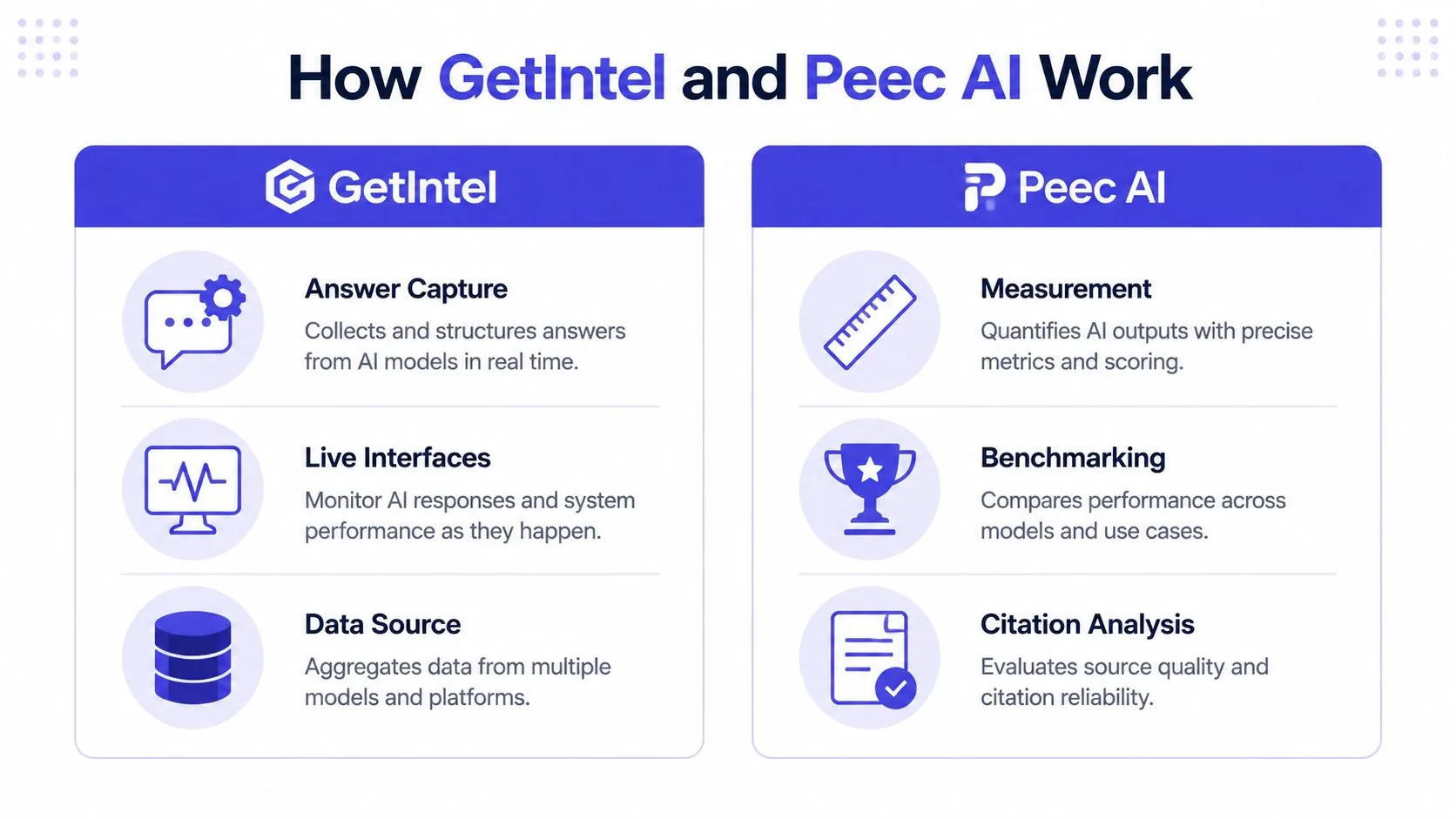
Neither GetIntel nor Peec AI publishes enough about its capture method for us to claim an edge, and we are not going to invent one. What we can say is what each does with the answer once it has it: Peec AI's own documentation describes a measurement layer reporting visibility, share of voice, sentiment and position, while GetIntel treats every gap it finds as the input to a draft.
The methodology point people usually raise here, interface capture versus API results, matters less than vendors claim. What it changes is what the number describes. A reading taken from the consumer surface reflects citation order and phrasing a buyer would actually see. A cleaner engine-level reading is easier to compare across brands at scale. Neither is wrong; they answer slightly different questions, and any tool that does not tell you which one it did is the one to be suspicious of.
Which AI engines does each tool actually track?
Peec AI lets you track three engines, chosen from a pool of six: ChatGPT, Google AI Mode, Google AI Overviews, Microsoft Copilot, Gemini and Naver AI. On its pricing page read 26 September 2026, Perplexity has moved out of that included pool and is listed as an add-on. GetIntel tracks four, ChatGPT, Perplexity, Gemini and Google AI Overviews, on every paid plan, with no per-engine add-on.
Two details are easy to miss when comparing engine counts:
- Peec charges per extra engine, and the price scales with your plan. A fourth or fifth model is an add-on at $30/month on Starter, $70 on Pro and $140 on Advanced. So "three engines" is the floor, not the ceiling, and the ceiling costs more on the plans that can afford it.
- Claude sits outside the self-serve pool entirely. It is an Enterprise-tier integration, not something you add to a Starter plan. Any comparison that lists Claude as a cheap Peec add-on is out of date.
Update, 23 September 2026. Peec's own agency pricing page lists Claude and Grok among its available models, alongside ChatGPT, Gemini, Perplexity, Microsoft Copilot, Google AI Overviews and Google AI Mode: eight rather than the six recorded below. Whether Claude and Grok are still gated to higher tiers could not be read, because Peec renders its plan-by-plan values dynamically and a plain fetch returns the row labels without the values. So treat the six-engine pool and the Claude-is-Enterprise-only line below as correct for the self-serve tiers as last verified, and the model list itself as wider than it was.
Source note: Peec AI's own pricing page lists the plan names and the six-engine pool. The engine add-on prices and the Claude/Enterprise placement come from independent reviews published in 2026, including Ziptie's Peec AI alternatives comparison, because Peec's page renders its figures dynamically and we could not read them directly at the time. Update, 26 August 2026: the plan names, six-engine pool, and Claude/Enterprise placement are now confirmed against a first-party read of peec.ai/pricing. The add-on prices are confirmed too, and the currency question is settled: a live read of peec.ai/pricing on 17 September 2026 shows $30, $70 and $140, in dollars. Peec displays in USD now, so the euro figures in older comparisons are the same amounts under the previous currency. See Peec AI pricing 2026 for the full breakdown, including the annual-vs-monthly distinction this page's numbers didn't originally disambiguate.
What do the metrics mean?
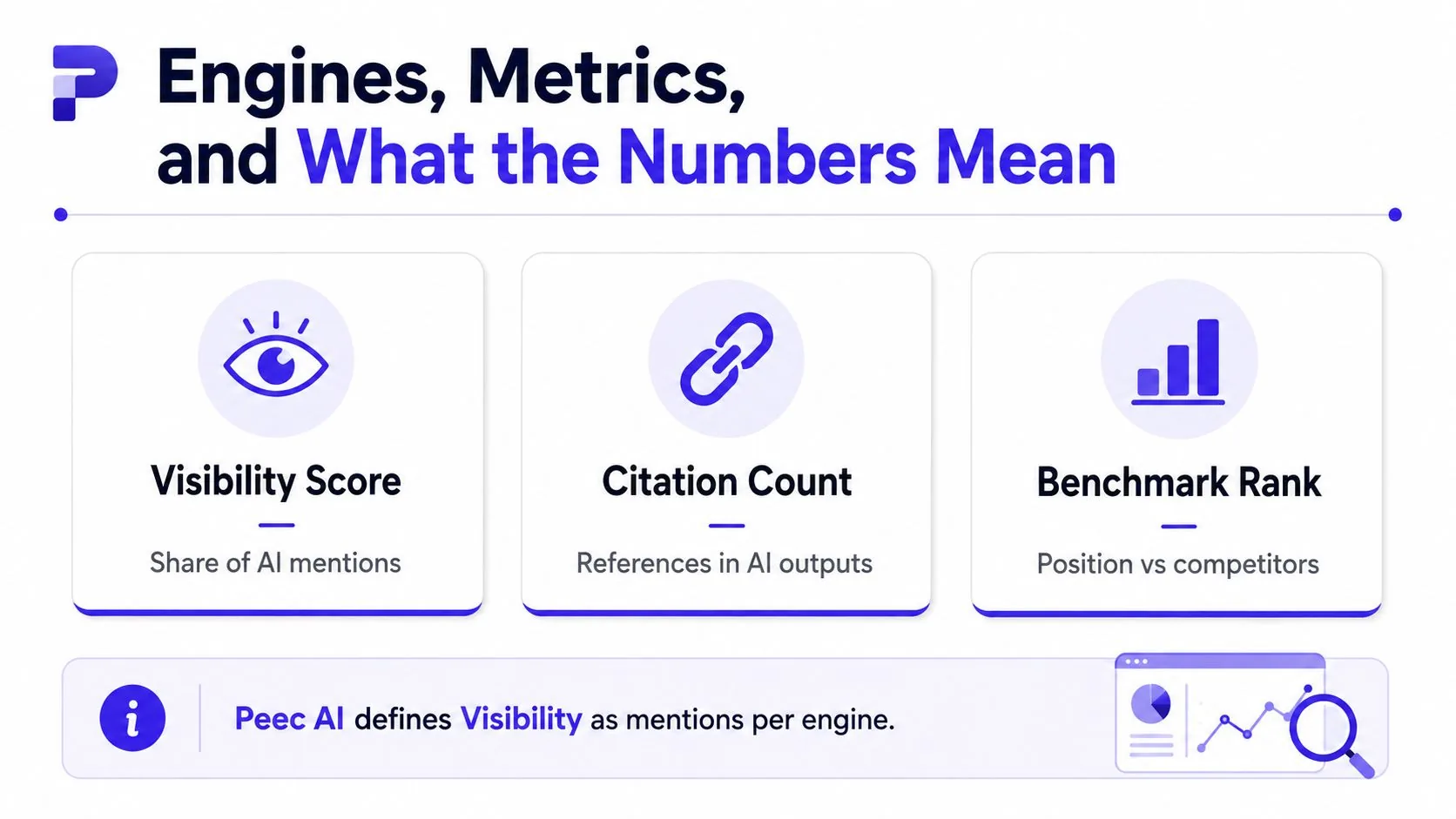
Presence and dominance are different numbers, and most confusion between these tools comes from mixing them up. Peec AI's own documentation defines Visibility as the share of AI responses in which a brand appears, Share of Voice as the share of brand mentions across the tracked set, and Position 1 as the first-mentioned brand, where lower is stronger.
GetIntel reports topic-level scores, Share of Voice and Average Citation Rank over the same kind of question set. The vocabulary is close enough that migrating a mental model between the two is not hard.
Read them in this order:
- Visibility first: does the brand appear at all?
- Share of voice second: or does a competitor own the conversation you appear in?
- Position third: is the mention early enough in the answer to be remembered?
A brand can post healthy visibility and still be losing, because appearing in an answer that recommends someone else is not the same as being recommended.
What does each tool hand you after the diagnosis?
Peec AI hands you a measurement; GetIntel hands you a draft. That is the single largest difference between them and the one worth deciding on.
GetIntel generates llms.txt entries, Schema.org and Wikidata markup, counter-article briefs and outreach emails tied to the specific gaps it found. Those move through a coding agent you already use, Claude Code or Cursor, as a reviewable diff, with optional publishing to WordPress, Ghost or Webflow. Nothing ships without approval.
We should be honest about the limits of that. A generated draft is a starting object, not a finished asset, and a team that would have written something better from scratch is not gaining much. The gain is for teams where the alternative to a rough draft is nothing at all, which, in our experience selling to lean marketing teams, is the common case.
We could not verify a fix-generation feature on Peec AI's side from its own documentation. That is an absence of evidence in their public docs rather than a confirmed gap in the product, and it is worth checking directly with them if it is your deciding factor.
Does Peec AI expose its data over MCP?
GetIntel and Peec AI both expose their data over MCP, so neither has an advantage on the connection itself. Peec publishes a Peec AI MCP server and documents workflows that query its visibility data from Claude, read 23 September 2026. GetIntel exposes its own MCP server on every paid plan, which is how its tasks and drafts reach Claude Code or Cursor.
The difference is what each returns. Peec's MCP serves the analytics: visibility, position, share of voice, sentiment, citations and competitors, for an assistant to read and summarise. GetIntel's returns the ranked task and the drafted artifact, so the assistant has something to ship rather than something to describe.
Does Peec AI sell to agencies?
Peec AI runs a dedicated agency lane with its own pricing page, read 23 September 2026. It is built around credits rather than flat prompt counts (its Scale plan carries 65,000 credits a month for agencies managing 11 to 25 or more clients, with a custom Comprehensive tier above), and it meters projects, team users and client users as separate line items so clients can log in and view their own project data.
It also runs pitch projects: free projects for auditing a prospect before they sign, with their own prompt allowance. That is the same idea as GetIntel's pitch reports, so an agency comparing the two on whether it can scan a prospect for free will find both do it. Worth knowing before treating either as unique.
What do GetIntel and Peec AI cost?
GetIntel starts at $29/month; Peec AI starts at $95/month. The gap widens as you scale, and it widens further once engine add-ons enter the picture.
| GetIntel | Peec AI | |
|---|---|---|
| Entry plan | $29/mo, 1 brand, 25 prompts | $95/mo (€89), 50 prompts |
| Mid plan | $79/mo, 1 brand, 60 prompts | $245/mo (€205), 150 prompts |
| Top self-serve | $149/mo, 120 prompts, Claude as a 5th engine | $495/mo (€425), 350 prompts |
| Engines included | 4, every plan | 3, chosen from a pool of 6 |
| Extra engines | Not sold separately | $30 / $70 / $140 per model by tier |
| Seats | Unlimited from $79 | Unlimited on all paid plans |
| Output | Measurement plus drafted fixes | Measurement and benchmarking |
Source note: GetIntel figures are our own list prices. Peec AI's plan names and engine pool come from its own pricing page; the dollar and euro figures come from independent reviews published in 2026, including TryAnalyze's Peec AI review. Prices move, so check both vendors before deciding. Update, 26 August 2026: the Peec AI figures above are now confirmed by a first-party read of peec.ai/pricing in Peec AI pricing 2026, which also clarifies that $95/$245/$495 is the monthly-billing rate; the page's default annual-billing rate is lower ($80/$205/$420).
Sticker price is not the whole cost either way. A measurement tool that costs three times more can still be cheaper overall if it replaces analyst work you were paying for anyway. A cheaper tool that drafts fixes is only cheaper if you actually use the drafts.
Who should pick which?
Pick Peec AI if you have people to act on what it finds; pick GetIntel if you don't.
Peec AI fits teams that want depth in competitive benchmarking, that need more than four engines and will pay per model for them, and - if GDPR-specific positioning is a procurement requirement for you - teams who should check that directly with them rather than take our word for it, and that already employ the writers and developers who turn a finding into a shipped change.
GetIntel fits lean teams where the same one or two people have to spot the problem and fix it, founders working through coding agents, and agencies running several client brands who need output per client rather than another dashboard to interpret. Our AI visibility tracking and the Peec AI alternatives go deeper on that split.
If you want to see how we compare against the broader tool set rather than one competitor, the GetIntel vs Semrush comparison covers the same ground against an incumbent.
How do you switch without losing your baseline?
Switch without losing your baseline by running both tools in parallel for a few weeks before cutting over, or you will lose the ability to tell a real change from a methodology change.
- Export the prompt library first. Your tracked questions are the asset, not the dashboard.
- Keep the buyer wording identical. Rephrasing a prompt changes the answer, so a rewritten set makes the two tools look different when only your input changed.
- Overlap for two to four weeks. Enough to see whether the tools disagree, and about which engines.
- Give one person the first batch of fixes. Whoever reviews the output should also own shipping it, or the handoff you were trying to fix reappears.
- Judge month one on what got published, not on how the dashboard looked.
The risk in this migration is not lost data. It is discovering that the reporting was never the bottleneck. If that turns out to be true for your team, the monitoring tool was the right buy and you should keep it.
If the bottleneck really is the gap between knowing and shipping, that is the one GetIntel is built to close. You can start free and check it against your own buyer prompts.
For the same comparison against other tools in this category: GetIntel vs Otterly.ai.
Related: GetIntel vs LLMrefs, and against a tool that meters its own fix-shipping mechanism by monthly execution count rather than a per-change diff, GetIntel vs KIME. For the shorter, positioning-focused version of this comparison, see GetIntel as a Peec AI alternative.