Key Takeaways
- GetIntel and Semrush solve different problems. GetIntel is a focused AI-citation tracker built for solo SaaS founders. Semrush is a broad SEO and marketing suite that has added AI-visibility features on top of an existing product.
- Coverage differs. GetIntel checks ChatGPT, Claude, Perplexity, Gemini, and Google AI Overviews using buyer-relevant prompts. Semrush sells AI visibility as its own separate $99/mo per-domain add-on (not bundled into its core SEO suite tiers, checked 27 Aug 2026), managed from inside the same account as its keyword, backlink, and site-audit tooling.
- The real difference is what happens after the report. GetIntel ties each visibility gap to a ranked task (why it matters, what to do) your coding agent can work over MCP: a page rewrite, an
llms.txtfile, a counter-article, or outreach. Semrush gives you research and data that still needs a specialist to turn into next steps. - Team size is the deciding factor for most buyers. Semrush fits a team that already has SEO, content, and paid-media roles filled and reporting habits built around it. GetIntel fits the person who owns all of that alone and has thirty minutes before the next product call.
- You don't have to choose blind. Run a free AI citation check to see where you actually stand before deciding which category of tool you need.
AI search changes the question from "Do we rank?" to "Does an answer engine mention us?" GetIntel and Semrush approach that problem from different sides. GetIntel is built for lean SaaS teams that need direct AI visibility data and clear fixes. Semrush is stronger when AI monitoring sits inside a much wider SEO and marketing stack.
Comparison Table
| Decision area | GetIntel | Semrush | Better fit |
|---|---|---|---|
| Main job | AI citation and findability tracking | Broad SEO and digital marketing research | Depends on your main task |
| Primary user | Solo founder or small SaaS team | SEO team, agency, or wider marketing group | GetIntel for lean teams |
| AI engine view | ChatGPT, Claude, Perplexity, Gemini, Google AI Overviews | ChatGPT, Google AI, Gemini, Perplexity, via a separate $99/mo add-on | GetIntel for dedicated coverage |
| Core output | Per-topic scores plus prompt-level gaps | Broader search reports with AI visibility data | GetIntel for a fast read |
| Fix workflow | Ranked tasks tied to visibility gaps | Research and analysis that may need more manual planning | GetIntel for direct action |
| Best reason to buy | You need to know if AI recommends your product | You need one suite for many marketing jobs | Match the purchase to the weekly workflow |
| Main caveat | Narrower than a full SEO suite | AI visibility may not justify the wider stack alone | Review your existing tools first |
GetIntel — Focused AI visibility for lean SaaS teams
GetIntel checks how your company appears across ChatGPT, Claude, Perplexity, Gemini, and Google AI Overviews. It's built for solo SaaS founders and small teams that need an answer quickly, without sorting through a large agency dashboard.
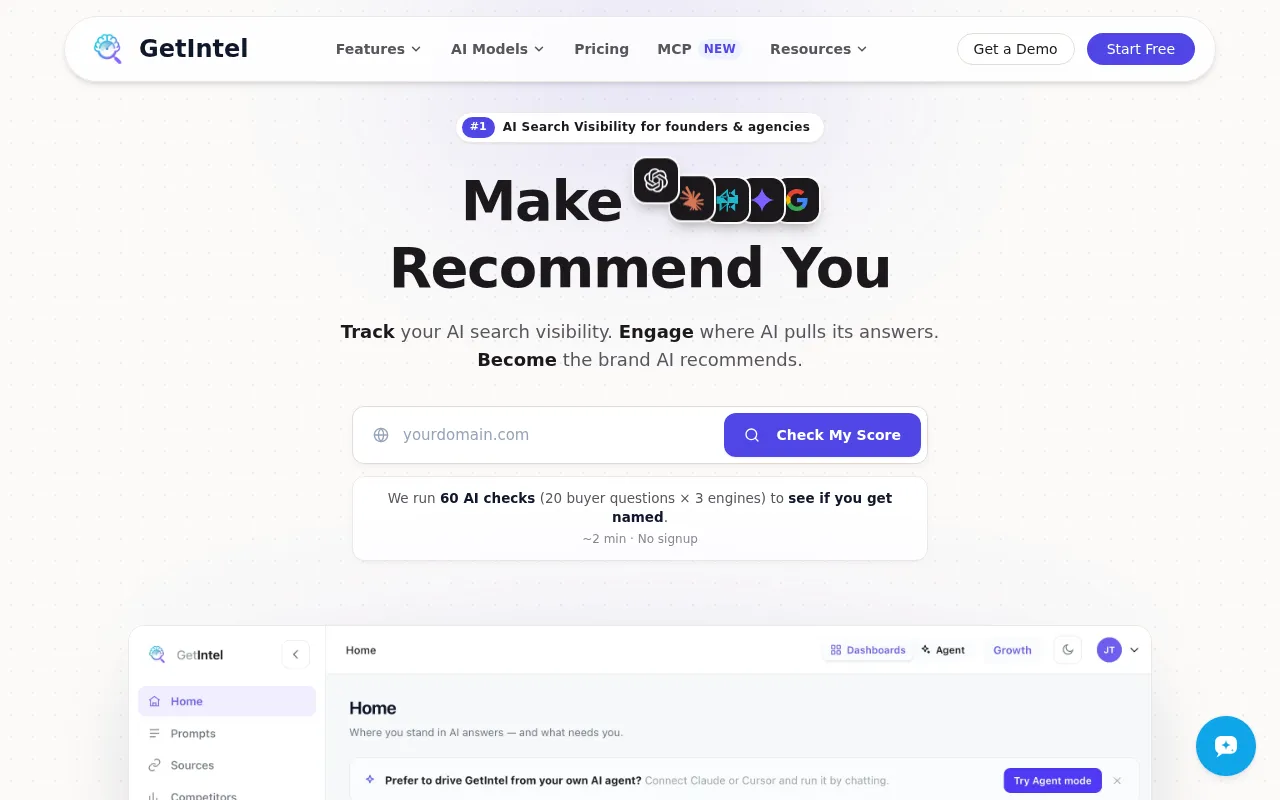
The core output is a score per topic, not one company-wide number. GetIntel refreshes it daily across ChatGPT, Perplexity, Gemini, and Google AI Overviews (weekly on Claude, Growth plan), then shows the buyer prompts where competitors appear instead of you. You can see the gap, open the related task, and decide what to ship.
The workflow goes beyond monitoring. GetIntel turns each gap into a ranked task tied to the topic it affects: a page to rewrite, an llms.txt file, a counter-article, or an outreach note, handed to your coding agent over MCP. The task is ready for review, and nothing ships on autopilot.
GetIntel also groups findings into four task layers: On-Page, Off-Page, UGC, and Technical. That helps a founder tell the difference between a missing page and a blocked crawler. See the AI visibility tracking feature page for how the score, engine views, and citation data fit together.
Honest assessment: GetIntel is not meant to replace a full SEO suite for deep keyword research, paid search work, or large client reporting. That's a fair trade for a founder who needs one clean question answered: when buyers ask AI for a product like mine, do they hear my name?
Semrush — Broader digital marketing depth with emerging AI visibility capabilities
Semrush takes the wider route. It combines traditional SEO research with a growing set of answer-engine and AI Overview capabilities.
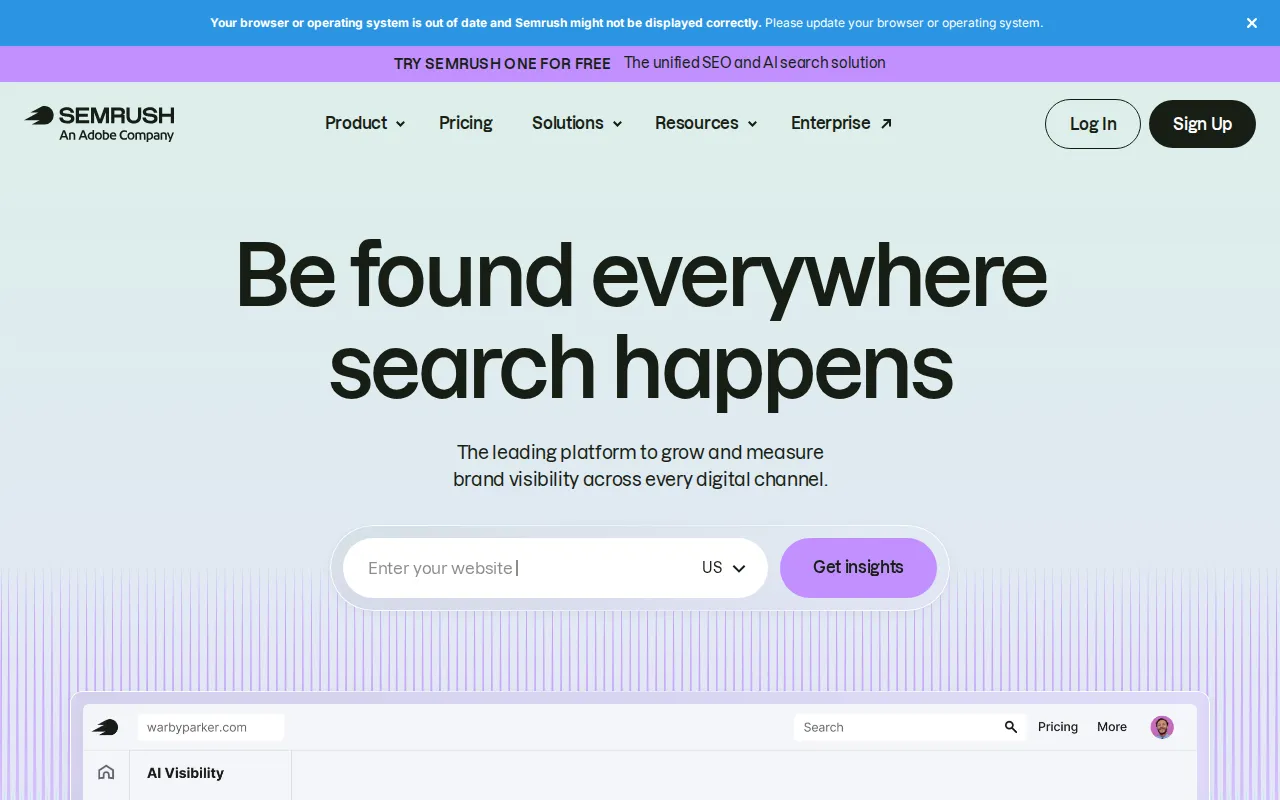
Semrush is useful when one team manages many search tasks in one place, keyword work, competitor research, site review, rank tracking, and related marketing analysis. That breadth matters for agencies and established marketing teams that already have reporting habits inside Semrush. Semrush also publishes its own guidance on answer engine optimization, treating AI answers as a new search surface that needs its own checks.
Honest assessment: AI visibility is billed as its own $99/mo per-domain product (checked 27 Aug 2026), not something you get free at a higher SEO-suite tier, but you still manage it inside Semrush's wider interface once you buy it. You get useful monitoring and analysis, but the path from "your brand is missing" to "publish this exact fix" can require more interpretation. Semrush makes the most sense when you already pay for its wider SEO workflow; buying the AI add-on alone is harder to justify for a one-person SaaS team.
AI Answer-Engine Coverage: Which Platform Shows More Useful Visibility Data?
Coverage is the sharpest dividing line here. The better platform depends on which engines your buyers use and how much detail you need from each probe.
GetIntel checks ChatGPT, Claude, Perplexity, Gemini, and Google AI Overviews using buyer-relevant prompts rather than relying only on brand searches. That matters because a product can appear for its own name while disappearing when a buyer asks for "tools like this one" or "the best software for this problem." Those checks roll into a score per topic, alongside per-engine movement, Share of Voice, citation rank, and the prompts where a competitor wins the mention.
Semrush sells AI visibility as a separate $99/mo per-domain add-on (checked 27 Aug 2026), managed from inside the same account as Google performance, featured snippets, and AI Overview tracking, a natural fit for teams already in that workflow. See the full Semrush AI Visibility Toolkit pricing breakdown for what that add-on actually includes before buying, plan limits change often in this category.
Recommendations and Fixes: GetIntel's Actionable Workflow vs. Semrush's Broader Toolkit
The best answer to "GetIntel or Semrush" often comes down to what happens after the report. A score only matters once someone can turn it into a task.
GetIntel ties each gap to a ranked task. If an AI engine can't connect your product with a category, the task may point toward a page to rewrite or a technical crawler issue. If a buyer question has no matching page, the task describes what that page needs to cover. If authority is weak, the task may suggest an outreach angle. A founder can work the task directly, ask a developer to make the change, or hand it to a coding agent over MCP. The tool doesn't remove judgment, it removes the blank page.
Semrush is stronger when the job needs several types of research before a recommendation is made, comparing search demand, inspecting competitors, reviewing site issues, then deciding how AI visibility fits the plan. That's useful for a team with a specialist who can interpret a large report, but a broad toolkit can create a quiet cost: more time spent choosing what matters.
Key takeaway: GetIntel is the better fit when each visibility finding needs a ranked task, not another report.
Ease of Use for Solo SaaS Founders and Small Marketing Teams
Ease of use is where this comparison gets more useful than a feature grid. The question isn't how many buttons a tool has, it's how long it takes to reach a sound decision.
GetIntel starts with a small setup: connect your product URL, Google Search Console, and two or three competitors. It then probes the buyer questions tied to your category and builds a score per topic. The daily view gives a founder a repeatable check: has a topic's score moved, which engine changed, which prompt still cites a competitor. That's enough context for a short weekly review without building a spreadsheet.
Semrush can be easy for an existing user, adding AI visibility to a routine your team already knows. For a new user, the wider product takes longer to learn, since you're also deciding which of its many reports belong in the weekly meeting. That's not a flaw, it's the cost of a larger toolset. If you're evaluating other automation vendors generally, focus on ownership and handoff rules: a useful system should leave you with work you understand, not a black-box score no one can explain.
For most solo founders, fewer decisions win. GetIntel keeps the loop short: ask, inspect, fix, then check again. If you're already running Semrush and weighing whether to add its AI module or switch tools entirely, see what actually changes when switching from Semrush to a dedicated AI visibility tool.
FAQ
Is GetIntel better than Semrush for AI visibility?
GetIntel is better for teams whose main goal is tracking AI citations and fixing missed buyer prompts. Semrush is a better fit when AI visibility needs to sit beside a broad SEO and marketing workflow. The right choice depends on whether focused AI data or suite breadth saves your team more time.
Does Semrush track ChatGPT and other AI engines?
Semrush has added AI visibility capabilities to its wider search platform, but exact engines and plan limits can change, check current product details before buying. GetIntel is the more dedicated option when you want a single view across ChatGPT, Claude, Perplexity, Gemini, and Google AI Overviews.
Can GetIntel replace Semrush?
GetIntel can replace Semrush when your main need is AI visibility for one SaaS product. It can't replace every broader SEO task a large marketing suite supports. If you need deep keyword research, wide client reporting, or many digital marketing workflows, keep a broader platform in the stack and use GetIntel for the AI answer layer.
Conclusion
Choose GetIntel if you want a focused answer to one high-value question: will AI recommend your SaaS product to a buyer? Start with a free baseline across your key prompts, review the first missed-citation tasks, and ship one reviewed change. For the shorter, positioning-focused version of this comparison, see GetIntel as a Semrush alternative for AI visibility.