Ahrefs does track AI visibility, through Brand Radar, and it is priced as an add-on to an SEO suite rather than as a product on its own terms. A Lite plan is $129/month and each AI platform index is $199/month on top, or $699/month for all of them, so full AI coverage lands near $828/month. GetIntel starts at $29 with its engines included. If you already live inside Ahrefs, that add-on is convenient; if AI visibility is the job you are buying for, you are paying for a keyword and backlink index you may not need.
Disclosure: GetIntel publishes this comparison and sells one of the two products in it. Ahrefs' figures below come from its own pricing and product pages.
In this article
- Does Ahrefs track AI visibility?
- What does Ahrefs Brand Radar cost?
- Which AI engines does each one track?
- What is Ahrefs genuinely better at?
- What does GetIntel do that Ahrefs does not?
- Should you use both?
Does Ahrefs track AI visibility?
Ahrefs does track AI visibility, and properly. Brand Radar reports mentions, citations, impressions and AI Share of Voice across the AI surfaces it indexes, built on what Ahrefs calls search-backed prompts, its own materials cite prompt sets in the hundreds of millions, published as 210M+ on the Brand Radar page and 271M+ on the pricing page.
That scale is the real argument for it. Ahrefs is measuring against a prompt corpus far larger than any dedicated AI-visibility startup has assembled, and its own AI search competitor analysis guide is a straight explanation of how it approaches the problem. Anyone claiming Ahrefs is not serious about this has not looked.
Ahrefs' own FAQ also states Brand Radar is available as a standalone tool, with a free Ahrefs account included when you buy it, so it is not strictly locked behind a full suite subscription.
What does Ahrefs Brand Radar cost?
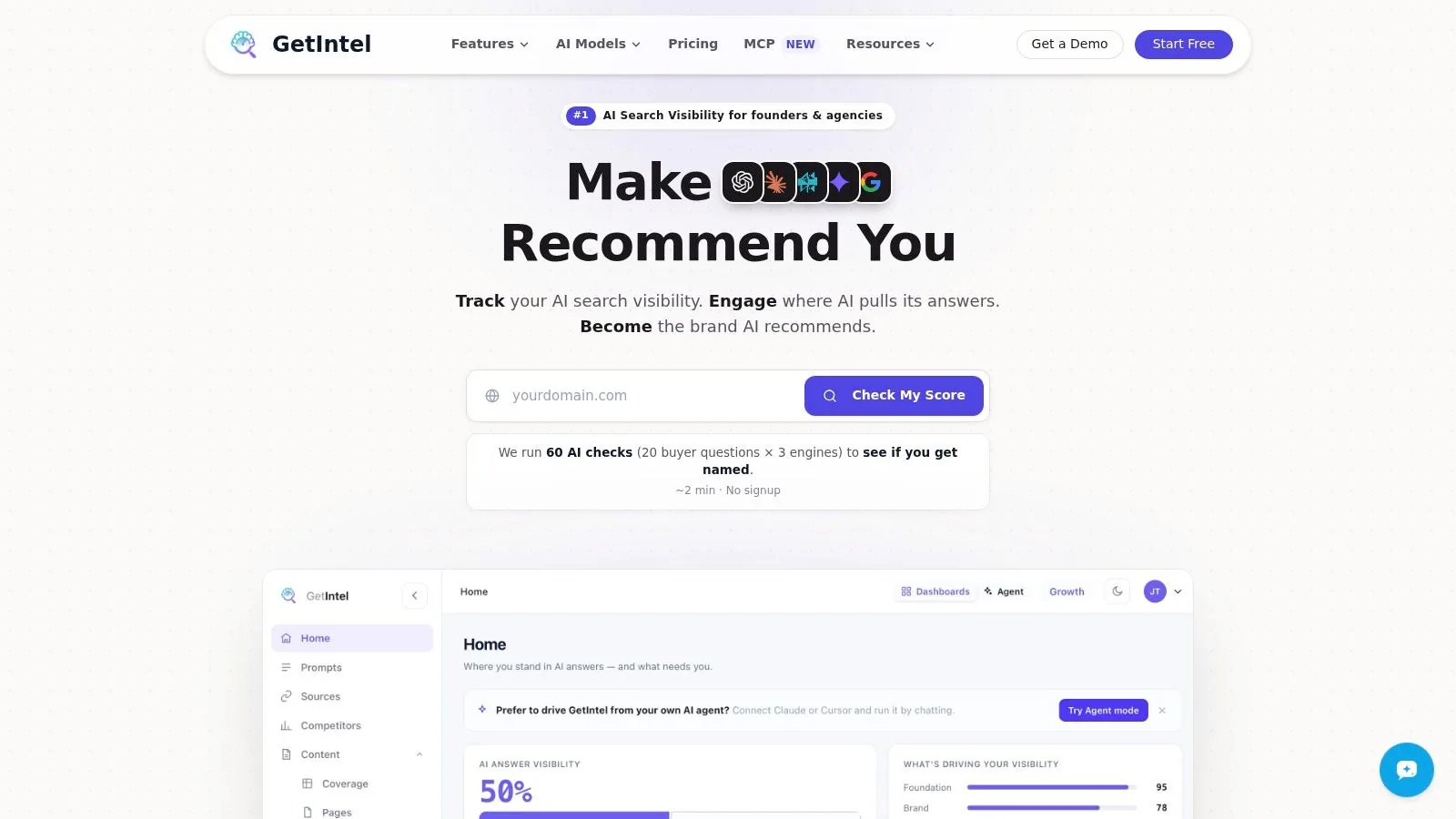
Ahrefs Brand Radar costs $129/month for the cheapest plan that can carry it, plus $199/month per AI platform index, or $699/month for all of them. The $129 Lite tier and the $199 Brand Radar AI entry price were re-verified on ahrefs.com/pricing on 19 September 2026. The $699 all-platforms figure was captured when this comparison was first published in August 2026 and could not be found on the page on that re-check, so treat it, and the ~$828 total derived from it, as the August capture rather than a current quote. Ahrefs' page now also lists custom prompt-tracking packages at $50, $100 and $250 a month, read 19 September 2026, which did not exist in the structure described below.
| Ahrefs | GetIntel | |
|---|---|---|
| Base plan | $129 Lite · $249 Standard · $449 Advanced · $1,499 Enterprise | $29 Monitor · $79 Pro · $149 Growth |
| AI engines | $199/mo each, or $699/mo for all | included |
| Full AI coverage | ~$828/mo (Lite + all indexes) | $149/mo (Growth, adds Claude weekly) |
The comparison is less lopsided than it looks, because the two prices buy different things. Ahrefs' $828 includes a full SEO suite, backlink index, keyword research, rank tracking, site audit. That GetIntel does not attempt. If you need those, you are buying them anyway and Brand Radar is an incremental cost on top.
It is genuinely lopsided if AI visibility is the whole reason you are buying. Then the SEO suite is overhead.
Which AI engines does each one track?
Ahrefs covers Google AI Overviews, ChatGPT, Gemini, Perplexity and Grok. GetIntel covers ChatGPT, Perplexity, Gemini and Google AI Overviews, adding Claude on the $149 Growth plan.
The overlap is four: ChatGPT, Perplexity, Gemini and Google AI Overviews. Ahrefs reaches Grok, which GetIntel does not track at all. GetIntel reaches Claude on its top tier, which Ahrefs does not index.
Neither list is complete, and the gap that matters is whichever engine your buyers actually use. That is worth checking before either purchase, because paying per index for a surface your market does not ask questions on is the most avoidable cost in this category.
What is Ahrefs genuinely better at?
Ahrefs is genuinely better at database breadth and at everything that is not AI visibility. This is not a close call and it would be dishonest to pretend otherwise.
Ahrefs' backlink index, keyword database and rank tracking are category-defining, built over more than a decade. Its prompt corpus for Brand Radar is larger than anything a dedicated AI-visibility tool has. If your work spans traditional SEO and AI search (and for most teams it still does), a single platform covering both is a real operational advantage, and one fewer subscription to justify.
There is also a data-quality argument. Ahrefs derives its prompts from search behaviour at a scale that lets it claim representativeness. Smaller tools, GetIntel included, run a curated prompt set that you or the tool defines, which is more targeted and less statistically broad. Both approaches are defensible; they are not the same thing.
What does GetIntel do that Ahrefs does not?
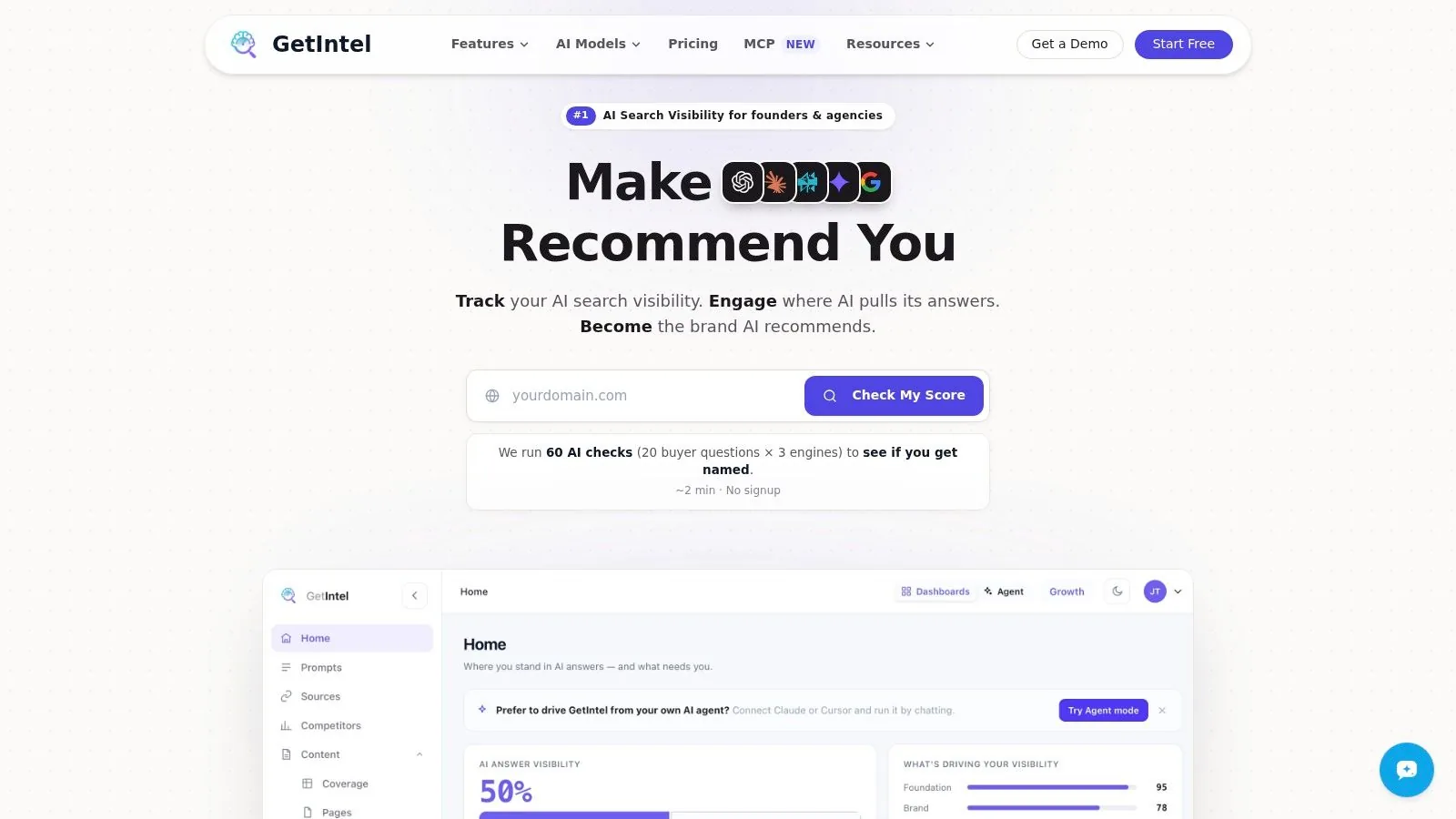
GetIntel drafts the fix. Brand Radar reports where you stand; GetIntel generates the artifact meant to change it.
That means llms.txt entries, Schema.org and Wikidata markup, counter-article briefs and outreach emails, tied to the specific gaps found, moving through Claude Code or Cursor as a reviewable diff, with optional publishing to WordPress, Ghost or Webflow. You approve everything.
The honest limit: a generated draft is a starting object, not a finished asset. A team with a good writer and spare time will do better from scratch. The gain is for teams whose realistic alternative is that nothing gets written, which (in our experience selling to lean marketing teams) is the common case.
We have not run a controlled side-by-side test against Brand Radar, and nothing here should be read as one.
Should you use both?
Running both usually makes sense if you are already paying for Ahrefs.
Most teams evaluating this are not choosing between two products; they are deciding whether to add $199-per-index to a subscription they already have, or to run a dedicated tool alongside it. At $699/month for all indexes against $149/month, that arithmetic usually answers itself, but only if the dedicated tool covers the engines you care about, which is worth verifying first.
Choose Ahrefs alone if AI visibility is a reporting line inside a broader SEO practice, you want one vendor, and the per-index cost is acceptable against not adding another tool.
Add GetIntel if the gap between knowing and shipping is where your work stalls, or if you want AI-engine coverage without buying an SEO suite to get it.
If you are assembling your own monitoring rather than buying either, the best AI web scraping tools is a reasonable starting survey, and it is worth knowing how people compare competitor monitoring platforms more generally before committing to a category-specific product.
The cheap test: take twenty buyer questions, run them through whichever tool you already have, and see whether the output changes what you publish. You can start free, and our AI visibility tracking covers how the probes work. For the same comparison against a full marketing suite rather than an SEO one, see GetIntel vs Semrush.
For the same comparison against other tools in this category: GetIntel vs Peec AI.
On a related note: what happened when we tried to actually pull Brand Radar data through Ahrefs' own API, rather than just reading the published price. For the shorter, positioning-focused version of this comparison, see GetIntel as an Ahrefs alternative for AI visibility.