The popular advice is to “track both keywords and AI citations.” That sounds balanced, but it dodges the core issue. Keyword tracking and AI citation tracking measure different units of reality, and only one of those units matches how buyers use answer engines.
A keyword is a string. A buyer prompt is a decision context. “Best CRM for SaaS” can produce a rank, volume estimate, and SERP feature report, while an actual buyer may ask ChatGPT which CRM supports usage-based billing and integrates with Stripe without developer help. The second question contains product entities, technical requirements, and a buying constraint that a keyword position can't represent.
This is why topic-level AI citation tracking vs keyword tracking isn't primarily a tooling debate. It's a measurement-design problem. If you are still working out what the citation side of that measurement involves, our comparison of AI citation tracking tools covers what each one stores and what separates a real tracker from a dashboard. Keywords still matter for blue-link acquisition, but buyer questions are the better primitive for understanding whether AI engines recommend your company when a prospect asks a commercially meaningful question.
Table of Contents
- Why Keywords Stop Working the Moment Buyers Ask Whole Questions
- The unit of analysis is the real problem
- What Does Each Approach Actually Measure?
- Use a shared vocabulary
- Data Sources, Metrics, and Capture Methods Compared
- Side-by-side measurement model
- Why Do Buyer-Prompt Topics Produce Better Signal?
- Intent clusters compress scattered demand
- Entity citations expose the recommendation graph
- Decision proximity improves the signal
- Which Approach Should You Choose?
- Choose based on team size
- Choose based on engine scope
- Choose based on reporting cadence
- Migrating From Keyword Rank Checks to Topic-Level Citation Tracking
- Week one builds the taxonomy
- Week two turns clusters into probes
- Week three instruments capture
- Week four establishes a baseline
- Recommended Workflows, Tool Mapping, and When to Run Both
- Three practical runbooks
- Tool mapping
Why Keywords Stop Working the Moment Buyers Ask Whole Questions
Reviewed 19 September 2026. Keyword tracking works well when the search result is the product, and stops working the moment buyers ask whole questions. You monitor a query string, associate it with a URL, and measure where that URL appears. The method becomes much less useful when the answer engine interprets a question, combines several sources, and produces a recommendation rather than a ranked list.
Consider “best CRM for SaaS.” A rank tracker can tell you where a page appears for that phrase. It may also report search volume or SERP features. But the buyer's real question could be, “Which CRM handles usage-based billing and integrates with Stripe without a developer?” That prompt asks the engine to evaluate a relationship between a product category, a billing model, an integration, and an implementation constraint.
Position one for the original keyword doesn't answer any of those questions. The page might rank well because it matches the phrase, yet fail to provide evidence the engine can use for the buyer's specific decision.
The unit of analysis is the real problem
A widely cited study of web queries is reported to have found user intent varying by topic by 15% to 24% depending on category. We have not been able to trace it to a named author, so treat the range as indicative. Two keywords can look nearly identical while belonging to different intent clusters. Conversely, several different queries can express one underlying buyer need.
That distinction matters even more in AI answers. Google's RankBrain rollout in spring 2015, publicly announced on October 26, 2015, marked a major move from rigid keyword matching toward interpreting meaning and context. At launch, RankBrain applied to queries Google hadn't previously encountered, a class representing about 15% of searches at the time.
Practical rule: If the buyer must add a condition, comparison, role, or outcome to make the question useful, a keyword rank is probably too small a measurement unit.
The keyword list still has a role. It can reveal language, page demand, and opportunities for conventional SEO. But it shouldn't define AI visibility. Use keyword-expansion tools when you need to expand query language, then convert that language into buyer questions, not an ever-growing spreadsheet of isolated strings.
What Does Each Approach Actually Measure?
Keyword tracking measures visibility for discrete query strings. The system pulls data from Google Search Console, rank APIs, or SERP scrapers, then reports metrics such as ranking position, estimated volume, click-through rate, and ownership of features like snippets or image packs. The tracked object is usually a keyword-to-URL relationship.
A typical keyword probe might be “project management software pricing.” The report can show which page ranks, whether a competitor occupies a prominent SERP feature, and whether the URL's position changes. That's useful for diagnosing organic search performance, especially when the goal is to improve landing-page traffic.
Topic-level AI citation tracking measures answer participation. The tracked object is a buyer prompt, tested across an answer engine, with the resulting response parsed for citations, named brands, source URLs, and order of appearance. The question isn't only whether your page ranks. It's whether the engine uses your company or its sources while answering a real commercial question.
A topic-level probe might be:
“Compare Notion, Asana, and ClickUp for a 10-person engineering team that needs SOC 2 by Q3.”
That prompt tests more than a product category. It tests entity relationships, team size, compliance requirements, and comparative reasoning. A keyword report can't show whether the engine understands those constraints or recommends your brand in the final answer. A citation report can.
Use a shared vocabulary
A shared vocabulary prevents most of the confusion here. Keep these terms separate:
- Keyword rank: The position of a URL for a specific search string.
- Prompt probe: A complete buyer question executed against an answer engine.
- Topic Score: Citation rate across the prompts being tested, grouped by topic.
- Share of Voice: Your citation share compared with named competitors inside answers.
- Average Citation Rank: The mean ordinal position of your citation when the engine cites you.
- Mention: A brand name appears in the answer.
- Citation: A source link or attribution connects the answer to a page or domain.
That last distinction is critical. A Semrush study found that 62% of AI citations were “ghost citations,” meaning the source link appeared without the brand name appearing in the answer. The same study reported that only 38.3% of brand appearances included a mention (Semrush's ghost-citations study). A team that reports only citations can overestimate recommendation visibility.
For a broader framework on the difference between these measurement systems, see AI visibility vs rank tracking. The practical takeaway is simple: keywords measure retrieval in a results format, while topic-level probes measure whether an answer engine can place your brand inside a buyer-relevant answer.
Data Sources, Metrics, and Capture Methods Compared
The two systems draw from different evidence. Keyword tracking usually accesses structured search data or fetches SERPs. Topic-level citation tracking must execute prompts and capture the rendered answer, because the answer itself, its citations, and the order of those citations are the objects being measured.
That difference changes the failure modes. A rank API can return a clean position while missing personalization, location, or an AI-generated answer above the traditional results. An AI capture can preserve what the buyer sees, but responses may vary as engines refresh, reformulate, or change their citation interfaces.
Side-by-side measurement model
| Dimension | Keyword Tracking | Topic-Level AI Citation Tracking |
|---|---|---|
| Source | Google Search Console, SERP scrapers, rank APIs | Interface-rendered answers from ChatGPT, Perplexity, Gemini, Claude, and Copilot |
| Primary metric | Position, volume, CTR, SERP feature flags | Topic Score, Share of Voice, Average Citation Rank |
| Unit of analysis | Discrete keyword string and indexed URL | Buyer prompt, intent topic, engine, brand, and cited source |
| Capture method | Fetch and parse search-result pages | Execute prompts, capture responses, parse citations, attribute entities |
| Refresh cadence | Scheduled rank checks or platform reporting cycles | Repeated prompt runs, with trendlines built from comparable probes |
| Main failure mode | Position becomes noisy when the result page includes personalization, location, or AI answers | Prompt drift and response variance can make poorly governed comparisons unreliable |
| Best diagnostic | Which page ranks for which query | Which brands and sources the engine uses to answer a buyer question |
Keyword data becomes noise when stakeholders treat a ranking as proof of recommendation. A page can hold a strong position for “project management software pricing” while never appearing when a buyer asks about compliance, integrations, team size, or migration risk.
AI answer data becomes the only relevant signal when the business outcome depends on being named inside the response. If the prospect asks an assistant for the best tools, alternatives, or vendors that satisfy a technical requirement, the citation and mention fields show whether your company entered the consideration set.
The distinction between citation and mention should be built into the data model from the start. Don't collapse them into one visibility number. A linked source without a named brand may support the answer while failing to create brand recognition. A named brand without a link may influence preference without generating measurable referral traffic. The methodology matters more than the dashboard: store the prompt, engine, response, cited URLs, brand mentions, citation order, and run date so another analyst can audit the result.
Why Do Buyer-Prompt Topics Produce Better Signal?
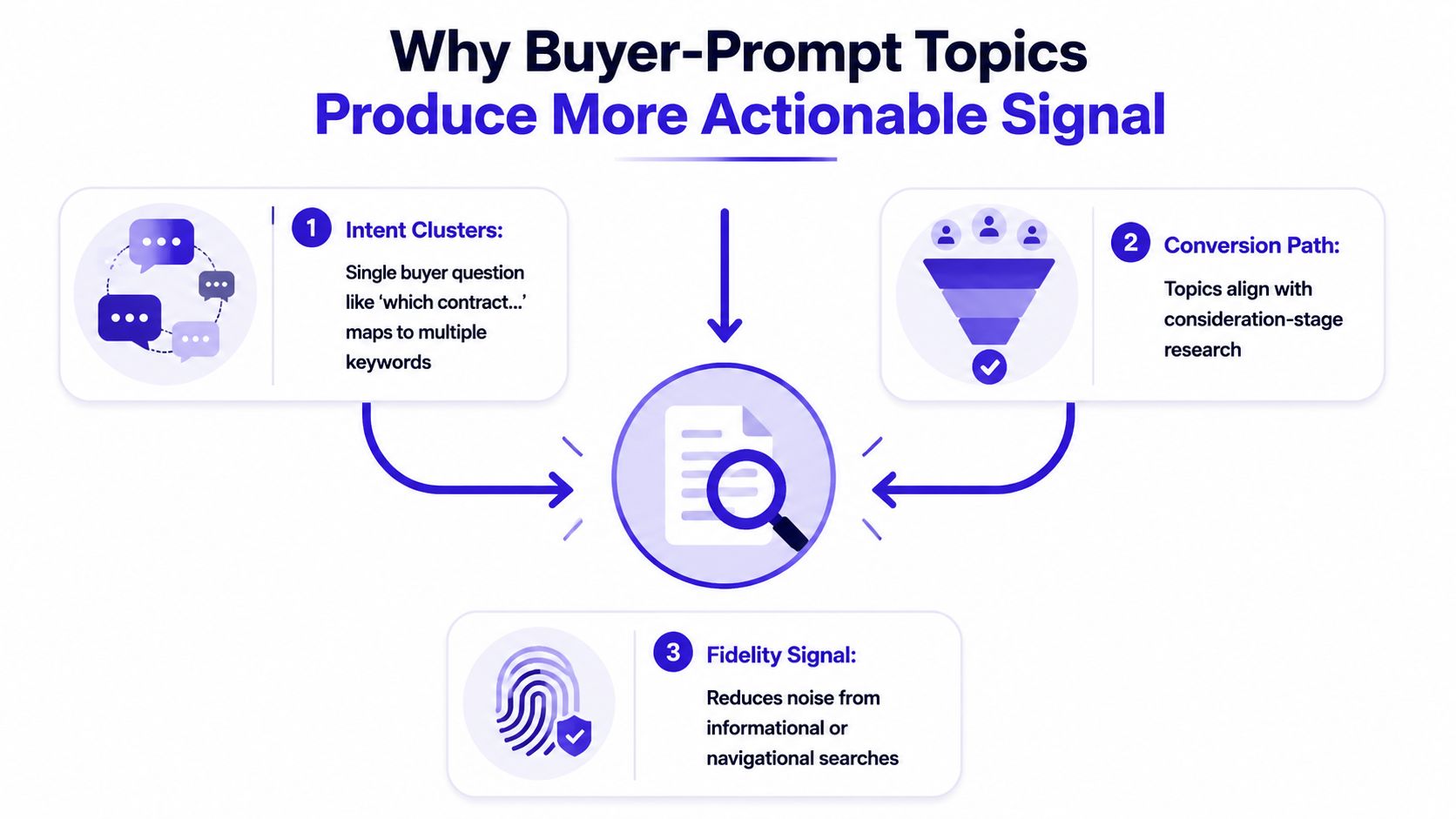
Buyer-prompt topics produce stronger strategic signal because they preserve the context that makes a search commercially meaningful. A complete question can reveal the buyer's intent, the entities under consideration, and the evidence the engine uses to justify its recommendation.
Library search methodology offers a useful analogy. Keyword searching uses natural-language terms selected by the researcher, while subject or topic searching groups records under controlled vocabulary. The Iowa library search guidance describes that distinction clearly. The same principle applies here: semantic grouping prevents measurement from fragmenting across near-duplicate phrasings.
Intent clusters compress scattered demand
Take the question, “Which contract lifecycle management platform handles auto-renewal clauses well?” A keyword list might split that need across phrases about contract management software, auto-renewal clauses, renewal alerts, contract automation, and legal workflow tools.
One buyer prompt keeps those signals together. The answer reveals which products the engine associates with the requirement, which review sources it trusts, and which proof points appear in the recommendation. That gives the content team a clearer assignment than “improve rankings for five related keywords.”
Question-form searches aren't an arbitrary trend. Academic work treats question intent as a distinct query property, and WWW proceedings classify question answering within informational search, including directed and undirected forms (the ACM and WWW material on question intent). Pricing, alternatives, and best-of prompts fit naturally into that taxonomy because they represent recognizable buyer questions.
Entity citations expose the recommendation graph
AI engines don't return ten URLs. They identify brands, products, publishers, and relationships, then synthesize those entities into an answer. Topic-level tracking shows whether your company is named, which competitors appear beside it, and which third-party sources support the response.
That evidence is more actionable than a rank change by itself. If competitors are cited for a prompt about implementation risk, you can inspect the sources and create content that addresses the missing proof. If your brand is cited but not named, the issue may be entity association rather than page relevance.
Decision proximity improves the signal
A buyer asking for alternatives or a category comparison is already framing a decision. A traditional ranking may attract research traffic, but it doesn't show whether an answer engine put your product into the recommendation set.
The keyword versus topic comparison from Similarweb reinforces the methodological difference. Topics group related questions around broader context, while keywords tend to isolate one phrase. That makes prompt probes better suited to measuring conversational reformulations, multi-source synthesis, and zero-click answers.
Measure the answer the buyer receives, not the string the buyer may have typed.
Which Approach Should You Choose?
Neither approach deserves a universal victory claim. Keyword tracking is still the foundation for teams that depend on blue-link traffic. Topic-level citation tracking is the right layer when the buying journey occurs inside AI assistants or when recommendations matter more than clicks.
The trade-off becomes clearer when you evaluate the methods against team capacity and reporting needs.
| Criterion | Keyword Tracking | Topic-Level Citation Tracking |
|---|---|---|
| Buyer-intent fidelity | Strong for narrow transactional strings | Strong for complete questions and decision contexts |
| Engine coverage | Mature around traditional search engines | Built for multiple answer engines and rendered responses |
| Competitive benchmarking | Compares rankings and SERP ownership | Compares named brands, cited domains, and answer presence |
| Cost per data point | Usually lower and easier to automate | Higher because each probe requires prompt execution and parsing |
| Governance | Keyword lists need maintenance | Prompt taxonomy needs ownership and version control |
| Change risk | Rankings shift with SERP and algorithm changes | Prompt drift and answer-format changes affect continuity |
| Stakeholder reporting | Familiar to executives and SEO teams | More representative of AI recommendations, but requires education |
| Best cadence | Weekly checks and monthly trend reviews | Frequent pulse checks for priority prompts, with governed baselines |
Choose based on team size
A team with fewer than five marketers should avoid building two sprawling systems. Keep a focused keyword set for pages tied to organic acquisition, then add a small, high-intent prompt library for the questions sales hears repeatedly.
Larger squads can assign ownership by layer. SEO can manage rank data, product marketing can govern buyer-prompt taxonomy, and demand generation can connect citation presence to pipeline signals.
Choose based on engine scope
If your buyers still rely mainly on Google's conventional results, keyword tracking remains central. If prospects use ChatGPT, Perplexity, Gemini, Claude, or Copilot to compare vendors, single-engine rank reporting leaves a serious gap.
Choose based on reporting cadence
Weekly meetings benefit from a compact operational view. Show which priority prompts changed, which competitor entered the answer, and which cited source deserves investigation. Monthly reviews can handle taxonomy changes, content assignments, and trend interpretation. The decision rule is direct: if buyers research inside AI assistants and conversions correlate with cited answers, run topic-level tracking. If you're still optimizing landing pages for blue-link traffic, keep keyword tracking as the foundation.
Migrating From Keyword Rank Checks to Topic-Level Citation Tracking
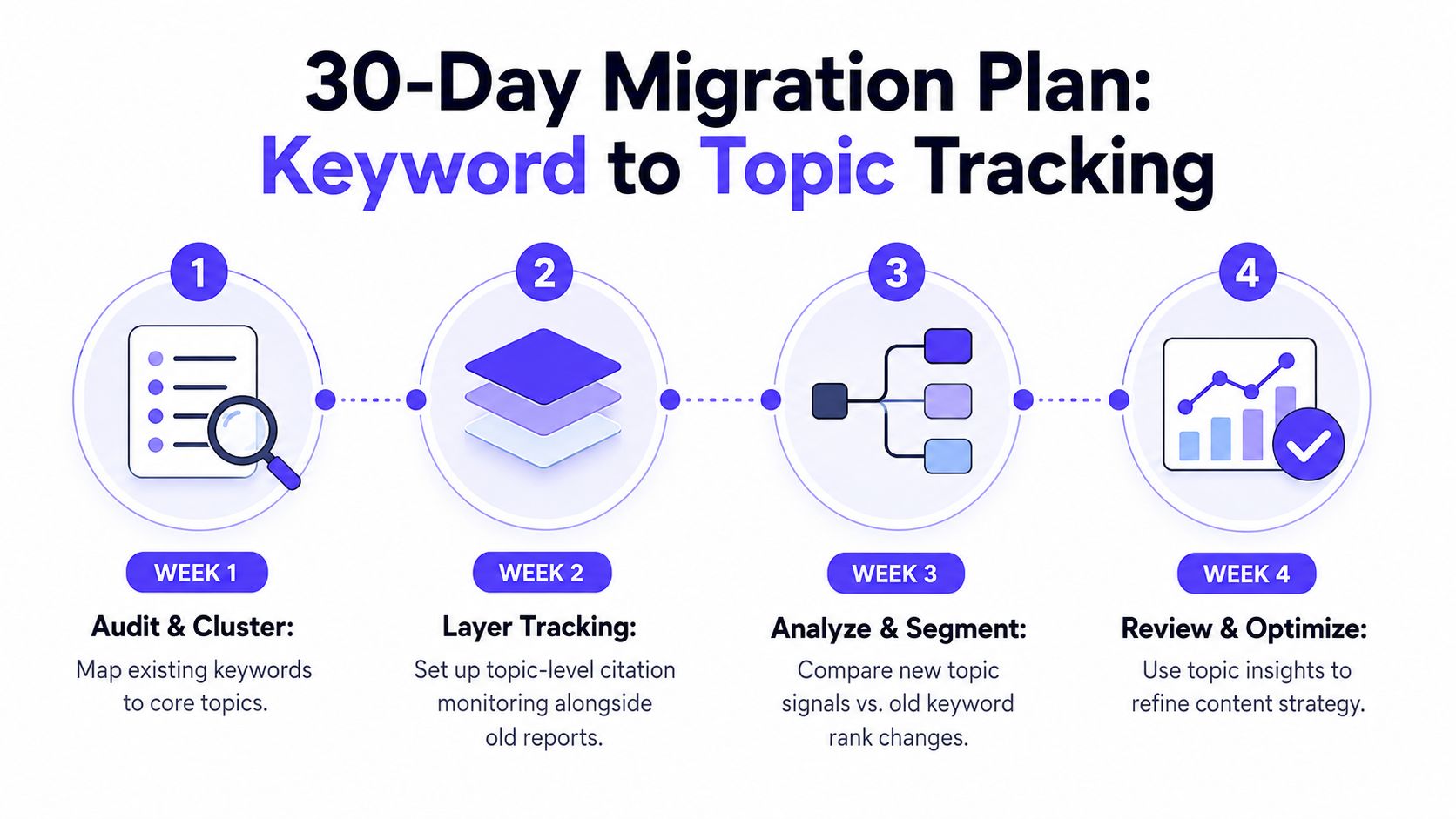
Don't replace keyword reporting in one dramatic move. Layer topic-level tracking on top, preserve the historical rank series, and use the first month to prove whether buyer prompts produce better decisions.
Week one builds the taxonomy
Audit the existing keyword list and group terms by the buyer question underneath them. A cluster might represent pricing, alternatives to a named competitor, or the best product for a specific use case. Tag each cluster with the persona, buying stage, and decision event it serves.
Remove duplicates aggressively. The point isn't to preserve every phrase. It's to create stable topic buckets that a team can use for content planning, prompt design, and competitor comparison.
Week two turns clusters into probes
Design 40 to 80 buyer-prompt probes grounded in real customer language. Pull questions from sales calls, support tickets, win-loss interviews, product comparisons, and objections. Include prompts for pricing, alternatives, implementation, integrations, compliance, and best-of-category decisions.
Stress-test the prompts across ChatGPT, Perplexity, Google AI Overviews, and Claude. Keep prompts that return a meaningful answer with identifiable entities and citations. Rewrite vague prompts that produce generic responses or no reliable source context.
Week three instruments capture
Log the interface-rendered response for each run. Store:
- Prompt identity: Topic bucket, persona, stage, and version.
- Engine context: Platform, run date, and response format.
- Citation fields: Source URL, domain, citation order, and whether the brand is named.
- Competitive fields: Named competitors, cited competitors, and missing brands.
- Business join: Related keyword group, page, opportunity, and pipeline signal.
Wire the output into a shared dashboard beside keyword position and organic traffic. The point is not to create another isolated report. It's to let the team compare a rank change with the buyer-answer outcome it may or may not explain.
Week four establishes a baseline
Run a baseline sprint, then set targets for Share of Voice and Average Citation Rank. Document who owns prompt changes, how often probes run, and what qualifies as a meaningful taxonomy revision.
Your readiness checklist should answer three questions:
- Ownership: Who approves new topics, retires stale prompts, and resolves competing definitions?
- Cadence: Which prompts run frequently, and which receive deeper monthly analysis?
- Training: Can sales, content, SEO, and leadership distinguish a citation from a mention?
Keep both datasets visible until the team understands the relationship. Topic-level tracking is an additional measurement layer, not an excuse to discard the organic system that still supports discoverability.
Recommended Workflows, Tool Mapping, and When to Run Both
The right workflow depends on who operates it. A solo marketer needs a narrow set of prompts and a repeatable review habit. A lean in-house team needs ownership boundaries. An agency needs versioned libraries, client-ready comparisons, and a consistent method across brands.
Three practical runbooks
Solo marketer: Maintain a focused library of priority buyer prompts. Run a weekly pulse, review citation changes against new content, and refresh prompts when the product, competitors, or customer language changes. Keep keyword checks for pages with clear transactional intent.
Lean in-house team: Let product marketing own the taxonomy and let SEO own the keyword baseline. Make the weekly meeting about prompt-level changes, source gaps, and the next content or entity fix. Review the full topic set monthly, not every time a response fluctuates.
Agency: Version each client's prompt library, record engine coverage, and deliver a change log with the weekly Topic Score delta and Share of Voice movement. Separate client-specific taxonomy decisions from the shared capture methodology so reporting stays consistent.
Tool mapping
| Tool | Engines Covered | Scoring Method | Best Fit Team | Key Limitation |
|---|---|---|---|---|
| GetIntel | ChatGPT, Claude, Perplexity, Gemini, and Google AI Overviews | Topic Score, Share of Voice, Average Citation Rank, cited URL and competitor comparisons | Lean B2B teams, agencies, and teams using coding agents | Requires governed buyer-prompt libraries and interpretation of changing answers |
| Otterly | Multi-engine AI search coverage | Citation and mention monitoring with source analysis | Teams starting dedicated AI monitoring | Coverage and response formats can vary by engine |
| Profound | Multi-engine enterprise AI search coverage | Enterprise visibility and citation analysis | Larger organizations with complex reporting needs | Enterprise-oriented workflows may be heavier for small teams |
| Traditional rank trackers | Conventional search results | Position, visibility, SERP features, and traffic-oriented reporting | SEO teams focused on blue-link acquisition | They don't show whether an AI engine names or cites the brand in an answer |
GetIntel's workflow is built around live-interface answer capture, buyer-prompt probes, cited URL logging, per-engine visibility, competitor benchmarks, and daily Topic Score, Share of Voice, and Average Citation Rank reporting. It also connects citation-source intelligence with a ranked task list across on-page, off-page, UGC, and technical fixes, which makes it relevant when the team needs to move from measurement to implementation.
A practical handoff package should contain the prompt library version, weekly Topic Score delta, Share of Voice change log, cited-source gap list, and assigned content or entity actions. Run both systems when a keyword still represents a transactional path, and route broader research, comparisons, alternatives, and recommendation questions through topic probes.
For a broader evaluation of available platforms, AI citation tracking tools provides a useful starting point. Don't buy a dashboard before defining the questions it must answer. For how citation tracking differs from a classic rank tracker more generally, see AI visibility vs rank tracker; for the position half of that picture specifically, see what Average Citation Rank means.
GetIntel helps teams measure how ChatGPT, Claude, Perplexity, Gemini, and Google AI Overviews represent their brand through buyer-prompt probes, cited URLs, Topic Score, Share of Voice, and Average Citation Rank. Visit GetIntel to compare topic-level citation visibility with your existing keyword data and turn citation gaps into a ranked task list your team can work through. Topic-level scoring of the kind described here is Topics.