A rank tracker exists because position is a stable property of a search result. In AI answers it is not. Across our own tracking between 10 July and 10 August 2026, when a domain survived from one run of a prompt into the next, it held the same position only 39.5% of the time and moved 1.73 places on average. The first-cited source changed in 67.7% of consecutive run pairs. Anything reporting an average position for an AI answer is averaging a quantity that does not persist.
That single fact drives most of the real differences between the two categories of tool. The rest follows from it.
These are our figures across 60 prompts and four engines - ChatGPT, Perplexity, Gemini and Google AI Overviews - and GetIntel sells one of the tools in question, so the dataset is published rather than summarised.
Does position mean anything in an AI answer?
Position barely means anything in an AI answer. We measured 14,008 cases where a domain appeared in two consecutive runs of the same prompt. In 5,532 of them it held the same slot, which is 39.5%.
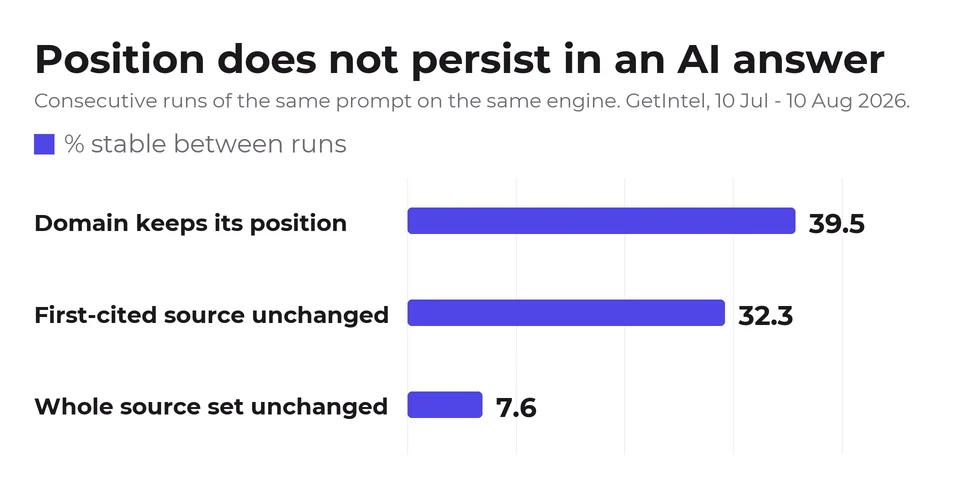
The first-cited source, which is the closest thing an AI answer has to a number-one ranking, was the same domain in only 1,185 of 3,672 consecutive pairs. That is 32.3%, so roughly two times in three the top slot changes hands overnight with nothing having happened.
| what stayed the same between consecutive runs | rate |
|---|---|
| A surviving domain kept its position | 39.5% |
| The first-cited source was unchanged | 32.3% |
| The entire source set was unchanged | 7.6% |
| Mean sources cited per answer | 8.82 |
Compare that with a search result, where in the ordinary case, outside an algorithm update, position three on Tuesday is very probably position three on Wednesday. That is the assumption the whole discipline of daily rank tracking rests on.
So what should a tool measure instead?
An AI visibility tool should measure presence, sources and competitor set instead of position, none of which are ordinal.
A useful AI visibility tool answers three questions: were you named at all, which sources did the engine draw on, and who else was named alongside you. It answers them per engine, because the engines share almost no sources with each other - AI Overviews and ChatGPT agree on 4.8% of cited domains. All three are stable enough to be worth watching. Position is not.
An answer also carries far more sources than a search result carries useful slots. Ours averaged 8.82 cited domains, with one answer citing 30. Being in a list of nine is a categorically different thing from being third of ten blue links, and it is why "are we in it" beats "where are we in it" as a metric.
Why can't a rank tracker just add AI answers?
A rank tracker cannot simply add AI answers because its data model does not fit and its tracking cadence is built on an assumption that no longer holds.
A rank tracker stores a keyword, a position and a date. An AI answer has no single position, has a variable-length source list, and produces different text every time. You can force it into the old schema by recording a position anyway, but then you are storing a number whose meaning changed underneath you.
The cadence assumption breaks too. Daily rank checking works because a daily sample of a slow-moving quantity is informative. AI answers move much faster. Only 7.6% of consecutive runs return the same set of sources at all. That particular figure comes from a separate and larger measurement covering 130 prompts rather than the 60 used elsewhere here, and it is pooled across four engines that individually range from 76.4% on Perplexity to 99.7% on ChatGPT, so quote the per-engine number if you are describing a specific engine. A single daily observation of that is not a trend line, it is a sample of one from a distribution, which is why a single check on a prompt that varies is off by 33 percentage points on average.
That is the substantive difference. Not that AI is newer, but that the quantity being measured has different statistical behaviour and the old instrument assumes the old behaviour.
What about SEO suites that added an AI visibility feature?
SEO suites that added an AI visibility module are worth evaluating on the same criteria as anything else, and the question to ask is what they store per run.
Some general SEO platforms have added AI visibility modules, and several appear in our own citation data. Buyers ask about this directly: two of the questions in our own tracked set name specific products, frase.io in one and kime.ai in another, which is how we know the comparison is a live one rather than a hypothetical. We have not tested either and are not going to characterise their features from the outside. Whether one is right for you turns on whether it kept the rank-tracker data model or built a new one. The diagnostic is simple: ask whether it stores the full cited source list and the raw answer text for every run, or whether it stores a score and a position.
If it stores a score and a position, it has fitted the new problem into the old schema, and you will not be able to answer "why was this competitor named" from it, because the answer lives in text it did not keep.
That is a question you can ask on a demo call in one sentence, and it separates the two categories faster than any feature matrix.
What should I look for if I want fixes and not just monitoring?
If you want fixes rather than numbers, the honest test is whether the tool can tell you what to change, on which page, for which prompt.
Monitoring tells you that a competitor was named on a buying question. That is where most tools stop, and on its own it is not actionable, because on most prompts there is no consistent competitor to respond to anyway: only 27 of our 60 prompts had a domain appearing in at least half their answers.
The buyer question we track on this phrases it as comparing kime.ai against the alternatives, and it is the right instinct badly served by feature lists. So the useful capability is not "generates fixes" as a feature bullet. It is whether the tool can connect a specific prompt to the specific sources the engine used, so the work has a target. A tool that outputs generic recommendations without naming the prompt and the sources behind them is producing content, not diagnosis.
We do the drafting-and-shipping part of this, which is a reason to be sceptical of us specifically on this point rather than to take our word for it.
What does this measurement not settle?
This measurement does not settle whether citation order carries meaning elsewhere. Our citation order is the order in which sources appear in the returned citation list. That is not necessarily the engine's own ranking of importance, and no engine publishes one, so we are measuring the only order that is observable rather than the one that might matter internally.
It is also one brand's prompt set on four engines over one month. The direction is unlikely to reverse, since instability in position and source ordering has shown up in every cut we have taken on that dimension, but the exact percentages are ours rather than universal.
Worth separating two things that are easy to conflate, because our own data splits them. Order and source composition are highly unstable. Whether a brand is named at all is comparatively stable: on a different cut, 275 of the 320 prompt-and-engine series with at least ten runs each never changed presence state once. Position moves constantly while presence sits still, and a tool built on the first will mislead you about the second.
And none of this says a rank tracker is a bad product. It says a rank tracker is a good product for a different problem, and that the difference is measurable rather than a matter of positioning. The same distinction plays out at the query level too: see topic-level citation tracking vs keyword tracking for why a keyword rank doesn't predict citation either.