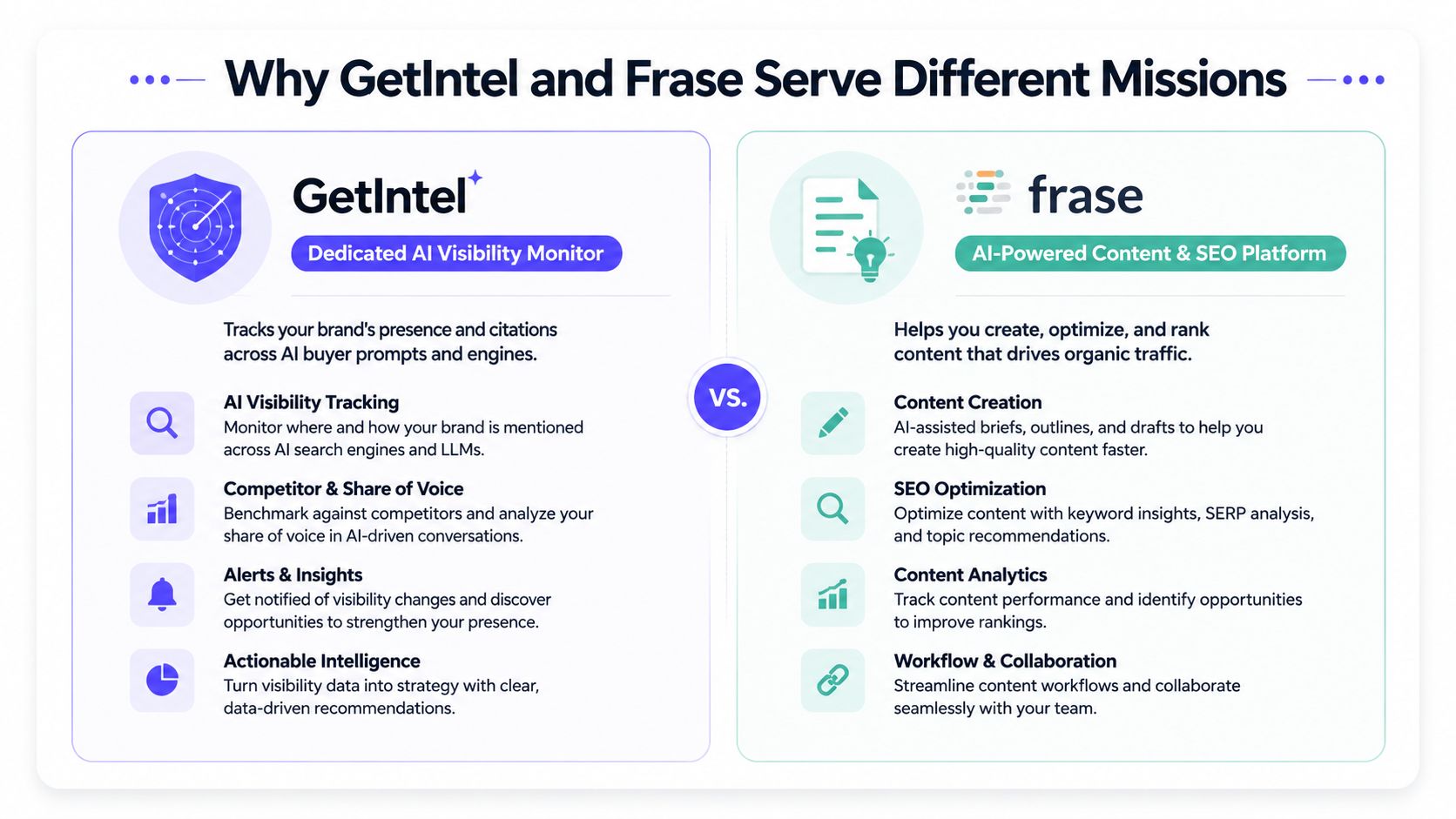
GetIntel and Frase are not really competing for the same buyer. GetIntel is built to measure how often AI engines cite a brand, then close the gap with fix-oriented deliverables. Frase is a content-optimization and AI-writing platform that also tracks visibility, but it's still centered on research, drafting, optimization, and publishing.
That distinction matters because the numbers only mean something if the underlying measurement model is comparable. It also matters because GetIntel is the publisher of this comparison, so the cleanest way to read it is as a buyer-side analysis from the monitor category, not a neutral marketplace directory. Frase can be a legitimate visibility tool, but it's not the same job-to-be-done as a dedicated AI-answer monitor.
| Dimension | GetIntel | Frase |
|---|---|---|
| Core mission | AI visibility monitoring and citation intelligence | Content creation and optimization with visibility layered in |
| What gets measured | Buyer prompts, citations, topic-level scoring, competitors | Prompt-based visibility, share of voice, position, sentiment |
| Output style | Gap-closing artifacts and benchmarked visibility signals | Drafts, briefs, content scoring, workflow support |
| Category center of gravity | Measurement first | Content workflow first |
Table of Contents
- Are GetIntel and Frase Even Competing for the Same Buyer?
- What Is Each Tool Actually Built to Do?
- Which AI Engines Does Each Tool Cover, and How Often?
- What Do the Visibility Scores Actually Mean?
- What Do You Get After a Gap Is Found?
- Which Fits an Agency Managing Several Brands?
- Which Tool Fits Which Buyer?
- What Does Each Tool Cost in Total?
Are GetIntel and Frase Even Competing for the Same Buyer?
The usual comparison treats AI visibility as a feature race, and that framing hides the buying decision. If the question is whether a model cites your brand, how often it does so, and what to change when it does not, the buyer is looking for a monitoring system. If the question is how to research, write, optimize, and publish content while visibility sits inside that workflow, the buyer is looking for a content platform.
The category split is real, not semantic
That category split is not just semantic, and it is the thing most comparisons skip straight past. GetIntel describes its product around AI search visibility, live answer capture, competitor benchmarking, and deliverables that point to specific fixes. Frase describes AI Visibility as one part of a broader workflow that still centers on writing and optimization, which its own comparison and help materials make clear. Buyers are not choosing between two versions of the same product, they are choosing between two different ways to turn AI answer data into work.
What that means for what you get back
The practical consequence shows up in the output. A monitoring system is supposed to produce evidence, gaps, and remediation paths that can be handed to SEO, content, or analytics teams. A content platform is supposed to produce drafts, briefs, scores, and publishing output, with visibility added to that workflow. Both can report on AI answers, but they do not treat the same data as the end product.
Practical rule: if the output has to become a report, a fix list, or a repo-ready artifact, you are in monitoring territory. If the output has to become a draft, brief, or content score, you are in content territory. For the measurement side of that split, see why AI visibility numbers are often misleading.
The better question is not which brand is “better.” It is which measurement model your team can defend when leadership asks why a visibility score moved. That is where the tools diverge, and it is why the comparison should focus on methodology, citation intelligence, and workflow output rather than on surface-level feature overlap.
What Is Each Tool Actually Built to Do?
GetIntel is built to measure where AI answers name your brand and to produce the fix; Frase is built to research and draft content. The two overlap on the word visibility and almost nowhere else.
GetIntel is built around visibility measurement
GetIntel's own materials describe a system that measures and improves a brand's visibility inside AI answer engines. The product tracks what major models show to buyers, scores how findable a brand is, and surfaces the artifacts needed to raise citation share. The unit of value is not a polished page, it is a measurable gap between where the brand appears now and where it should appear in buyer-facing answers.
That orientation shows up in the output model too. The platform does not stop at observation, it produces drafts meant to close visibility gaps, then routes them through reviewable delivery paths. For a growth lead, that matters more than a feature checklist because it connects the diagnosis to an operational next step. For an SEO manager, it also means the tool behaves less like a reporting dashboard and more like a remediation system.
Frase is built around content work, with visibility attached
Frase's own documentation positions AI Visibility as a feature inside a larger research, write, optimize, publish workflow. Its help center defines visibility as the percentage of prompts where a brand appears, and its product language includes Share of Voice, Average Position, Avg Mentions, and Sentiment across AI-generated responses. That is real AI visibility tracking, but it sits alongside content scoring, drafting, editing, and publishing rather than replacing them.
That difference affects how a team uses the product day to day. A content lead can open Frase and move from brief to draft without leaving the platform. A growth analyst can use GetIntel to investigate why a competitor appears in prompts where the brand does not, then use the outputs to drive changes elsewhere. The first is content-first, the second is measurement-first.
The split also shows up in how each product treats the underlying capture method. Systems built on AI answers are only as defensible as the prompt set, refresh cadence, and source capture rules behind them.
Which AI Engines Does Each Tool Cover, and How Often?
Both tools cover the same major AI surfaces, so the engine list is not the difference. GetIntel tracks ChatGPT, Perplexity, Gemini and Google AI Overviews on every paid plan, with Claude on the $149 Growth plan only. What separates them is how each captures answers and how often it reruns the same prompts.
Same engines on paper, different measurement trust models
Both tools cover the major AI surfaces buyers care about. GetIntel tracks ChatGPT, Perplexity, Gemini and Google AI Overviews on every paid plan, with Claude on the $149 Growth plan only. That overlap is why the comparison keeps showing up in buying discussions. The meaningful difference is not the engine list alone. It is how each system captures answers and how often it reruns the same prompts.
GetIntel's visibility model uses live-answer capture with daily reruns across four engines (ChatGPT, Perplexity, Gemini and Google AI Overviews). Its public benchmark runs a fixed set of buyer-intent questions on a rolling 7-day window, which means the board moves and any figure taken from it needs a date.
What did the benchmark show on 7 August 2026?
Across 239 buyer-intent questions on 7 August 2026, GetIntel was cited on 8.4% of them and Frase on 6.3%. The wider board that day: Otterly.ai 59.8%, Profound 38.1%, Peec AI 37.7%, Semrush 37.2%, Ahrefs 22.2%, SE Ranking 17.6%, HubSpot 13.0%, LLMrefs 8.8%, Scrunch AI 8.4%.
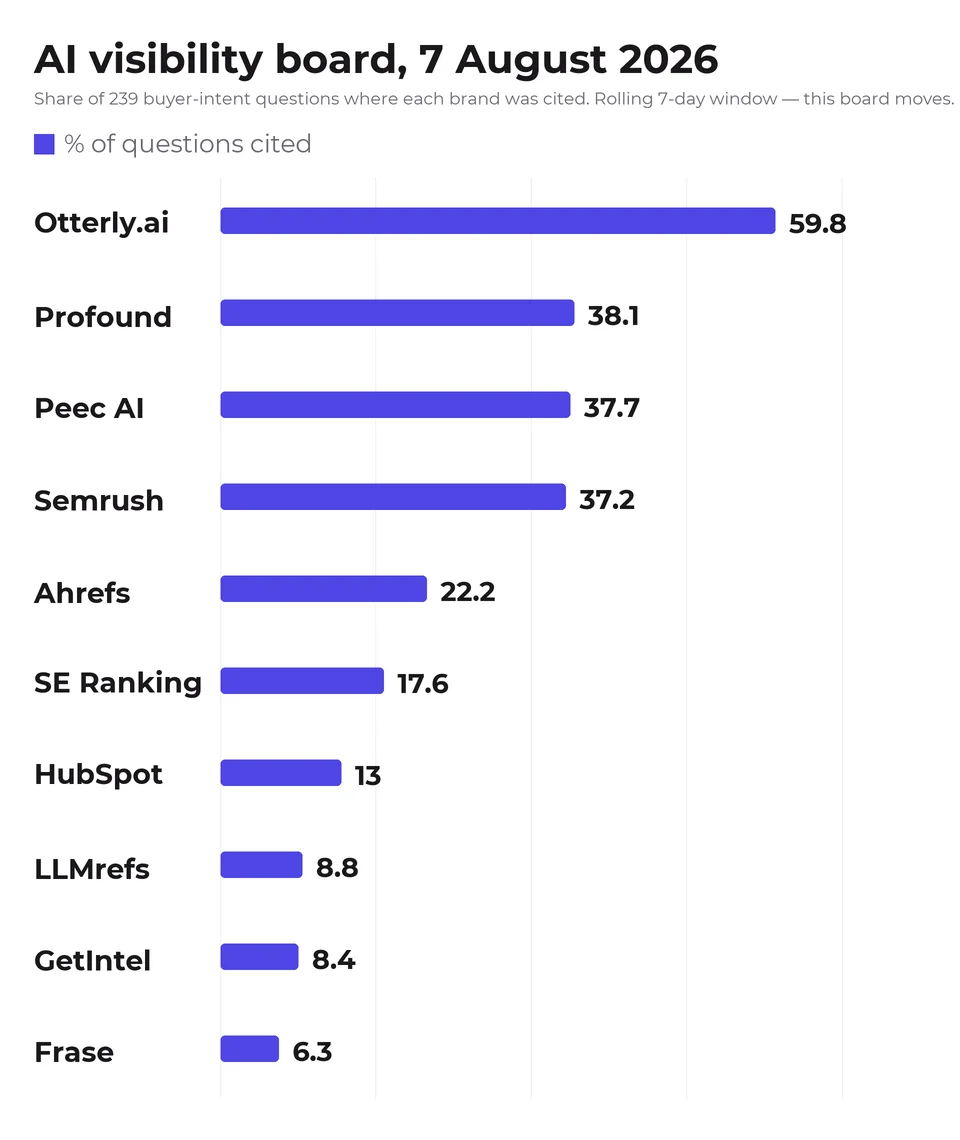
Update, 24 August 2026. Seventeen days later, GetIntel is cited on 7.5% of the same 239-probe window. The board has reshuffled: Otterly.ai 41.4%, Profound 33.5%, Peec AI 33.5%, Semrush 32.2%, Ahrefs 21.8%, SE Ranking 11.3%, Scrunch AI 7.5% (tied with us). Frase no longer appears in the current top 10, which is sorted by rate, so its citation rate is now below the cutoff at roughly 4.6%, down from 6.3%. The comparison direction has not flipped: neither tool leads by a wide margin, and both remain well behind Otterly.ai. The live number for GetIntel is always at our visibility tracker.
That ordering is not stable, and it is worth saying why. An earlier version of this page cited a snapshot in which Frase appeared roughly eleven times as often as GetIntel. That was true of the window it came from and is not true of this one. A single undated number from a rolling window is the most common way comparison content misleads, and we published one ourselves. The snapshot lives at GetIntel's visibility benchmark, where it is dated.
Where the Frase figures here come from
A note on the Frase figures below. They are read from Frase's own public product and help pages as of 7 August 2026, not from an account we hold, and no side-by-side test of the two products was run. Frase's materials change, so check its own pages before relying on any of it, including this page.
Frase's documentation defines visibility differently. Its system starts with real prompts, then reports the percentage of prompts where the brand appears, alongside share of voice, platform breakdown, sentiment, and trend velocity. The coverage is still engine-based, but the number sits inside a broader content environment, not a dedicated citation intelligence layer. That makes the metric useful for content teams watching brand presence inside their workflow, while GetIntel is organized around measurement that is easier to compare across engines and prompt sets.
Why live capture changes the trust level
Live capture changes how much you should trust a number. Teams are right to be cautious about lining up two vendors' dashboards as if they were measuring the same thing. AI surfaces do not behave like classic rank trackers. A score can move because the prompt set changed, the engine mix shifted, or the interface itself updated. Methodology is the part that determines whether the comparison is stable.
A daily score only matters if the same prompts and same engines are being rerun consistently. Otherwise you are watching the measurement move, not the market.
It helps explain why live capture is closer to what buyers see inside the engine.
| Dimension | GetIntel | Frase |
|---|---|---|
| Engine coverage | ChatGPT, Perplexity, Gemini, Google AI Overviews on all paid plans; Claude on Growth | ChatGPT, Claude, Perplexity, Gemini, Google AI Overviews |
| Refresh cadence | Daily reruns | Daily prompt tracking |
| Capture method | Live-interface capture | Prompt-based visibility tracking |
| Primary output | Topic scoring and citation benchmarking | Visibility score, share of voice, sentiment |
| Trust model | Fixed prompts, comparable visibility measurement | Content workflow visibility inside a broader platform |
What Do the Visibility Scores Actually Mean?
A visibility score means whatever its denominator says it means, and the two tools do not share one. GetIntel scores topics against Share of Voice and Average Citation Rank, refreshed daily and traced back to the specific sources an answer pulled from.
How GetIntel scores visibility
GetIntel's model centers on topic-level scoring alongside Share of Voice and Average Citation Rank, refreshed daily and benchmarked against the competitors AI cites instead of you. That combination matters because it doesn't stop at a number: the same platform surfaces which domains and community sources, Reddit threads, G2 reviews, competitor blogs, AI actually pulled the citation from, so a movement in the score traces back to a specific source rather than an abstract label. The result is not just “up or down,” it's a diagnosis.
That's the kind of score a leadership team can review without a translator. If visibility rises, the team can ask which source or shipped fix likely drove the change. If visibility falls, the same source data helps isolate whether a competitor gained a citation source you're absent from, or a prompt simply drifted.
How Frase scores visibility
Frase tracks share of voice, average position, sentiment, and trend velocity across AI-generated responses. That makes it easier for content teams to watch brand presence over time and react to what changed in the prompt space. The system is useful when the question is whether your content is showing up in the conversation and how it compares to named competitors.
But that isn't the same as a diagnostic score. A trend dashboard can tell a writer that presence dropped. It doesn't have to explain which element in the visibility system broke. That's why the same data can be operationally useful in one product and strategically useful in another.
A leadership-ready visibility number should tell you what changed and why. A content dashboard should tell your writer what to fix before the next publish cycle.
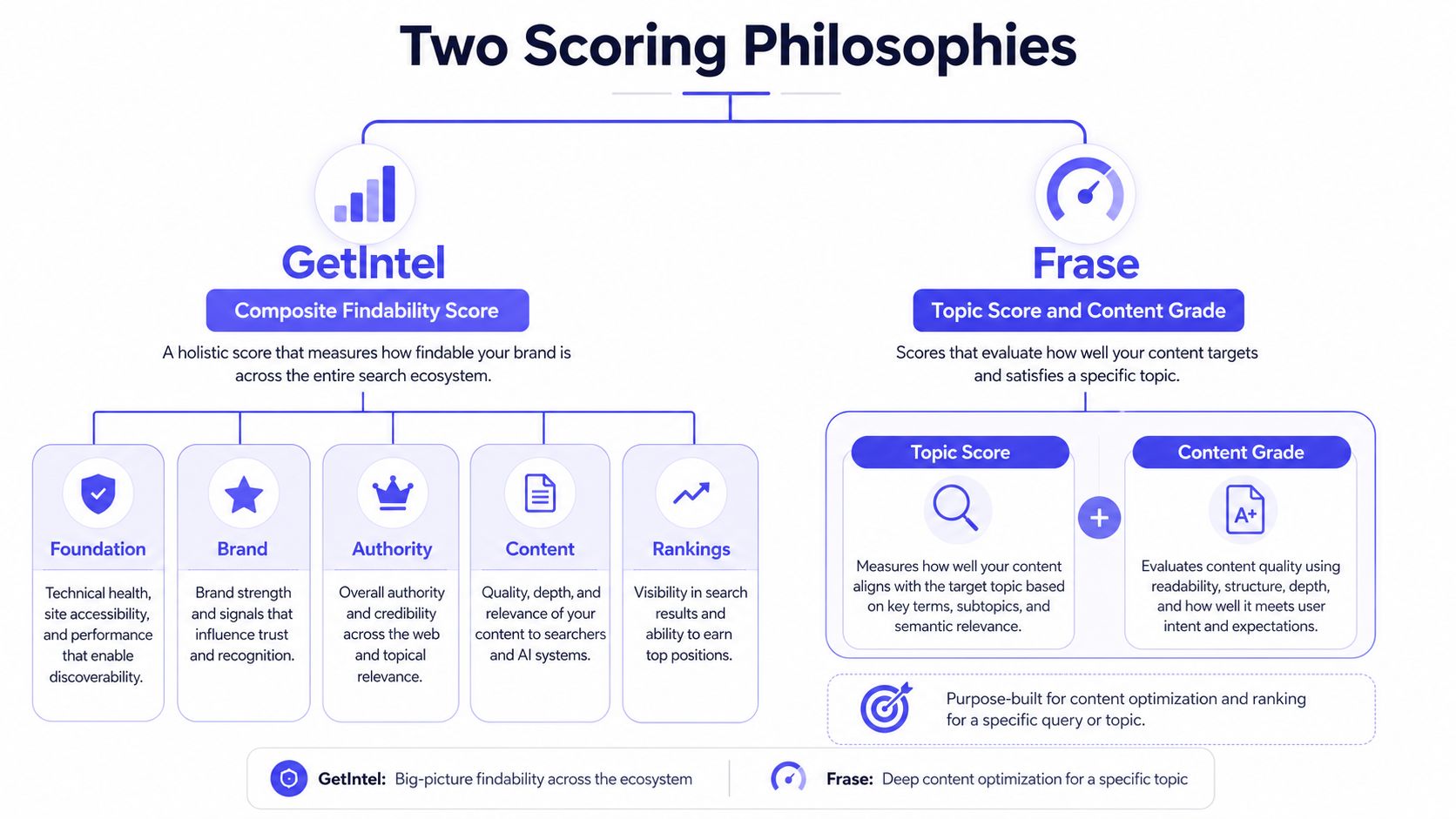
The important buyer-side conclusion is simple. Directly comparing the two scores is not meaningful unless the prompt set, engine mix, and capture cadence are identical. They aren't presented as identical, so the safer reading is that the scores answer different operational questions. GetIntel asks, “How findable are we, and what changed?” Frase asks, “How visible are we inside the content workflow?”
What Do You Get After a Gap Is Found?
GetIntel hands back a shippable artifact rather than a report: llms.txt drafts, Schema.org markup, Wikidata entries, counter-articles and outreach emails, delivered through a coding agent or straight to WordPress, Ghost or Webflow.
What ships after the gap is found
GetIntel's distinguishing output isn't the score itself, it's the set of fixes that follow. The platform generates llms.txt drafts, Schema.org markup, Wikidata entries, counter-articles, and outreach emails, then delivers them through coding agents such as Claude Code or Cursor via MCP. It can also route approved changes to WordPress, Ghost, or Webflow, which turns a visibility gap into an artifact that can be reviewed and shipped.
That matters because citation intelligence only becomes useful if it leads to action. If a brand is absent from a prompt where it should win, the team doesn't just need to know the absence exists. It needs the entity cleanup, content revision, or supporting evidence that might change the citation pattern next time the engine reruns.
Frase's outputs are more content-first. Its AI Visibility layer sits beside optimized briefs, draft articles, and content scoring, so the artifact you get is geared toward publishing workflow rather than entity repair. That makes sense for a platform built around writing. It's less useful if the problem is that an AI engine is recommending a competitor because your source entity or supporting citations are weak.
Why the output type changes the buyer decision
The category split becomes practical instead of theoretical. A content team often wants a draft it can edit immediately. A growth analyst wants a fix list that explains why the prompt result is off and what can be changed outside the draft itself. The former can live inside Frase's workflow. The latter is closer to GetIntel's model.
If you're comparing visibility tools, the right question is whether the output fixes a page or fixes the system around the page. Most buyers need both eventually, but they don't need both from the same vendor.
Which Fits an Agency Managing Several Brands?
For an agency the operational fit differs more than the feature lists do. GetIntel's stack is built around monitoring and attribution: Search Console, Ahrefs, Slack, Zapier, webhooks, API and MCP access, CSV export, trend histories and scheduled client reports.
The operational fit is different
GetIntel's reporting stack is built for monitoring and attribution. It includes Google Search Console, Ahrefs, Slack, Zapier, Webhooks, API/MCP access, CSV export, trend histories, multi-brand management, unlimited seats on eligible plans, and scheduled white-label client reports. That mix makes sense for agency work, where one team may need to track several brands, compare changes across prompts, and hand clients something they can review without opening the platform.
Frase fits a different operational rhythm. Its editor, content scoring, and CMS touchpoints matter most when the same person who sees the visibility signal also writes the page. The workflow stays close to production, which is useful for publishing teams, but the center of gravity is still content creation rather than measurement and attribution.
The right tool depends on whether visibility is the deliverable or the input to a deliverable.
That same test applies here. If a client needs audit-ready attribution and white-label reporting, a monitoring tool fits the job. If the client needs in-line writing support, a content platform covers that need better.
Worth knowing before you weigh any roundup that names either tool: 16 of 17 vendor-written "best tools" lists rank their own product first. The reporting question also explains why GetIntel's positioning differs from other AI visibility tools. The GetIntel vs Ahrefs AI visibility comparison shows the same pattern. A suite can include visibility, but that does not mean visibility is the main workflow.
Which Tool Fits Which Buyer?
GetIntel fits a lean growth lead who needs daily visibility reporting and a path to ship the fix. Frase fits a team whose bottleneck is producing content at volume, not knowing where they stand.
Lean growth leads need shipped fixes, not another content workspace
A lean B2B SaaS growth lead usually needs three things, daily visibility reporting, a clear explanation of why a competitor is cited, and a path that lets someone ship the fix. That profile fits GetIntel. The monitor-first workflow centers on prompt tracking, citation comparison, and remediation artifacts, so the visibility issue can move into an owned task without translating it into a separate writing process.
A founder using Claude Code or Cursor often has the same requirement. If answer engines miss the company on buyer questions, the founder usually needs reviewable diffs and a practical handoff, not another drafting environment. GetIntel fits that job better because the output can move directly into a repo or CMS workflow.
Content teams should choose the platform that keeps writing and visibility together
A content team that wants visibility tracking tied to briefs and drafts is a better fit for Frase. The visibility layer still matters, but it sits inside a broader writing system, which matches teams whose bottleneck is production. Frase helps them see whether pages appear in answers while the same team keeps creating and optimizing the source content.
Agencies need reporting that survives client scrutiny
An agency running multiple client brands should look at reporting and seat structure first. GetIntel's white-label reporting, multi-brand handling, and eligible unlimited-seat model fit that use case more naturally than a content-centered platform. The same logic applies when the agency needs to explain score movement to clients who care less about drafts and more about whether visibility changed.
The comparability question is the harder one. Direct score comparisons only make sense if the same prompts, engines, and capture rules are used, which is why the earlier GetIntel vs Ahrefs AI visibility comparison matters here. These tools are not interchangeable instruments, so their numbers answer different operational questions.

What Does Each Tool Cost in Total?
GetIntel costs $29, $79 or $149 a month, read from our own pricing page on 19 September 2026. We are not quoting a Frase figure against it, because Frase prices a content workflow rather than a visibility one and the tiers are not comparable; check Frase's own page for a current number. Pricing only means something if it reflects the job being bought. GetIntel's tiers are organised around prompt volume, one brand on every self-serve plan, which fits a monitoring product where cost rises with how many buyer questions a team needs tracked. Frase includes AI Visibility in every plan from the entry tier, but the wider product is still a content platform, so its pricing logic follows the content workflow first and the visibility module second.
What you are actually paying for
That difference matters more than the sticker price.
What each buyer is really paying for
A team buying monitoring is paying for prompt coverage, engine coverage, and reporting depth. A team buying Frase is paying for writing, optimization, and publishing support, with visibility included as part of the package rather than as the primary line item.
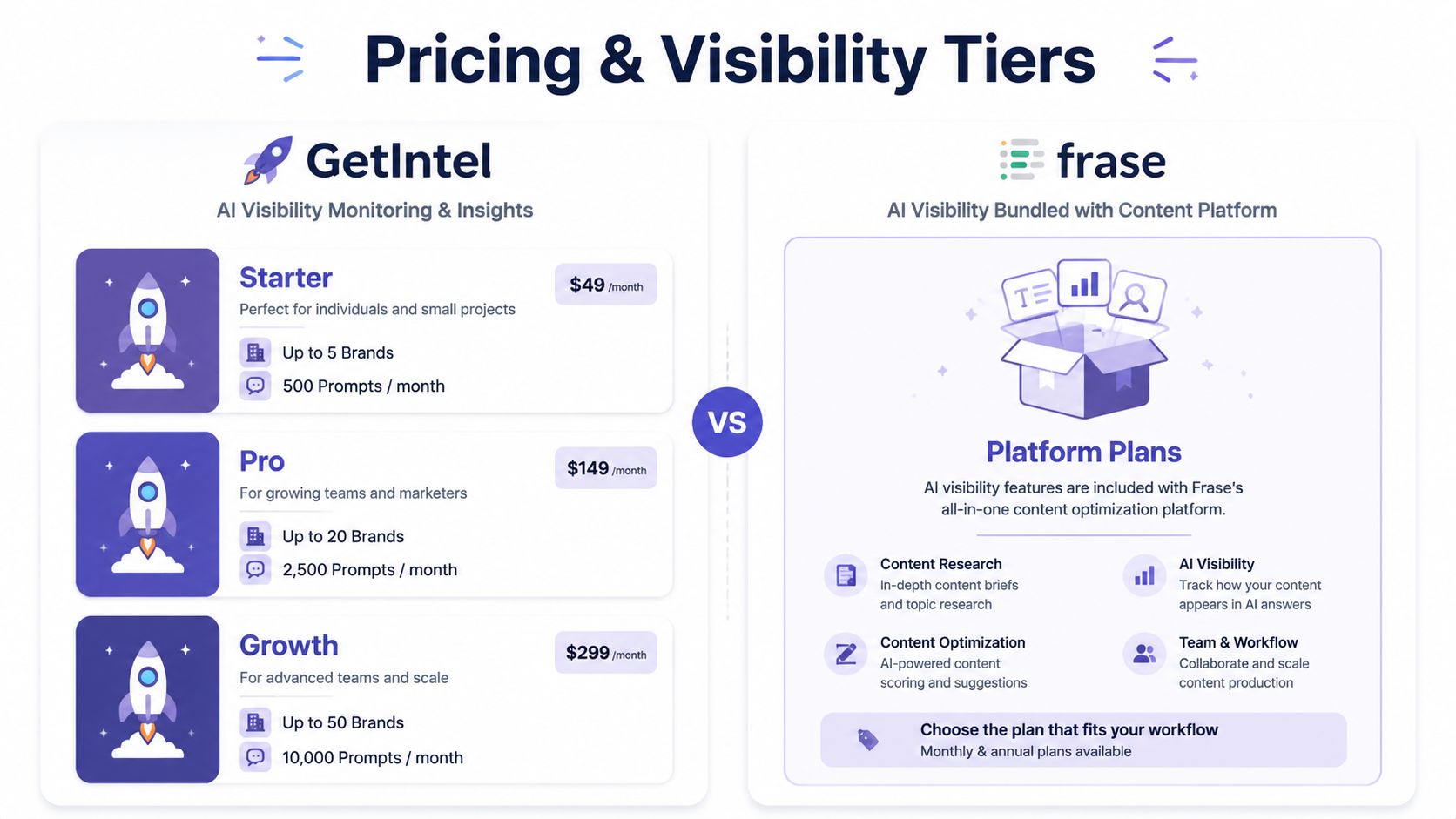
The subscription line item is only part of the spend. The usual build-versus-buy TCO model counts the labour needed to interpret a finding, decide what to change and ship it. In this category, that labor often becomes the larger cost center because the workflow behind the number is what determines whether visibility improves.
If the deliverable is a visibility scoreboard and shipped fixes, GetIntel matches the category. If the deliverable is content production with visibility as a supporting metric, Frase matches the category.
The buyer takeaway is direct. Use GetIntel when the main job is measuring AI visibility and closing citation gaps. Use Frase when the main job is creating and optimizing content with AI visibility layered in. If the two tools are forced onto the same scoreboard, the numbers may look similar while the work required to produce them is not.
If you want to evaluate AI visibility as a monitoring problem instead of a content feature, GetIntel gives you the prompt-based measurement, citation intelligence, and fix-oriented outputs discussed here. It is built for teams that need to see where AI engines cite them, why they are missing, and what to ship next.
For the same comparison against other tools in this category: GetIntel vs SE Ranking.