SE Ranking is named in 15.1% of the buyer-intent prompts in our own category. GetIntel is named in 8.0%. Both come from GetIntel's own tracker over the trailing seven days, 238 probes across ChatGPT, Perplexity, Gemini and Google AI Overviews, and the gap between an established SEO suite and a new tool is smaller than either of us would have guessed.
Disclosure: GetIntel publishes this and sells one of the two products in it. The visibility figures are from our own live tracker and move daily. SE Ranking's product details come from its own published pages; we name them rather than link them, because we compete.
In this article
- How often does AI name each tool in this category?
- What does SE Ranking actually track?
- Daily versus monthly: does refresh rate matter?
- What does GetIntel do that SE Ranking does not?
- What does SE Ranking cost for the AI part?
- Should you pick GetIntel or SE Ranking?
How often does AI name each tool in this category?
SE Ranking, at 15.1% against GetIntel's 8.0%, roughly twice as often, on the same 238 probes over the same seven days.
The full board, because a single pair of numbers is easy to cherry-pick:
| tool | named in (238 probes, trailing 7 days) | share of voice |
|---|---|---|
| Otterly.ai | 55.5% | 9.2% |
| Profound | 37.8% | 6.3% |
| Peec AI | 35.3% | 5.9% |
| Semrush | 34.0% | 5.7% |
| Ahrefs | 19.7% | 3.3% |
| SE Ranking | 15.1% | 2.5% |
| HubSpot | 11.3% | 1.9% |
| LLMrefs | 8.4% | 1.4% |
| GetIntel | 8.0% | 3.3% |
| AthenaHQ | 6.7% | 1.1% |
| Dageno AI | 6.7% | 1.1% |
Measured by GetIntel's own tracker, trailing seven days to 6 August 2026, across ChatGPT, Perplexity, Gemini and Google AI Overviews. This is a live window. It moves daily, and any figure here will have drifted by the time you read it.
Two things worth pulling out of that table, neither of which flatters us.
We are ninth. We build an AI visibility tool and eight competitors are named more often than we are, including two SEO suites that treat AI visibility as a side feature. That is the honest position.
But share of voice tells a different story. GetIntel's 3.3% share of voice equals Ahrefs' and beats SE Ranking's 2.5%, despite being named in half as many answers. When we do get named, we take up more of the answer. Visibility rate and share of voice are different questions, and a tool that reports only one of them is showing you half a picture.
What does SE Ranking actually track?
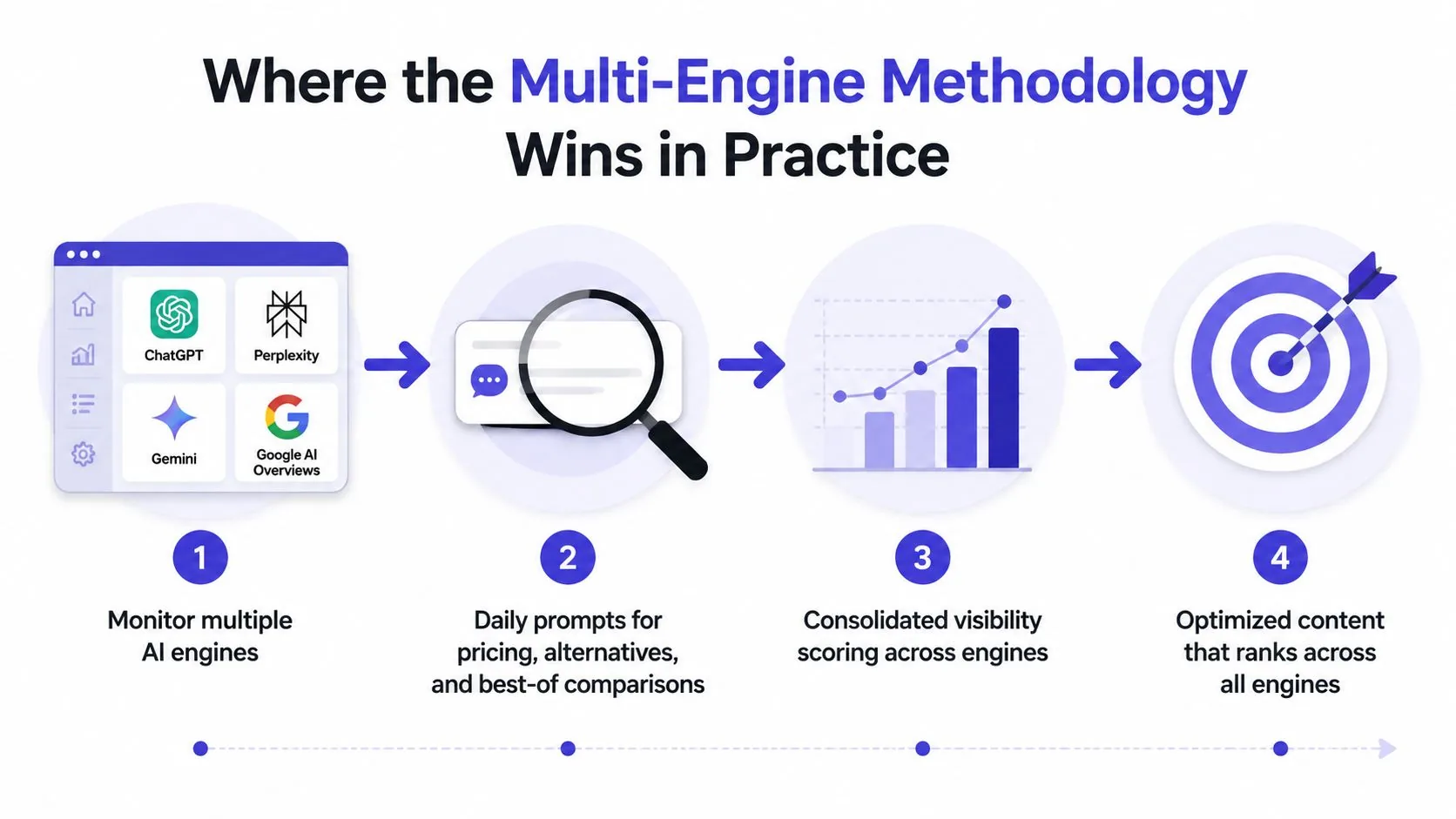
SE Ranking tracks five engines, with a prompt corpus far larger than any dedicated tool's. SE Ranking's own data page states it tracks ChatGPT, Google AI Overviews, Google AI Mode, Perplexity and Gemini, built on more than 25.5 million tracked prompts, reporting prompt-level mentions, cited sources and links.
That corpus is the real argument for it. No purpose-built AI visibility startup has assembled prompt data at that scale, and it is why SE Ranking's own research, including the 300,000-domain llms.txt study widely cited across this category, carries weight that vendor blog posts do not.
GetIntel tracks four engines on every paid plan (ChatGPT, Perplexity, Gemini, Google AI Overviews), adding Claude on the $149 Growth tier. Fewer engines, a curated prompt set rather than a corpus.
Daily versus monthly: does refresh rate matter?
Refresh rate matters for what you can act on, and less for what you can conclude. SE Ranking's published cadence is a monthly data refresh with historical trends. GetIntel probes daily.
The honest version: daily data lets you notice a change within a week rather than a quarter, which is useful if you are actively shipping fixes and want to know whether they landed. It is close to useless if you are not, because day-to-day movement is mostly noise, in our own repeat testing three days apart, every engine's citation behaviour moved less than 6%.
The numbers at the top of this article are a good illustration. They are a seven-day trailing window and they will have moved by the time you read this. That is a property of the measurement, not a defect in it, and it is why any AI visibility figure quoted without a date and a prompt count is not worth much.

What does GetIntel do that SE Ranking does not?
GetIntel drafts the fix. SE Ranking reports prompt-level mentions and the sources behind them, and it is worth being precise about what that does and does not mean for agent workflows. SE Ranking ships an SEO MCP server described on its own site as putting live SE Ranking data in any AI assistant, plus SEO, Marketing and Content Skills for Claude, all read 23 September 2026. So an agent can query SE Ranking. The difference is what comes back: SE Ranking serves its data to the assistant, where GetIntel produces the artifact. GetIntel generates the artifact intended to change them, Schema.org and Wikidata markup, counter-article briefs, outreach emails, and llms.txt entries, with the caveat that the same SE Ranking study found no measurable citation effect for llms.txt and we would not claim otherwise, and ships it through Claude Code or Cursor as a reviewable diff, or to WordPress, Ghost or Webflow. Nothing publishes without approval.
Two honest limits. A generated draft is a starting object, not a finished asset; a team with a good writer and spare time does better without it. And on the evidence of the board above, drafting fixes has not yet made us a leader in our own category. We are ninth. We cannot cleanly attribute that either way, and we are not going to pretend a single number proves anything about the product.
If you would rather hand the whole function to people than run either tool yourself, GetIntel sells that as done-for-you work rather than software, priced separately from the tiers above.
What does SE Ranking cost for the AI part?
SE Ranking sells AI prompt tracking two ways, read from seranking.com on 23 September 2026: as an AI Search add-on at $89 a month, or bundled into the platform, where Core is $129 a month (or $103 billed yearly) and includes 100 AI prompts tracked daily, and Growth is $279 (or $223 yearly). GetIntel is $29, $79 or $149.
The comparison only works if you are honest about what the money buys. SE Ranking's tiers carry rank tracking, keyword research, a site audit and a backlink checker alongside the AI toolkit. If you want those, the bundle is the cheaper route to both jobs. If you do not, the add-on is the number to compare, and it sits between GetIntel's $79 and $149 tiers.
Should you pick GetIntel or SE Ranking?
Most teams should buy SE Ranking and only some should buy GetIntel, because a broad SEO suite and a dedicated AI visibility tracker are two different jobs rather than two rivals for one job.
SE Ranking if you want AI visibility as one report inside a broader SEO practice. It is a full suite (rank tracking, audits, competitor research) with the AI layer on top and a prompt corpus nothing dedicated can match. This is not just tidiness: roughly 97% of AI Overview results cite a page already ranking in the top 20, per SeoClarity data collected by SEOProfy, so conventional ranking is still the entry ticket to being cited at all, which makes ordinary SEO fundamentals a prerequisite for AI visibility rather than a parallel track.
GetIntel if AI visibility is the job itself, you want daily rather than monthly movement, and the thing that stalls your work is turning a finding into published output.
Neither, yet if you have not checked which engines your buyers actually use. That is free: take your ten most important buyer questions and run them by hand across ChatGPT, Perplexity, Gemini and Google AI Overviews.
We have not run a controlled side-by-side test against SE Ranking. Everything above is either our own tracker data, which moves daily and is dated where it appears, or SE Ranking's own published product claims. You can start free, and our AI visibility tracking explains how the probes work.
This piece doesn't cover what SE Ranking's AI tracking actually costs; SE Ranking AI visibility pricing 2026 breaks that down, including a real gap in its own pricing page: it's unclear whether the paid AI Search add-on's prompt allowance stacks with or replaces the base plan's.
For the same comparison against other tools in this category: GetIntel vs Peec AI, GetIntel vs Frase.
If SE Ranking is not the right fit either, our list of SE Ranking alternatives compares six options on price, engines and fix workflow, with every price dated.