You're probably not starting from zero. Your team already uses Semrush for keyword research, technical audits, competitor analysis, and perhaps the $99 per month AI Visibility Toolkit for 25 prompts, read 27 August 2026. The problem appears when a growth lead asks a simple question: Are buyers seeing us in AI answers, and can we prove which sources are creating that visibility?
For the current full breakdown of what that $99/mo tier includes, what its add-ons cost, and what Semrush doesn't publish about it, see Semrush AI Visibility Toolkit pricing 2026.
That question changes the workflow. Traditional SEO tools organize work around keywords, rankings, backlinks, and pages. An AI visibility platform organizes it around buyer prompts, rendered answers, mentions, citations, and competitor gaps. The decision therefore isn't about replacing one dashboard with another. It's about deciding whether your measurement method still matches how prospects discover software.
Google remains a major discovery surface, accounting for about 90.04% of worldwide search engine usage across devices in January 2026, per StatCounter. At the same time, AI Overviews appeared in roughly 25% to 60% of Google queries, depending on the dataset and month measured in 2026, so classic rankings and AI answer visibility increasingly overlap.
Table of Contents
- Why the Switch Is Rarely a Simple Replacement
- The operational trigger points
- Coexistence can be the mature answer
- What Does Each Tool Actually Cover?
- What a switch can add
- The Data Migration and Export Playbook
- Step 1, export the account record
- Step 2, preserve the probe taxonomy
- Step 3, map the new tool without resetting history
- Which Visibility Numbers Should You Distrust?
- Audit the methodology before trusting the score
- Build a measurement contract
- Restructuring Team Workflows and Seat Management
- Assign ownership by action
- Model seats and brands before buying
- How Do You Validate the Switch Before Committing?
- What to compare during the run
- Final Decision Matrix and Recommended Next Steps
- Use this decision matrix
- A practical first-month plan
Why the Switch Is Rarely a Simple Replacement
If you already pay for a suite, check what its AI module covers before adding a second subscription: our roundup lists what each tool tracks and costs, and the AEO tools engines actually name are a different set again.
Teams considering switching from Semrush to an AI visibility tool are already operating a hybrid stack. Semrush still handles the conventional SEO work, while its AI add-on offers prompt research, brand monitoring, competitor comparison, and visibility reporting. That makes a full replacement difficult because the team may not want to give up backlink analysis, site audits, keyword databases, or established reporting habits.
The market has blurred the boundary further. Semrush now offers an AI Visibility Toolkit, a free-plan entry point, and a combined SEO and AI bundle, according to its AI Visibility Toolkit documentation. A dedicated platform, meanwhile, focuses more narrowly on the answer layer. It may capture what appears in ChatGPT, Perplexity, Gemini, Claude, or Google AI Overviews, then connect each answer to its citations and competitor gaps.
The practical choice is usually one of three paths:
- Stay with Semrush: Suitable when the team needs basic prompt research and already has a strong SEO workflow.
- Run both tools: Appropriate when SEO remains centralized in Semrush, but product marketing or content teams need deeper answer monitoring.
- Migrate substantially: Sensible when the organization requires multi-engine testing, interface-level answer capture, daily re-runs, flexible prompt coverage, or source-level citation intelligence.
Practical rule: Don't evaluate the switch by counting features. Evaluate it by identifying which decisions your team currently can't make with confidence.
The operational trigger points
A migration becomes more compelling when the team needs to know whether a brand was cited, not merely mentioned. It also becomes more compelling when analysts need the exact rendered response a buyer saw, rather than an answer reconstructed from a sanitized API output. Published market comparisons describe Semrush as primarily keyword-oriented for this purpose, while dedicated AI visibility platforms emphasize direct citation tracking, live answer capture, and engine-specific prompt testing.
The key question is methodological: are you still measuring search demand and rankings, or are you measuring recommendation behavior inside answer engines? Those are related signals, but they aren't interchangeable.
Coexistence can be the mature answer
A lean SaaS team may keep Semrush for technical SEO and add a dedicated platform only for high-intent buyer prompts. An agency may retain Semrush as its shared SEO system while using a separate tool with multi-brand workspaces and client reporting. Full replacement is only justified when the dedicated workflow covers enough of the existing SEO workload, or when the value of answer-level intelligence outweighs the cost of maintaining two systems.
What Does Each Tool Actually Cover?
The most useful comparison starts with the unit of measurement. Semrush is organized around keywords and rankings, even when its AI features introduce prompts. Dedicated platforms make the prompt and the answer the primary record. That difference affects what gets stored, refreshed, benchmarked, and assigned to a content or technical team.
| Capability | Semrush AI Toolkit | Dedicated AI Visibility Tool |
|---|---|---|
| SEO research and technical workflows | Strong, integrated with broader SEO capabilities | Often narrower or dependent on integrations |
| Prompt-level monitoring | Supported, with daily tracking of up to 25 custom prompts | Typically designed around prompt collections and recurring probes |
| AI citation tracking | Market summaries describe direct citation tracking as limited compared with dedicated platforms | Core capability, with source and citation reporting |
| Engine coverage | Supports selected AI surfaces through the toolkit and broader enterprise offerings | Commonly designed for multiple engines, such as ChatGPT, Perplexity, Gemini, and Google AI Overviews |
| Answer capture | Validate whether the product captures the rendered interface or a processed response | Interface-level capture is a central technical requirement |
| Competitor comparison | Available through Semrush's AI and enterprise positioning | Usually built around side-by-side citation and prompt benchmarks |
| Content and technical action layer | Connects naturally to SEO and content workflows | May provide gap-closing drafts, integrations, or agent handoffs |
| Best fit | Teams prioritizing one established SEO environment | Teams prioritizing AI answer fidelity and multi-engine visibility |
The distinction between interface capture and API output deserves particular attention. AI answers can vary by engine, query framing, retrieval context, and interface behavior. If a vendor only returns a normalized response, the report may be easier to process but less representative of what a prospect sees.
What a switch can add
A dedicated tool can give the team a clearer operating model for:
- Daily prompt re-testing: Run the same buyer questions repeatedly so trendlines are comparable.
- Engine-specific reporting: Separate performance in ChatGPT, Perplexity, Gemini, and Google AI Overviews instead of collapsing everything into one score.
- Citation-source intelligence: See which domains and pages engines cite when competitors appear.
- Prompt gap analysis: Identify pricing, alternatives, and “best of” questions where the brand is absent.
- Implementation handoffs: Send structured findings into Slack, Zapier, webhooks, APIs, or coding-agent workflows.
The loss is just as real. Teams may lose the convenience of one subscription, one login, and one established SEO reporting system. A dedicated platform may also require new taxonomy, new stakeholder training, and a separate definition of success. Before choosing, review GetIntel vs Semrush as one example of the specific distinction between conventional SEO monitoring and answer-level visibility work.
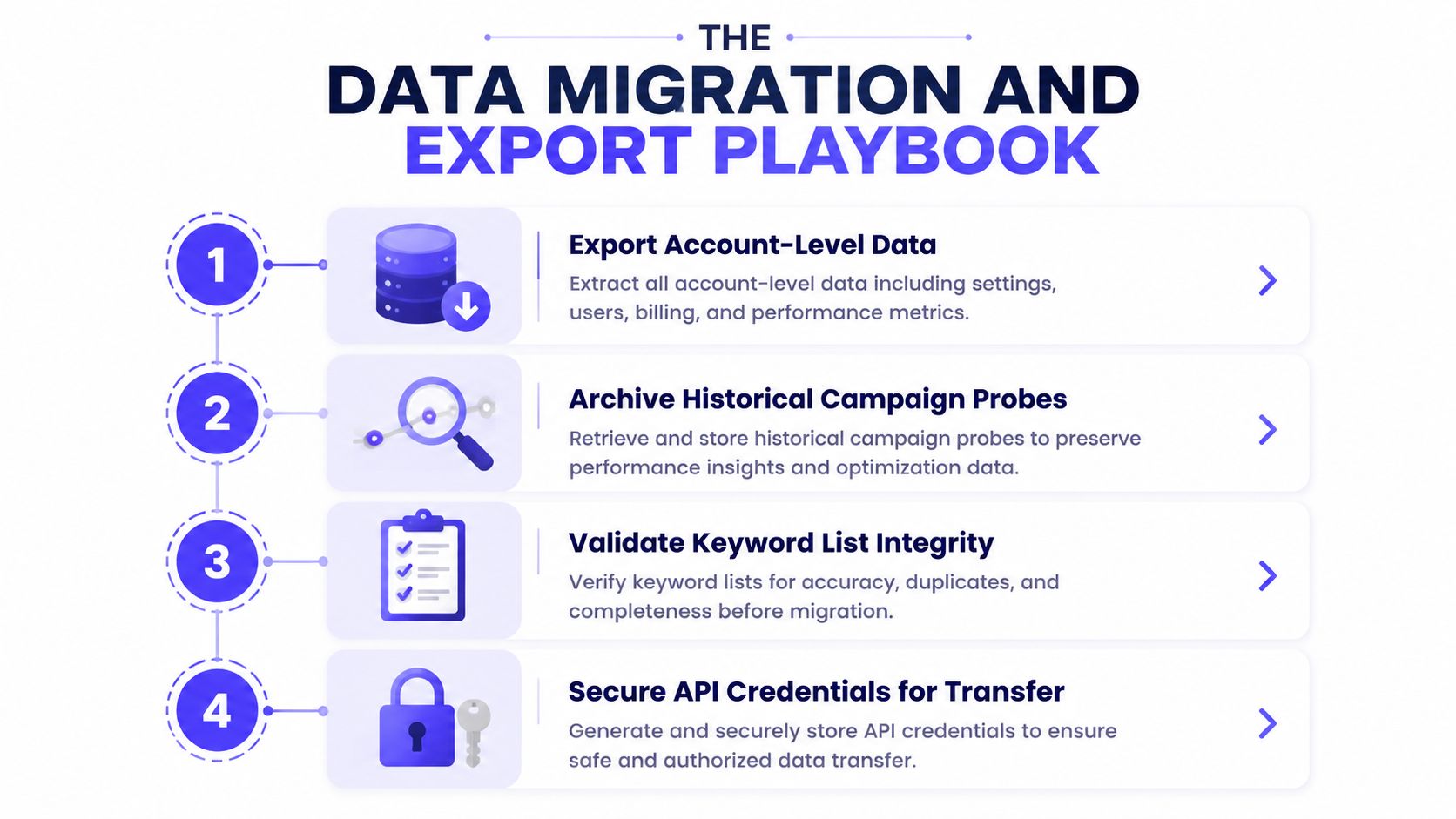
The Data Migration and Export Playbook
A clean migration preserves the baseline before it introduces a new score. If the old and new tools test different prompts, use different competitor lists, or group intent differently, the resulting trendline won't tell you whether visibility changed. It will only tell you that the measurement system changed.
Step 1, export the account record
Start with account-level artifacts, not screenshots. Export or manually document:
- Tracked prompts: Preserve exact wording, capitalization, punctuation, and question order.
- Domain lists: Include your domain, product domains, regional domains, and named competitors.
- Prompt categories: Record categories such as pricing, alternatives, comparison, use case, and “best of.”
- Report templates: Save the fields executives, content managers, and analysts already expect.
- Historical results: Archive available answer captures, citations, mentions, visibility scores, and competitor comparisons.
- Ownership details: Map which user owns each campaign and which stakeholders receive reports.
Semrush's pricing materials describe daily tracking for up to 25 custom prompts and reports for any domain, with one domain available for Brand Performance analysis in its AI pricing documentation. Treat that cap as a prioritization constraint, not as a complete representation of your market.
Step 2, preserve the probe taxonomy
Create a master sheet with one row per prompt. Keep the original prompt in one column, then add normalized fields for category, persona, funnel stage, engine, competitor, and business owner. Don't rewrite a prompt merely to make it sound cleaner. Small wording differences can produce different answers, so a rewritten prompt breaks the before-and-after comparison.
Prioritize prompts that reflect a buying decision. Pricing questions, alternatives, category comparisons, and “best” queries usually deserve priority over broad educational questions because they connect more directly to commercial visibility.
Step 3, map the new tool without resetting history
Load the exact baseline prompts into the dedicated platform, then create new prompts in a separate group. Run the old and new systems in parallel before treating the new dashboard as a replacement. Keep a note of differences in engine coverage, answer capture method, refresh cadence, and scoring definitions.
Independent benchmark work illustrates why this discipline matters. One 2026 study analyzed 126 million real user prompts, while another tested 172 buyer prompts across ChatGPT, Perplexity, and Google AI Overviews, recording 3,340 citation events across 1,174 unique domains in the Semrush AI Visibility Index. Large datasets can support useful analysis, but they don't eliminate the need to preserve your own prompt set.
Which Visibility Numbers Should You Distrust?
A visibility score is only meaningful when the team understands what it counts. One platform may reward a brand mention, another may emphasize a citation, and a third may blend position, sentiment, and coverage. A higher number after migration could reflect broader prompt coverage rather than better performance.
AI search behavior is fragmented by engine and query type. Two further figures circulate widely in this category and we could not trace either to whoever measured it: Google AI Overviews triggering for 33.38% of queries, and commercial-intent prompts representing 62.7% of AI-search prompts. Both are quoted here because they shape how people talk about the switch, not because they pass our own four-check test for a usable statistic. Those findings don't establish one universal benchmark. They show why a tool that overweights one signal can create a misleading impression of progress.
Audit the methodology before trusting the score
Ask the vendor to document:
- Prompt selection: Are prompts generated from real buyer behavior, manually selected, or supplied by the customer?
- Intent segmentation: Can the platform separate commercial questions from informational research?
- Engine coverage: Which engines are tested, and are results shown separately?
- Answer capture: Does the system preserve the rendered interface, citations, and surrounding answer context?
- Mention versus citation: Are those outcomes reported as different events?
- Refresh cadence: Can the team rerun important prompts daily or at another consistent frequency?
- Competitor logic: Are competitors selected by the customer, by keyword overlap, or by who appears in answers?
- Historical comparability: Does a methodology change alter the score retrospectively?
The average AI Overview answer is often said to draw from five sources per query, with 52% of cited sources also ranking in the top 10 organic results. We have not traced this one to a named study either, so treat the direction as the point rather than the decimal. That overlap is useful, but it doesn't mean a top organic position guarantees a citation. It means SEO and AI visibility often share source signals while measuring different outcomes.
A score should answer a business question, not replace one. “Are we cited for the prompts that influence buyers?” is more useful than “Did our dashboard number rise?”
Build a measurement contract
Before switching, define the primary outcome as citation coverage for a fixed set of buyer prompts. Track mentions separately, record the cited source, and review results by engine. If the new platform can't expose those dimensions, the migration may be a cosmetic dashboard change rather than a methodological upgrade.
Restructuring Team Workflows and Seat Management
The hidden cost of switching from Semrush to an AI visibility tool often appears after procurement. The team discovers that the old process was designed for one SEO owner, one domain, and a limited prompt set, while the new opportunity requires product marketing, content, SEO, engineering, and agency stakeholders to work from the same evidence.
Semrush's AI visibility add-on is commonly described as limited to one domain, one user, and 25 prompts in independent pricing reviews such as this cost analysis. That structure can work for a focused brand-monitoring program. It becomes restrictive when multiple product lines, clients, or regions need independent prompt libraries and shared reporting.
Assign ownership by action
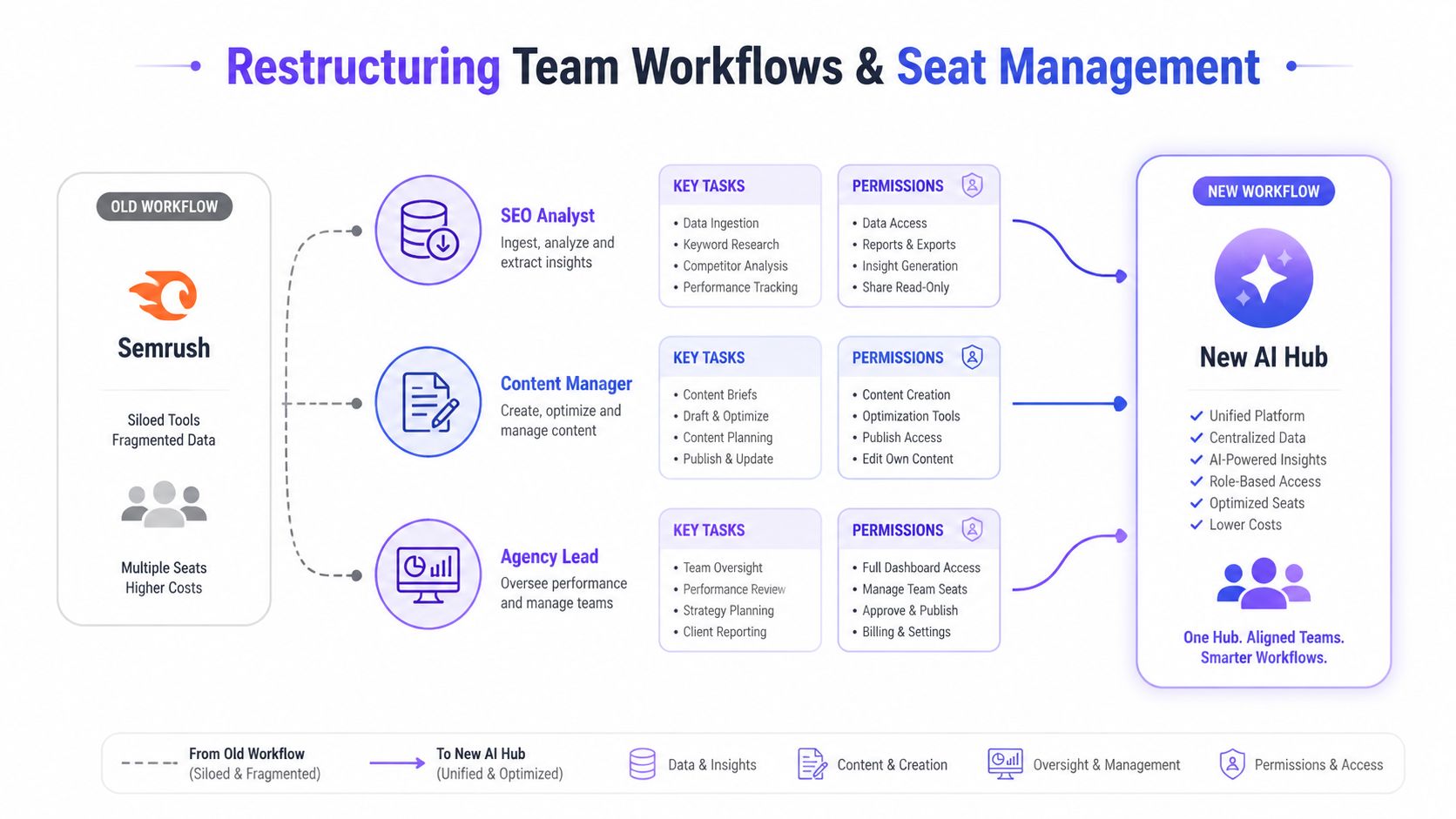
A useful operating model separates evidence from execution:
- SEO analysts maintain prompt libraries, validate citations, and compare engine-level trends.
- Product marketers decide which positioning gaps matter and review how the brand is described.
- Content managers turn source gaps into pages, comparison content, counter-articles, or updates.
- Developers implement Schema.org markup, llms.txt files, entity improvements, and other technical changes.
- Agency leads manage client workspaces, permissions, white-label reports, and escalation rules.
The platform should fit the team's existing rhythm. Slack alerts can flag a citation loss. Zapier or webhooks can route a high-priority gap to the right owner. APIs and CSV exports can feed internal reporting. Coding agents such as Claude Code or Cursor can help prepare implementation drafts, but a human still needs to review and approve changes before publication.
Model seats and brands before buying
List every person who needs to view data, edit prompts, approve recommendations, and export reports. Then list every brand, product, market, and client that needs separate tracking. Compare those requirements against the new vendor's seat, brand, prompt, workspace, and report limits.
A cheaper subscription can become expensive if it forces separate accounts, manual exports, or add-on prompt packs. Conversely, an enterprise platform can be wasteful if only one marketer will act on the findings. Choose the workflow that minimizes analysis overhead, not the tool with the shortest feature list.
How Do You Validate the Switch Before Committing?
A parallel run is the safest way to test whether switching from Semrush to an AI visibility tool improves measurement rather than merely changing the interface. Keep Semrush active, load the same buyer prompts into the candidate platform, and compare the outputs under a defined protocol.
The test should use prompts that represent actual buying questions. Include pricing, alternatives, category comparisons, and “best of” phrasing. For each prompt, record whether the brand appears, whether it is cited, where it appears in the answer, which source is cited, and which competitors are present.
GetIntel's own tracking on 22 August 2026 found Semrush cited in 41.8% of 239 buyer-prompt probes over the trailing seven days, which places it fourth in this category behind Otterly at 65.7%, Profound at 43.9% and Peec AI at 43.1%. An earlier one-off run put Semrush at 84%, but that used a different prompt set and window, and GetIntel scored 0% in the same run, so quoting it here without both caveats would be the selective framing this section is warning against. That isn't a claim about every market or a reason to assume one tool will win. It's a useful example of the benchmark a team can replicate in its own category before deciding whether to switch or run both systems.
What to compare during the run
Use one shared worksheet and keep the fields stable:
- Coverage: Did the brand appear for the prompt?
- Citation status: Was the brand's site or another source cited?
- Citation position: Where did the cited source appear relative to competitors?
- Answer fidelity: Did the tool capture the live answer as a buyer would see it?
- Engine variation: Did the result change between ChatGPT, Perplexity, Gemini, and Google AI Overviews?
- Actionability: Could the team identify a concrete content, authority, or technical fix?
Don't declare a winner based on one snapshot. Run the same probes repeatedly, document methodology differences, and ask whether discrepancies come from model variation, prompt selection, source indexing, or the tool's own scoring rules.
The final decision should reflect operating reality. If Semrush produces enough reliable insight for the team's limited prompt set, keep it. If the dedicated platform reveals important citation gaps, supports broader collaboration, and produces answer captures the team can act on, the evidence supports migration or coexistence.
Final Decision Matrix and Recommended Next Steps
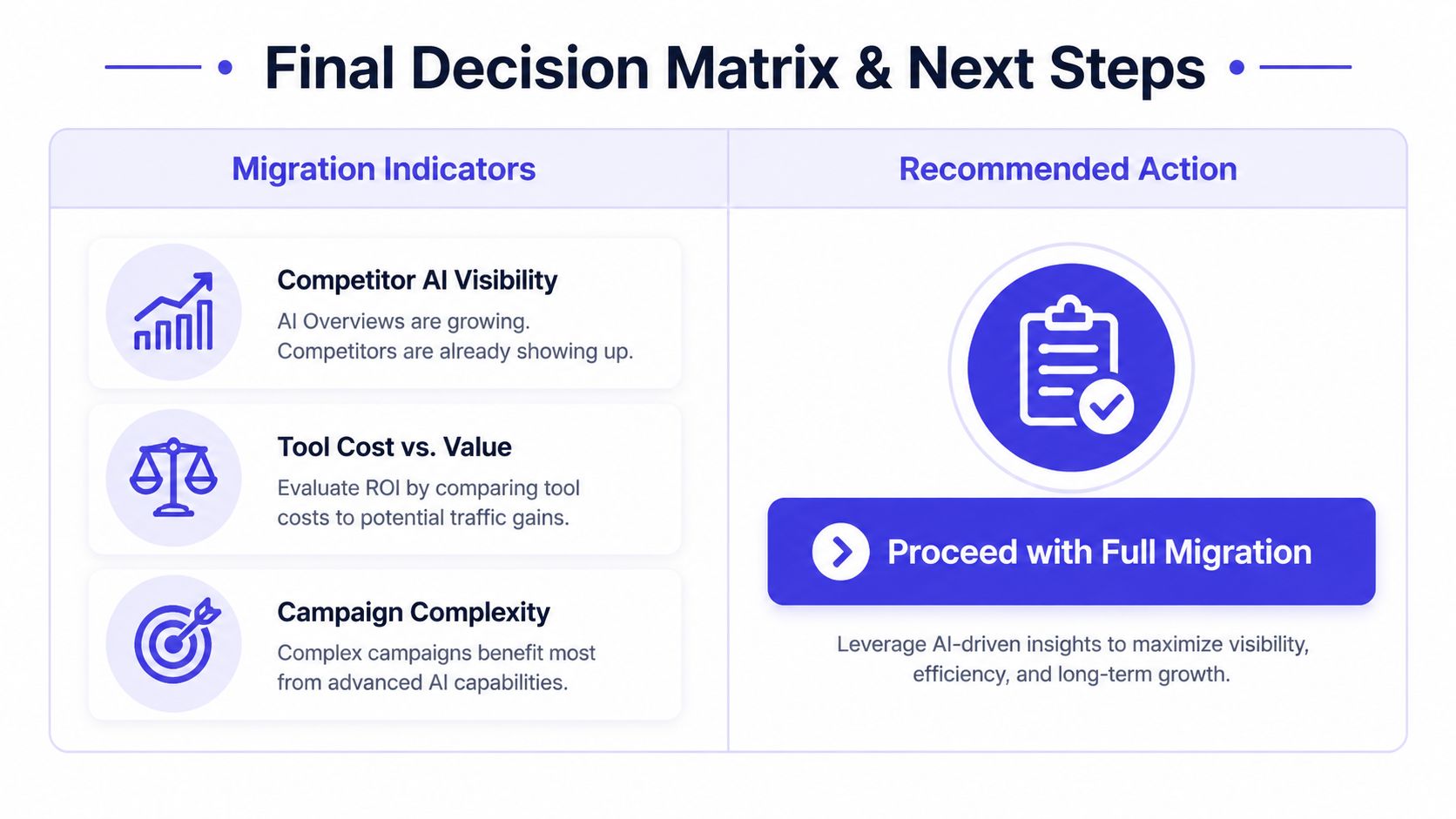
The decision should be tied to operational requirements, not the novelty of an AI dashboard. Semrush remains a reasonable choice when the team wants AI prompt research alongside conventional SEO and doesn't need extensive engine-by-engine answer capture. A dedicated platform becomes more appropriate when AI visibility has its own owner, budget, reporting cadence, and implementation backlog.
Use this decision matrix
| Situation | Recommended direction |
|---|---|
| One brand, limited prompt set, established Semrush workflow | Keep Semrush and formalize the prompt baseline |
| Need for broader multi-engine monitoring | Add or migrate to a dedicated AI visibility platform |
| Need for rendered answer capture and citation-source intelligence | Favor a dedicated platform |
| Multiple brands or agency clients | Prioritize workspace, seat, and white-label reporting capabilities |
| Engineering team uses Claude Code or Cursor | Select a platform with API, MCP, or structured export support |
| No owner for acting on visibility findings | Delay an expensive migration and assign ownership first |
| Semrush and the new platform produce incompatible scores | Continue parallel testing until the methodology is reconciled |
A practical first-month plan
Days one through five: Export prompts, domains, competitors, report templates, and available history. Freeze the original prompt wording and classify each probe by buyer intent.
The following week: Load the baseline into the candidate platform. Configure daily topic-level score tracking, Share of Voice, Average Citation Rank, competitor benchmarks, and separate engine reporting where available.
During the parallel period: Review answer captures with content and product marketing. Identify one citation-source gap, one content gap, and one technical gap that the team can realistically address.
By the end of the first month: Ship a reviewed fix, such as an llms.txt draft, Schema.org markup update, Wikidata improvement, counter-article, or outreach email. Connect the change to the relevant prompt and record what happens afterward.
For a focused evaluation of the migration path, the Semrush AI Toolkit alternatives should be judged against these requirements: daily probe refreshes, multi-engine coverage, live-interface answer capture, competitor citation benchmarks, export flexibility, and a workflow that moves findings into implementation.
The strongest decision may still be coexistence. Keep Semrush where its SEO depth saves time, and add a dedicated AI visibility workflow where citation evidence, buyer prompts, and answer fidelity are now business-critical. Make the change only after the parallel data shows that the new method answers questions the current stack can't answer reliably. If you do decide to switch platforms rather than just add one, this 8-step migration checklist covers preserving the trendline through the cutover.
GetIntel tracks buyer-prompt visibility across ChatGPT, Perplexity, Gemini, and Google AI Overviews, with daily topic-level score reporting, competitor benchmarks, citation-source intelligence, and a ranked task list for closing gaps. Visit GetIntel to evaluate whether its answer-level workflow fits your migration plan or your parallel measurement stack.