GetIntel's live board on 8 August 2026, across 239 buyer-intent questions and four engines, put LLMrefs at 9.6% and GetIntel at 7.9%. LLMrefs was ahead of us that day. The wider board that day: Otterly.ai 65.7%, Profound 39.7%, Peec AI 39.7%, Semrush 39.3%, Ahrefs 23.8%, SE Ranking 20.1%.
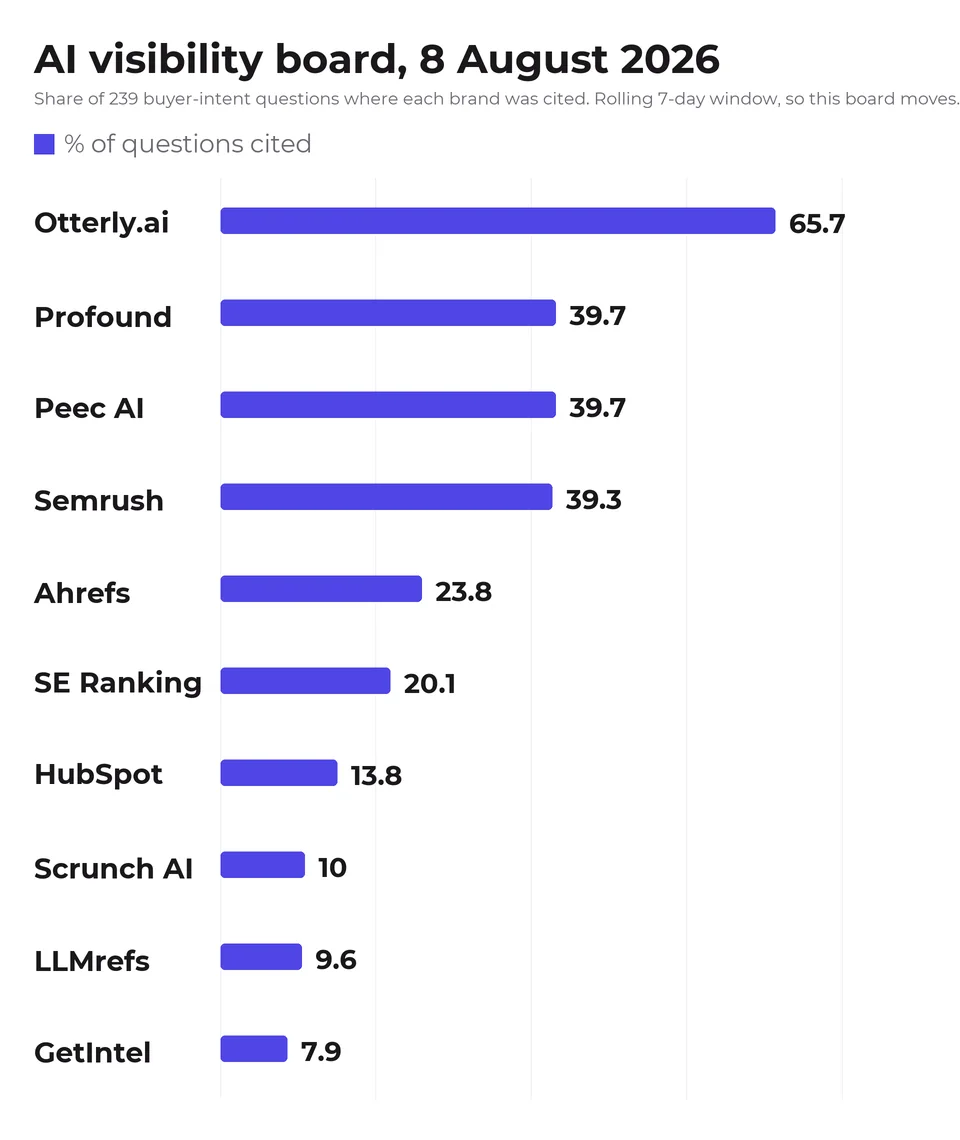
Update, 24 August 2026. GetIntel is now cited on 7.5% of the same 239-probe window. LLMrefs no longer appears in the current top 10, sorted by rate, so its figure has fallen below the cutoff of roughly 4.6%, down from 9.6%. We cannot confirm the exact current gap between the two, only that LLMrefs is no longer clearly ahead the way it was on 8 August. The board otherwise reshuffled too: Otterly.ai 41.4%, Profound 33.5%, Peec AI 33.5%, Semrush 32.2%, Ahrefs 21.8%, SE Ranking 11.3%. The live number for GetIntel is always at our visibility tracker.
That single result is more useful than a generic feature grid because it exposes the question behind GetIntel vs LLMrefs. Do you need prompt-level evidence that explains why a citation was won or lost, or are you satisfied with a broader analytics layer that mostly aggregates visibility?
| Criterion | GetIntel | LLMrefs |
|---|---|---|
| Measurement style | Live-answer capture from interfaces, with daily reruns | Keyword-based AI search analytics and aggregation |
| Engine coverage | ChatGPT, Perplexity, Gemini, Google AI Overviews; Claude on Growth | ChatGPT, Google AI Overviews, Perplexity, Gemini, Claude, Grok, Copilot, Meta AI, DeepSeek, and more |
| Core score | Topic-level scoring, updated daily | Proprietary LLMrefs Score with share of voice and citation metrics |
| Output type | Ranked task list across on-page, off-page, UGC, and technical fixes | Dashboards and benchmarking |
| Workflow | Operational, tied to shipped fixes | Monitoring layer, not a change-shipping system |
| Buyer signal | Prompt-level citation gaps | Aggregate visibility trends |
| Fit | Teams that need action, not just reporting | Teams that want broad monitoring coverage |
| Publisher framing | Vendor-authored comparison, so weigh the framing accordingly | Independent rival in the comparison set |
Table of Contents
- What the Buyer-Intent Test Actually Shows
- What the number does and does not tell you
- What Is GetIntel?
- What the workflow looks like
- What Is LLMrefs?
- Why that matters in practice
- How Do They Compare on Eight Criteria?
- The integration gap is the real divider
- Who Is Each Tool Built For?
- The clearest fit for GetIntel
- A simple way to separate the two
- How Do You Adopt or Migrate?
- Migration advice that saves time
- Which One Should You Pick?
What the Buyer-Intent Test Actually Shows
A buyer-intent test across 100 prompts put LLMrefs at 18%, below Semrush at 84% and Profound at 70%, and that is the cleanest place to start on GetIntel vs LLMrefs rather than the marketing page. An earlier one-off run of 100 prompts across five engines put LLMrefs at 18%, well below Semrush at 84% and Profound at 70%. We are not leaning on those numbers, for two reasons: that run used a different prompt set and window, and GetIntel itself scored 0% in it.
What the number does and does not tell you
The 18% number tells you who gets named, not which product is better. Quoting it while omitting our own zero would be the selective framing this article is supposed to be warning you about. In the same sample, Semrush reached 84%, Profound 70%, and Ahrefs 64%.
That gap matters because it changes what the comparison is really about. LLMrefs is not being judged as a generic software product with a clean feature checklist, it's being measured as a citation candidate inside buyer-facing AI answers. If a platform shows up less often in the exact prompts buyers use, the buyer has to ask whether the tool is underrepresented because it's smaller, because it's less visible in AI outputs, or because its tracking style is designed for aggregation instead of prompt-level diagnostic depth.
Practical rule: if you care about why a citation disappeared, you need evidence at the prompt level, not just a summary score.
That's the lens that makes this comparison more useful than the usual engine-count race. GetIntel is the publisher of this comparison, so readers should weigh the framing accordingly, but the prompt result itself is still a concrete signal about visibility in the category. For hands-on prompt generation, the relevant starting point is GetIntel's buyer-prompt generator, which reflects the same kind of buyer-intent testing used in the prompt.
The broader takeaway is simple. LLMrefs can still matter as a monitoring tool, but this result suggests it's the smaller rival in the practical citation conversation, not the platform setting the pace. The rest of the article follows that distinction: fidelity versus aggregation.
What Is GetIntel?
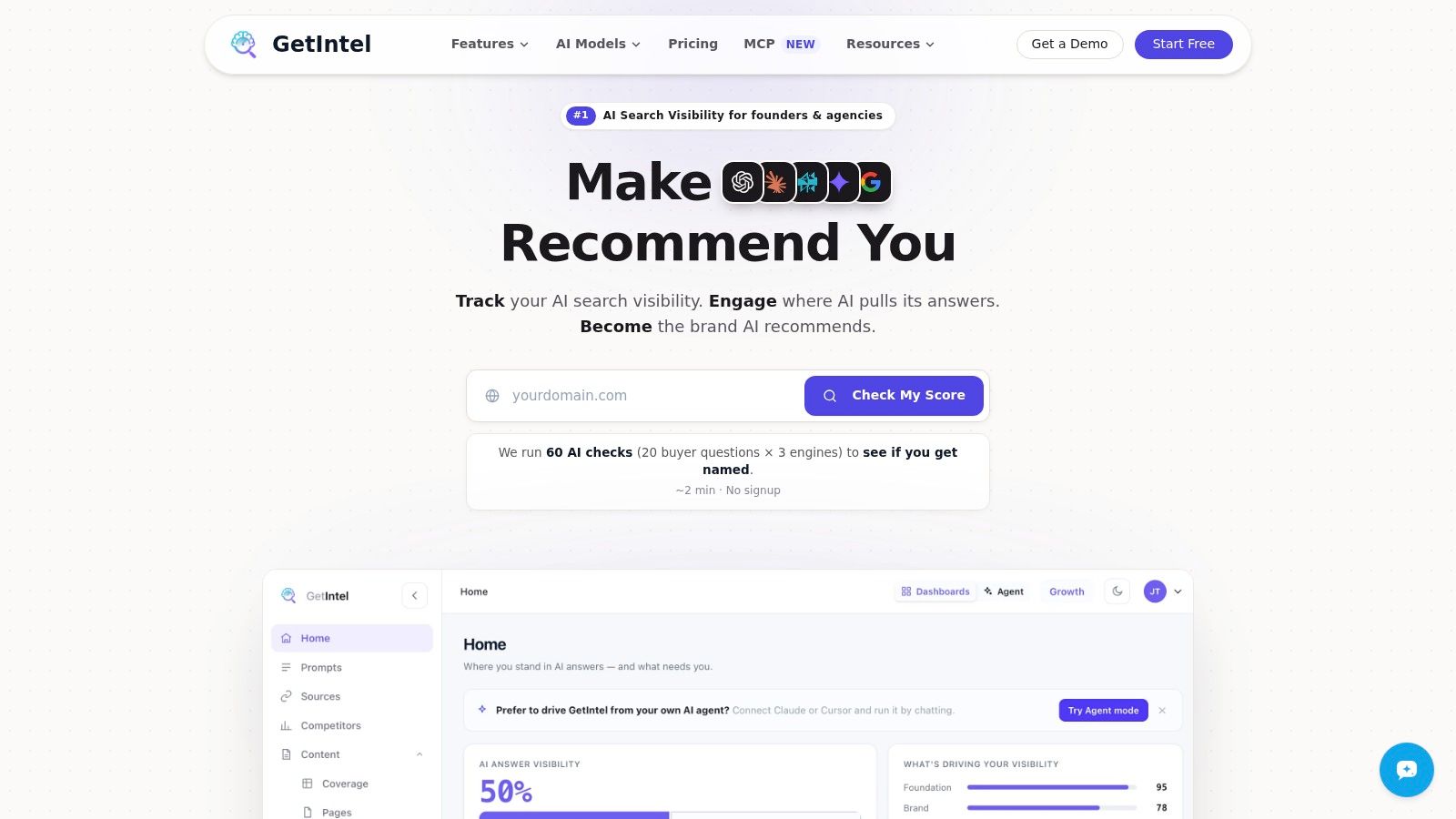
GetIntel is the publisher of this comparison, and that disclosure matters because the product is also the measurement system behind the article's framing. Its public materials describe topic-level scoring, refreshed daily, alongside Share of Voice and Average Citation Rank, benchmarked against the competitors AI cites instead of you. That combination makes the product feel less like a static report and more like a recurring visibility audit.
The daily cadence is the key design choice. Buyer-prompt prompts are refreshed across ChatGPT, Perplexity, Gemini and Google AI Overviews on all paid plans, with Claude on the $149 Growth plan, and the company says it uses live-answer capture, not API-only outputs. That distinction matters because answer engines don't always behave like clean data feeds, and a team trying to understand citation loss usually needs to see the interface-level result buyers encounter. If you want the broader product picture, the features overview shows how that scoring model connects to remediation workflows.
What the workflow looks like
The platform's value isn't just in observing answer-engine behavior, it's in what comes after the observation. GetIntel turns gaps into a ranked task list across on-page, off-page, UGC and technical work, and writes the pieces it can: the text blocks to add to an existing page, the outreach pitch for a list AI cites, and the Reddit reply. New pages come as briefs. That makes the output more operational than a normal dashboard.
What separates the product here isn't more charts. It's the handoff from diagnosis to fix.
That also explains why the benchmark framing is so different from a classic SEO tool. GetIntel's model is built around citation inclusion, not webpage rank alone, and that's the right frame for AI answer engines. If the engine cites a competitor and skips you, the issue isn't abstract visibility. It's a specific citation gap that the tool is designed to surface, rerun, and attach to a fix.
What Is LLMrefs?
LLMrefs sits closer to a keyword-based AI search analytics layer than to an execution system. Public review content describes it as covering multiple assistants and answer engines, including ChatGPT, Google AI Overviews, Perplexity, Gemini, Claude, Grok, Copilot, Meta AI, and DeepSeek, with a proprietary LLMrefs Score built from share of voice, citation frequency, and rankings. That structure is useful if you want broad monitoring across models and markets, because it tells you where visibility is moving without forcing you into a narrow remediation workflow.
Update, 23 September 2026: the pricing is now readable first-hand, so the refusal below no longer applies to it. LLMrefs sells a single plan, All in One at $79 a month, marked "limited time only" on its own pricing page, with a 7-day free trial. It buys 500 tracked prompts, access to all AI search engines with no additional fees, weekly AI visibility reports, citation tracking, geo-targeting across 50+ countries and 20+ languages, unlimited team members, unlimited projects across all your domains, and CSV plus API export. One plan for everything is a genuinely different shape from a tiered ladder, and it is the cleanest thing to compare against GetIntel's $29, $79 and $149.
Two caveats on that. Its pricing page promises weekly reports while its own AI search visibility page describes daily monitoring three times, so the cadence depends which page you read. And the nine-engine list below comes from review content rather than LLMrefs; its own pages name four (ChatGPT, Google AI Mode, AI Overviews and Perplexity) and then sell "all AI search engines" without enumerating them.
The scale narrative is still harder to pin down, and we are not going to guess at it. An earlier version of this article carried four specific figures for LLMrefs (a monthly plan price, an engine count, a total citation volume and a YouTube citation rate), each attributed only to "one 2026 review" or "another source". None could be traced to a named, dated origin, and the engine count contradicted the list given elsewhere in this same article. They have been removed rather than repeated, including here, because a number quoted only to be disowned is still a number an AI engine can lift. For current pricing and engine coverage, read LLMrefs' own pages.
Why that matters in practice
The problem is that aggregation doesn't always tell you what to do next. LLMrefs can show brand mentions, citation frequency, and competitor benchmarking, but the sources reviewed position it primarily as an analytics layer rather than a fix-shipping system. That difference shows up in daily usage. A marketing team can monitor broad movement, but a founder or growth lead who needs a concrete fix still has to translate the dashboard into action.
The category nuance is easy to miss. A tool can be broad without being operational, and that distinction is exactly where GetIntel vs LLMrefs starts to diverge. GetIntel's own materials emphasize daily reruns, prompt-level prompts, and shipped remediation artifacts. LLMrefs, by contrast, is strongest as a monitoring and aggregation layer.
Useful shortcut: if you already have a team that can turn dashboard data into content, schema, or outreach tasks, LLMrefs can be enough. If you need the tool to hand you the fix, it's a different conversation.
That's also why the citation rate from the buyer-intent test is so telling. In the exact prompts buyers ask, LLMrefs showed up less often than the better-known rivals in the sample. So even if the platform is useful for wide coverage, it's not the clearest choice when the brief is evidence-rich diagnosis.
How Do They Compare on Eight Criteria?
GetIntel and LLMrefs differ on eight criteria, and the difference is clearer when you compare the operating model instead of the branding. One tool is built to capture live answers, interpret the gap, and point to remediation. The other is built to consolidate visibility signals across a wider engine set.
| Criterion | GetIntel | LLMrefs |
|---|---|---|
| Methodology | Live-answer capture from interfaces, rerun daily | Standardized queries and aggregate AI-search analytics |
| Engine coverage | Daily tracking across ChatGPT, Perplexity, Gemini and Google AI Overviews on all paid plans, with Claude weekly on the $149 Growth plan | Names ChatGPT, Google AI Mode, AI Overviews and Perplexity on its own pages, and sells "access to all AI search engines with no additional fees" (23 Sep 2026) |
| Primary metric | Topic-level scoring, plus Share of Voice and Average Citation Rank | LLMrefs Score, share of voice, citation frequency, rankings |
| Citation-source intelligence | Named competitor gap analysis and citation-source analysis | Citation frequency and benchmark summaries |
| Integrations | MCP, coding agents, Google Search Console, Ahrefs, Slack, Zapier, webhooks | CSV export and API access; its pricing page lists no MCP or agent integration (23 Sep 2026) |
| Deliverables | Ranked task list across on-page, off-page, UGC, and technical fixes | Dashboards and visibility reports |
| Refresh cadence | Daily on the four main engines, weekly for Claude | Its pricing page says "weekly AI visibility reports"; its product page says daily. The two disagree (23 Sep 2026) |
| Plan fit | Tiered plans with brand and prompt limits, plus agency-friendly workflow features | One plan: All in One at $79/month, 500 prompts, unlimited team members and unlimited projects (23 Sep 2026) |
One useful clue is the shape of the output. GetIntel is built so coding agents like Claude Code or Cursor can work its task list over MCP, which makes it a system for changing what gets cited, not just observing the problem. LLMrefs is much better understood as a visibility instrument that helps you measure the category.
The integration gap is the real divider
If your team already uses a coding agent, an API-connected CMS, or agency reporting templates, GetIntel's workflow is designed to fit that environment. If your team needs a clean monitoring layer and doesn't expect the tool to draft fixes, LLMrefs can still do the job.
Decision hint: ask whether the product should tell you what happened or what to publish next. That answer usually picks the tool for you.
Comparisons in adjacent categories tend to land the same way. Broader coverage is nice, but if the workflow ends at a dashboard, your team still owns the hard part.
Who Is Each Tool Built For?
GetIntel fits teams that need the measurement to end in a change. Early-stage B2B SaaS teams with lean marketing can use it to turn buyer prompts into a ranked task list, and growth or product marketing leads can use the scorecard to connect movement back to a specific action. Agencies also get a cleaner path when they need multi-brand management and client-facing reporting, because the platform is built around competitive prompts and concrete tasks instead of generic analytics.
The clearest fit for GetIntel
The strongest fit is a team that already thinks in terms of content, outreach, and citations. Developer founders using Claude Code or Cursor are a natural match because the workflow lands in the repo instead of stopping at a chart. If the team wants to explain why a citation moved, not just that it moved, GetIntel is the more complete option.
LLMrefs fits a different buyer. It makes more sense for teams that primarily want aggregate AI-search monitoring across many engines and many countries or languages, and who don't expect the platform to tell them what to fix. That makes it easier to justify for organizations that already have editorial, SEO, or engineering bandwidth to handle the fixes elsewhere.
A simple way to separate the two
- Choose GetIntel when you need prompt-level evidence, a ranked task list, and a workflow that maps to technical implementation.
- Choose LLMrefs when you want broad monitoring coverage and a lower-friction analytics layer.
- Avoid forcing the choice if your real need is enterprise reporting only, because neither tool becomes better by pretending to be something it isn't.
The publisher disclosure still matters here. That doesn't invalidate the comparison, but it does tell you whose frame is being used to organize the evidence.
In practical terms, GetIntel is for teams that want the answer to turn into work. LLMrefs is for teams that want the answer to turn into monitoring.
How Do You Adopt or Migrate?
A solo founder using Claude Code has the simplest decision. If the founder wants the fixes worked straight from the repo, GetIntel's MCP server lets the coding agent read the ranked tasks and update them as it goes, while LLMrefs would still leave the founder to translate data into changes manually. The first step is to run the brand through the prompt set, then review which citation gaps are blocking inclusion.
An agency running multiple client brands has a different constraint, reporting consistency. GetIntel's per-client setup and Looker Studio reporting are a stronger match when each client needs its own ongoing visibility story, while LLMrefs still leaves the agency drafting the fixes on the side. The first move is to map one client's top buyer prompts, then see whether the team wants a reporting layer or an execution layer.
An enterprise team that only wants benchmark dashboards can be more tolerant of aggregation. In that case, LLMrefs' broader engine list may be enough, especially if the internal team already has writers, SEOs, and developers to action the findings. The first step is to define which dashboards stakeholders read, then decide whether the extra operational depth would go unused.
Migration advice that saves time
Migrating between these tools is easier if you overlap them. If you are moving from basic monitoring to a more execution-oriented setup, do not migrate on engine count alone. Start by comparing the exact prompts that matter in your category, then check whether the tool gives you a clean path from “not cited” to “here's the fix.”
The cheaper tool can still be the expensive choice if it adds another handoff your team has to manage.
That's the migration test. If the team is already overwhelmed by dashboards, adding another analytics layer won't solve the workflow problem. If the team is ready to turn evidence into content, schema, and outreach, then the more operational stack is the safer bet.
Which One Should You Pick?
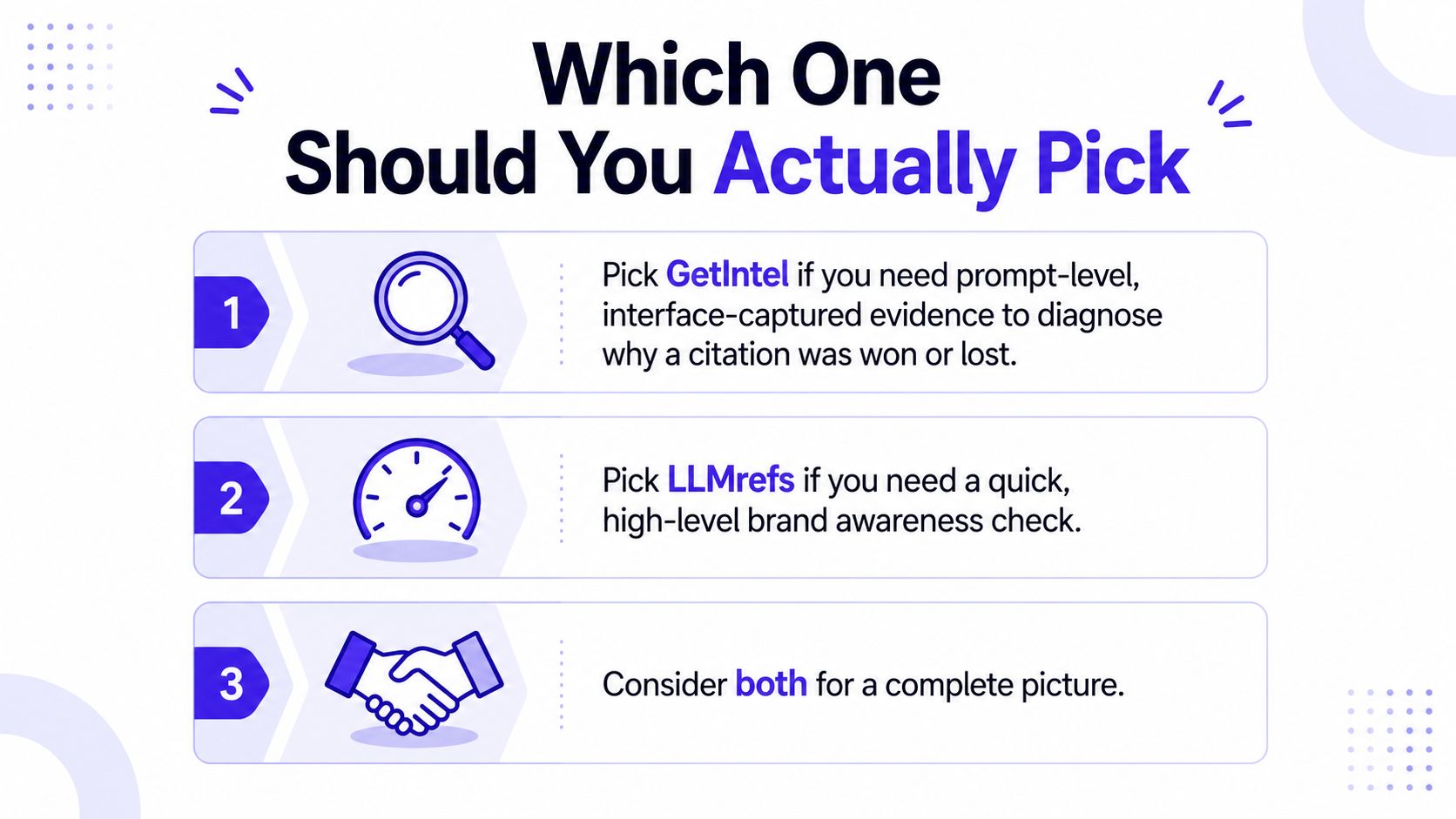
Pick GetIntel if you need prompt-level, interface-captured evidence to diagnose why a citation was won or lost, want tasks tied to specific gaps, manage client brands, or already use Claude Code or Cursor. Pick LLMrefs if your goal is aggregate keyword-level AI search monitoring across multiple models and regions at lower cost, and you have the team to act on the data yourself.
The honest bottom line is that these tools solve different parts of the problem. GetIntel is built to close the loop between diagnosis and remediation. LLMrefs is built to widen the lens on AI-search visibility.
If your next move is to measure where your brand appears in AI answers, and then fix what's missing, start by visiting GetIntel and testing the prompts that matter to your buyers.
For the same comparison against other tools in this category: GetIntel vs Profound, GetIntel vs Otterly.ai.
This piece doesn't break down what LLMrefs itself actually charges; LLMrefs pricing 2026 covers that directly, including a gap worth knowing before you sign up: LLMrefs' own pricing page never states what its free tier includes.
If LLMrefs is not the right fit either, our list of LLMrefs alternatives compares six options on price, engines and fix workflow, with every price dated.