Otterly.AI publishes four tiers: Lite at $29 a month, Standard at $189, Premium at $489, and Enterprise starting from $1,000, with 15 percent off annual billing. Read from otterly.ai/pricing on 22 August 2026. What separates them is not engines, it is how many prompts you are allowed to track.
Disclosure: GetIntel is an AI visibility tool and competes with Otterly, so weigh the comparison accordingly. Every Otterly figure below was read from their own pricing page on 22 August 2026, not from a third-party roundup. Our own measurement data is published and linked so you can check the reasoning.
Most vendors in this category gate on engine count. Otterly does something different and, for a buyer, more interesting: all four paid tiers include the same four engines, and the ladder is built almost entirely on prompt volume.
That makes the prompt number the thing to think hardest about, and it is the number buyers scrutinise least.
What does each tier include?
Four tiers, read from otterly.ai/pricing on 22 August 2026.
| Plan detail | Lite | Standard | Premium | Enterprise |
|---|---|---|---|---|
| Price per month | $29 | $189 | $489 | From $1,000 |
| Search prompts | 15 | 100 | 400 | Customisable |
| Engines included | 4 | 4 | 4 | 4 |
| Extra prompts | Not listed | 100 for $99 | Not listed | Custom |
| API access | Not listed | Yes | Yes | Yes |
| MCP access | Not listed | Yes | Yes | Yes |
| Unlimited team members | Stated | Not itemised | Not itemised | Not itemised |
| Daily tracking | Stated | Not itemised | Not itemised | Not itemised |
| SSO | Not listed | Not listed | Not listed | Yes |
Otterly.AI tier structure, read from otterly.ai/pricing on 22 August 2026. Annual billing is 15 percent cheaper across the paid tiers. "Not itemised" means the page states the feature once rather than listing it per tier, and the page describes higher tiers cumulatively, so those rows are almost certainly inherited rather than absent. We have marked them as read rather than as assumed.
The four engines on every tier are ChatGPT, Google AI Overviews, Perplexity and Microsoft Copilot. Claude, Google AI Mode and Gemini are paid add-ons at every level, including Enterprise.
Two things here are unusual for the category. Unlimited team members on a $29 plan is genuinely rare, since most vendors meter seats. And daily tracking on the entry tier is not something every competitor offers at any price.
Is 15 prompts enough to measure anything?
This is the question the Lite tier turns on, and our own data suggests the honest answer is no.
GetIntel tracks 60 prompts, measured between 10 July and 10 August 2026, and is named on 24 of them. On a 15-prompt set, each prompt is 6.7 percent of your visibility score, so a single prompt flipping moves the headline number by nearly seven points with nothing having changed about your brand.
The problem compounds. Across our own 60 prompts averaging 38.7 runs each between 10 July and 10 August 2026, six of the 24 that named us did so exactly once in 39 runs. On a 15-prompt sample those single-mention prompts are indistinguishable from real coverage, because there is not enough surrounding data to tell noise from signal.
Separately, across 320 prompt-and-engine series measured between 10 July and 10 August 2026 with at least ten runs each, 275 never varied at all while 45 did. On the ones that vary, a single check is off by 33 percentage points on average. A small prompt set does not cause that variance, but it removes your ability to see it.
None of this is a criticism of Otterly specifically. Any tool at 15 prompts has the same arithmetic. It is a reason to treat the entry tier as a way to watch a handful of questions you already care about, rather than as a measurement of your category.
What does each prompt actually cost?
Premium is the value tier and it is not close, on the prices published at 22 August 2026.
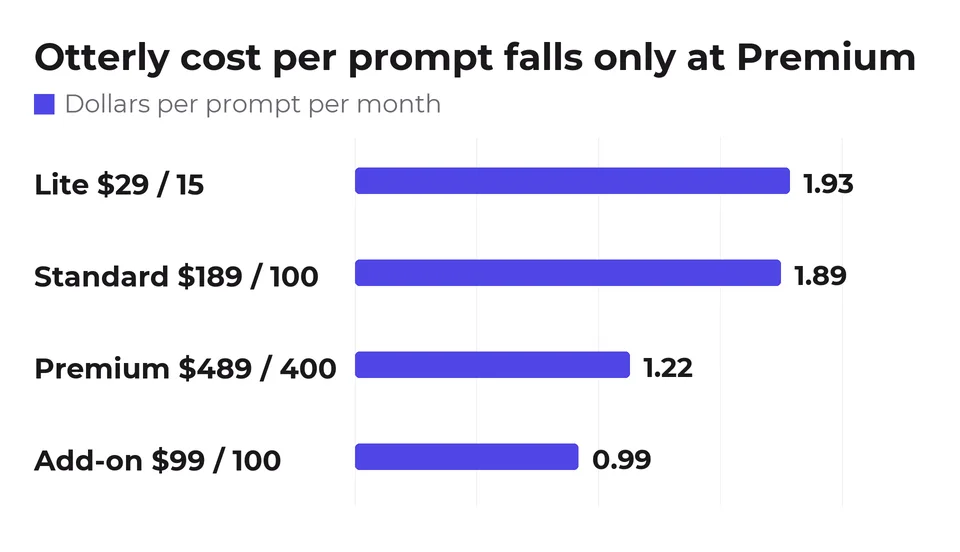
- Lite: $29 for 15 prompts, $1.93 per prompt per month.
- Standard: $189 for 100 prompts, $1.89 per prompt.
- Premium: $489 for 400 prompts, $1.22 per prompt.
- Standard add-on: 100 extra prompts for $99, $0.99 per prompt, the cheapest rate published.
Lite and Standard cost almost exactly the same per prompt, which means the jump from $29 to $189 buys volume and API access rather than a better rate. The discount only arrives at Premium.
The add-on rate is the oddity. At $0.99 per prompt it undercuts every tier, but Standard plus one add-on is $288 for 200 prompts, or $1.44 each, still worse than Premium's $1.22. So the add-on is good value against Standard alone and poor value against upgrading, which is worth modelling before you buy it twice.
What happens between Premium and Enterprise?
Between Premium and Enterprise the price roughly doubles and the published detail stops, as the page read on 22 August 2026.
Premium is $489 for 400 prompts. Enterprise starts from $1,000, and the only additions listed are customisable prompt tracking, single sign-on and custom payment options. No prompt allowance is published for it, so the jump cannot be evaluated on volume the way every step below it can. What is listed is service rather than capacity: a quarterly GEO health check, personalised onboarding, a dedicated customer success manager and custom terms.
That matters because the tier ladder is otherwise unusually legible. Lite to Standard to Premium is 15 to 100 to 400 prompts at prices you can divide. Then the pattern breaks, and the buyer moves from arithmetic to a sales conversation.
Single sign-on is the tell about who Enterprise is really for. SSO is rarely a marketing requirement and almost always a security or procurement one, which means the tier is priced for companies whose IT function has a say rather than for agencies who simply need more prompts. An agency wanting 800 prompts and no SSO has no published route to it.
How does the annual discount change the maths?
By 15 percent on the 22 August 2026 prices, which is meaningful at the top and close to irrelevant at the bottom.
Applied to the published monthly prices, annual billing brings Lite to about $24.65 a month, Standard to about $160.65, and Premium to about $415.65. In absolute terms that is roughly $52 saved a year on Lite against roughly $880 on Premium.
The trade is the usual one. A year of commitment on a category this young is a real cost, because the tool you would choose in August may not be the tool you would choose in February. On Lite the discount is small enough that monthly billing costs you little for the flexibility. On Premium it is large enough to be worth deciding deliberately rather than defaulting.
How does this compare with the rest of the category?
At the entry price, favourably on engines and unusually on seats.
Otterly's $29 Lite includes four engines. Profound's $99 Starter, read from its own page on 18 August 2026, includes one. So at roughly a third of the price Otterly covers four times the engines, though with 15 prompts against Profound's 50.
That trade is the real comparison: Otterly gates on prompts, Profound gates on engines. Which constraint hurts more depends on whether your buyers cluster on one engine or spread across several, and that is answerable against your own buyer questions rather than assumed from a tier table.
Other published entry prices for context, captured 2 August 2026: GetIntel at $29, LLM Pulse from €49, Peec AI from €70, Dageno at $79. We have not re-verified those four today, so treat them as indicative rather than current, unlike the Otterly and Profound figures above.
What does the pricing page not tell you?
Three things the 22 August 2026 page leaves open, all worth asking before signing.
- What a search prompt counts as. Whether a prompt tracked across four engines consumes one allowance or four is the single biggest determinant of what 15 actually buys, and it is not stated.
- Whether Lite can buy add-on prompts. The 100-for-$99 add-on is listed under Standard. If it is unavailable on Lite, the only route past 15 prompts is a jump to $189.
- What the engine add-ons cost. Claude, Google AI Mode and Gemini are named as add-ons on every tier without prices, so the real cost of full engine coverage is not published.
None of that is unusual. It is the set of things a published price does not settle, and all three are answerable on a trial.
Who is each tier for?
Otterly's own tier descriptions, quoted from the 22 August 2026 page, are specific and map cleanly onto the prompt ladder.
Lite is described as for solo marketers and small teams, Standard for SMEs and small marketing teams, Premium for mid-sized companies and agencies, and Enterprise for organisations needing customisable tracking and single sign-on.
The agency read is the interesting one. Premium at $489 names agencies explicitly and carries 400 prompts, with team seats inherited from the shared Lite terms rather than itemised again. Those 400 divide across however many clients an agency runs, which is the number to check against your own roster rather than a figure Otterly publishes. Whether that is enough per client depends on the same arithmetic as the Lite question, just distributed.
Where did these figures come from?
Every Otterly figure came from otterly.ai/pricing, read on 22 August 2026, on the monthly billing view. Prices and tier contents change, which is why the date is stated with the table rather than buried in a footer.
The measurement figures are GetIntel's own, published in full: the 60-prompt tracked set and the 24 we are named on come from how to find the buyer questions where you are invisible, and the variance figures come from how many reruns before a number means anything. Both describe our own category and our own prompt set, so the specific numbers will not transfer to yours. The arithmetic about small samples will.
We compete with Otterly, which is why the tier table is quoted rather than characterised, and why the comparison section names the places their structure is better than ours. If you want the head-to-head rather than the price breakdown, that is in GetIntel versus Otterly.AI.