A B2B SaaS founder asks ChatGPT, Perplexity, and Google AI Overviews which workflow automation tools mid-market RevOps teams buy. Her brand appears once. A competitor appears three times. By the next refresh, the answer changes, and nobody on the team knows whether they've lost visibility or caught a noisy sample.
That uncertainty is the central problem with AI search. Traditional rank reports can tell you where a page appears in a list of blue links, but they can't tell you whether an answer engine selects that page as evidence, how often the selection repeats, or which third-party sources shape the buyer's impression. AI citation tracking turns that invisible layer into an operating signal.
Table of Contents
- What AI Citation Tracking Actually Means
- The answer is the unit of work
- Why AI Citation Tracking Replaces Rank Tracking
- The surface has changed
- Keywords become question clusters
- Optimization targets become more direct
- Volatility is part of the system
- Which Signals Should You Measure Across Engines?
- Four signals with different jobs
- Read every metric by engine
- Why Do Citation Numbers Move Between Runs?
- Three ways citation share misleads
- What Does a Weekly Tracking Workflow Look Like?
- Monday starts with buyer language
- Midweek is for classification, not celebration
- Friday converts gaps into artifacts
- AI Citation Tracking vs Traditional SEO Tools
- The trade-off is specialization
- Putting AI Citation Tracking Into Practice
- A 90-day ramp
- Measurement hygiene and execution hygiene
What AI Citation Tracking Actually Means
Reviewed 19 September 2026. AI citation tracking is the systematic measurement of how often, where, and in what position a brand appears as a cited source inside AI-generated answers. The answer may come from ChatGPT, Perplexity, Gemini, Claude, or Google AI Overviews. The question isn't whether a model names your company. It's whether the engine attributes information to your domain, a specific page, or another source that represents your category.
That distinction matters in the founder's example. A brand mention without a URL can indicate recognition, but it doesn't identify the content an engine trusts. A citation connects the answer to a source. A useful tracking system records both, while keeping them separate.
The answer is the unit of work
The answer, not the keyword, is the unit of work here. Traditional SEO treats the keyword and the search results page as the basic units. AI citation tracking treats the prompt and the generated answer as the basic units. For each probe, a team should capture:
- Prompt cluster: The buyer-language questions that represent awareness, comparison, alternatives, pricing, implementation, and evaluation.
- Engine response: The full answer, not just a visibility score.
- Cited domains and URLs: The sources the engine presents.
- Citation position: Where your source appears in the cited list or answer.
- Mention type: Whether the brand is linked, named without a link, or absent.
- Refresh behavior: Whether the same URL remains visible when the prompt is rerun.
A leaderboard that says “you were cited” is incomplete. It doesn't show whether the citation appeared for a high-intent comparison prompt, whether the source was your own product page or a review site, or whether the result disappeared after a refresh cycle.
Practical rule: Treat a citation as a repeated observation to validate, not a trophy to screenshot.
The distinction between presence and persistence is especially important. A large 2026 analysis of 1,000 Google AI Overviews found an average of 4.2 citations per answer, with results ranging from 2 to 9 citations, and only 8% of answers cited more than seven domains. The citation-pattern analysis shows why source selection is competitive and concentrated. Your objective isn't to appear once. It's to become a repeatable source across the prompts and engines that matter to revenue.
Why AI Citation Tracking Replaces Rank Tracking
Rank tracking still answers a valuable question: Can a buyer discover your page through a conventional search result? That signal remains useful for technical SEO, content planning, and organic demand capture. AI citation tracking asks a different question: Which sources does the answer engine use when a buyer asks for a recommendation or explanation?
The difference becomes clearer across four dimensions.
The surface has changed
The surface itself has changed. In traditional search, success usually meant securing a position among blue links. In an AI answer, several sources may support one synthesized response. Being the second cited source in a short answer can matter more than ranking first for a loosely related keyword, particularly when the buyer never opens a search results page.
The competition is also answer-level. A competitor can appear beside you, replace you, or become the only named recommendation. The relevant report is no longer just “position for keyword X.” It's “citation presence and citation position for prompt cluster Y.”
Keywords become question clusters
Keywords become question clusters, because keyword lists are too narrow for conversational systems. Buyers ask the same commercial question in many forms, such as which tools serve a specific team size, which products integrate with a particular workflow, or which alternatives fit a defined budget and deployment model.
A credible probe set therefore groups prompts by intent and language. It should include the phrases customers use in sales calls, product reviews, community discussions, and comparison pages. The cluster matters because one isolated prompt can produce a misleading result.
Optimization targets become more direct
Traditional SEO relies on ranking proxies, including page structure, links, technical accessibility, and topical relevance. AI citation tracking measures the output directly. That shifts attention toward retrievable facts, clear attribution, consistent entity descriptions, and third-party source coverage.
The evidence supports this change. The 2026 citation-pattern analysis reported that pages with named-source citations in the body were cited 2.1 times more often than pages without them, and pages longer than 2,500 words received 1.6 times more citations than shorter pages. Those findings don't mean every long page will win. They indicate that explicit sourcing and sufficient topical depth can create useful retrieval signals.
Volatility is part of the system
Classic rank tracking often benefits from relatively stable result pages. Answer engines combine retrieval, ranking, and generation, so source lists can change even when your website hasn't. A longitudinal industry measurement reported that AI Overviews appeared for nearly 48% of tracked Google queries as of February 2026, while a citation-overlap study found only 38% of cited pages ranked in Google's top ten organic results. The industry analysis of AI Overview citation sources demonstrates why first-page rank is no longer a sufficient proxy for answer visibility.
Teams that only review weekly keyword positions are measuring a neighboring channel. Keep rank tracking, but give AI citation tracking its own prompts, source records, volatility analysis, and action queue.
Which Signals Should You Measure Across Engines?
A useful dashboard doesn't overwhelm a team with every available count. It separates signals that describe coverage, placement, and source authority. Four metrics provide a practical foundation.
Four signals with different jobs
Answer Rate measures how often a brand is named or cited across the tracked prompts and engines. It's useful as a program-health indicator because it prevents a team from celebrating a single citation while overall coverage deteriorates. It should be inspected per engine and per topic, not treated as one blended number.
Share of Voice measures the proportion of tracked prompts in a cluster where a brand is cited at all. It helps teams compare their visibility with named competitors and identify topic areas where a rival is replacing them. Share of Voice is strongest as a competitive diagnostic. It becomes weak when teams use it without checking source quality or persistence.
Average Citation Rank records the mean position of a brand's source within an answer's citation list. A value such as 1.8 means the brand typically appears between the first and second cited positions. It adds context to raw presence because a citation near the top usually receives more attention than a source buried at the end.
Source Domain Mix shows which outside domains engines cite when answering relevant prompts. Review publications, Wikipedia, Reddit, analyst sites, education domains, government sources, and industry publishers each play different roles. A brand may improve its visibility faster by influencing the source graph around its category than by repeatedly editing its own product page.
| Signal | What It Measures | Best Used For | Key Limitation |
|---|---|---|---|
| Answer Rate | How often the brand is named or cited | Monitoring program health over time | A single average can hide which engine or topic changed |
| Share of Voice | Prompts where the brand is cited | Competitive and topic-level comparison | Presence alone says little about source quality |
| Average Citation Rank | Mean position in cited sources | Evaluating prominence and likely attention | Averages can conceal engine-specific differences |
| Source Domain Mix | Domains and communities engines cite | Prioritizing authority and outreach work | Domain presence doesn't prove buyer influence |
Read every metric by engine
Don't flatten ChatGPT, Perplexity, Gemini, Claude, and Google AI Overviews into one average. Their retrieval systems and visible answer formats differ, so a stable aggregate can hide decay on one engine and a temporary lift on another.
Track the same prompt cluster separately by engine, URL, competitor, and time window. Then compare the trendline with the raw answer captures. If the score rises because one source briefly dominates a small sample, the underlying program hasn't necessarily improved.
Why Do Citation Numbers Move Between Runs?
Citation share is noisy because answer engines make several decisions at once. They retrieve possible sources, rank them, generate an answer, and may route the request through a different system after a model or index update. The same prompt can return a different source list across sessions without any obvious change to the web.
Some volatility is structural. Model updates, index churn, changing retrieval policies, and prompt routing can alter which sources qualify. Other volatility is probabilistic. Retrieval randomness, personalization, location, and response generation can change the final answer even when the underlying evidence remains similar.
The research base makes point-in-time confidence difficult to justify. A six-week, three-wave audit across three answer engines found only 10.6% URL-level citation persistence over 28 days, with 119 of 1,127 tracked URLs appearing in all three waves. Retention varied by engine, from 11% in Gemini to 44% in Perplexity. The 2026 evidence review of how AI engines cite the web supports a stability-first approach.
Three ways citation share misleads
A high Share of Voice reading doesn't automatically mean buyers trust or act on your brand.
- Weak source quality: A brand can receive many citations from low-authority or poorly maintained pages.
- Bad narrative context: An answer can cite the brand while presenting an outdated, negative, or contradictory description.
- Ghost visibility: The engine can cite a URL while paraphrasing the material so heavily that the buyer never recognizes the source or visits it.
Trust research adds another warning. One experiment found that the presence of citations increased perceived trust even when the citations were random, while checking the citations reduced trust. Another study found citations didn't significantly change trust for politically controversial topics, where answer balance mattered more. The cited experiment on citation presence and trust shows why citation count is a weak substitute for source quality and answer quality.
Replace leaderboard snapshots with rolling citation persistence, source-domain repeatability, and decay analysis. A practical dashboard should show how long a URL remains cited, which prompts retain it, and whether its context supports the positioning your sales team uses. The growth asset is not a Tuesday win. It's durable findability that survives repeated prompts and engine changes.
What Does a Weekly Tracking Workflow Look Like?
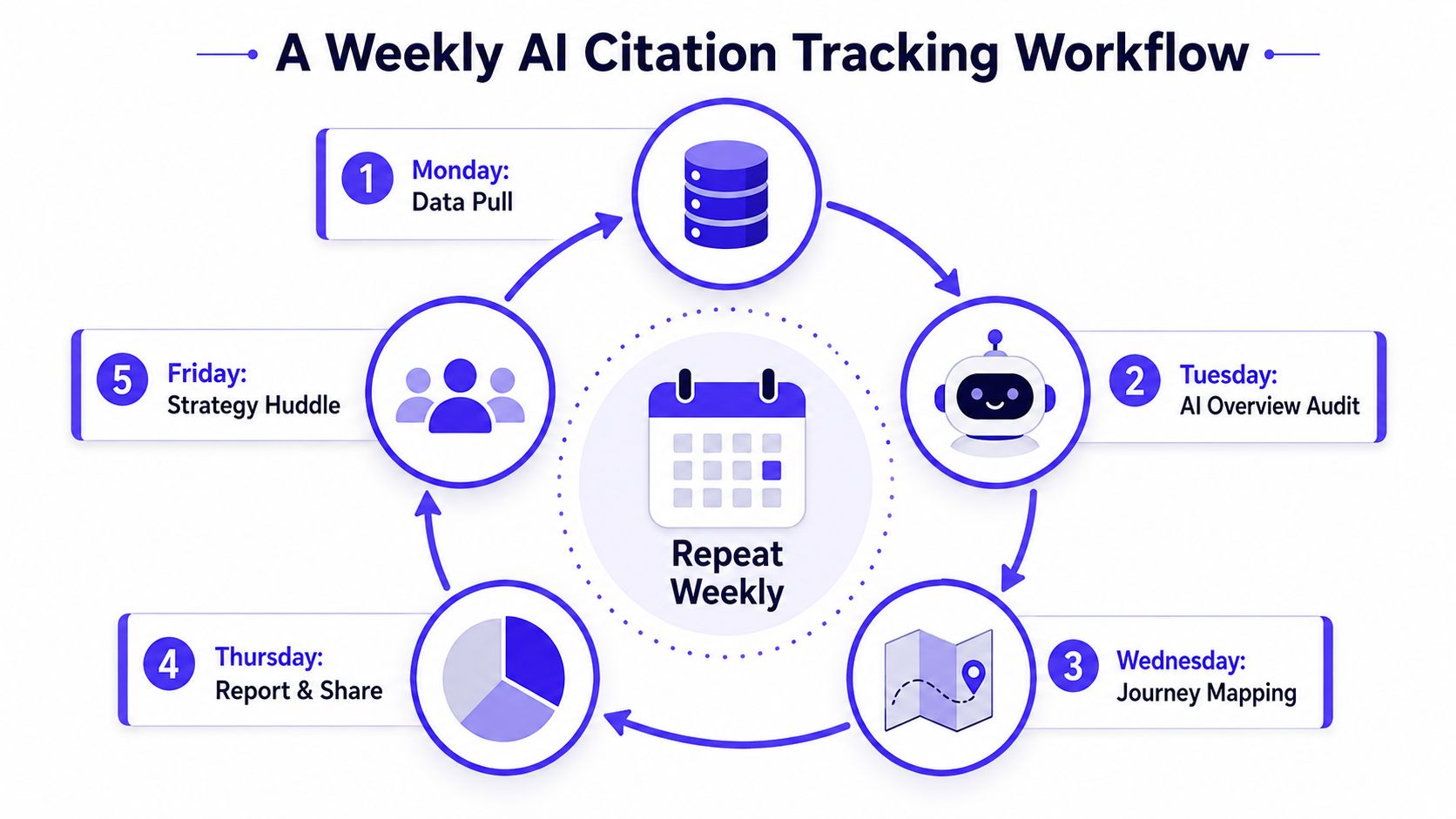
A repeatable cadence keeps AI citation tracking connected to production. The workflow below gives a lean B2B SaaS team a way to move from buyer questions to evidence, then from evidence to shippable fixes.
Monday starts with buyer language
Refresh the probe library for each product line. Use customer wording from sales calls, support tickets, review conversations, and competitive evaluations. Include category questions, “best of” prompts, alternatives, implementation questions, and comparison prompts. The exact number of probes should match team capacity, but every probe needs a clear business owner and intent label.
Run the prompts across the engines your buyers use, including ChatGPT, Perplexity, Claude, and Gemini. Capture the full answer and every cited URL. For Google AI Overviews, preserve the visible source list separately because the answer surface behaves differently from a chat transcript.
Midweek is for classification, not celebration
Classify source domains by practical authority tier and role. A review site that influences evaluation deserves a different response from a community thread that reveals buyer language. Score Answer Rate, Share of Voice, and Average Citation Rank per engine, then flag prompts where Average Citation Rank has fallen below 3. Reporting should preserve raw answers, not only charts, so someone can verify whether the cited context is accurate.
Friday converts gaps into artifacts
Production should focus on a small number of fixes with a clear connection to a citation gap. Possible outputs include:
- llms.txt update: Clarify the pages and entities you want machines to find.
- Schema markup refresh: Make product, organization, article, and author relationships easier to interpret.
- Wikidata revision: Correct or strengthen the entity record where appropriate.
- Counter-article: Publish a focused response to a prompt where a competitor consistently earns the citation.
- Outreach list: Contact the most relevant uncited source domains with evidence, corrections, or useful material.
Don't ship changes because a dashboard moved. Ship them because a source, prompt, or narrative gap gives the team a specific intervention. Close the week with a business review that connects citation movement to assisted visits, branded searches, demo conversations, and pipeline notes, while acknowledging that AI influence is often under-attributed in analytics.
AI Citation Tracking vs Traditional SEO Tools
Traditional rank trackers answer, “Where does this page rank for keyword X on Google?” AI citation tracking answers, “Which sources does an answer engine cite when a buyer asks a category question?” Both questions matter, but combining them into one score produces an unclear operating picture.
| Dimension | Traditional Rank Tracking | AI Citation Tracking |
|---|---|---|
| Target surface | Organic result pages and blue links | Generated answers and source references |
| Unit of success | Keyword position | Citation presence, position, and persistence |
| Volatility | Result changes are monitored by query and location | Retrieval, generation, engine, and refresh behavior create churn |
| Optimization lever | On-page relevance, technical SEO, and backlinks | Attributable facts, structured content, entity signals, and third-party coverage |
| Attribution | Clicks, impressions, and last-click paths | Presence in answers, source context, referrals, and assisted influence |
The trade-off is specialization
A SERP-based Share of Voice suite may show that your page ranks well for a category term, yet miss the fact that a competitor's review page is cited when buyers ask for recommendations. Conversely, a citation tracker can show your brand appearing in an answer without proving that the answer generated a visit or opportunity.
That means rank tracking isn't dead. It remains a useful system for diagnosing crawlability, organic demand, and page-level search performance. AI citation tracking is a complementary system with a different prompt library, data model, and review cadence.
Teams choosing tools should ask whether the platform captures the actual visible answer or only an API approximation, whether it stores cited URLs, and whether it distinguishes a brand mention from a linked citation. They should also check how the tool handles repeated runs and engine-level reporting. A platform that presents one blended number may look simple while hiding the decay that matters operationally. For the answer-engine layer, compare workflows, prompt coverage, and source analysis in this guide to AI citation tracking tools. The right setup usually keeps both systems, but stops pretending they measure the same form of visibility.
Putting AI Citation Tracking Into Practice
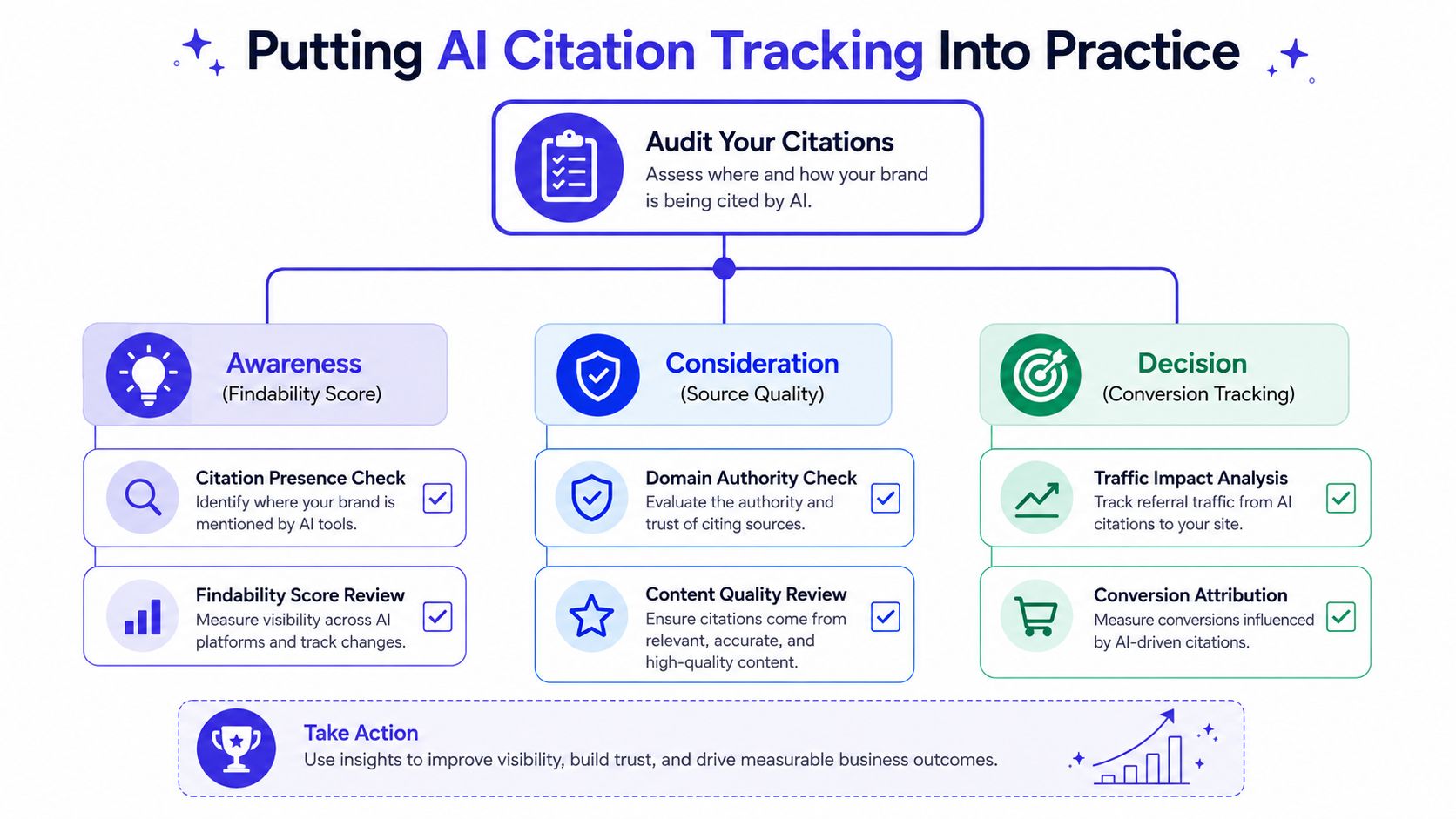
The buyer journey gives each citation signal a job. During awareness, Answer Rate shows whether answer engines can retrieve your brand for category and problem prompts. During consideration, Source Domain Mix and Average Citation Rank reveal whether credible sources frame your company as a viable option. During evaluation, Share of Voice on comparison and alternatives prompts shows whether competitors occupy the conversation when buyers are close to a decision.
A 90-day ramp
Start with a disciplined baseline rather than immediate optimization.
- Instrument buyer prompts. Build a focused set of 25 to 40 prompts across ChatGPT, Perplexity, Gemini, and Claude. Include the questions sales and product marketing teams hear in real conversations.
- Observe before changing. Run the set weekly for two sprints and record cited URLs, source domains, citation position, mentions, and context.
- Prioritize two artifacts each week. Choose from llms.txt, Schema.org markup, Wikidata updates, counter-articles, and source outreach. Each artifact should address a documented prompt or source gap.
- Align sales enablement. Give sales the prompts where Share of Voice is weakest, along with the competing sources and the narrative currently appearing in answers.
- Revisit the probe set monthly. Add new product language, objections, competitors, and use cases as the market narrative changes.
Measurement hygiene and execution hygiene
Measurement hygiene means consistent prompts, engine separation, stored answer captures, and trendlines that distinguish persistence from temporary exposure. Execution hygiene means every meaningful gap receives an owner, an artifact, a review date, and a record of what changed.
A tracking platform such as GetIntel can store cited source lists across supported answer engines, score Answer Rate, Share of Voice, and Average Citation Rank, compare source domains with competitors, and turn identified gaps into a ranked task list across on-page, off-page, UGC, and technical fixes.
For a more structured way to connect prompt gaps with fixes, use the AI citation gap framework. The central discipline is simple: track what buyers ask, inspect what engines cite, identify what persists, and ship changes that improve the source graph or the answer context. A dashboard matters only when it changes the next week's work.
GetIntel helps B2B SaaS teams measure how ChatGPT, Perplexity, Gemini, Claude, and Google AI Overviews represent their brand, including cited URLs, competitors, prompt-level coverage, and source-domain gaps. Visit GetIntel to audit your buyer prompts, establish a stability baseline, and turn citation gaps into a ranked task list your team can work through.